filmbriefs
Fiction

Arthouse

1053
briefs
13:00
average
13689 min
in total
461
people
All briefs1053
13:00

20th Century Women

Mike Mills · 2016

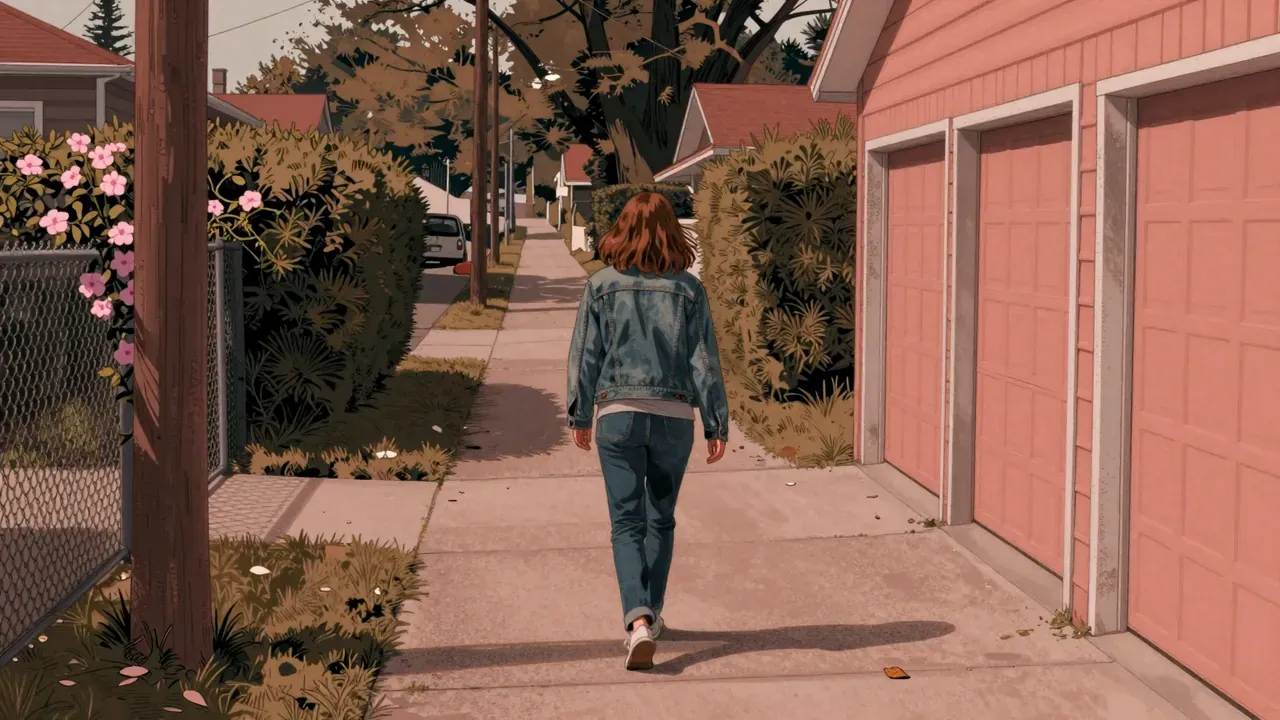
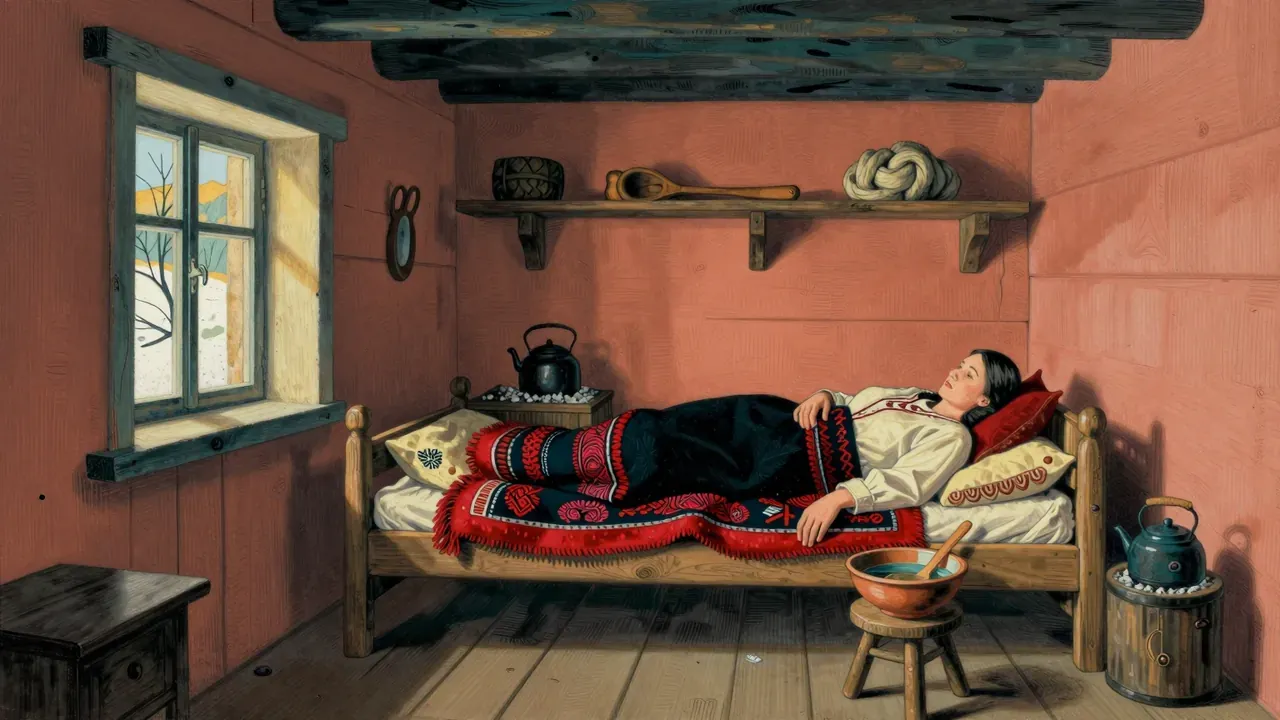
Set in 1979 Santa Barbara, Mike Mills’ 20th Century Women follows 15-year-old Jamie as his single mother Dorothea enlists two younger women — photographer Abbie and teenage friend Julie — to help raise him. Anchored by Annette Bening’s restrained performance, the film observes their overlapping lives with warmth and precision, treating feminism, illness, ageing and adolescence as lived conditions rather than themes. Shot by Sean Porter and edited by Leslie Jones, it moves at the pace of real conversation, building meaning through accumulation rather than climax.

13:00

24 Frames

Abbas Kiarostami · 2017

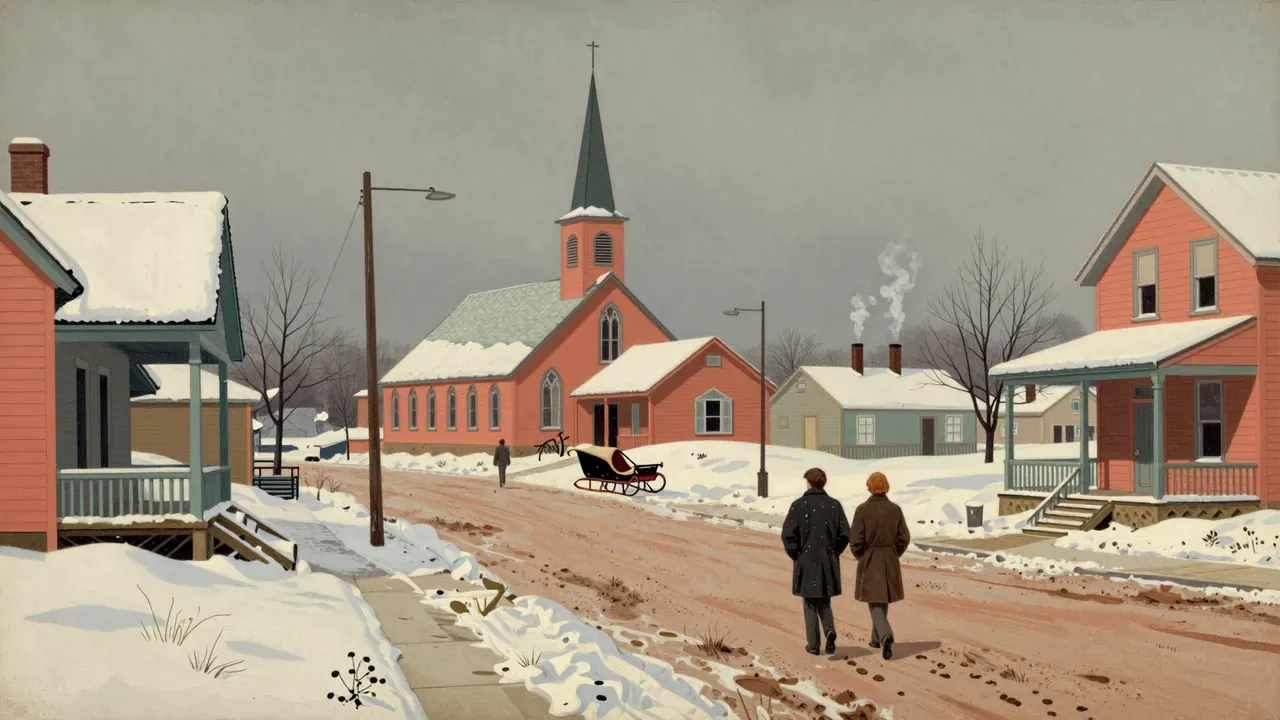
Abbas Kiarostami’s final film, 24 Frames, comprises twenty-four uncut, static shots — each ninety seconds long — observing nature, animals, and thresholds between interior and exterior. Beginning with animated movement superimposed on Bruegel’s Hunters in the Snow, it proceeds into real-world stillness, testing how much meaning resides in time, attention, and unmediated presence. Released posthumously at Cannes 2017, it is a rigorous, unsentimental essay on perception and impermanence.

13:00

3 Women

Robert Altman · 1977

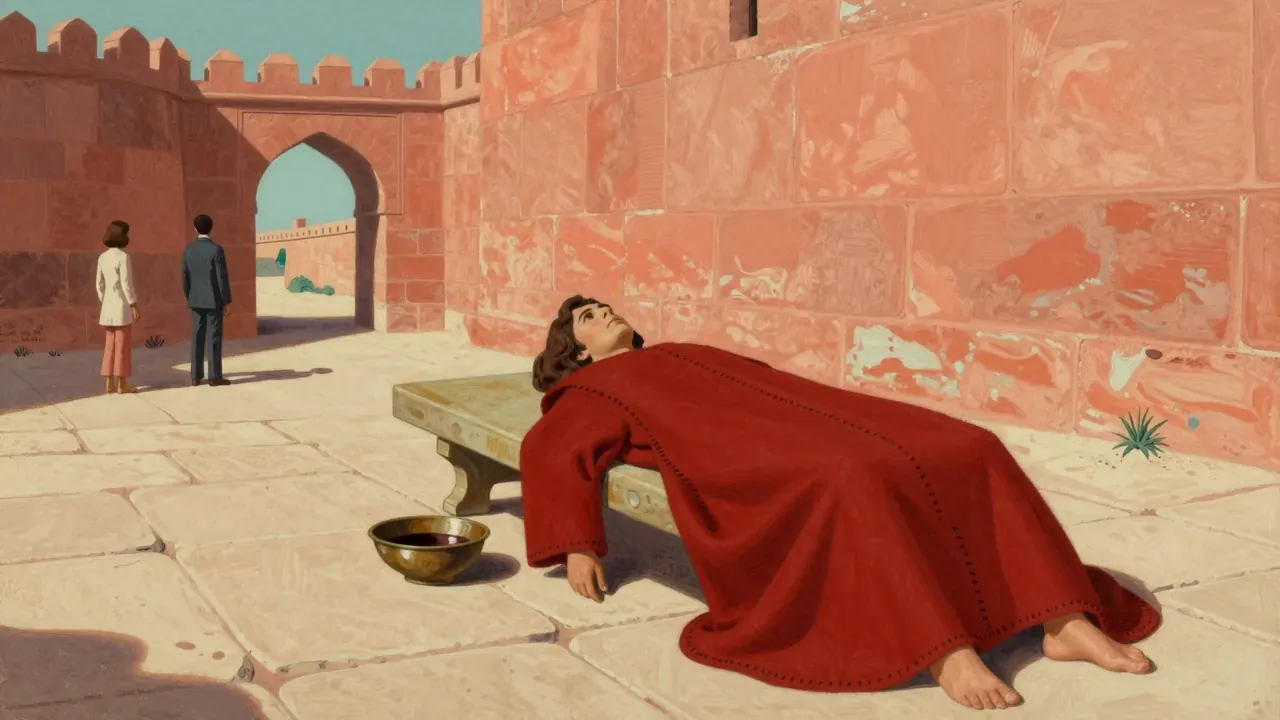
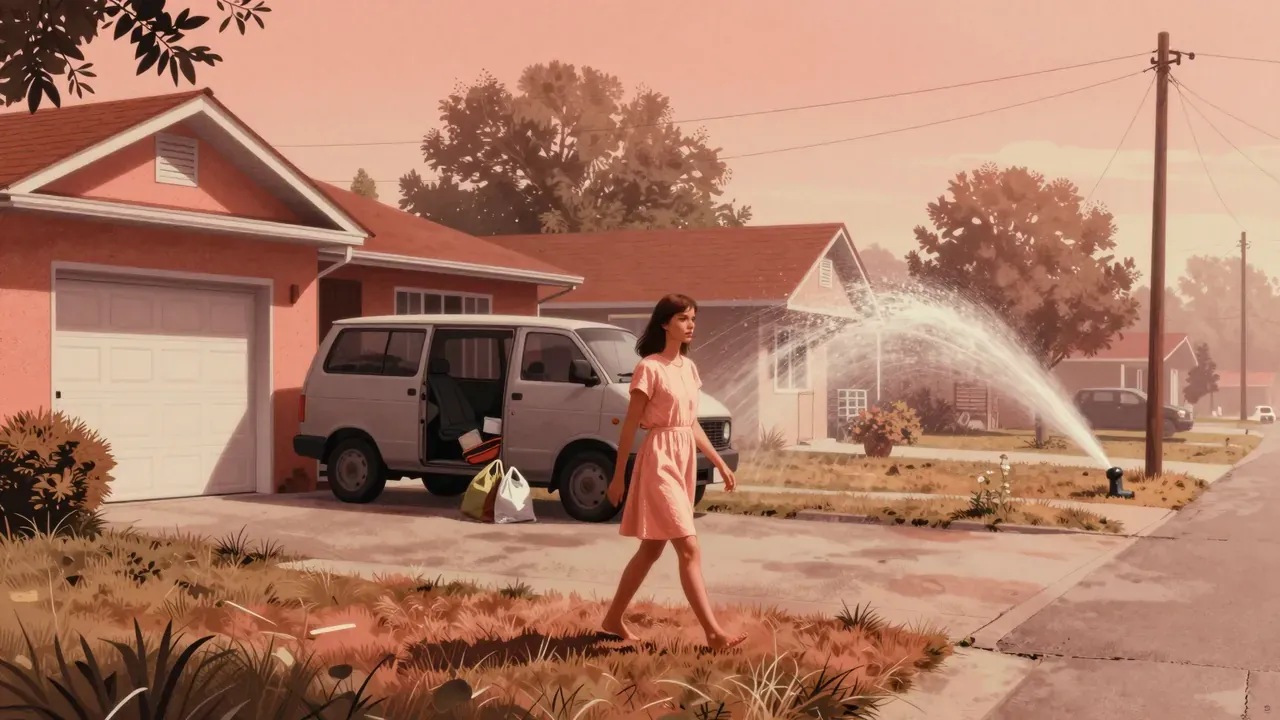
Robert Altman’s 1977 film 3 Women follows the uncanny merging of identities among a timid young woman, her garrulous roommate and a silent, pregnant artist in a sun-scorched California town. Built from a dream and shot with deliberate, unhurried precision, it uses repetition, reflection and improvisation to explore how selves are borrowed, performed and abandoned.

13:00

4 Months, 3 Weeks and 2 Days

Cristian Mungiu · 2007

Set in Communist Romania in 1987, 4 Months, 3 Weeks and 2 Days follows two university students as they arrange an illegal abortion under Decree 770. Directed by Cristian Mungiu and shot by Oleg Mutu in long, unbroken takes, it avoids exposition, music and close-ups to render the physical and moral weight of the act with unsentimental precision. The film won the Palme d'Or at Cannes in 2007 and remains a benchmark of Romanian New Wave austerity.

13:00

45 Years

Andrew Haigh · 2015

A retired Norfolk couple prepare for their 45th wedding anniversary when news arrives that the body of Geoff’s long-dead lover has emerged from a Swiss glacier. Over six days, Kate observes his growing distance, uncovers buried evidence of Katya’s pregnancy, and begins to question the foundations of their marriage — not through confrontation, but through quiet, accumulating realisations. Directed by Andrew Haigh and adapted from David Constantine’s short story, the film relies on Charlotte Rampling and Tom Courtenay’s restrained performances, Lol Crawley’s naturalistic cinematography, and a script that trusts silence over exposition.

13:00

71 Fragments of a Chronology of Chance

Michael Haneke · 1994

Michael Haneke’s 1994 Austrian drama arranges thirty-seven fragmented scenes — intercuts of Viennese lives, real news footage, and black pauses — into a chronology that culminates in a bank shooting. Shot by Christian Berger and edited by Marie Homolkova, it avoids psychology and music, presenting migration, isolation, and mediated violence as systemic conditions rather than personal tragedies. Set in Vienna between October and December 1993, it forms the final part of Haneke’s early trilogy. Winner of the Sitges Film Festival’s Best Feature and Best Screenplay awards, and the Gold Hugo at Chicago.

13:00

A Canterbury Tale

Michael Powell, Emeric Pressburger · 1944

A Canterbury Tale (1944) follows three strangers — a Land Girl, a British soldier and an American GI — who converge in a Kent village during WWII and investigate a local 'glue man' mystery. Directed by Powell and Pressburger, it uses Chaucer’s pilgrimage framework to explore English identity, wartime community and the weight of place, all filmed on location amid real bomb sites and rural villages. Its power lies in restraint: in Erwin Hillier’s understated cinematography, in performances that avoid theatrics, and in a story that values observation over explanation.

13:00

A Christmas Tale

Arnaud Desplechin · 2008

Arnaud Desplechin’s 2008 French drama follows the fractured Vuillard family as they reunite for Christmas after matriarch Junon is diagnosed with leukemia. Set over several wintry days in Roubaix, the film charts shifting alliances, buried resentments, and fragile intimacies among three adult siblings, their partners, children, and extended kin — all held in uneasy orbit by Junon’s iron will and Abel’s quiet endurance. With a dense script, naturalistic performances, and Éric Gautier’s muted cinematography, it treats family as a site of repetition, inheritance, and unspoken history.

13:00

A Clockwork Orange

Stanley Kubrick · 1971

Stanley Kubrick’s 1971 adaptation of Anthony Burgess’s novel follows Alex DeLarge, a charismatic teenage delinquent subjected to state-mandated aversion therapy. Stylised, unsettling, and formally exacting, it interrogates free will, coercion, and the aestheticisation of power through John Alcott’s cinematography, Wendy Carlos’s electronic score, and Malcolm McDowell’s indelible performance.

13:00

A Colt Is My Passport

Takashi Nomura · 1967

Takashi Nomura’s 1967 yakuza noir follows contract killer Shuji Kamimura as he navigates a collapsing web of yakuza betrayals after a botched hit. With precise, unhurried direction and Joe Shishido’s stoic performance, the film treats survival as a series of calibrated actions — installing a second brake, digging a ditch, building a bomb — rather than a psychological journey. Its power lies in functional coherence, not thematic elaboration.

13:00

A Confucian Confusion

Edward Yang · 1994

Edward Yang’s 1994 satirical comedy follows a web of young professionals in 1994 Taipei whose relationships, careers, and self-presentation are governed by unspoken codes of duty, face, and transactional loyalty. Over three days, misunderstandings accrue not from malice but from systemic pressure to perform coherence — whether in love, work, or art. With muted performances, flat lighting, and procedural pacing, it maps the quiet corrosion of authenticity under late-capitalist professionalism.

13:00

A Constant Forge

Charles Kiselyak · 2000

A two-hundred-minute documentary portrait of John Cassavetes, assembled from interviews and archival footage. It focuses on his working process — rehearsal, editing, directing — rather than biography or filmography. Featuring Ben Gazzara, Gena Rowlands, Peter Falk, Sean Penn and others, it treats filmmaking as embodied resistance, refusing summary or resolution.

13:00

A Day in the Country

Jean Renoir · 1946

Jean Renoir’s 1946 featurette, shot in 1936 and adapted from Maupassant, captures a summer day in 1860 when a Paris shopkeeper’s daughter is briefly drawn from her world by a riverbank encounter. Forty minutes long, it relies on atmosphere, restraint, and precise visual storytelling rather than exposition or resolution. Claude Renoir’s cinematography, Joseph Kosma’s score, and Marguerite Renoir’s editing sustain a mood of quiet inevitability. Though some structural choices feel tentative, its emotional accuracy and formal discipline make it a benchmark of poetic realism.

13:00

A Face in the Crowd

Elia Kazan · 1957

Elia Kazan’s 1957 drama follows Larry 'Lonesome' Rhodes, a charismatic drifter turned national TV star, whose rise and fall exposes the collusion between media, advertising and politics in shaping public belief. Andy Griffith’s debut performance anchors a tightly structured critique of persuasion as infrastructure, not personality.

13:00

A Long Goodbye

Kira Muratova · 1971

Kira Muratova’s 1971 Soviet drama observes the quiet unraveling of a mother-son relationship as eighteen-year-old Sasha prepares to move to Siberia. Shot by Gennadi Karyuk and starring Zinaida Sharko and Oleg Vladimirsky, it avoids exposition and climax in favour of behavioural realism: glances held too long, letters intercepted and unopened, conversations that circle but never land. Shelved until 1987, it remains a study in asymmetry — of care, of memory, of time — where emotional weight gathers in silence, routine, and the physical effort of staying present.

13:00

A Master Builder

Jonathan Demme · 2013

Jonathan Demme’s 2013 film A Master Builder adapts Ibsen’s play into a tightly contained, single-set drama starring Wallace Shawn as the ageing architect Halvard Solness. With Declan Quinn’s restrained cinematography and Tim Squyres’ unhurried editing, it foregrounds language, pause and presence over action or spectacle. Julie Hagerty and Lisa Joyce deliver precise, understated performances that deepen the film’s study of memory, guilt and the slow collapse of authority. Though its formal austerity divides opinion, it remains a rare and committed act of textual fidelity — demanding, quiet, and morally unblinking.

13:00

À Nos Amours

Maurice Pialat · 1983

Maurice Pialat’s 1983 drama follows sixteen-year-old Suzanne (Sandrine Bonnaire) as she navigates sexual experience, family fracture and emotional drift in early-1980s Paris. Shot with observational restraint by Jacques Loiseleux and written by Pialat and Arlette Langmann, it avoids exposition, score-driven emotion or narrative resolution, holding Suzanne’s contradictions — her hunger for connection and her inability to sustain it — without judgment or explanation.

13:00

À Nous la Liberté

René Clair · 1931

René Clair’s 1931 À Nous la Liberté follows two convicts — one who becomes a tramp, the other a phonograph magnate — and their reunion in a factory whose assembly line echoes the prison they fled. With Georges Auric’s music supplying much of the diegetic sound, and Georges Périnal’s cinematography framing both institutions as variations on the same geometry, the film stages a precise, unsentimental satire of mechanisation, class and the illusion of upward mobility. It is formally inventive, politically light-footed, and built on recurrence rather than revelation.

13:00

A Report on the Party and the Guests

Jan Němec · 1966

A group of picnickers are intercepted in the woods and directed to a celebration, where arbitrary rules govern their conduct. When one guest disappears, the party mobilises to retrieve him — not out of concern, but to preserve the integrity of the event. Made by Jan Němec at Barrandov Studios, the film uses stark visual discipline and behavioural minimalism to trace how authority takes root in shared compliance.

13:00

A Room in Town

Jacques Demy · 1982

Jacques Demy’s 1982 sung-through musical, set during the 1955 Nantes shipyard strike, follows a young striker torn between two women as political tension escalates. Every line is sung to Michel Colombier’s austere score; Jean Penzer’s cinematography is precise and unflashy. Though less buoyant than The Umbrellas of Cherbourg, it pursues a graver, more politically explicit vision of musical storytelling — one where melody carries ideology, and tragedy arrives in perfect time.

13:00

A Safe Place

Henry Jaglom · 1971

Henry Jaglom’s 1971 drama follows Noah, a young woman drifting between present loneliness and childhood memory in New York City. Starring Tuesday Weld, Orson Welles, and Jack Nicholson, it uses fragmented editing, recurring motifs, and nostalgic music to evoke mental fragility without diagnosis. Culled from fifty hours of footage, it is a formally ambitious but divisive experiment in psychological portraiture — intimate, unresolved, and demanding of its viewer.

13:00

A Ship Bound for India

Ingmar Bergman · 1947

A Ship Bound for India (1947) is Ingmar Bergman’s third feature and first original screenplay, co-written with Martin Söderhjelm. Set in a Swedish port town, it follows Johannes, who returns after seven years at sea and dreams of his teenage years under his domineering, blind-bound father. Built around a single extended flashback, the film charts Johannes’s slow assertion of self amid familial cruelty, unrequited love, and physical stigma — all rendered with stark, unhurried realism and no stylistic flourish.

13:00

A Special Day

Ettore Scola · 1977

Set in Rome on 4 May 1938 — the day Hitler visits Mussolini — A Special Day confines itself to a single apartment building where a housewife and a dismissed gay radio broadcaster spend an afternoon together. Directed by Ettore Scola and starring Sophia Loren and Marcello Mastroianni, it uses muted colour, deep focus, and restrained performances to explore gender, sexuality, and quiet dissent under fascism.

13:00

A Story of Floating Weeds

Yasujirō Ozu · 1934

A Story of Floating Weeds (1934) is Yasujirō Ozu’s silent drama about an ageing kabuki actor who revisits a provincial town to see the son he abandoned years earlier. With minimal intertitles and a restrained visual style, the film traces quiet tensions between duty and desire, permanence and transience, across a travelling troupe and a rooted family. Shot by Hideo Shigehara and edited by him, it relies on composition, rhythm, and understated performance rather than exposition or climax.

13:00

A Summer's Tale

Éric Rohmer · 1996

Éric Rohmer’s 1996 comedy-drama follows mathematics graduate Gaspard over three weeks in the Breton seaside town of Dinard, as he navigates hesitant affections for three women — Margot, Léna and Solène — without ever resolving between them. Shot with quiet precision by Diane Baratier and edited to sustain long takes and unhurried dialogue, the film treats romantic uncertainty not as failure but as sustained, everyday practice. Its power lies in its fidelity to duration, silence and the moral weight of small, unremarkable choices.

13:00

A Tale of Springtime

Éric Rohmer · 1990

Éric Rohmer’s 1990 film follows Jeanne, a philosophy teacher, as she navigates a weekend at a country house orchestrated by her student Natacha. Through precise dialogue, restrained performances, and unhurried pacing, the film charts Jeanne’s gradual realisation that she is being slotted into an existing relational pattern—and her decision to step out of it. Shot by Luc Pagès and scored sparingly with Beethoven, it is the first of Rohmer’s ‘Tales of the Four Seasons’.

13:00

A Tale of Winter

Éric Rohmer · 1992

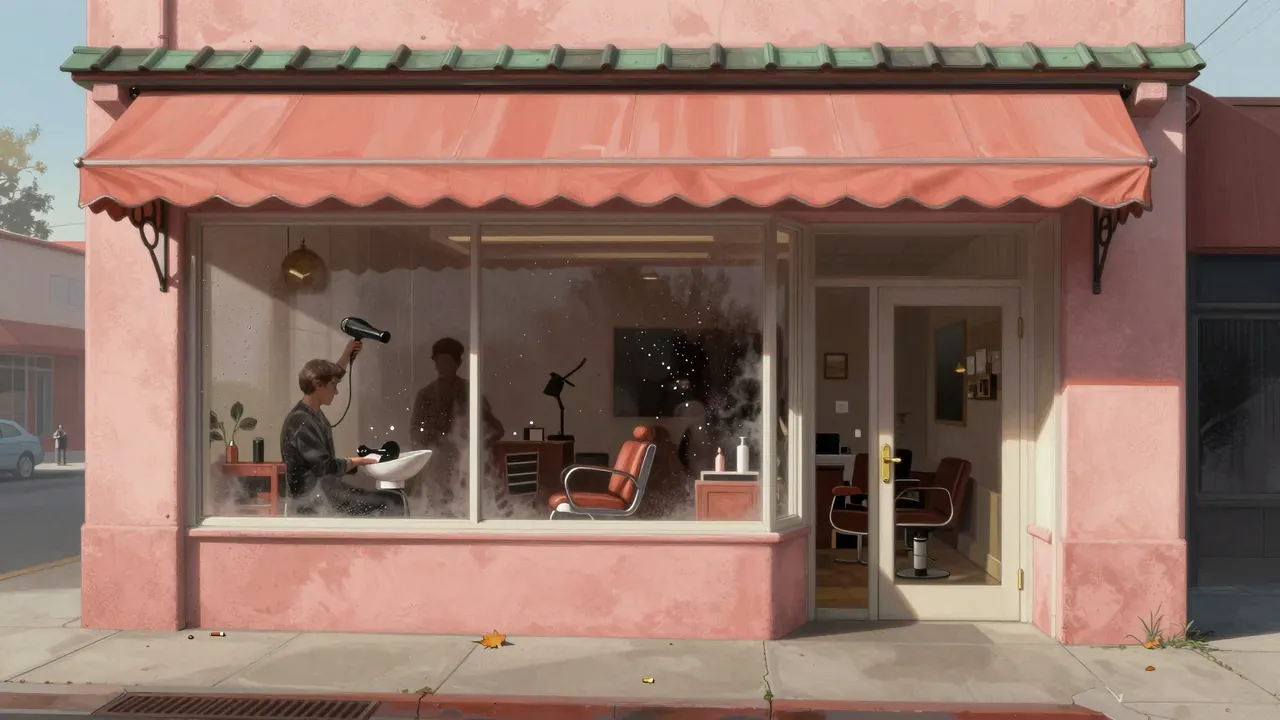
Éric Rohmer’s 1992 film follows Félicie, a Parisian hairdresser raising her daughter alone, as she navigates two unsatisfying relationships while holding onto the memory of a summer romance. Five years after losing contact with Charles, she sees him by chance on a New Year’s Eve bus — a reunion made possible not by fate, but by her unwavering, quiet fidelity to possibility. Shot by Luc Pagès and written and directed by Rohmer, it is the second in his ‘Tales of the Four Seasons’ series.

13:00

A Taste of Honey

Tony Richardson · 1961

Tony Richardson and Shelagh Delaney’s 1961 adaptation of her own play follows Jo, a teenage girl in Salford, as she navigates abandonment, pregnancy, and makeshift kinship amid post-war austerity. Shot on location in Manchester and Blackpool, with Walter Lassally’s naturalistic cinematography and Rita Tushingham’s breakthrough performance, it is a cornerstone of British kitchen-sink realism — unsentimental, formally restrained, and politically precise in its depiction of class, race, and sexuality.

13:00

A Wedding Suit

Abbas Kiarostami · 1976

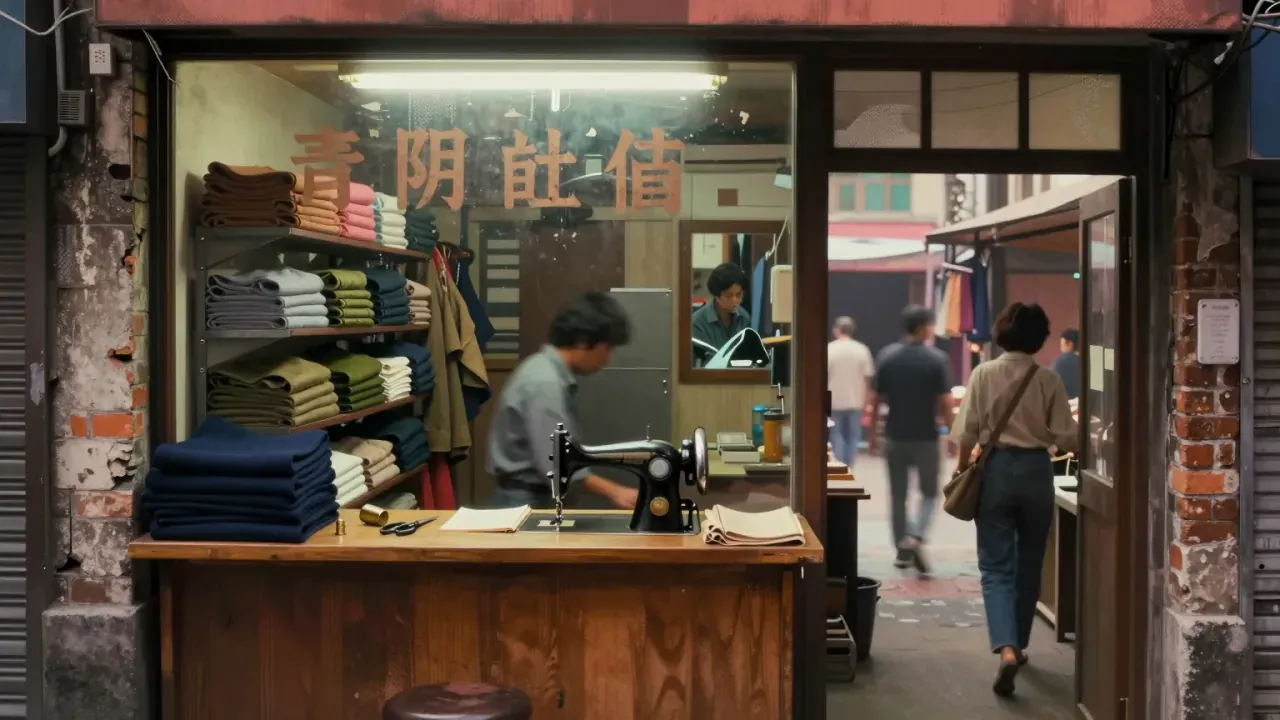
A Wedding Suit (1976) is Abbas Kiarostami’s 54-minute comedy made for Iran’s Institute for the Intellectual Development of Children and Young Adults. A woman orders a suit for her son to wear to a wedding; her tailor’s apprentice and two friends secretly try it on overnight. Structured around quiet observation and precise, unhurried staging, the film finds humour and humanity in small-scale decisions, material detail, and the unspoken rhythms of adolescent collaboration. It contains no score, minimal dialogue, and no overt commentary — its concerns are procedural, spatial, and tactile.

13:00

A Woman Is a Woman

Jean-Luc Godard · 1961

Jean-Luc Godard’s 1961 colour debut is a self-aware, formally restless romantic comedy starring Anna Karina as Angéla, an exotic dancer determined to have a child. Shot in Paris by Raoul Coutard and scored by Michel Legrand, it uses musical interludes, abrupt edits, and stylised dialogue to interrogate genre conventions, gender roles, and the language of desire — all without relinquishing its wit or warmth.

13:00

A Woman of Paris

Charlie Chaplin, A. Edward Sutherland · 1923

A Woman of Paris (1923) is Charlie Chaplin’s sole silent drama without the Tramp, starring Edna Purviance as Marie St. Clair — a woman whose life unravels not through vice, but through miscommunication, social constraint, and quiet consequence. Directed with surgical restraint, it uses décor, editing, and understated performance to trace fate as environment rather than destiny. Though its contemporary reception was mixed and its lead performance uneven, its influence on narrative realism endures.

13:00

About Dry Grasses

Nuri Bilge Ceylan · 2023

Nuri Bilge Ceylan’s About Dry Grasses follows a disillusioned Istanbul teacher stationed in eastern Anatolia after he and a colleague face student accusations. Shot in Erzurum and Adıyaman by Kürşat Üresin and Cehavir Şahin, the film unfolds across winter in long takes and muted tones, anchored by Merve Dizdar’s Cannes-winning performance. Co-written by Ceylan, Ebru Ceylan and Akın Aksu, it resists narrative resolution in favour of sustained atmosphere, probing education, geography and epistemic limits without recourse to exposition or catharsis.

13:00

Accattone

Pier Paolo Pasolini · 1961

Pasolini’s 1961 debut follows Accattone, a Roman pimp adrift in the borgate, as he slides from exploitation to theft to death. Shot in stark black-and-white with non-professional actors and scored to Bach, it treats poverty not as condition to be solved but as reality to be held in view — unflinching, unexplained, and utterly devoid of sentiment.

13:00

Ace in the Hole

Billy Wilder · 1951

Billy Wilder’s 1951 drama follows a disgraced reporter who manipulates a cave rescue into a week-long media circus in rural New Mexico. With Kirk Douglas as the ruthlessly pragmatic Chuck Tatum, the film charts the incremental erosion of ethics across journalism, law enforcement, and community—treating truth as a negotiable resource rather than a principle. Shot by Charles Lang and edited by Arthur P. Schmidt, it remains stark, unsentimental, and structurally rigorous.

13:00

Ådalen 31

Bo Widerberg · 1969

Bo Widerberg’s 1969 Swedish drama Ådalen 31 reconstructs the 1931 Ådalen shootings through the daily life of the working-class Andersson family. Anchored by Peter Schildt and Roland Hedlund, it traces springtime tensions between strikers and strikebreakers in northern Sweden, culminating in a military massacre that kills five. Shot by Jörgen Persson with deliberate restraint, it avoids polemic in favour of tactile realism — fishing, jazz, French lessons, abortion, grief — making ideology legible through habit, not speech. It won the Cannes Grand Prix and remains a landmark of socially engaged arthouse cinema.

13:00

Adoption

Márta Mészáros · 1975

Márta Mészáros’s 1975 drama follows Kata, a 42-year-old Hungarian factory worker, as she forms a bond with a teenage girl at a children’s home and pursues adoption. Shot with documentary restraint and performed with quiet intensity, it examines reproductive choice, institutional care, and the unremarked labour of kinship — all without sentimentality or resolution.

13:00

Afire

Christian Petzold · 2023

Christian Petzold’s Afire follows a brittle young writer whose self-absorption fractures under the pressure of shared space, honest criticism, and an approaching forest fire. Set in a Baltic holiday home, the film traces his slow disorientation as relationships shift and catastrophe interrupts narrative control. With restrained performances and unadorned craft, it asks how people begin to see clearly only after their stories stop holding.

13:00

After Hours

Martin Scorsese · 1985

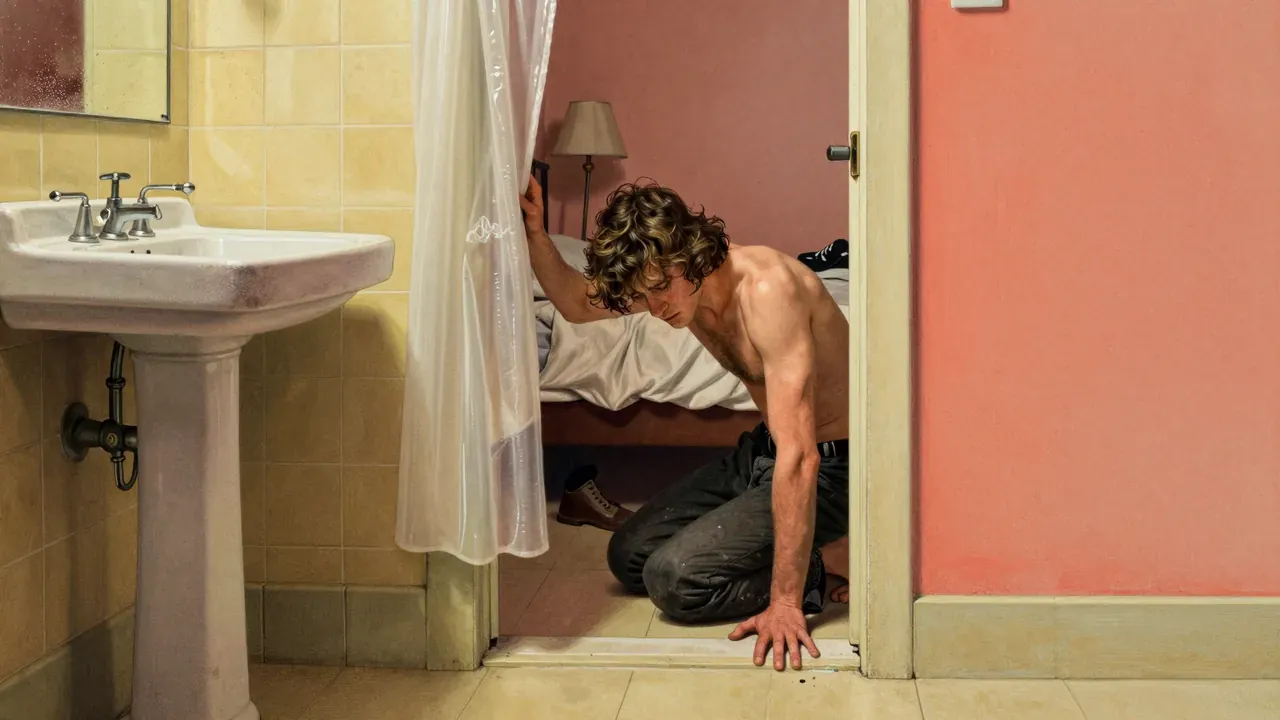
Martin Scorsese’s 1985 black comedy follows office worker Paul Hackett through a single, increasingly surreal night in SoHo. Stranded without money, misunderstood at every turn, and hunted by neighbours, he careens from one absurd crisis to the next — until the plaster hardens, the van doors fly open, and he crashes, barefoot and broken, into his office at dawn. Michael Ballhaus’s tight cinematography, Thelma Schoonmaker’s razor-sharp editing, and Howard Shore’s nervy score sustain a tone of escalating, inescapable farce.

13:00

After Life

Hirokazu Koreeda · 1998

After Life (1998) is Hirokazu Koreeda’s gently speculative film set in a way station between life and death, where the newly deceased must choose one memory to carry into eternity. Shot on grainy 16 mm and 8 mm film, it blends scripted scenes with real interviews, treating memory not as fixed truth but as subjective, evolving reconstruction. With understated performances and deliberate pacing, it explores how identity forms through fragments — a dress, a breeze, a letter — and how meaning accrues in quiet, relational moments rather than grand events.

13:00

After the Rehearsal

Ingmar Bergman · 1984

After the Rehearsal is a 1984 Swedish television film written and directed by Ingmar Bergman, shot by Sven Nykvist and starring Erland Josephson, Ingrid Thulin, and Lena Olin. Set entirely in a theatre rehearsal room, it traces a charged encounter between a veteran director and his lead actress — a meeting that triggers memories of her late mother, also his former lover and star. Drawing on Strindberg’s A Dream Play, it uses doubling, repetition, and minimal staging to explore inheritance, memory, and the blurred line between performance and lived experience.

13:00

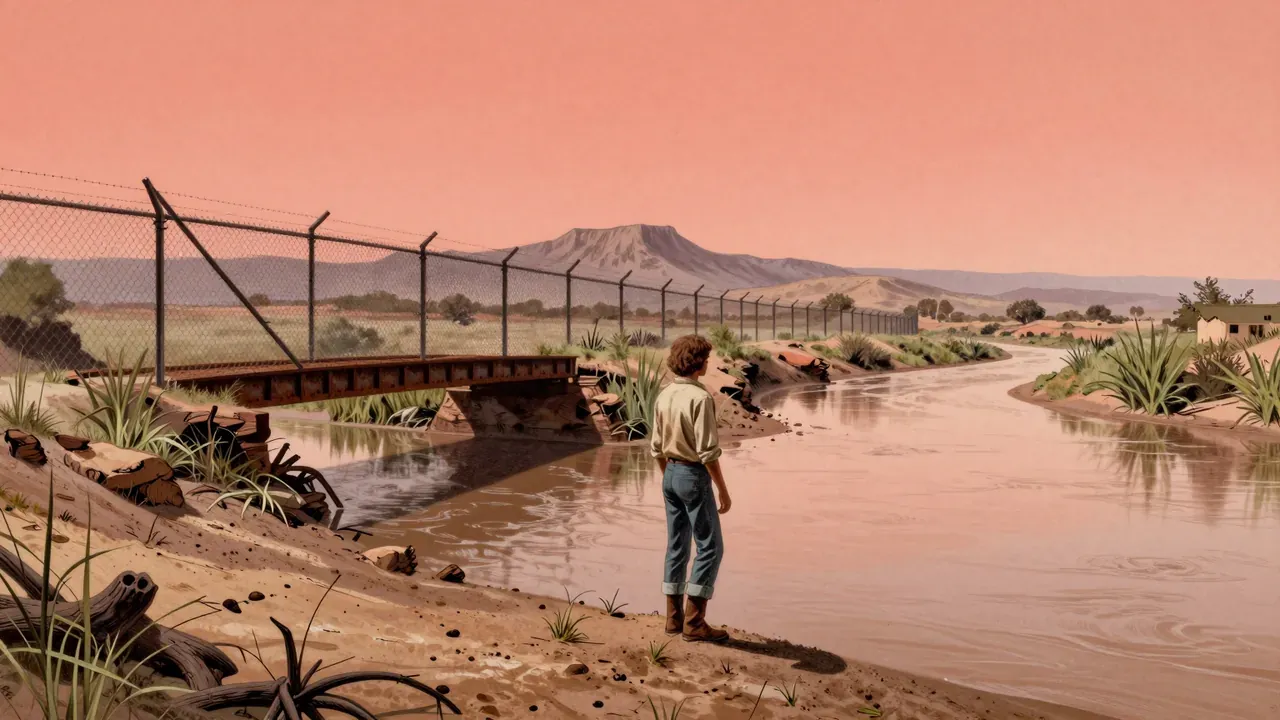
Alambrista!

Robert Milton Young · 1977

Alambrista! (1977), written and directed by Robert Milton Young, follows Roberto, a Mexican farmer who crosses into the US to find work. Shot on location with non-professional actors, it observes his journey with minimal dialogue, no exposition, and sustained attention to physical detail. The film avoids drama, psychology and commentary, instead building meaning through repetition, duration and quiet encounters. Inducted into the National Film Registry in 2023, it remains a rigorous, unsentimental portrait of endurance.

13:00

Alex Wheatle

Steve McQueen · 2020

Steve McQueen’s Alex Wheatle (2020) follows the British novelist from institutional childhood through Brixton’s sound-system culture to imprisonment after the 1981 uprising, where he discovers literature. Starring Sheyi Cole and shot by Shabier Kirchner, it is the fourth film in the Small Axe anthology — a focused, atmospheric biographical drama that prioritises sensory detail and quiet transformation over exposition or historical sweep.

13:00

Ali: Fear Eats the Soul

Rainer Werner Fassbinder · 1974

Rainer Werner Fassbinder’s 1974 drama follows a 60-year-old German widow and a Moroccan migrant worker whose marriage exposes the everyday machinery of racism and class prejudice in postwar West Germany. Shot in under two weeks, it uses Sirkian melodrama not for irony but precision — compressing social critique into intimate gesture, silence, and repeated, unadorned images. Brigitte Mira and El Hedi ben Salem perform with restrained gravity, while Jürgen Jürges’ cinematography and Thea Eymèsz’s editing sustain a tone of quiet, accumulating pressure. The film ends not with resolution but with commitment: two hands held in a hospital corridor, after everything else has been worn away.

13:00

Alice in the Cities

Wim Wenders · 1974

Wim Wenders’ 1974 road film follows a stalled writer and a nine-year-old girl as they search across Germany for her estranged grandmother. Shot in black-and-white 16 mm by Robby Müller, it favours duration over exposition, silence over speech, and observation over explanation. Its power lies in restraint: in the weight of a glance, the rhythm of a bus ride, the quiet persistence of mutual attention.

13:00

All About My Mother

Pedro Almodóvar · 1999

Pedro Almodóvar’s 1999 film follows a nurse who, after her son’s death, seeks his transgender parent in Barcelona and becomes entwined with a community of women and men navigating illness, faith, performance, and motherhood. Shot in Spanish, it uses saturated colour, theatrical reference, and deliberate narrative coincidence to affirm care across difference — not as ideal but as daily, embodied practice.

13:00

All of Us Strangers

Andrew Haigh · 2023

Andrew Haigh’s All of Us Strangers follows a lonely screenwriter who reconnects with his deceased parents and begins a relationship with a mysterious neighbour. Set in contemporary London and rooted in the emotional textures of 1980s Britain, the film uses fantasy not as escape but as a means to examine unresolved grief, queer identity, and the quiet violence of familial silence. With restrained performances, precise cinematography, and a carefully curated soundtrack, it builds its power through stillness and repetition rather than revelation.

13:00

All That Jazz

Bob Fosse · 1979

Bob Fosse’s 1979 semi-autobiographical musical follows Joe Gideon—a director and editor burning himself out across Broadway and Hollywood—as his body fails. Using dance, dream logic, and clinical realism, it maps the collision of creative obsession and physical collapse. Roy Scheider stars; Giuseppe Rotunno shoots; Alan Heim edits; Ralph Burns scores. It won four Oscars and the Palme d’Or, and remains a benchmark for formal audacity in American cinema.

13:00

All These Women

Ingmar Bergman · 1964

Ingmar Bergman’s 1964 comedy All These Women is a stylised, colour-saturated parody of artistic biography and authorial myth-making. Set over four days at a summer villa, it follows a biographer unable to meet his subject — a cellist surrounded by lovers, each performing a version of devotion. With Sven Nykvist’s precise cinematography and Erik Nordgren’s waltz-and-dissonance score, the film sustains a tone of elegant, unrelenting artifice. It is among Bergman’s few comedies, and his first in colour — a formal departure that underscores its thematic preoccupation with surface, performance, and the unreliability of memory.

13:00

All We Imagine as Light

Payal Kapadia · 2024

Payal Kapadia’s 2024 drama follows three women — nurses Prabha and Anu, and cook Parvaty — as they move between Mumbai’s chawls and Ratnagiri’s coast. Shot with restrained naturalism by Ranabir Das and edited with unhurried precision by Clément Pinteaux, it builds emotional resonance through duration, texture, and unspoken connection rather than plot. Premiering at Cannes, where it won the Grand Prix, it is a study in care, displacement, and the quiet dignity of ordinary endurance.

13:00

Alphaville

Jean-Luc Godard · 1965

Jean-Luc Godard’s 1965 Alphaville transplants American detective Lemmy Caution into a nameless, near-future city ruled by Alpha 60, a sentient computer that bans emotion, poetry, and questioning. Shot on real Paris locations with no futuristic props, it merges film noir and dystopian satire to interrogate language, control, and the persistence of feeling. Eddie Constantine and Anna Karina star; Raoul Coutard shot it, Agnès Guillemot edited it, Paul Misraki scored it. It won the Golden Bear at Berlin in 1965.

13:00

American Utopia

Spike Lee · 2020

Spike Lee’s American Utopia films David Byrne’s Broadway concert as a sustained act of collective presence: twelve performers, wireless instruments, no sets, choreographed movement, and spoken interludes on connection and civic life. Shot by Ellen Kuras with formal rigour, it avoids spectacle in favour of clarity, repetition, and physical continuity — less a celebration than a rehearsal of unity.

13:00

Amores perros

Alejandro González Iñárritu · 2000

Alejandro González Iñárritu’s 2000 debut is a tripartite Mexican drama linked by a single car crash. Three stories — a teenager in dogfighting, a model recovering from injury, and a hitman estranged from his daughter — unfold across Mexico City’s social strata. Rodrigo Prieto’s unadorned cinematography and Iñárritu’s tight editing sustain a tone of controlled urgency. The film treats dogs not as symbols but as narrative counterpoints, and its themes — fractured masculinity, economic precarity, moral inertia — emerge through action, not exposition. It won the BAFTA for Best Film Not in the English Language and remains a touchstone of early-2000s arthouse cinema.

13:00

An Actor's Revenge

Kon Ichikawa · 1963

Kon Ichikawa’s 1963 film follows Yukinojō Nakamura, an onnagata kabuki actor who returns to Edo to enact revenge on the men who caused his parents’ suicide. Kazuo Hasegawa plays both Yukinojō and the thief Yamitarō, anchoring a film defined by theatrical composition, restrained music by Yasushi Akutagawa, and Musei Tokugawa’s wry benshi narration. It is less a story of justice than a study in performance as survival, gender as labour, and vengeance as repetition — all rendered with formal control and deliberate emotional distance.

13:00

An Angel at My Table

Jane Campion · 1990

Jane Campion’s 1990 film adapts Janet Frame’s three autobiographies into a restrained, chronologically grounded portrait of a New Zealand writer whose voice was nearly erased by misdiagnosis and institutionalisation. Kerry Fox leads a layered performance across Frame’s life stages, supported by Stuart Dryburgh’s muted cinematography and Veronika Jenet’s unhurried editing. It avoids biopic cliché, focusing instead on the quiet labour of self-reclamation through language.

13:00

An Autumn Afternoon

Yasujirō Ozu · 1962

Yasujirō Ozu’s 1962 An Autumn Afternoon follows widower Shūhei Hirayama as he arranges his daughter Michiko’s marriage — not as a triumph of paternal love, but as an act of belated self-reckoning. Set in Tokyo, the film moves through school reunions, bar visits and domestic routines, using precise framing, muted colour and deliberate pacing to trace how time, duty and silence shape family life. With Chishū Ryū, Shima Iwashita and Mariko Okada, it is a restrained, deeply humane portrait of ageing, obligation and the quiet cost of staying put.

13:00

An Enemy of the People

Satyajit Ray · 1990

Satyajit Ray’s 1990 Bengali-language drama transposes Ibsen’s An Enemy of the People to a small Indian town whose economy depends on a temple’s ‘holy water’. When doctor Ashok Gupta (Soumitra Chatterjee) proves the water is contaminated, he is systematically silenced by municipal officials, journalists and religious authorities — all invested in maintaining the status quo. Shot with clinical precision and performed with restrained gravity, the film traces the erosion of professional integrity and communal trust. Though its resolution feels underprepared, its central inquiry — how facts are weighed against utility — remains urgently relevant.

13:00

And the Ship Sails On

Federico Fellini · 1983

Set aboard the luxury liner Gloria N. in July 1914, Federico Fellini’s And the Ship Sails On follows a funeral voyage to scatter the ashes of a legendary opera singer. Through journalist Orlando’s wry narration, the film assembles a gallery of caricatured aristocrats, artists, and dignitaries — all performing grief, status, and obsession aboard a vessel that doubles as a stage, museum, and mausoleum. Giuseppe Rotunno’s cinematography and Dante Ferretti’s sets sustain a lush, theatrical artifice, while Gianfranco Plenizio’s score underscores the film’s blend of grandeur and gentle absurdity. The voyage ends not with resolution but with sinking — literal and metaphorical — as the ship founders amid cannon fire and butterflies.

13:00

Anna's Meetings

Chantal Akerman · 1978

Chantal Akerman’s 1978 film follows Anne Silver, a Belgian filmmaker travelling across Western Europe to promote her work. She meets lovers, friends, family and strangers, but remains emotionally detached. Shot in restrained, observational style by Jean Penzer and edited by Francine Sandberg, the film builds its power through duration, repetition and unspoken tension — culminating in Anne alone, listening to unanswered messages. It is a study in autonomy, exhaustion and the quiet persistence of loneliness.

13:00

Apart from You

Mikio Naruse · 1933

Mikio Naruse’s 1933 silent drama follows Kikue, an ageing geisha, her ashamed teenage son Yoshio, and Terugiku, a younger colleague who mediates between them. Set in Tokyo’s geisha districts and a coastal fishing village, the film traces shifting loyalties, familial duty, and the cost of survival in a rigid social order. With precise editing, understated performances, and a pragmatic view of its world, it avoids moralising in favour of sustained observation.

13:00

Arabian Nights

Pier Paolo Pasolini · 1974

Pier Paolo Pasolini’s 1974 Arabian Nights is the final film of his ‘Trilogy of Life’, adapting fragments from the One Thousand and One Nights across real locations in Yemen, Iran, Ethiopia and Nepal. It abandons the frame narrative to focus on bodily pleasure, poetic recitation and episodic storytelling, using non-professional actors, long takes and Ennio Morricone’s sparse score. Though formally daring and visually rich, its resistance to psychology and narrative cohesion divides viewers. It won the Cannes Grand Prix in 1974.

13:00

Ariel

Aki Kaurismäki · 1988

Aki Kaurismäki’s 1988 drama follows a displaced Finnish miner, Taisto Kasurinen, as he drifts from Lapland to Helsinki, surviving eviction, robbery, imprisonment, and finally a bank heist — all with deadpan reserve and minimal dialogue. Shot by Timo Salminen in muted tones and edited with deliberate stillness, the film treats economic abandonment as atmosphere rather than crisis, and resilience as routine rather than triumph.

13:00

As Long as You've Got Your Health

Pierre Étaix · 1966

Pierre Étaix’s 1966 anthology comedy As Long as You’ve Got Your Health presents four self-contained sketches—on insomnia, cinema queues, psychiatric consultation, and forest visits—unified by deadpan timing, restrained performances, and Jean Boffety’s unobtrusive cinematography. Written by Jean-Claude Carrière and edited with surgical calm, it observes urban alienation and bureaucratic fatigue not through satire but through repetition and pause. Its humour is physical, its themes implicit, its pace deliberate.

13:00

Autumn Sonata

Ingmar Bergman · 1978

Ingmar Bergman’s 1978 drama centres on pianist Charlotte and her daughter Eva, who invite her to their rural Swedish home after seven years apart. Over two days, suppressed grief, resentment, and guilt surface in a series of tightly framed confrontations. Shot by Sven Nykvist in muted tones, with Chopin’s Prelude No. 2 as its only musical motif, the film sustains emotional intensity through stillness, silence, and the physical proximity of Ingrid Bergman and Liv Ullmann. It is Bergman’s last theatrically released film and Ingrid Bergman’s final screen role.

13:00

Autumn Tale

Éric Rohmer · 1998

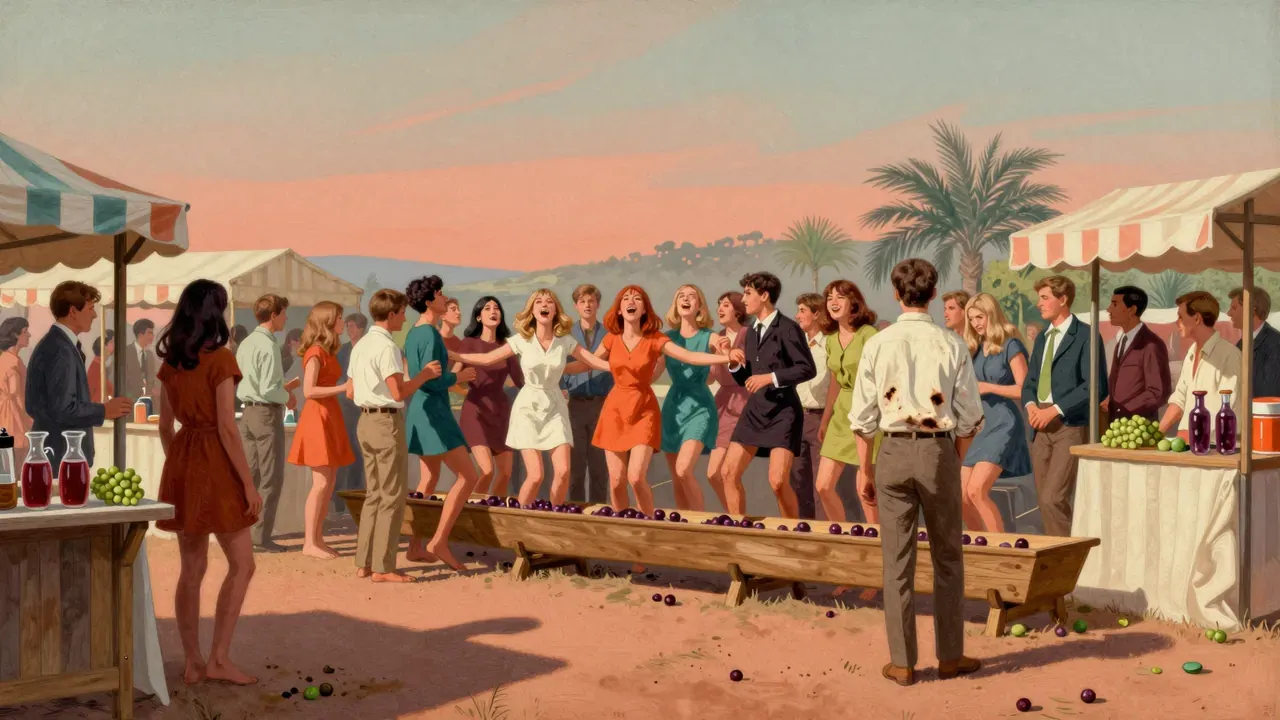
Éric Rohmer’s 1998 Autumn Tale, the final chapter of his Tales of the Four Seasons, follows a widowed winemaker in the Rhône Valley as her friends orchestrate quiet, conflicting attempts to reintroduce her to love. Shot with calm precision by Diane Baratier and performed with understated rigour by Béatrice Romand and Marie Rivière, it locates emotional truth in hesitation, miscommunication, and the slow realignment of intention. Its power lies in restraint: no grand declarations, no dramatic reversals—just the fragile, earned possibility of connection, harvested like grapes at the right moment.

13:00

Baal

Volker Schlöndorff · 1970

Volker Schlöndorff’s 1970 adaptation of Brecht’s Baal transposes the 1923 play into late-1960s West Germany, starring Rainer Werner Fassbinder in the title role. Shot in vivid, expressionistic colour by Dietrich Lohmann and scored sparsely by Klaus Doldinger, it refuses psychological exposition or moral framing. Instead, it holds Baal — a self-destructive, charismatic, violently entitled poet — in unrelenting focus, exposing the social machinery that enables his ‘genius’. Long suppressed and recently restored, it remains a rigorous, uncomfortable, and formally exacting work.

13:00

Babo 73

Robert Downey Sr. · 1964

Babo 73 is a 1964 American underground comedy directed by Robert Downey Sr., presenting a surreal, non-narrative campaign for a fictional presidential candidate named Babo. Shot on 16mm in black and white, it uses repetition, deadpan delivery, and jagged editing to dissect the performative emptiness of political theatre. With no score, minimal dialogue, and no character development, it operates as a formal experiment in anti-rhetoric—less satire than structural diagnosis.

13:00

Bad Timing

Nicolas Roeg · 1980

Nicolas Roeg’s 1980 psychological thriller Bad Timing follows an inspector’s investigation into a woman’s suicide attempt, using non-linear editing and restrained cinematography to dissect the obsessive, destructive relationship between a psychoanalyst and his lover. Set in Vienna and shot by Anthony B. Richmond, it stars Art Garfunkel and Theresa Russell, with Harvey Keitel as the investigator. Adapted by Yale Udoff from an Italian story, the film was controversial on release — rejected by its UK distributor and X-rated in the US — yet won the Toronto International Film Festival People’s Choice Award. Its formal rigour and emotional austerity have secured its status as an arthouse landmark.

13:00

Bamboozled

Spike Lee · 2000

Spike Lee’s 2000 film Bamboozled follows a Black television writer who creates a modern minstrel show as a cynical ploy to get fired—only to see it become a hit. Shot partly on Mini DV and partly on Super 16, it blends satire, drama and documentary-style montage to confront the persistence of racist imagery in American media. Though critically divisive on release, it has since been reappraised for its prescience and added to the National Film Registry.

13:00

Barcelona

Whit Stillman · 1994

Whit Stillman’s 1994 romantic comedy follows two American cousins — a salesman and a naval officer — navigating love, language, and ideology in post-Franco Barcelona. Written and directed by Stillman, it forms the second part of his 'Doomed Bourgeois in Love' trilogy. With Taylor Nichols, Chris Eigeman, and Mira Sorvino, the film uses precise dialogue, deliberate pacing, and understated performances to explore miscommunication across cultures, classes, and generations.

13:00

Barnvagnen

Bo Widerberg · 1963

Bo Widerberg’s 1963 Swedish drama Barnvagnen follows a young father’s first months in a Stockholm apartment, using restrained performance, Jan Troell’s naturalistic cinematography, and Jan Johansson’s sparse piano score to observe the uneventful gravity of early care. It avoids narrative escalation, psychological exposition, or symbolic framing — instead building meaning through duration, acoustic detail, and the physical presence of domestic objects.

13:00

Basquiat

Julian Schnabel · 1996

Julian Schnabel’s 1996 directorial debut is a biographical film about Jean-Michel Basquiat, starring Jeffrey Wright and David Bowie as Warhol. Made without access to Basquiat’s actual artwork, it relies on stylistic approximation and a self-reflexive script co-written by Schnabel and Lech Majewski. The film traces Basquiat’s rapid ascent and decline in 1980s New York, foregrounding his relationship with Warhol and his struggle with addiction. Its strength lies in texture and restraint; its limitation, in the narrowing of Basquiat’s voice, politics and heritage to fit Schnabel’s personal elegy.

13:00

Baxter, Vera Baxter

Marguerite Duras · 1977

Baxter, Vera Baxter (1977) is a French arthouse drama written and directed by Marguerite Duras. Set largely in a rented seaside villa, it follows Vera Baxter as she receives two visitors and recounts fragments of her marriage. With Delphine Seyrig, Noëlle Châtelet, and Claudine Gabay, the film uses stillness, repetition, and architectural framing to explore existential exhaustion, bourgeois entrapment, and the silent circuits of duty. Carlos d’Alessio’s sparse score and unhurried editing reinforce its austere tone.

13:00

Bay of Angels

Jacques Demy · 1963

Jacques Demy’s 1963 black-and-white drama follows a young bank clerk and a compulsive gambler through the casinos of Nice and Monte Carlo. Built around Jeanne Moreau’s tightly coiled performance and Michel Legrand’s percussive score, it studies addiction as rhythm, not pathology — where money is incidental, and the real stakes are time, attention, and the diminishing space between decisions.

13:00

Beau Travail

Claire Denis · 1999

Claire Denis’s 1999 arthouse drama relocates Herman Melville’s Billy Budd to the French Foreign Legion in Djibouti, tracing Adjudant-Chef Galoup’s psychological unravelling as he fixates on a new recruit. Shot by Agnès Godard and edited by Nelly Quettier, it relies on physicality, repetition and withheld motivation to explore power, masculinity and colonial space — culminating in a solitary, ecstatic nightclub dance that resolves nothing but everything.

13:00

Bed and Board

François Truffaut · 1970

François Truffaut’s 1970 film follows Antoine Doinel and Christine as newlyweds navigating Parisian domestic life: a cramped apartment, a faltering job, the birth of their son, and Antoine’s brief, hollow affair with a Japanese woman. Shot by Néstor Almendros with restrained naturalism, it avoids moralising or climax, instead observing the textures of habit, compromise, and quiet endurance. It is the fourth in Truffaut’s Doinel cycle and stands apart for its unblinking, unsentimental portrayal of marriage as daily practice rather than emotional event.

13:00

Before Midnight

Richard Linklater · 2013

Before Midnight (2013), directed by Richard Linklater and co-written by Linklater, Ethan Hawke, and Julie Delpy, follows Jesse and Céline nine years after Before Sunset as they vacation in Greece with their twin daughters. Structured around three extended conversations — in a car, at dinner, and in a hotel room — the film examines the quiet tensions of long-term partnership, parental compromise, and the erosion and endurance of love. Shot in 15 days on the Peloponnese coast, it relies on performance, writing, and restraint rather than plot or spectacle. It received universal critical acclaim and was nominated for Best Adapted Screenplay at the Academy Awards.

13:00

Before Sunrise

Richard Linklater · 1995

Two strangers meet on a train, disembark in Vienna, and spend twelve hours walking the city, talking, hesitating, revealing, and connecting. There is no plot beyond that; no music swells, no camera lingers on faces for effect, no external drama intrudes. What remains is the texture of real conversation, the weight of time passing, and the quiet ache of something meaningful that cannot last.

13:00

Before Sunset

Richard Linklater · 2004

Before Sunset (2004), directed by Richard Linklater and written by Linklater, Ethan Hawke, and Julie Delpy, follows Jesse and Céline as they reunite in Paris nine years after their first meeting in Vienna. Shot in real time across 77 minutes, the film unfolds in a single afternoon across Parisian locations—from Shakespeare & Company to Céline’s apartment—with no flashbacks or narrative shortcuts. Lee Daniel’s Steadicam cinematography, Sandra Adair’s seamless editing, and Julie Delpy’s acoustic score support a performance-driven portrait of ageing, memory, and the fragile persistence of connection. It was nominated for an Academy Award for Best Adapted Screenplay.

13:00

Before the Rain

Milcho Manchevski · 1994

Before the Rain (1994) is Milcho Manchevski’s debut feature: a non-linear Macedonian drama structured in three interlocking parts — WORDS, FACES, PICTURES — that begin and end at the same moment. Shot by Manuel Teran and scored by Anastasia, it traces cycles of silence, misrecognition, and reprisal across Macedonia and London. Its formal rigour and ethical austerity have made it a touchstone of post-Yugoslav cinema — and a test of how much meaning a film can hold without explanation.

13:00

Being John Malkovich

Spike Jonze · 1999

Being John Malkovich (1999) is a surrealist comedy-drama written by Charlie Kaufman and directed by Spike Jonze. A down-on-his-luck puppeteer discovers a portal into actor John Malkovich’s mind, sparking a chain of ethical and existential complications among his wife, co-worker, and employer. With precise writing, restrained performances, and a singular conceptual rigour, it explores identity, desire, and control without resorting to explanation or sentiment.

13:00

Being There

Hal Ashby · 1979

Hal Ashby’s 1979 adaptation of Jerzy Kosiński’s novel follows Chauncey Gardiner, a sheltered gardener mistaken for a sage after stepping into Washington society. Peter Sellers delivers a performance of radical stillness, while the film’s craft — cinematography, editing, score — enforces a tone of calm, unblinking observation. It is satire without ridicule, comedy without punchlines, and a portrait of meaning-making as collective fiction.

13:00

Benny's Video

Michael Haneke · 1992

Michael Haneke’s 1992 Austrian horror film follows Benny, a Vienna teenager obsessed with video recording, whose emotionally detached parents enable his fixation. After filming a pig’s slaughter, he invites a girl to his home, kills her on camera, and proceeds with chilling normalcy — cleaning, socialising, travelling — while his parents dispose of the body. The film uses static camerawork, diegetic sound, and layered recordings to dissect how media saturation erodes moral response, treating violence not as rupture but as data.

13:00

Berlin Alexanderplatz

Rainer Werner Fassbinder · 1980

Rainer Werner Fassbinder’s 1980 fourteen-part television adaptation of Alfred Döblin’s novel traces Franz Biberkopf’s failed attempts at honest living in late-Weimar Berlin. Shot by Xaver Schwarzenberger, scored by Peer Raben, and edited by Juliane Lorenz, it treats the city as a system of pressures — economic, legal, sexual — that wear down individual agency. With a cast including Barbara Sukowa, Gottfried John, and Hanna Schygulla, it avoids psychological exposition in favour of documentary texture, rhythmic repetition, and moral density. At 894 minutes, it asks for time not as concession but as condition.

13:00

Betty Blue

Jean-Jacques Beineix · 1986

A 1986 French psychological drama directed by Jean-Jacques Beineix, Betty Blue follows Zorg, a handyman and aspiring writer, and Betty, a volatile 19-year-old, as their passionate relationship unravels across coastal, urban and provincial France. Shot by Jean-François Robin and scored by Gabriel Yared, it renders emotional extremity through saturated visuals, rhythmic editing and physical performance — prioritising mood and texture over exposition or diagnosis.

13:00

Beware of a Holy Whore

Rainer Werner Fassbinder · 1971

Rainer Werner Fassbinder’s 1971 drama Beware of a Holy Whore stages the slow disintegration of a film crew stranded in a Spanish hotel, awaiting production that never begins in earnest. Shot by Michael Ballhaus and edited by Fassbinder and Thea Eymèsz, it uses repetition, confinement and unresolved tension to explore self-deception, dependency and the violence of creative collaboration.

13:00

Beyond the Hills

Cristian Mungiu · 2012

Beyond the Hills (2012), directed by Cristian Mungiu, follows two orphaned Romanian women — one newly professed at an Orthodox convent, the other arriving from Germany seeking reunion — as their bond unravels under the weight of doctrine, isolation, and escalating restraint. Based on real events surrounding the 2005 Tanacu exorcism, it unfolds with clinical restraint: long takes, muted sound, no score, and performances that withhold explanation. The film builds not to revelation but to consequence — a death that arrives not with fanfare, but as the logical endpoint of unchallenged assumptions.

13:00

Beyond the Law

Norman Mailer · 1968

Norman Mailer’s 1968 film is a self-financed, largely unscripted experiment set over one night in a Manhattan police station, following detectives and suspects through interrogations, lineups, and personal fallout. Shot with three crews over four nights, it uses improvisation to probe the psychological and ethical continuities between law enforcement and criminality — a theme Mailer pursued across his writing. Though technically rough and narratively diffuse, its rawness serves its purpose: to show power not as policy but as habit, posture, and proximity.

13:00

Beyond the Valley of the Dolls

Russ Meyer · 1970

Beyond the Valley of the Dolls (1970) is a Russ Meyer–Roger Ebert collaboration: a knowingly excessive, tonally unstable parody of Valley of the Dolls and Hollywood itself. Made quickly on the Fox lot, it blends teen melodrama, rock musical, exploitation thriller and moral fable — all delivered with poker-faced solemnity. Its cult status rests on its deliberate incoherence, not despite it.

13:00

Bigger Than Life

Nicholas Ray · 1956

Nicholas Ray’s 1956 drama follows schoolteacher Ed Avery, whose recovery from a rare illness via cortisone treatment triggers a psychological unraveling that fractures his marriage, terrifies his son, and exposes the brittle ideologies underpinning Eisenhower-era domestic life. James Mason stars and produced; Joseph MacDonald’s CinemaScope cinematography turns suburban interiors into psychological pressure chambers.

13:00

Bim

Albert Lamorisse · 1950

A forty-five-minute French drama from 1950, written by Jacques Prévert and Albert Lamorisse and directed by Lamorisse. It follows a boy in rural France whose life is structured around his dog — until the dog disappears. With no score, minimal dialogue, and deliberate pacing, the film traces grief through gesture, silence, and the persistence of routine.

13:00

Birth

Jonathan Glazer · 2004

Jonathan Glazer’s 2004 film Birth follows Anna, a woman who becomes convinced that her deceased husband has been reborn in a ten-year-old boy. Shot in New York with Haris Savides, scored by Alexandre Desplat, and anchored by Nicole Kidman’s restrained performance, it is a psychological mystery that sustains ambiguity as principle. It does not confirm or deny the boy’s claim, instead focusing on the weight of Anna’s belief, the erosion of shared reality among those around her, and the quiet devastation of love that refuses to expire. Polarising on release, it has since gained recognition for its formal rigour and emotional precision.

13:00

Black Girl

Ousmane Sembène · 1966

Ousmane Sembène’s 1966 feature debut follows Diouana, a young Senegalese woman who moves to France to work for a French couple, only to find her identity stripped away by isolation, linguistic erasure, and routine condescension. Shot in Senegal with a minimal crew and dubbed dialogue, the film uses stark visual contrast and elliptical editing to trace the psychological toll of colonial labour. Its power lies in restraint: no score, no exposition, no redemption—just the quiet accumulation of small violences, culminating in an act of final autonomy. Widely regarded as the first Sub-Saharan African feature by an African filmmaker to gain international attention, it remains a foundational text of anti-colonial cinema.

13:00

Black God, White Devil

Glauber Rocha · 1964

Glauber Rocha’s 1964 Black God, White Devil is a foundational Cinema Novo film set in Brazil’s drought-ravaged sertão. It follows a ranch hand and his wife as they flee, convert, join bandits, and flee again — never escaping cycles of violence sanctified by religion or revolution. Shot in stark black and white, edited by Rocha himself, and scored by Sérgio Ricardo, it treats myth and history as inseparable, and endurance as the only authentic political act.

13:00

Black Moon

Louis Malle · 1975

Louis Malle’s 1975 Black Moon is a self-contained, English-language French fantasy filmed at his Dordogne estate. Cathryn Harrison plays Lily, a young woman fleeing gendered violence who stumbles into a decaying château inhabited by talking animals, resurrected elders, telepathic siblings and a judging unicorn. Shot by Sven Nykvist with deliberate under-lighting and edited for hypnotic slowness, it rejects narrative logic in favour of sustained mood and symbolic recurrence. Though divisive, it won César Awards for cinematography and sound.

13:00

Black River

Masaki Kobayashi · 1957

Masaki Kobayashi’s 1957 drama Black River follows a university student and a waitress in a Tokyo district shadowed by a US military base. When she is raped by a local gangster and forced into a coercive relationship, and when both are evicted as part of a development scheme, their fragile bond culminates in an act of desperate, unsentimental violence. Shot with stark realism and performed with restrained intensity, the film treats systemic oppression as atmosphere rather than argument.

13:00

Black Sun

Koreyoshi Kurahara · 1964

Black Sun (1964), directed by Koreyoshi Kurahara for Nikkatsu, follows Akira, a young Japanese thief, and Gill, an injured African-American soldier, as they move silently toward the sea after a violent encounter. Shot in high-contrast monochrome, with sparse music by Toshiro Mayuzumi and Max Roach, it uses jazz records, ruined architecture, and deliberate pacing to explore connection without translation. Its themes centre on embodied difference, failed communication, and freedom as ascent rather than arrival.

13:00

Blaise Pascal

Roberto Rossellini · 1972

Roberto Rossellini’s 1972 biographical film follows Blaise Pascal’s intellectual and spiritual path from scientific prodigy to Jansenist recluse. Starring Pierre Arditi and shot by Mario Fioretti, it prioritises fidelity to Pascal’s writings over dramatic convention, using restrained performance, flat natural lighting, and sparse music to render ideas as embodied acts. It lands most strongly as a study of intellectual exhaustion and the physical cost of certainty — but falters in situating Pascal’s ideas within their historical and political consequences.

13:00

Blast of Silence

Allen Baron · 1961

Blast of Silence is a 1961 American neo-noir crime film written, directed by, and starring Allen Baron. Set over Christmas week in New York City, it follows Frankie Bono, a hitman returning to his hometown to carry out a contract killing. Shot on location without permits and scored with stark minimalism, the film leans on atmosphere, silence, and moral ambiguity rather than plot mechanics. Its narration — written by blacklisted Waldo Salt and voiced uncredited by Lionel Stander — adds a layer of literary distance. Though modest in budget and scope, it endures as a precise, unsparing study of alienation and consequence.

13:00

Blind Chance

Krzysztof Kieślowski · 1987

Krzysztof Kieślowski’s 1987 film follows Witek (Bogusław Linda) through three divergent lives, each triggered by how he navigates a single encounter at Łódź Fabryczna station. In one, he joins the Communist Party; in another, he joins the anti-Communist resistance; in the third, he retreats into apolitical domesticity. Shot with procedural restraint by Krzysztof Pakulski and edited with mathematical parity by Elżbieta Kurkowska, the film treats political identity as emergent from physical circumstance — not philosophy, but timing, surface, and sequence.

13:00

Blonde Venus

Josef von Sternberg · 1932

Blonde Venus (1932), directed by Josef von Sternberg and starring Marlene Dietrich, follows a chemist’s wife who returns to the cabaret stage to fund her husband’s life-saving treatment, then descends into flight, poverty, and arrest before a fragile reconciliation. Its power lies not in plot but in Dietrich’s commanding presence, Bert Glennon’s high-contrast cinematography, and a formal insistence on dignity amid degradation — all within the constrained moral universe of pre-Code Hollywood.

13:00

Blood for Dracula

Paul Morrissey, Antonio Margheriti · 1974

Blood for Dracula (1974) is a co-credited Paul Morrissey–Antonio Margheriti splatter film starring Udo Kier as a dying Count Dracula who travels to pre-Fascist Italy seeking virgin blood, only to find sexual candour, Marxist rhetoric, and aristocratic bankruptcy instead. Shot in France with an English-speaking cast, it uses gothic tropes to dissect legitimacy, scarcity, and ideological exhaustion. Luigi Kuveiller’s underlit cinematography and Claudio Gizzi’s sparse score reinforce its clinical tone. Though released as Andy Warhol’s Dracula, Warhol’s involvement was nominal. The film opened to mixed reviews and remains a singular artefact of 1970s arthouse-horror hybridity.

13:00

Blood Wedding

Carlos Saura · 1981

Carlos Saura’s 1981 Blood Wedding is a rigorously stripped-back flamenco staging of Federico García Lorca’s play, performed by Antonio Gades and company in a bare studio. With no sets, minimal props, and no spoken dialogue, it translates Lorca’s themes of blood, honour, and fate into choreography, percussion, and sustained physical presence. Teodoro Escamilla’s cinematography observes without embellishment; the film begins and ends with the dancers preparing — foregrounding labour, discipline, and collective authorship.

13:00

Blow Up My Town

Chantal Akerman · 1968

Blow Up My Town is a 13-minute Belgian short film directed by and starring Chantal Akerman, released in 1968. Filmed in French in a single domestic interior with no edits or soundtrack, it follows a solitary woman performing mundane kitchen tasks before an off-screen explosion ends the film. It belongs to Akerman’s early structuralist period, sharing concerns with time, repetition, and the charged ordinariness of domestic space. Though obscure and formally austere, it functions as a precise calibration of attention — less a story than a sustained observation of how routine holds latent force.

13:00

Blue Is the Warmest Colour

Abdellatif Kechiche · 2013

Abdellatif Kechiche’s 2013 drama follows Adèle Exarchopoulos as a young woman navigating desire, class, and vocation across a decade. Adapted from Jul Maroh’s graphic novel, it uses extreme length, close-up cinematography, and unvarnished performance to chart intimacy as physical labour and identity as accumulated habit — though its focus remains resolutely, sometimes problematically, on Adèle’s perspective.

13:00

Bob le flambeur

Jean-Pierre Melville · 1956

Jean-Pierre Melville’s 1956 heist film follows ageing gambler Bob as he plans a raid on a Deauville casino. Shot on location in Paris and Deauville by Henri Decaë, it moves with unhurried precision, treating criminality as habit rather than transgression. Its influence on the French New Wave stems less from innovation than from its disciplined use of space, silence, and repetition. Roger Duchesne anchors the film with quiet authority; the heist fails not through chaos but through Bob’s fatal, human lapse — losing track of time at the roulette table. A film of tone over twist, form over function.

13:00

Bogeyman

G. Aravindan · 1979

G. Aravindan’s 1979 Bogeyman (Kummatty) is a lyrical Malayalam fantasy following a boy named Chindan whose encounter with a wandering masked man blurs the line between folklore and lived reality. Shot by Shaji N. Karun and scored by M. G. Radhakrishnan, it unfolds in unhurried, observational rhythms across a Kerala village, culminating in literal transformation — children become animals, one remains a dog, and only witnessing restores him. Awarded Kerala’s Best Children’s Film, it resists explanation in favour of sensory fidelity and quiet moral weight.

13:00

Borderline

Kenneth Macpherson · 1930

Borderline (1930), written and directed by Kenneth Macpherson, is a silent British-Swiss drama starring Paul and Eslanda Robeson and H.D. Set in a Swiss guesthouse, it traces an interracial love triangle amid local hostility, using Eisensteinian montage and Pabst-influenced psychological framing. Restored in 2006 and again in 2010 with new soundtracks, it remains a demanding, formally rigorous work — less concerned with storytelling than with how cinema constructs meaning around race, gender, and social boundary-making.

13:00

Boudu Saved from Drowning

Jean Renoir · 1932

Jean Renoir’s 1932 Boudu Saved from Drowning follows a Paris bookseller who rescues a suicidal tramp and tries to assimilate him into middle-class life. Starring Michel Simon, the film uses precise staging, behavioural realism and dry wit to dissect the contradictions of respectability — not by arguing against it, but by letting its rituals collapse under the weight of an unassimilable presence.

13:00

Boy Meets Girl

Leos Carax · 1984

Leos Carax’s 1984 debut is a black-and-white French drama following Alex, a jaded aspiring filmmaker, and Mireille, a woman teetering on self-erasure, as their paths intersect in a heat-struck Paris. Built on eavesdropping, misdirection, and withheld emotion, it privileges texture over trajectory—using tight framing, sparse sound, and restrained performances to evoke post-adolescent stasis. Though structurally reliant on coincidence and stylistically indebted to the French New Wave, its emotional precision and formal control mark an unmistakable arrival.

13:00

Boyhood

Richard Linklater · 2014

Richard Linklater’s Boyhood (2014) follows Mason Evans Jr. from age six to eighteen, filmed annually over twelve years with the same cast. Eschewing conventional plot, it traces quiet shifts in family, place, and self amid the unremarkable flow of daily life. Patricia Arquette won an Oscar for her grounded, evolving portrayal of Mason’s mother. Shot on 35mm film, edited with patient restraint, and scored with minimal intervention, the film treats time as material rather than metric — a structural experiment that succeeds as portraiture precisely because it refuses to dramatise.

13:00

Brand upon the Brain!

Guy Maddin · 2006

Guy Maddin’s 2006 silent-film pastiche follows a man revisiting his childhood home — a lighthouse-orphanage — triggering twelve chapters of repressed memory. Filled with Freudian horror, surreal ritual, and maternal vampirism, it uses stylised performance, intertitles, and Jason Staczek’s score to build a world where trauma repeats like a scratched record. Narrated on screen by Isabella Rossellini, it is arthouse cinema at its most formally committed and emotionally raw.

13:00

Brazil

Terry Gilliam · 1985

A 1985 dystopian satire directed by Terry Gilliam, Brazil follows Sam Lowry, a low-ranking bureaucrat in a decaying, anachronistic state, as he navigates absurd administrative logic, misfiled arrest warrants, and increasingly unstable fantasies. With Jonathan Pryce, Robert De Niro, Katherine Helmond and Michael Palin, it uses retro-futurist design, black comedy and Kafkaesque structure to dissect technocracy, surveillance and institutional incompetence — not as future threats, but as present habits dressed in tweed and duct tape.

13:00

Breaking the Waves

Lars von Trier · 1996

Breaking the Waves (1996), directed by Lars von Trier, follows Bess McNeill, a devout young woman in the Scottish Highlands, whose literal interpretation of love and faith leads her to increasingly harrowing acts of self-sacrifice after her husband is paralysed. Shot on location in Scotland and in Danish studios, with Robby Müller’s handheld cinematography and Emily Watson’s breakthrough performance, it is a morally uncompromising drama about belief, gender, and communal judgment—neither a Dogme 95 film nor a conventional religious parable, but something starker and more enduring.

13:00

Breaktime

Abbas Kiarostami · 1972

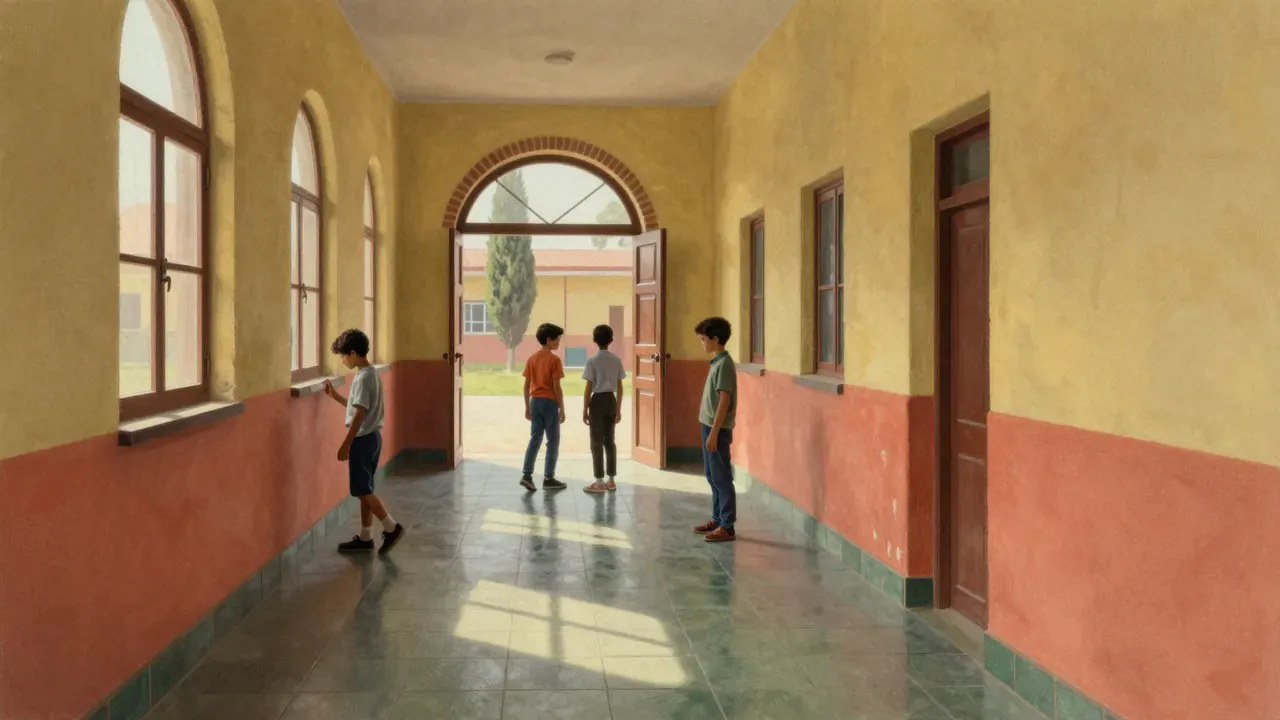
Breaktime (1972) is Abbas Kiarostami’s fourteen-minute observational drama, shot during an actual school break in Tehran. With no script, no score and no intervention, it records children’s unstructured movement and interaction in static, natural-light frames. Made early in his career for Kanun, it exemplifies his commitment to unvarnished presence over narrative artifice.

13:00

Brink of Life

Ingmar Bergman · 1958

Ingmar Bergman’s 1958 hospital drama observes three pregnant women — one miscarrying, one facing an unwanted pregnancy, one enduring a stillbirth — within the unadorned confines of a Swedish maternity ward. Shot with clinical precision by Max Wilén and written by Ulla Isaksson, it trades psychological exposition for procedural realism, letting silence, duration and restraint carry its moral weight.

13:00

Burden of Dreams

Les Blank · 1982

Les Blank’s 1982 documentary Burden of Dreams observes the gruelling, near-failed production of Werner Herzog’s Fitzcarraldo in the Peruvian jungle. Shot on location over several months, it captures exhaustion, ambition, and the jungle’s indifference — without narration, music, or editorial judgement. It remains a landmark of observational documentary craft.

13:00

Canal

Andrzej Wajda · 1957

Andrzej Wajda’s 1957 film Canal follows a group of Polish Home Army fighters and civilians retreating through Warsaw’s sewers during the final days of the 1944 uprising. Adapted by veteran Jerzy Stefan Stawiński and shot by Jerzy Lipman, it uses tight framing, low light, and minimal music to render exhaustion, disorientation, and the erosion of command. There are no speeches, no flashbacks, no explanations — only movement, hesitation, and collapse. It is a war film without battle scenes, a drama without catharsis, and a landmark of Polish cinema for its unflinching formal rigour.

13:00

Canoa: A Shameful Memory

Felipe Cazals · 1976

Felipe Cazals’s 1976 Mexican drama reconstructs the 1968 San Miguel Canoa massacre, where five university employees were lynched after a local priest branded them communists. Shot in documentary style in the actual town, with Alex Phillips Jr.’s restrained cinematography and Enrique Lucero’s chillingly calm performance as the priest, the film traces how fear, faith, and state rhetoric coalesce into mob violence — not as exception, but as logical outcome.

13:00

Capricious Summer

Jiří Menzel · 1968

Jiří Menzel’s 1968 Czechoslovak comedy follows three middle-aged men — a bathhouse owner, a retired artillery major and a local canon — over three rainy summer days at an abandoned resort. Their routines are disrupted by the arrival of a touring tightrope walker and his assistant, prompting a series of small, overlapping seductions, humiliations and quiet reconciliations. Shot in soft colour by Jaromír Šofr and performed with understated precision, the film treats desire, ageing and social ritual as weather systems — persistent, unpredictable, ultimately indifferent to individual will.

13:00

Carlos

Olivier Assayas · 2010

Olivier Assayas’s 2010 French drama Carlos traces the operational life of Ilich Ramírez Sánchez across three decades and multiple continents. Shot in English with multilingual dialogue, it avoids moral framing in favour of procedural fidelity: safe houses, intercepted signals, bureaucratic friction, and the slow decay of ideological certainty. Édgar Ramírez leads a large international cast; editing and cinematography privilege duration and texture over exposition. At 338 minutes, it demands sustained attention but repays it with historical granularity and structural rigour.

13:00

Carmen

Carlos Saura · 1983

Carlos Saura’s 1983 Carmen follows a troupe of dancers rehearsing a flamenco adaptation of Bizet’s opera, as their off-stage relationships mirror the opera’s fatal arc. Shot in Spain by Teodoro Escamilla and scored by Paco de Lucía, the film blurs rehearsal and reality, using movement and music — not dialogue — to trace obsession, rivalry and violence. It won the BAFTA for Best Film Not in the English Language and was nominated for an Oscar.

13:00

Carnival of Souls

Herk Harvey · 1962

Carnival of Souls (1962), directed by Herk Harvey, follows organist Mary Henry as her grip on reality loosens after a car accident. Shot on location in Kansas and Utah for $33,000, it uses stark black-and-white cinematography, Gene Moore’s eerie organ score, and deliberate pacing to build psychological unease. With no gore, few close-ups, and minimal dialogue, it relies on atmosphere, reflection, and liminal spaces — especially the derelict Saltair Pavilion — to evoke dislocation and ontological doubt. Though overlooked on release, it gained cult status for its formal rigour and sustained mood. The 84-minute director’s cut is considered definitive.

13:00

Cartesius

Roberto Rossellini · 1974

Roberto Rossellini’s 1974 biographical film Cartesius follows René Descartes’ intellectual discipline across 152 minutes of restrained, daylight-lit scenes. Starring Ugo Cardea and scored by Mario Nascimbene, it treats philosophy as embodied practice — writing, walking, pausing, revising — rather than as doctrine or drama. Produced by Renzo Rossellini, it belongs to Rossellini’s late pedagogical phase, prioritising method over myth.

13:00

Caught by the Tides

Jia Zhangke · 2024

Caught by the Tides is a 2024 Chinese drama directed by Jia Zhangke, constructed from footage shot between 1999 and 2024 — including material from Unknown Pleasures, Still Life, and Ash Is Purest White — and centred on Zhao Tao’s character Qiao Qiao across two decades of social and personal change. It premiered in competition for the Palme d’Or at Cannes.

13:00

Ceddo

Ousmane Sembène · 1977

Ousmane Sembène’s 1977 Ceddo is a Senegalese historical drama set in a pre-colonial West African village torn between animist tradition, Islam, Christianity, and the slave trade. When the ceddo — the outsiders — abduct the king’s daughter to protest forced conversion, the conflict escalates into violence, conversion, and regicide. Shot in French with Wolof cultural grammar, the film refuses exposition, moral simplification, or sentimental resolution. Its power lies in its formal rigour, political clarity, and unwavering centreing of African epistemic autonomy.

13:00

Celine and Julie Go Boating

Jacques Rivette · 1974

Jacques Rivette’s 1974 film follows two women who enter a looping, magical-realist narrative housed in a Paris mansion, gradually learning its rhythms and rewriting its ending. Built on repetition, collaboration and patient observation, it models fiction as a space to inhabit rather than interpret.

13:00

Certain Women

Kelly Reichardt · 2016

Kelly Reichardt’s 2016 triptych adapts three Maile Meloy stories set in Montana, following a lawyer, a builder’s wife and a ranch hand as they navigate quiet crises of agency, expectation and connection. Shot by Christopher Blauvelt and edited by Reichardt, it uses precise framing, location sound and deliberate pacing to explore how law, geography and gender shape ordinary lives — without exposition, score or resolution.

13:00

Chafed Elbows

Robert Downey Sr. · 1966

Robert Downey Sr.’s 1966 underground comedy Chafed Elbows uses still photography, post-dubbed dialogue, and radical role doubling to dismantle narrative cinema from within. Shot for $12,000, mostly on 35mm stills developed at Walgreens, it follows Walter Dinsmore’s hallucinatory day at the 1964 World’s Fair — a sequence of grotesque, satirical episodes held together by rhythm and repetition rather than logic. Though technically crude and structurally fractured, it remains a pivotal work of American experimental film: abrasive, intelligent, and deliberately unsustainable as entertainment.

13:00

Chan Is Missing

Wayne Wang · 1982

Wayne Wang’s 1982 debut is a black-and-white arthouse comedy-drama structured as a search for a missing Chinatown taxi broker. As two men interview locals, each offers a contradictory portrait of him — revealing not Chan, but the fractured, polyglot reality of Chinese American life. Shot on location with non-professionals, it privileges ambiguity over exposition, sound over subtitle, and absence over answer.

13:00

Children of Paradise

Marcel Carné · 1945

Marcel Carné’s 1945 French romantic drama, written by Jacques Prévert and shot under Nazi occupation, follows courtesan Garance and the four men — mime, actor, criminal, aristocrat — who love her in 1830s Paris. Its 190-minute span balances theatrical grandeur with psychological restraint, using deep-focus cinematography, meticulous production design, and Arletty’s commanding stillness to explore love as asymmetry, art as resistance, and performance as identity.

13:00

Chilly Scenes of Winter

Joan Micklin Silver · 1979

Joan Micklin Silver’s 1979 adaptation of Ann Beattie’s novel follows Charles Richardson, a Salt Lake City civil servant clinging to a failed relationship. Shot with quiet precision and performed with unshowy realism, it charts his slow, uneventful withdrawal from obsession — not through epiphany, but through accumulated small choices. Two versions exist: the original 1979 cut ends with reconciliation; the 1982 re-release concludes with quiet resignation. Neither offers catharsis. Both insist on the dignity of ordinary endurance.

13:00

Chimes at Midnight

Orson Welles · 1965

Orson Welles’s 1965 Chimes at Midnight condenses five Shakespeare plays into a stark, tactile drama centred on Sir John Falstaff and Prince Hal. Shot in Spain on a tight budget, it privileges physical presence and moral ambiguity over narrative fluency or sonic consistency. Its enduring power lies in Welles’s performance, Edmond Richard’s muted cinematography, and a vision of kingship as betrayal dressed as duty.

13:00

Choose Me

Alan Rudolph · 1984

Alan Rudolph’s Choose Me is a 1984 romantic comedy-drama set in a neon-lit Los Angeles bar, where a drifter, a bar owner, and a radio host orbit each other in a cycle of concealment and confession. Shot in three weeks on a modest budget, it favours mood and gesture over exposition, with performances that withhold as much as they reveal. Its themes—self-deception, persona, and urban isolation—are sustained through Jan Kiesser’s dusky cinematography and Phil Woods’ smoky score. Though structurally loose and emotionally elusive, it coheres as a singular, unhurried tone poem about choosing, again and again, without certainty.

13:00

Chop Shop

Ramin Bahrani · 2007

Chop Shop follows twelve-year-old Ale as he works, saves, and schemes in Willets Point, Queens — a scrap-metal district where auto repair shops double as homes and survival is measured in hubcaps, candy bars, and stolen DVDs. Directed by Ramin Bahrani with non-professional actors and handheld digital footage, it is a neorealist portrait of resourcefulness without recourse, ambition without infrastructure, and care without safety nets.

13:00

Christ Stopped at Eboli

Francesco Rosi · 1979

Francesco Rosi’s 1979 adaptation of Carlo Levi’s memoir follows a Turin intellectual exiled to rural Basilicata under Fascism. Shot on location in crumbling villages, it renders poverty, superstition and resilience without sentiment or exposition. Gian Maria Volonté plays Levi as observer first, healer second, and the film’s power lies in its patient, unsparing gaze—not on suffering, but on what power ignores.

13:00

Circus Angel

Albert Lamorisse · 1965

Albert Lamorisse’s 1965 Circus Angel follows a burglar who joins a travelling circus to evade arrest but continues stealing in his spare time, all while navigating its fragile community and tentative romance. Shot in France with a restrained, observational style, it uses fantasy not as spectacle but as a lens for ethical ambiguity and transient belonging. Though its loose structure and muted romance divide opinion, its visual cohesion and tonal discipline make it a distinctive, unhurried work of mid-century arthouse cinema.

13:00

Claire's Knee

Éric Rohmer · 1970

Éric Rohmer’s 1970 film follows diplomat Jérôme during a summer stay at Lake Annecy, where his interactions with two teenage girls — Laura and Claire — expose the gap between his stated principles and his unspoken desires. Shot in luminous colour by Néstor Almendros, the film unfolds through measured dialogue and subtle physical detail, treating moral life as a series of minor, reversible decisions. It is the fifth of Rohmer’s Six Moral Tales, and won the Louis Delluc Prize, the National Board of Review Award for Best Foreign Language Film, and the National Society of Film Critics Award for Best Film.

13:00

Clean, Shaven

Lodge Kerrigan · 1994

Lodge Kerrigan’s 1994 debut Clean, Shaven follows Peter Winter (Peter Greene), a man recently released from a psychiatric institution, as he navigates a hostile world while searching for his daughter. Shot on 16mm with fragmented editing, dissonant sound design and tightly constrained perspective, the film immerses the viewer in a subjective experience of schizophrenia — avoiding diagnosis, exposition or moral framing. Its power lies in sustained formal discipline, not plot resolution.

13:00

Cléo from 5 to 7

Agnès Varda · 1962

Agnès Varda’s 1962 French New Wave drama follows singer Cléo Victoire across 90 minutes of real time in Paris as she awaits biopsy results. Shot in natural light with minimal score, it centres Corinne Marchand’s physically precise performance and treats dread, identity, and connection as textures to be observed, not resolved. Structurally rigorous and emotionally unhurried, it remains a landmark of feminist, humanist filmmaking.

13:00

Cloud

Kiyoshi Kurosawa · 2024

A Japanese factory worker abandons his job to run an online resale business, only to be hunted down by disgruntled suppliers and customers after his operations expand and isolate him. When a former assistant intervenes violently, the survivor finds himself bound not to redemption but to deeper complicity — suggesting the system consumes even those who escape it.

13:00

Clouds of Sils Maria

Olivier Assayas · 2014

Olivier Assayas’s 2014 drama follows Juliette Binoche as an established actress cast opposite a young starlet in a revival of a play that made her famous two decades earlier. Shot on 35mm in Switzerland, Germany and Italy, it traces her psychological recalibration alongside her American assistant (Kristen Stewart) against the backdrop of the Alps and the Maloja Snake — both weather phenomenon and metaphor. The film explores performance, time, and shifting power between women, with restrained craft and deliberate ambiguity.

13:00

C'mon C'mon

Mike Mills · 2021

Mike Mills’ 2021 drama follows radio journalist Johnny (Joaquin Phoenix) as he temporarily cares for his nine-year-old nephew Jesse (Woody Norman) while his sister tends to her husband’s mental health crisis. Shot in black-and-white across multiple US cities, the film centres on quiet exchanges, authentic child interviews, and the slow recalibration of fractured family bonds — all held together by Robbie Ryan’s textured cinematography and a restrained Dessner score.

13:00

Code Unknown

Michael Haneke · 2000

Michael Haneke’s Code Unknown (2000) assembles intersecting lives in Paris, Romania and rural France through unedited long takes and strict perspective shifts. Juliette Binoche plays Anne, an actress whose professional command of emotion contrasts with her passivity amid real suffering — a neighbour’s screaming child, a deported homeless woman, her boyfriend’s war trauma. The film refuses exposition or resolution, using structure itself to examine translation, jurisdiction and silence as political conditions. Shot by Jürgen Jürges and edited by Prochaska, Hartusch and Muse, it sustains discomfort without catharsis.

13:00

Cold Water

Olivier Assayas · 1994

Olivier Assayas’s 1994 drama Cold Water follows two French teenagers—Christine and Gilles—as they flee unstable homes and converge at an all-night party in an abandoned country house. Set in the early 1970s and scored entirely with period American rock, the film immerses itself in the physicality of youth: smoke, sweat, vinyl crackle, and unspoken understanding. Shot by Denis Lenoir and edited by Luc Barnier, it favours duration and texture over exposition. Though its ending falters in abstraction, its middle section remains a masterclass in atmospheric storytelling—quietly political, deeply sensory, and resolutely unsentimental.

13:00

Colossal Youth

Pedro Costa · 2006

Pedro Costa’s 2006 Colossal Youth is a DV-shot, static-take meditation on ageing, memory and displacement in Lisbon’s Fontainhas district. Starring non-professional Cape Verdean residents — especially the 75-year-old Ventura — it blends documentary observation with scripted recitation, refusing narrative clarity in favour of durational presence. Shot in high-contrast interiors and stark new housing blocks, it explores the aftermath of Portugal’s Carnation Revolution through quiet encounters, repeated phrases and sustained silences.

13:00

Come on Children

Allan King · 1973

Allan King’s 1973 documentary observes Toronto teenagers living unsupervised on a rural Ontario farm for ten weeks. Filmed in early 1971 with no script, no narration beyond a brief opening statement, and no adult presence, it tracks their self-organisation, conflicts and quiet routines. Its power lies in sustained observation, not interpretation — a demanding, unsentimental portrait of adolescence as lived practice rather than developmental phase.

13:00

Compensation

Zeinabu irene Davis · 2000

Compensation is a 1999 independent film directed by Zeinabu irene Davis, telling parallel love stories—one in 1910 Chicago, the other in the 1990s—between deaf women and hearing men. Shot in black-and-white silent-film style for the past and with open captions for the present, it draws on Paul Laurence Dunbar’s 1906 poem and foregrounds ASL, Chicago’s geography, and the social realities of tuberculosis and AIDS. Restored in 4K by Criterion and UCLA, it premiered at Sundance 2000 and entered the National Film Registry in 2024.

13:00

Contempt

Jean-Luc Godard · 1963

Jean-Luc Godard’s 1963 Contempt adapts Moravia’s novel into a self-aware drama about a playwright whose marriage unravels during the fraught production of a film version of the Odyssey. Shot in Rome and Capri, it stars Brigitte Bardot and Michel Piccoli, with Fritz Lang playing himself. The film interrogates authorship, fidelity, and the commodification of art — using form, colour, and silence as its primary arguments.

13:00

Coup de Grâce

Volker Schlöndorff · 1976

Volker Schlöndorff’s 1976 Coup de Grâce, adapted from Marguerite Yourcenar’s novel and co-written by Margarethe von Trotta, relocates the story from Erich von Lhomond’s first-person account to Sophie von Reval’s silent, searching presence. Set in a Latvian chateau during the 1919 Freikorps campaign, it uses black-and-white cinematography, elliptical editing and muted performances to examine desire, trauma and ideological vacancy amid collapsing empires. Not a conventional war film, it holds violence at a distance and finds its force in omission, restraint and unresolved tension.

13:00

Coup de Torchon

Bertrand Tavernier · 1981

Bertrand Tavernier’s 1981 adaptation of Jim Thompson’s Pop. 1280 relocates the story to French West Africa in 1938, following a lethargic, humiliated police chief who begins murdering local figures to assert control. Starring Philippe Noiret and Isabelle Huppert, it is a satirical neo-noir dark comedy that treats violence as bureaucratic procedure and colonialism as ambient condition — dry, exact, and morally unflinching.

13:00

Crash

David Cronenberg · 1996

David Cronenberg’s 1996 adaptation of J.G. Ballard’s novel follows a television producer drawn into a subculture obsessed with the erotic potential of car crashes. Shot with clinical precision by Peter Suschitzky and scored with mechanical restraint by Howard Shore, the film treats trauma, technology and desire as interlocking systems — not metaphors, but conditions. Its performances are muted, its pacing deliberate, its conclusions withheld. It remains a polarising, formally exacting work of arthouse cinema.

13:00

Crazed Fruit

Kō Nakahira · 1956

Crazed Fruit (1956), directed by Kō Nakahira and written by Shintarō Ishihara, follows two brothers whose rivalry over a woman escalates to fatal violence on Japan’s summer coast. Stylised and restrained, it uses heat, water, and motor noise as narrative forces, avoiding psychology in favour of physical and rhythmic inevitability. Its power lies in what it omits: explanation, redemption, or moral framing.

13:00

Cría Cuervos

Carlos Saura · 1976

Cría Cuervos (1976), directed by Carlos Saura, follows eight-year-old Ana in the months after her father’s death and her mother’s earlier passing. Set in Madrid during the final days of Franco’s rule, the film moves through memory, fantasy and present-tense reality without clear demarcation. Ana Torrent’s performance anchors a study of childhood consciousness under pressure: guilt, care, silence and imagined agency all coexist in a large, quiet house. Teodoro Escamilla’s restrained cinematography and Federico Mompou’s sparse piano score deepen its atmosphere of suspended time. Though it won the Grand Prix at Cannes, its power lies not in pronouncement but in persistence — in what it refuses to name.

13:00

Crisis

Ingmar Bergman · 1946

Ingmar Bergman’s 1946 debut Crisis adapts a Danish radio play into a tightly plotted Swedish drama about an 18-year-old girl torn between her stern foster mother and her glamorous, compromised biological mother. Shot in studio-bound naturalism by Oscar Rosander, it traces Nelly’s journey from village innocence to urban disillusionment and back — not as psychological evolution but as a series of ethically weighted decisions. Its strength lies in structural rigour and moral specificity; its weakness in underdeveloped psychology and tonal uncertainty in the city sequences.

13:00

Cronos

Guillermo del Toro · 1992

Guillermo del Toro’s 1992 debut follows an elderly antique dealer who discovers a 460-year-old alchemical device that reverses ageing at the cost of bloodlust and physical decay. As he grapples with renewed youth, moral compromise, and encroaching monstrosity, a dying industrialist and his violent nephew pursue the device. Shot in Mexico in Spanish, the film balances gothic horror with Catholic solemnity and familial tenderness — all without recourse to exposition or excess.

13:00

Cruel Gun Story

Takumi Furukawa · 1964

Takumi Furukawa’s 1964 Cruel Gun Story follows ex-convict Joji Togawa as he leads a heist for a yakuza boss, only to be betrayed and drawn into escalating violence. Starring Joe Shishido and Chieko Matsubara, it is a tightly wound crime film grounded in moral exhaustion rather than glamour or catharsis — its power lies in its restraint, its downfall in its late departure from that discipline.

13:00

Cul-de-sac

Roman Polanski · 1966

Roman Polanski’s 1966 Cul-de-sac follows two injured American gangsters who take refuge in a remote Northumberland castle owned by a brittle Englishman and his French wife. Trapped by the tide and their own unraveling composure, the four characters enact a series of increasingly absurd rituals — a beachside wake, a forced dinner party, a futile escape attempt — until all pretence collapses. Shot on location at Lindisfarne Castle, the film uses geography, silence, and precise performance to explore alienation, failed masculinity, and the fragility of domestic order. It won the Golden Bear at Berlin in 1966.

13:00

Daddy Longlegs

Josh Safdie, Benny Safdie · 2009

Daddy Longlegs (2009) follows Lenny, a divorced Manhattan projectionist, during his annual two-week custody of his sons Sage and Frey. Shot on digital video with non-professional performers and minimal score, it observes his chaotic, often reckless parenting — from impromptu road trips to drugging the boys to avoid leaving them alone — without moral framing or psychological exposition. Directed by Josh and Benny Safdie and written by Benny Safdie and Ronald Bronstein, it is a rigorously unsentimental study of adult failure witnessed by children.

13:00

Dance, Girl, Dance

Dorothy Arzner · 1940

Dorothy Arzner’s 1940 RKO drama follows two dancers — a ballerina and a burlesque performer — navigating patronage, poverty, and prejudice in Depression-era America. Structured around contrasting performance worlds, it foregrounds labour over glamour, material constraint over romantic fantasy, and direct address over emotional exposition. Though commercially unsuccessful on release, its formal rigour and ethical clarity have secured its place as a landmark of early feminist cinema.

13:00

Danton

Andrzej Wajda · 1983

Andrzej Wajda’s 1983 Danton, starring Gérard Depardieu and Wojciech Pszoniak, dramatises the final weeks of Georges Danton during the Reign of Terror. Adapted from Stanisława Przybyszewska’s play, it avoids historical literalism in favour of stark political psychology — showing how revolutionary ideals curdle into bureaucratic violence. Shot in muted tones by Igor Luther, edited with deliberate gravity by Halina Prugar-Ketling, and scored sparingly by Jean Prodromidès, it rests on two towering, mutually corrosive performances. Though occasionally opaque in its plotting, its moral precision and formal restraint make it a defining arthouse drama of the Cold War era.

13:00

David Golder

Julien Duvivier · 1930

Julien Duvivier’s 1930 adaptation of Irène Némirovsky’s David Golder stars Harry Baur as a dying Jewish financier whose wealth cannot insulate him from betrayal or bodily failure. Shot by Georges Périnal with deliberate claustrophobia and scored sparingly by Walter Goehr, the film sustains moral and psychological pressure through performance, framing, and silence — not spectacle or sentiment. Its rigour is uncompromising: no catharsis, no exposition, no relief. A landmark of early French sound cinema and a precise study of transactional identity.

13:00

Day for Night

François Truffaut · 1973

François Truffaut’s 1973 film Day for Night chronicles the chaotic, tender, and stubbornly ordinary making of a forgettable melodrama. Shot in Nice on a repurposed Paris street set, it follows director Ferrand (Truffaut) and his international cast and crew through accidents, affairs, and technical hiccups. With Pierre-William Glenn’s unshowy cinematography and Georges Delerue’s restrained score, it privileges process over personality and collective resilience over individual revelation. It won the 1974 Academy Award for Best International Feature Film.

13:00

Day of Wrath

Carl Theodor Dreyer · 1943

Carl Theodor Dreyer’s 1943 Danish drama, set in 1623, follows Anne, a young woman married to an elderly pastor, as she navigates suspicion, forbidden desire and the violent logic of witch trials. Made under Nazi occupation, it uses extreme restraint—of movement, music, editing—to expose how authority, faith and family conspire to erase individual conscience.

13:00

Days of Being Wild

Wong Kar-wai · 1990

Wong Kar-wai’s 1990 romantic drama follows drifting young people in 1960 Hong Kong — a playboy searching for his birth mother, a ticket seller holding onto a lost moment, a policeman turning to the sea — bound not by plot but by shared unease. Christopher Doyle’s cinematography, Chan Ming-Diy’s score, and a cast including Leslie Cheung and Maggie Cheung build a world of suspended time and unfulfilled desire. It is the first in an informal trilogy, and the foundation of Wong’s singular style.

13:00

Days of Heaven

Terrence Malick · 1978

Terrence Malick’s 1978 period drama follows migrant workers in 1916 Texas who entangle themselves in deception and desire on a wealthy farmer’s estate. Shot almost entirely in magic hour by Néstor Almendros, it prioritises image and atmosphere over narrative exposition. Linda Manz’s improvised narration anchors its elliptical structure. Though commercially modest, it won the Academy Award for Best Cinematography and has since been canonised for its painterly realism and meditative pacing.

13:00

Dazed and Confused

Richard Linklater · 1993

Richard Linklater’s 1993 ensemble comedy follows a group of Texas teenagers on the last day of school in 1976. With no central plot or protagonist, it builds meaning through accumulation: hazing rituals, car cruises, pool-hall loitering, and overlapping conversations. Shot on location in Austin with an ensemble of then-unknown actors, it prioritises texture over narrative, using Lee Daniel’s naturalistic cinematography, Alan Silvestri’s diegetic-heavy score, and improvised performances to evoke adolescent stasis rather than growth. Though commercially muted on release, it has since become a defining cult film of the 1990s.

13:00

Dead Man

Jim Jarmusch · 1995

Dead Man (1995) is Jim Jarmusch’s monochrome acid western starring Johnny Depp as a fatally wounded accountant guided west by Gary Farmer’s enigmatic Native American spirit-guide Nobody. Shot by Robby Müller and scored by Neil Young, it rejects narrative convention in favour of ritual, silence, and poetic logic — foregrounding Indigenous epistemology, untranslated Cree and Blackfoot dialogue, and a vision of landscape as sentient participant. Though critically divisive on release, it has since been reassessed as a singular, austere meditation on mortality, colonialism, and perception.

13:00

Death by Hanging

Nagisa Ōshima · 1968

Nagisa Ōshima’s 1968 film follows the botched hanging of an ethnic Korean man known only as R. When he survives but loses his memory, prison officials attempt to reconstruct his past — and his guilt — through increasingly absurd re-enactments. Using Brechtian techniques, stark staging and deliberate artifice, the film interrogates the death penalty not as a moral question but as a mechanism of racial and political control.

13:00

Death of a Cyclist

Juan Antonio Bardem · 1955

Juan Antonio Bardem’s 1955 Spanish drama follows a wealthy married woman and her academic lover after they strike and abandon a cyclist. As guilt and paranoia fracture their relationship, the film maps the moral geography of Franco-era Madrid — contrasting bourgeois insulation with working-class reality through precise editing, restrained performances, and Alfredo Fraile’s stark cinematography. It won the FIPRESCI Prize at Cannes and remains a landmark of socially engaged arthouse cinema.

13:00

Deep Crimson

Arturo Ripstein · 1996

Arturo Ripstein’s 1996 Deep Crimson transposes the Lonely Hearts Killers’ crimes to Mexico, following Coral Fabre and Nicolás Estrella as their lonely-hearts scam hardens into serial murder. With no psychological exposition or moral framing, the film charts their descent through ritualised acts, understated performances, and a stark visual style. It won eight Ariel Awards and Sundance Honorable Mention, and was Mexico’s Oscar submission.

13:00

Demon Pond

Masahiro Shinoda · 1979

Masahiro Shinoda’s Demon Pond adapts Izumi Kyōka’s 1913 play into a formally rigorous Japanese fantasy. Set in 1930s rural Japan, it follows a schoolteacher caught in a village’s pact with a dragon god — a covenant enforced by daily bell-ringing. When drought drives the villagers to sacrifice the rumoured sorceress Yuri (Tamasaburo Bando, in a dual role), ritual fractures, unleashing flood and transformation. Shot by Masao Kosugi, scored by Isao Tomita with Moog-Debussy-Mussorgsky hybrids, and featuring optical composites by Nobuo Yajima, the film sustains a precise balance between kabuki abstraction and cinematic naturalism.

13:00

Desert Hearts

Donna Deitch · 1985

A 1985 romance set in 1959 Reno, Desert Hearts follows a reserved English professor who, while awaiting a divorce, falls in love with a free-spirited sculptor. Directed by Donna Deitch and adapted from Jane Rule’s novel, it treats lesbian desire with narrative gravity, visual restraint, and emotional authenticity — avoiding both sensationalism and didacticism. Its power lies in quiet accumulation: glances, silences, gestures — all anchored by Helen Shaver and Patricia Charbonneau’s restrained, deeply felt performances.

13:00

Désiré

Sacha Guitry · 1937

Sacha Guitry’s 1937 Désiré is a tightly wound Parisian comedy in which an actress’s growing fixation on her valet destabilises her relationship with a government minister. Set almost entirely in three interior spaces, it relies on precise dialogue, restrained performances — especially by Arletty and Jacqueline Delubac — and a still, observational camera. It explores class, service, and the erotic charge of being truly seen, without recourse to plot twists or moralising.

13:00

Desperate Living

John Waters · 1977

John Waters’ 1977 Desperate Living is the third and most formally controlled entry in his Trash Trilogy: a black comedy set in Mortville, a shantytown exile colony ruled by a fascist queen. Made without Divine and shot on scavenged sets in rural Maryland, it trades shock for sustained tone — using deadpan performances, flimsy production design, and bureaucratic absurdity to dissect power, gender, and class. Its cult status rests not on laughter, but on its unwavering commitment to a world where cruelty wears a clipboard and revolution smells of roasting pork.

13:00

Diamonds of the Night

Jan Němec · 1964

Jan Němec’s 1964 debut Diamonds of the Night follows two teenage boys fleeing a train to a concentration camp. With minimal dialogue and radical editing, it immerses the viewer in their physical and psychological disintegration—hunger, memory, hallucination and exhaustion rendered through stark cinematography, tactile sound design and restrained performances. Adapted from Arnošt Lustig’s autobiographical story, it avoids exposition in favour of embodied realism and surreal rupture. Its power lies in what it withholds as much as what it shows.

13:00

Diary of a Chambermaid

Luis Buñuel · 1964

Luis Buñuel’s 1964 Diary of a Chambermaid adapts Octave Mirbeau’s novel with Jean-Claude Carrière, following Jeanne Moreau’s Célestine as she navigates a decaying provincial household in late-1920s France. Rejecting surrealism for restrained realism, the film traces how power, prejudice and violence settle into routine — through glances, footwear, leaflets and wills. Roger Fellous’ cinematography treats interiors like crime scenes; Moreau’s performance hinges on withheld reaction. It ends not with justice but consolidation: the system endures, reshaped but intact.

13:00

Diary of a Country Priest

Robert Bresson · 1951

Robert Bresson’s 1951 adaptation of Georges Bernanos’ novel follows a young priest in rural France whose failing health, spiritual doubt, and isolation are rendered with stark formal discipline. Voice-over narration repeats on-screen action; performances are muted; light is flat and spaces are empty. It is less a story of faith than of vocation as daily, unglamorous labour — and grace as something given, not earned.

13:00

Dillinger Is Dead

Marco Ferreri · 1969

Marco Ferreri’s 1969 Italian drama follows Glauco — a gas-mask designer played by Michel Piccoli — over one night in his Milan apartment. He cooks, watches films, cleans a revolver found in a 1934 newspaper, seduces the maid, rehearses suicide, and finally kills his sleeping wife before fleeing to Tahiti as a yacht chef. Shot by Mario Vulpiani with clinical detachment and scored sparingly by Teo Usuelli, the film treats bourgeois comfort as a sealed, suffocating environment. It is arthouse cinema at its most austere: refusing psychology, satire, or resolution, it renders alienation not as theme but as physical law.

13:00

Dim Sum: A Little Bit of Heart

Wayne Wang · 1985

Dim Sum: A Little Bit of Heart (1985), directed by Wayne Wang, follows Julia, a Chinese immigrant widow in San Francisco, as she navigates the Lunar New Year amid a fortune-teller’s prediction of her death. With gentle precision, the film observes her efforts to arrange her daughter’s marriage and revisit China, all within the rhythms of family meals, mahjong games, and unspoken affection. Starring Cora Miao, Victor Wong, Joan Chen, and Amy Hill, it is a restrained, dialogue-driven drama grounded in behavioural realism and cultural specificity.

13:00

Divorce, Italian Style

Pietro Germi, Renzo Marignano · 1961

Divorce, Italian Style (1961) is a Sicilian black comedy in which an impoverished nobleman plots to murder his wife in order to claim leniency under Italy’s honour-killing statutes. Directed by Pietro Germi and written by Germi, Ennio de Concini, Alfredo Giannetti and Agenore Incrocci, it stars Marcello Mastroianni as Ferdinando Cefalù, whose elaborate scheme exposes the contradictions between law, religion and social expectation in pre-divorce Italy. The film won the Academy Award for Best Original Screenplay and remains a benchmark of satirical precision.

13:00

Do the Right Thing

Spike Lee · 1989

Set over one sweltering day in Bedford–Stuyvesant, Do the Right Thing follows residents of a Brooklyn block as racial tensions escalate around Sal’s pizzeria. Spike Lee’s script, direction and performance anchor a tightly composed ensemble piece whose visual intensity, rhythmic editing and layered sound design sustain pressure until a violent climax forces confrontation — not resolution. It is a film about proximity without understanding, labour without equity, and protest without guarantees.

13:00

Dodes'ka-den

Akira Kurosawa · 1970

Akira Kurosawa’s 1970 film is a mosaic of lives in a Tokyo shantytown, structured as overlapping vignettes rather than a linear narrative. With no central protagonist, it follows characters including a boy who imagines himself a trolley driver, a silversmith who aids thieves, and parents burdened by neglect and infidelity. Shot in colour for the first time by Kurosawa, with Takao Saito as cinematographer and Tōru Takemitsu scoring in restrained, percussive tones, the film insists on dignity without sentiment, endurance without triumph. Its 140-minute runtime unfolds with unhurried precision, asking the viewer to inhabit a world shaped by scarcity, imagination, and quiet reciprocity.

13:00

Don't Look Now

Nicolas Roeg · 1973

Don’t Look Now (1973), directed by Nicolas Roeg, follows a British couple in Venice after their daughter’s death. As John restores a church and Laura encounters clairvoyants, reality blurs: red coats recur, water rises, time folds. Shot by Roeg and Anthony B. Richmond, edited by Graeme Clifford, and scored by Pino Donaggio, it treats mourning as a perceptual disorder — not a story to resolve, but a condition to inhabit.

13:00

Don't Play Us Cheap

Melvin Van Peebles · 1973

Melvin Van Peebles’ 1973 musical film adapts his stage work into a vibrant, low-budget allegory: two demons infiltrate a Harlem birthday party to break it up, only to be undone by song, solidarity, and the unassailable groove of everyday Black life. Shot on location with a cast of stage veterans and non-professionals, it treats gospel, soul, and doo-wop as tools of social analysis — not backdrop. Its themes of communal resilience, class critique, and joy-as-resistance remain urgent, its form deliberately anti-spectacle.

13:00

Double Suicide

Masahiro Shinoda · 1969

Masahiro Shinoda’s Double Suicide adapts Chikamatsu’s 1721 puppet play into live action, preserving its theatrical grammar: kuroko in black manipulate the world around the lovers, sets remain deliberately artificial, and music by Tōru Takemitsu punctuates rather than soothes. Shima Iwashita plays both wife and courtesan, binding the film’s duality in performance. It is a rigorous, unsentimental study of obligation, debt, and the formal limits of agency — where suicide is not escape but the only sentence the world permits.

13:00

Double Suicide: Japanese Summer

Nagisa Ōshima · 1967

Double Suicide: Japanese Summer (1967), directed by Nagisa Ōshima, is a stark, symbol-laden drama in which a young woman named Nejiko is imprisoned by yakuza after witnessing them unearth buried weapons. Stylised rather than realistic, it uses theatrical roles (Televi, Oni, Omocha), flat lighting by Yasuhiro Yoshioka, and a dissonant score by Hikaru Hayashi to examine coercion, gendered control, and the banality of violence. With no exposition or psychological backstory, it relies on repetition, gesture, and spatial constraint to make ideology visible — not as idea, but as practice.

13:00

Down by Law

Jim Jarmusch · 1986

Jim Jarmusch’s 1986 black-and-white arthouse film follows three mismatched convicts — a radio DJ, a pimp, and an Italian immigrant — who escape from a New Orleans prison into the Louisiana bayou. With minimal plot, deliberate pacing, and Robby Müller’s stark cinematography, it foregrounds texture, silence, and the quiet evolution of trust over conventional narrative drive. Starring Tom Waits, John Lurie, and Roberto Benigni, it is a study in tonal precision, linguistic friction, and the unforced poetry of ordinary endurance.

13:00

Downhill Racer

Michael Ritchie · 1969

Michael Ritchie’s 1969 debut follows American downhill skier David Chappellet — played by Robert Redford — as he joins the U.S. Ski Team in Europe. Written by James Salter and shot on real World Cup courses, the film avoids sports-movie tropes: no training montages, no last-minute comebacks, no emotional breakthroughs. Instead, it observes Chappellet’s unyielding self-containment — his victories, silences, and failures — with clinical precision. Brian Probyn’s cinematography and Kenyon Hopkins’ sparse score reinforce its austere tone. It is less about skiing than about the cost of treating excellence as a solitary metric.

13:00

Downpour

Bahram Beyzai · 1972

Bahram Beyzai’s 1972 debut is a black-and-white Iranian drama following a teacher’s quiet integration into a provincial town. With restrained performances, sparse sound, and deliberate pacing, it traces his unspoken relationship with a student’s sister, his solitary renovation of a derelict school theatre, and his eventual transfer — all rendered without exposition or catharsis. Restored in 2011 after near-total loss, it remains a study in moral ambiguity, institutional silence, and the weight of unperformed expectation.

13:00

Dragnet Girl

Yasujirō Ozu · 1933

Yasujirō Ozu’s 1933 silent crime film Dragnet Girl follows Tokiko, girlfriend of a small-time gangster, as she slowly withdraws from complicity and steers both herself and him toward surrender. With restrained performances, unemphatic pacing, and Hideo Shigehara’s naturalistic cinematography, it treats moral change as incremental, not dramatic — a film less about breaking the law than about noticing the weight of a choice, a glance, a pause.

13:00

Dragon Gate Inn

King Hu · 1967

King Hu’s 1967 Dragon Gate Inn is a foundational wuxia film set in 15th-century Ming China, centred on a group of martial artists defending an exiled official’s family at a remote desert inn. Shot in Taiwan with Hua Hui-ying’s austere cinematography and edited by Chen Hung-min for rhythmic precision, it treats action as structural logic rather than flourish. Its themes—fidelity, jurisdiction, restraint—are enacted, not explained. Though lean in character depth and historical context, its formal control and spatial intelligence make it a benchmark of genre discipline.

13:00

Dreams

Akira Kurosawa, Ishirō Honda · 1990

Akira Kurosawa’s 1990 anthology film Dreams comprises eight vignettes drawn from his own recurring dreams. Shot in Japan with assistance from Steven Spielberg and George Lucas, it deploys rigorous formalism — saturated colour, symmetrical framing, long takes — to render emotional states rather than narratives. Starring Akira Terao, Martin Scorsese as Van Gogh, and Chishū Ryū, it explores childhood, mortality, ecology, and ritual without exposition or irony. Though structurally loose and uneven in impact, its best sequences achieve a rare fusion of painterly control and moral gravity.

13:00

Drive, He Said

Jack Nicholson · 1971

Jack Nicholson’s 1971 directorial debut, adapted from Jeremy Larner’s novel, follows a disillusioned college basketball star navigating affairs, draft anxiety, campus unrest, and a volatile roommate. Shot on location at the University of Oregon, it features committed performances from William Tepper, Karen Black, and Bruce Dern, with cinematography by Bill Butler and a sparse score by David Shire. Though critically divided and commercially obscure, it remains a singular artefact of early-70s American countercinema—uneven, urgent, and uninterested in tidy answers.

13:00

Drive My Car

Ryusuke Hamaguchi · 2021

Drive My Car (2021), directed by Ryusuke Hamaguchi, follows a Tokyo theatre director who, two years after his wife’s death, accepts a residency in Hiroshima to direct a multilingual production of Uncle Vanya — required to be chauffeured in his red Saab. With Hidetoshi Nishijima and Tōko Miura, and shot by Hidetoshi Shinomiya, it unfolds across 179 patient minutes, building meaning through repetition, silence, and the physicality of speech and listening.

13:00

Dry Summer

Metin Erksan · 1964

Metin Erksan’s 1964 Turkish drama Dry Summer follows tobacco farmer Osman, who dams a river to secure his harvest at the expense of neighbouring farmers. His younger brother Hasan reluctantly complies, then wavers; their conflict escalates legally and violently, entangling Hasan’s wife Bahar in a web of coercion, deception and retribution. Shot in stark black-and-white with minimal score and restrained performances, the film traces how property law, patriarchal control and ecological scarcity converge. It won the Golden Bear at Berlin and remains a landmark of socially engaged Turkish cinema.

13:00

Drylongso

Cauleen Smith · 1998

A 1998 Oakland-set drama following Pica Sullivan, a Black photography student documenting young men she fears are disappearing. Shot on 16mm, it balances intimate portraiture with ambient dread, treating safety, gender, and community as daily practices rather than plot points. Restored and re-released in 2023, it remains a precise, unsentimental portrait of ordinary resilience.

13:00

Early Spring

Yasujirō Ozu · 1956

Yasujirō Ozu’s 1956 drama follows a Tokyo salaryman whose affair with a colleague unravels his marriage not through melodrama but through accumulated silences, routine, and unspoken grief. Shot in restrained black and white, it replaces Ozu’s usual generational tensions with a study of white-collar disillusionment — quiet, precise, and anchored in the physical details of postwar Japanese domestic and office life.

13:00

Early Summer

Yasujirō Ozu · 1951

Yasujirō Ozu’s 1951 drama observes Noriko, a 28-year-old Tokyo secretary, as her extended family gently pressures her to marry — then watches, with quiet precision, as she chooses a path that fractures their domestic equilibrium. Set in Kamakura and rural Japan, the film traces the emotional residue of that choice through restrained performances, static compositions, and a structure built on absence and repetition rather than conflict or resolution.

13:00

Education

Steve McQueen · 2020

Steve McQueen’s Education (2020), the closing film of the Small Axe anthology, follows an 11-year-old Black boy in 1970s London subjected to an 'educationally subnormal' assessment — a real historical practice that disproportionately diverted Black children from mainstream schooling. Shot by Shabier Kirchner with deliberate stillness and no score, it focuses on procedural indifference rather than individual villainy. Based on documented inequities but using fictional characters, it builds its argument through accumulation, silence, and restraint.

13:00

Él

Luis Buñuel · 1953

Luis Buñuel’s 1953 Mexican drama Él follows Francisco, a bourgeois husband whose obsessive jealousy isolates and terrorises his wife Gloria. Adapted from Mercedes Pinto’s novel, the film uses rigorous realism — Gabriel Figueroa’s cinematography, restrained performances, and a tightly controlled structure — to dissect how paranoia functions not as breakdown but as coherent, socially reinforced logic. Its power lies in plausibility, not shock.

13:00

El Amor brujo

Carlos Saura · 1986

Carlos Saura’s 1986 El Amor brujo adapts Manuel de Falla’s ballet into a tightly wound flamenco drama starring Antonio Gades and Cristina Hoyos. Set in Andalusia, it follows Candela, haunted by her dead husband’s ghost, whose release requires a ritual dance with the woman he loved in life. Shot by Teodoro Escamilla and choreographed by María Pagès, the film subordinates narrative to rhythm, dialogue to zapateado, and psychology to physical repetition — making it less a ghost story than a study in embodied memory.

13:00

El Norte

Gregory Nava · 1983

A Guatemalan brother and sister flee civil war, cross Mexico, and enter the US undocumented. Their journey — from rural persecution to sewer-pipe crossing to precarious survival in Los Angeles — is rendered with procedural realism, sparse sound, and unflinching attention to labour, language, and loss. No score until the final scene. No resolution beyond recurrence.

13:00

Election

Alexander Payne · 1999

Alexander Payne’s 1999 black comedy follows a high school teacher’s attempt to sabotage an overachieving student’s bid for class president. Told through four intersecting voiceovers and shot on location in Omaha, it uses the mechanics of a student election to dissect ambition, resentment, and institutional failure — with Reese Witherspoon and Matthew Broderick delivering performances of unnerving clarity.

13:00

Elena and Her Men

Jean Renoir · 1956

Jean Renoir’s 1956 film follows a Polish princess in fin de siècle Paris whose romantic entanglements intersect with a general’s wavering ambition and a shoe magnate’s calculations. Shot in Paris studios and locations, with design by Jean André and music by Joseph Kosma, it treats politics as theatre and desire as strategy — light in tone, precise in execution, and deliberately unmoored from psychological realism.

13:00

Elevator to the Gallows

Louis Malle · 1958

Louis Malle’s 1958 debut follows two parallel failures: a meticulously planned murder undone by a forgotten rope, and a casual theft escalating to murder through chance and misreading. Shot in stark black-and-white by Henri Decaë and scored in a single improvised session by Miles Davis, it builds dread through duration, light and silence rather than exposition or climax. Jeanne Moreau’s breakthrough performance anchors a film less about guilt than about the physics of consequence.

13:00

Elvira Madigan

Bo Widerberg · 1967

Bo Widerberg’s 1967 Elvira Madigan retells the fatal romance of a Danish circus performer and a Swedish army officer as a study in sensory presence and quiet dissolution. Shot with natural light and minimal crew, it follows their summer-long flight through rural Denmark, using Mozart and Vivaldi as structural anchors and Jörgen Persson’s cinematography to render every blade of grass and drop of sweat with painterly precision. Its power lies in what it omits — exposition, judgement, aftermath — and in what it insists upon: the weight of a shared silence, the dignity of a final choice, and the beauty of a world seen, for ninety-one minutes, without hurry.

13:00

Empire of Passion

Nagisa Ōshima · 1978

Nagisa Ōshima’s 1978 French-Japanese co-production Empire of Passion adapts a novel by Itoko Nakamura into a stark, psychologically rigorous kaidan. Set in 1895 rural Japan, it follows Seki and Toyoji, whose affair leads to the murder of her husband — and the subsequent, inescapable haunting that follows. Shot by Yoshio Miyajima and scored by Tōru Takemitsu, the film rejects gothic ornament in favour of austere composition, deliberate pacing, and moral weight. It premiered at Cannes, where Ōshima won Best Director.

13:00

EO

Jerzy Skolimowski · 2022

Directed by Jerzy Skolimowski, EO follows a Polish circus donkey across fragmented episodes in Poland and Italy — from stable to forest to slaughterhouse — using six real donkeys and a rigorously observational style. Inspired by Bresson’s Au hasard Balthazar, it rejects anthropomorphism in favour of sustained, unsentimental attention to non-human presence, time and physicality. Shot by Michał Dymek, scored by Paweł Mykietyn and edited by Agnieszka Glińska, it premiered at Cannes 2022, winning the Jury Prize and twelve international awards including Best Cinematography and Best Composer.

13:00

Epidemic

Lars von Trier · 1987

Lars von Trier’s 1987 metafictional horror Epidemic follows two screenwriters drafting a script about a plague while a real outbreak begins to mirror their fiction. Shot on 16mm, structured across five days, and starring von Trier and Niels Vørsel as themselves, it treats narrative as a vector and authorship as contagion — the second instalment of the Europa trilogy.

13:00

Equinox Flower

Yasujirō Ozu · 1958

Equinox Flower (1958) is Yasujirō Ozu’s first colour feature—a domestic comedy tracing a Tokyo businessman’s reluctant acceptance of his daughter’s self-chosen marriage. Shot in Agfa colour, it observes generational friction through stillness, repetition, and muted reds, trusting the viewer to register change in posture, silence, and the movement of a teapot. Fujiko Yamamoto’s standout performance anchors a structure built on evasion and quiet reversal, not crisis or catharsis.

13:00

Europe '51

Roberto Rossellini · 1952

Roberto Rossellini’s 1952 film follows Irene Girard (Ingrid Bergman), an industrialist’s wife in post-war Rome, whose son’s death precipitates a radical commitment to helping others — a commitment that brings her into conflict with family, politics, medicine, the church and finally the asylum. Shot in austere black-and-white by Aldo Tonti, with a sparse score by Renzo Rossellini, the film treats compassion as a systemic challenge rather than a personal virtue.

13:00

Everlasting Moments

Jan Troell · 2008

Set in early-20th-century Malmö, Everlasting Moments follows Maria Larsson, a Finnish immigrant who wins a camera in a lottery and begins taking photographs — of her children, the dead, monarchs — as a slow, unspoken assertion of self. Directed by Jan Troell with deliberate, grainy 16 mm imagery and restrained performances, it treats time, class and visibility as physical presences, not abstractions. Based loosely on a true story, it avoids biography in favour of accumulated detail, finding resonance in silence, gesture and the chemical patience of early photography.

13:00

Every Man for Himself

Jean-Luc Godard · 1980

Every Man for Himself (1980) is Jean-Luc Godard’s rigorously structured drama, composed in four parts like a musical work. Following three protagonists — a filmmaker, a journalist, and a sex worker — across intersecting lives in Switzerland, it examines alienation, commodification, and the erosion of time and intimacy under capitalism. Shot by Renato Berta and William Lubtchansky, edited by Godard himself, and scored by Gabriel Yared, it employs deliberate decelerations, sparse dialogue, and the recurring aria Suicidio! as structural motif. Nathalie Baye won the César Award for Best Supporting Actress.

13:00

Every-Night Dreams

Mikio Naruse · 1933

Mikio Naruse’s 1933 silent drama follows Omitsu, a bar hostess in depression-era Yokohama, as she navigates poverty, abandonment, and moral compromise to protect her young son. With Sumiko Kurishima in a performance of extraordinary restraint, the film traces how economic precarity reshapes love, duty, and selfhood — not through grand tragedy, but through accumulated, quiet concessions.

13:00

Eve's Bayou

Kasi Lemmons · 1997

Set in 1962 Louisiana, Eve’s Bayou follows ten-year-old Eve Batiste as she witnesses fractures in her prosperous Creole-American family — infidelity, silence, spiritual inheritance — without the language or authority to name them. Kasi Lemmons’ debut sustains a mood of suspended dread and quiet revelation, anchored by Jurnee Smollett’s restrained performance and Amy Vincent’s humid, intimate cinematography. It treats memory, mysticism, and moral ambiguity not as devices but as conditions of being.

13:00

Evil Does Not Exist

Ryusuke Hamaguchi · 2023

Ryusuke Hamaguchi’s 2023 drama follows Takumi, a widower living with his daughter in a remote Japanese mountain village, as residents confront a proposed glamping development. Shot on natural light with grainy texture and scored sparingly by Eiko Ishibashi, the film builds tension through procedural realism—community meetings, hydrological concerns, quiet labour—before pivoting to an ambiguous, visceral climax. It won the Grand Jury Prize and FIPRESCI Award at Venice and Best Film at the BFI London Film Festival.

13:00

Exotica

Atom Egoyan · 1994

Atom Egoyan’s 1994 Canadian drama Exotica unfolds in and around a Toronto strip club, tracing the restrained, overlapping lives of a grieving tax auditor, a dancer, a club owner, and a bird smuggler. Structured like a striptease — withholding, then revealing — it treats the club as ritual space rather than spectacle, using Paul Sarossy’s precise cinematography, Mychael Danna’s layered score, and Susan Shipton’s deliberate editing to explore how trauma reshapes memory, time, and connection. It won Best Canadian Film at TIFF and the Genie for Best Picture.

13:00

Eyes Without a Face

Georges Franju, Claude Sautet · 1960

Eyes Without a Face (1960) is a French arthouse horror film directed by Georges Franju, following a plastic surgeon who kidnaps women to graft their faces onto his disfigured daughter. Shot by Eugen Schüfftan and scored by Maurice Jarre, it sustains a tone of poetic anguish rather than visceral terror. Its restrained performances, deliberate pacing, and clinical visuals have earned it retrospective acclaim as a landmark of moral and aesthetic horror.

13:00

Eyimofe

Arie Esiri, Chuko Esiri · 2020

Eyimofe (2020), co-directed by Arie and Chuko Esiri, follows two Lagos residents — a printer and a hairdresser — each pursuing migration to Europe. Shot on 16mm across 48 Lagos locations, it unfolds in two chapters (Spain and Italy) without voiceover or score, relying on performance, texture, and duration to trace how economic and familial pressures reshape ordinary lives. It premiered at Berlin, London, Toronto and 15 other international festivals, earning a 100% Rotten Tomatoes score and praise for its quiet, unsentimental realism.

13:00

Fallen Angels

Wong Kar-wai · 1995

Wong Kar-wai’s 1995 Hong Kong drama Fallen Angels unfolds across two parallel, nocturnal storylines: a hitman seeking autonomy and a mute ex-convict drifting through repetition. Shot entirely at night by Christopher Doyle with extreme wide-angle lenses, it privileges atmosphere over exposition, using voiceover, pop music, and visual distortion to render urban alienation as physical fact. Though structurally loose and emotionally restrained, its sensory consistency and precise articulation of loneliness make it a defining arthouse work of the 1990s.

13:00

Farewell Amor

Ekwa Msangi · 2020

Farewell Amor follows an Angolan family reuniting in Brooklyn after a 17-year separation. Told in three interwoven chapters — from the perspectives of father Walter, mother Esther, and teenage daughter Sylvia — the film observes their tentative, often wordless reconnection in a cramped apartment. Directed by Ekwa Msangi, it prioritises behavioural detail over exposition, using subtle performance, naturalistic lighting, and precise editing to explore migration, memory, and the quiet labour of rebuilding intimacy.

13:00

Farewell My Concubine

Chen Kaige · 1993

Farewell My Concubine follows two Peking opera performers across five decades of Chinese history. Their artistic partnership and fraught personal bond are tested by war, revolution, and ideological purges. Directed by Chen Kaige and starring Leslie Cheung, Zhang Fengyi, and Gong Li, it uses the formal rigour of opera as both subject and structure — tracing how discipline, repetition, and gesture sustain and ultimately shatter the self.

13:00

Fat Girl

Catherine Breillat · 2001

Catherine Breillat’s 2001 drama follows twelve-year-old Anaïs and her fifteen-year-old sister Elena over a summer holiday in Les Mathes. Through precise, unsentimental staging and restrained performances, the film charts their divergent encounters with desire, bodily autonomy, and adult indifference. Its power lies in accumulation — not shock — as small exclusions build toward inevitable rupture. Controversial on release for its frank depiction of teenage sexuality and coercion, it remains a rigorous, unsettling examination of epistemic injustice in the domestic sphere.

13:00

Fear and Loathing in Las Vegas

Terry Gilliam · 1998

Terry Gilliam’s 1998 adaptation of Hunter S. Thompson’s Fear and Loathing in Las Vegas commits fully to the novel’s hallucinatory logic and period specificity. Starring Johnny Depp and Benicio del Toro as Raoul Duke and Dr. Gonzo, it charts their chemically accelerated descent through Las Vegas in 1971 — less a story than a sensory and moral autopsy of a fraying American dream. The film’s craft serves immersion over clarity, its themes revolve around eroded reality and institutional decay, and its value lies in fidelity, not comfort.

13:00

Female Trouble

John Waters · 1974

John Waters’ 1974 comedy Female Trouble follows Divine as Dawn Davenport, a Baltimore delinquent whose life escalates from expulsion and teen pregnancy to criminal stardom and execution — all staged with deadpan precision, handmade production design, and zero psychological compromise. Shot on 16mm in Baltimore for $25,000, it treats celebrity, punishment, and beauty as interchangeable currencies in a world governed by spectacle, not sense.

13:00

Fighting Elegy

Seijun Suzuki · 1966

Seijun Suzuki’s 1966 drama follows Kiroku Nanbu, a Catholic teen in pre-war Japan whose sexual repression and institutional alienation spiral into ritualised violence and, finally, political extremism. Adapted by Kaneto Shindō from Takashi Suzuki’s novel, the film uses stark black-and-white imagery, abrupt editing and physical performance to chart a psyche collapsing under the weight of unspoken longing and enforced discipline.

13:00

Fires on the Plain

Kon Ichikawa · 1959

Kon Ichikawa’s 1959 adaptation of Shōhei Ōoka’s novel follows a tubercular Japanese private abandoned on Leyte in late 1944. Shot in stark black-and-white, it traces his physical and moral dissolution amid starvation, disease and escalating atrocity—not as drama, but as inexorable attrition. With minimal dialogue, sparse music and unflinching realism, it asks what remains of personhood when every boundary—bodily, ethical, linguistic—has been breached.

13:00

Fish Tank

Andrea Arnold · 2009

Andrea Arnold’s 2009 drama follows Mia, a volatile 15-year-old on a London council estate, as she navigates neglect, burgeoning desire and fleeting connection with her mother’s boyfriend. Shot on location in Tilbury with non-professional lead Katie Jarvis, it uses natural light, diegetic music and chronological structure to sustain an unflinching, physically precise portrait of adolescence shaped by class and silence.

13:00

Fists in the Pocket

Marco Bellocchio · 1965

Marco Bellocchio’s 1965 debut is a stark, black-and-white drama about a young epileptic man who plots to kill his dysfunctional family. Set in a provincial Italian villa, it uses rigorous composition, sparse sound, and restrained performances to explore inheritance, enclosure, and moral inertia — not as ideas, but as lived conditions.

13:00

Five Easy Pieces

Bob Rafelson · 1970

Bob Rafelson’s 1970 drama follows Jack Nicholson as Bobby Dupea, a former piano prodigy working on an oil rig in California, who abandons his rootless life to visit his ailing, estranged father in Washington. Accompanied by his girlfriend Rayette (Karen Black), he re-enters the cultured, musically rigorous world he fled — confronting his siblings, his brother’s fiancée, and the unspoken reasons for his departure. László Kovács’ naturalistic cinematography and Carole Eastman and Rafelson’s sparse script anchor the film in behavioural realism, treating class, alienation, and self-erasure as physical facts rather than abstractions.

13:00

Flesh for Frankenstein

Paul Morrissey, Antonio Margheriti, Andy Warhol · 1973

Flesh for Frankenstein (1973) is a Paul Morrissey-directed body horror film shot in Rome, starring Udo Kier as a Serbian-obsessed Baron who constructs living specimens from corpses. Its deadpan satire targets eugenics, authoritarianism and sexual repression through grotesque, tactile set-pieces and stilted dialogue. Though credited to Warhol and Margheriti, Morrissey shaped its vision, aided by Luigi Kuveiller’s flat, theatrical cinematography and Claudio Gizzi’s jagged score. It is neither pure parody nor sincere horror, but a conceptual object that demands attention to texture, logic and failure.

13:00

Floating Weeds

Yasujirō Ozu · 1959

Yasujirō Ozu’s 1959 colour remake of his 1934 silent film follows a fading kabuki troupe and its lead actor, Komajuro, as he revisits his former mistress and their adult son — whose paternity has been concealed. Set over one summer in Wakayama, the film unfolds with Ozu’s signature stillness: low angles, spare dialogue, and compositions that treat laundry lines and empty corridors as emotional anchors. Kazuo Miyagawa’s cinematography uses muted colour deliberately; Toshiro Mayuzumi’s score is near-absent. Its power lies in restraint — in what is withheld, repeated, or left unresolved.

13:00

Forty Guns

Samuel Fuller · 1957

Samuel Fuller’s 1957 Forty Guns is a lean, black-and-white Western filmed in CinemaScope, starring Barbara Stanwyck as Jessica Drummond, a landowner who rules Tombstone with forty hired guns. Griff Bonnell (Barry Sullivan) arrives to enforce federal law, not settle scores — and finds himself negotiating not with outlaws but with systems: debt, inheritance, jurisdiction. Fuller’s direction is precise, Joseph F. Biroc’s cinematography exploits width for irony not spectacle, and the film’s moral architecture refuses easy binaries. It is less about taming the frontier than transferring authority — from family to state, from whip to warrant.

13:00

Fox and His Friends

Rainer Werner Fassbinder · 1975

Rainer Werner Fassbinder’s 1975 drama follows Franz ‘Fox’ Bieberkopf, a working-class gay man who wins the lottery and enters the orbit of Eugen, the elegant, calculating son of an industrialist. As Fox funds Eugen’s failing business and lifestyle, his generosity is absorbed, his manners corrected, his autonomy erased — until he is discarded, penniless and alone. Shot by Michael Ballhaus and scored by Peer Raben, the film treats affection as a commodity with expiry dates, and class as a grammar no amount of love can rewrite.

13:00

Frances Ha

Noah Baumbach · 2012

Frances Ha (2012) follows Frances, a 27-year-old dancer in New York, as her career stalls and her closest friendship frays. Shot in black-and-white on consumer-grade equipment, it favours observational detail over plot, using Gerwig’s performance and Baumbach’s direction to chart emotional shifts across apartments, cities and roles — from Brooklyn to Sacramento to Paris to Washington Heights. Its themes centre on friendship as infrastructure, class as daily friction, and identity as something folded, not fixed.

13:00

French Cancan

Jean Renoir · 1955

Jean Renoir’s 1955 French Cancan follows nightclub owner Henri Danglard as he transforms a Montmartre dance hall into the Moulin Rouge, betting everything on the revival of the cancan. Starring Jean Gabin and Françoise Arnoul, it is a musical comedy-drama less concerned with plot than with the textures of creation: rehearsal, construction, rivalry, and collective euphoria. Shot in colour at Joinville Studios with art direction by Max Douy and cinematography by Michel Kelber, it evokes Impressionist painting without imitation. Though uneven in emotional payoff, it remains a singular testament to Renoir’s belief in cinema as a space for presence, not just meaning.

13:00

From the Life of the Marionettes

Ingmar Bergman · 1980

Ingmar Bergman’s 1980 German-language television film reimagines the troubled couple from Scenes from a Marriage as Peter and Katarina Egermann, a Munich-based pair whose emotional disintegration culminates in Peter’s murder of a prostitute. Shot in black and white by Sven Nykvist, with a dissonant score by Rolf Alexander Wilhelm, the film unfolds through clinical interrogations and restrained performances. It is less a crime drama than a psychological case study — austere, unsentimental, and formally exacting.

13:00

Frownland

Ronald Bronstein · 2007

Ronald Bronstein’s 2007 debut follows Keith, a socially overwhelmed door-to-door salesman in New York, over three days of escalating disconnection. Shot on a minimal crew and budget, it uses relentless close-ups, fragmented editing, and Dore Mann’s physically exacting performance to immerse the viewer in sustained psychological exposure—without exposition, score, or narrative relief.

13:00

Funny Games

Michael Haneke · 1997

Michael Haneke’s 1997 Austrian drama Funny Games uses the skeleton of a home-invasion thriller to dissect how cinema conditions viewers to tolerate, anticipate and even desire violence. With clinical precision, static camerawork and metafictional interruptions, it implicates the spectator in its own brutality — not through gore, but through duration, expectation and refusal.

13:00

Gate of Flesh

Seijun Suzuki · 1964

Seijun Suzuki’s 1964 Nikkatsu drama follows a group of sex workers enforcing rigid communal rules in a bombed-out Tokyo building. When a wounded ex-soldier arrives, their fragile order fractures. Shot on a rushed schedule with deliberately artificial sets, the film uses formal restraint and allegorical structure to critique the continuity of militarised social control under Occupation. Performances are muted, editing jarring, and the ending offers no resolution — only repetition.

13:00

George Washington

David Gordon Green · 2000

David Gordon Green’s 2000 debut is a slow, sun-baked coming-of-age drama set in a decaying North Carolina town. Following a group of preteens — including a boy whose skull never hardened — it traces the aftermath of an accidental death not through plot, but through lingering glances, ambient sound, and Tim Orr’s grain-heavy cinematography. Made for $42,000 with local non-actors, it trades exposition for texture, and resolution for resonance.

13:00

Germany, Year Zero

Roberto Rossellini · 1948

Roberto Rossellini’s 1948 drama follows twelve-year-old Edmund Köhler in ruined Berlin, where hunger, ideological debris, and adult failure converge on a single child’s conscience. Shot partly on location and partly in Rome studios, it uses non-professional actors and restrained craft to trace a quiet, logical descent into moral collapse — ending not with outcry, but with silence and a jump from rubble.

13:00

Gertrud

Carl Theodor Dreyer · 1964

Carl Theodor Dreyer’s final film, Gertrud (1964), adapts Hjalmar Söderberg’s 1906 play into a rigorous, dialogue-driven drama about a woman who chooses absolute fidelity to her idea of love over every form of compromise. Shot in static, prolonged takes, with minimal music and muted visuals, it follows Gertrud Kanning from marital rupture through successive failed attachments to a solitary, unrepentant old age. Its power lies in its refusal to dramatise or explain—only to present, hold, and trust the viewer to attend.

13:00

Gervaise

René Clément · 1956

René Clément’s 1956 Gervaise adapts Émile Zola’s L’Assommoir with forensic restraint, following Maria Schell’s laundress through a decade of incremental collapse in mid-nineteenth-century Paris. Shot by Robert Juillard and scored sparingly by Georges Auric, it locates tragedy not in grand gestures but in the weight of wet linen, the silence after a slammed door, the slow emptying of a shopfront. Its power lies in accumulation, not revelation.

13:00

Ghost Dog: The Way of the Samurai

Jim Jarmusch · 1999

Ghost Dog: The Way of the Samurai (1999) follows a Black hitman in New Jersey who lives by the samurai code of Hagakure while working for an Italian-American crime family. Directed by Jim Jarmusch and scored by RZA, it unfolds with deliberate stillness, using Robby Müller’s restrained cinematography and Forest Whitaker’s physically precise performance to sustain a world where ritual, silence, and cross-cultural synthesis are structural facts, not themes to be explained.

13:00

Ghost World

Terry Zwigoff · 2001

Ghost World (2001), directed by Terry Zwigoff and co-written with Daniel Clowes, follows Enid and Rebecca through the hollow summer after high school. Shot by Affonso Beato with deliberate oversaturation and lingering takes, it renders adolescent disaffection as structural fact rather than passing mood. Thora Birch’s performance anchors a film that values silence over exposition, texture over plot, and ambiguity over resolution.

13:00

Girlfight

Karyn Kusama · 2000

Girlfight (2000), Karyn Kusama’s debut, follows Diana Guzman, a Brooklyn teenager who takes up boxing to channel her rage and claim autonomy in a hostile environment. Shot in 24 days on a $1 million budget, it stars Michelle Rodriguez in her first role, trained rigorously at Gleason’s Gym. The film avoids sports-movie clichés, focusing instead on physical discipline, gendered constraint, and quiet, hard-won agency. It won Sundance’s Grand Jury and Directing Prizes, and remains a benchmark for grounded, unsentimental female-led drama.

13:00

Girlfriends

Claudia Weill · 1978

Claudia Weill’s 1978 debut follows Susan Weinblatt, a Jewish photographer in Manhattan, as her life shifts after her best friend and roommate moves out to marry. Shot over a year on a shoestring budget, the film traces Susan’s struggles with freelance work, romantic missteps, and the slow build toward her first gallery show — all rendered with documentary-like precision, naturalistic performances, and a refusal to resolve its central tensions. It won the Toronto People’s Choice Award and was named one of the National Board of Review’s Top Ten Films of 1978.

13:00

Girls of the Night

Kinuyo Tanaka · 1961

Kinuyo Tanaka’s 1961 drama follows Kuniko, a woman repeatedly released from a reformatory after Japan’s Prostitution Prevention Law, as she seeks work and dignity across domestic service, factory labour, and horticulture — only to be rejected each time her history becomes known. With Chisako Hara in a performance of quiet endurance, and Asakazu Nakai’s unadorned cinematography, the film charts the quiet mechanics of social exclusion, not as cruelty but as routine. It ends not with resolution but relocation: Kuniko working as an ama in Bōsō.

13:00

Godland

Hlynur Pálmason · 2022

Set in late-19th-century Iceland, Godland follows a Danish priest sent to build a church in a remote settlement. His inability to speak Icelandic, his failing health, and the indifference of the land gradually dismantle his authority and certainty. Shot in stark wet-plate-inspired visuals, the film renders colonial encounter as slow sensory erosion — of language, theology, and bodily endurance — rather than political confrontation.

13:00

Gods of the Plague

Rainer Werner Fassbinder, Michael Fengler · 1969

Gods of the Plague is Rainer Werner Fassbinder’s 1970 black-and-white drama, co-directed with Michael Fengler and shot in Munich and Dingolfing. It follows ex-convict Franz Walsch as he re-enters Munich’s criminal underworld, navigating ambiguous relationships with two women and a friend implicated in his brother’s death. Stylised through static compositions, minimal dialogue, and high-contrast monochrome cinematography by Dietrich Lohmann, the film treats noir not as genre but as structure to be exposed and exhausted. Its themes centre on mediated identity, erotic ambiguity, and the futility of narrative resolution. Though critically respected for its formal control and ensemble discipline, its austerity makes it demanding — rewarding for those attuned to Fassbinder’s early methods, less so for viewers seeking emotional or narrative engagement.

13:00

Godzilla vs. Hedorah

Yoshimitsu Banno · 1971

Godzilla vs. Hedorah (1971), directed by Yoshimitsu Banno, recasts Godzilla as an ecological corrector confronting Hedorah — a monster born from industrial pollution. Shot in 35 days on a tight budget, it blends live action, animation, and stop-motion to deliver a blunt, child-facing warning about smog, acid rain, and systemic toxicity. Though criticised on release for tonal inconsistency and the infamous flying-Godzilla sequence, it has since gained stature as a singular, ideologically committed entry in the franchise — less entertainment than intervention.

13:00

Gomorrah

Matteo Garrone · 2008

Matteo Garrone’s 2008 film adapts Roberto Saviano’s non-fiction book into a five-thread portrait of the Camorra’s reach across Naples and Caserta. It follows a timid middleman, a teenage recruit, a waste-management graduate, a tailor, and two deluded wannabes — none heroic, none redeemed. Shot with documentary restraint by Marco Onorato and edited without flourish by Marco Spoletini, it treats crime as infrastructure: logistical, banal, and woven into fashion, toxic dumping, and housing estates. It won the Cannes Grand Prix and seven David di Donatello awards.

13:00

Good Morning

Yasujirō Ozu · 1959

Yasujirō Ozu’s 1959 colour comedy follows two brothers who stop speaking to protest their parents’ refusal to buy a television. Set in a Tokyo suburb, the film traces how their silence ripples through the neighbourhood, exposing the fragility of gossip, the labour of politeness, and the quiet absurdity of adult consensus — all observed with Ozu’s characteristic stillness and dry precision.

13:00

Graduation

Cristian Mungiu · 2016

A Transylvanian doctor tries to fix his daughter’s exam results after she is assaulted, triggering a slow collapse of professional, marital and paternal certainties. Directed by Cristian Mungiu, the film observes moral compromise as a series of quiet, irreversible steps — not grand betrayals, but small accommodations made in the name of love, duty, or survival.

13:00

Grey Gardens

Albert Maysles, David Maysles, Ellen Horde · 1975

A 1975 direct-cinema documentary by Albert and David Maysles, Ellen Hovde and Muffie Meyer, Grey Gardens observes Edith ‘Big Edie’ Beale and her daughter ‘Little Edie’ Bouvier Beale in their decaying East Hampton home. Filmed over several months in 1974, it offers no narration, no external context, and no judgment — only sustained, intimate observation of two women performing dignity amid squalor, memory amid decay, and selfhood amid erasure.

13:00

Gummo

Harmony Korine · 1997

Harmony Korine’s 1997 debut is an experimental collage of life in a tornado-ravaged Midwestern town, shot in Nashville with non-actors, fragmented formats, and zero narrative scaffolding. It privileges texture over story, presence over psychology, and ambiguity over judgment — landing as a singular, abrasive, and deeply felt portrait of adolescence and poverty on the American periphery.

13:00

Hamlet

Laurence Olivier · 1948

Laurence Olivier’s 1948 Hamlet is a tightly focused, black-and-white adaptation that cuts over half the play to centre Hamlet’s paralysed will and moral uncertainty. Shot by Desmond Dickinson with deep focus and scored by William Walton, it uses sound design, editing, and performance to render interiority as physical fact. Though controversial among purists for its omissions — including Fortinbras and Rosencrantz and Guildenstern — it won Best Picture and Best Actor at the 1949 Oscars, and remains a landmark of Shakespearean cinema for its formal rigour and psychological intensity.

13:00

Hands Over the City

Francesco Rosi · 1963

Francesco Rosi’s 1963 Golden Lion winner follows Neapolitan developer and councillor Edoardo Nottola as he leverages public office for private real-estate gain—until a building collapse triggers an official inquiry. Shot in stark, observational style by Gianni Di Venanzo and written with journalistic rigour, the film avoids psychology and spectacle in favour of committee rooms, permits, and quiet complicity. Rod Steiger and Carlo Fermariello anchor a cast that includes non-professionals, reinforcing its documentary texture. It is a film about how power consolidates not in crises but in paperwork.

13:00

Happy Together

Wong Kar-wai · 1997

Happy Together (1997) follows two Hong Kong men whose turbulent relationship fractures during a trip to Argentina. Directed by Wong Kar-wai and shot by Christopher Doyle, it uses saturated, grainy imagery, South American music, and elliptical structure to explore memory, displacement, and the quiet aftermath of love. Tony Leung and Leslie Cheung anchor the film with restrained, physically precise performances. It is less a story about reconciliation than about learning to live alongside absence.

13:00

Harakiri

Masaki Kobayashi · 1962

Masaki Kobayashi’s 1962 jidaigeki follows rōnin Tsugumo Hanshirō as he requests seppuku at the Iyi clan’s estate — not to die, but to force a reckoning with their hypocrisy. Through precise framing, restrained performance, and a narrative structured like a legal deposition, the film exposes how bushido functions as bureaucratic cover for cruelty. Tatsuya Nakadai anchors the film with implacable gravity; Yoshio Miyajima’s cinematography and Tōru Takemitsu’s score deepen its moral austerity. It remains a landmark of ethical cinema, less concerned with honour than with who bears the cost when honour becomes theatre.

13:00

Harold and Maude

Hal Ashby · 1971

Hal Ashby’s 1971 film follows Harold Chasen, a young man obsessed with staging his own death, and Maude, a 79-year-old woman who lives with irreverent joy in a railroad car. Their relationship unfolds across San Francisco locations — cemeteries, ruins, hospitals, and highways — to a soundtrack by Cat Stevens. Written by Colin Higgins, it balances black comedy, romance, and existential reflection without resolving its central tension. Initially unsuccessful, it gained cult status and was preserved in the National Film Registry in 1997.

13:00

Head

Bob Rafelson · 1968

A 1968 satirical musical directed by Bob Rafelson and written by Jack Nicholson, Head uses The Monkees as raw material to dissect celebrity, media construction, and narrative coherence. With non-linear editing, meta-commentary, and deliberate tonal rupture, it rejects conventional storytelling in favour of structural critique — exposing how pop culture manufactures meaning by assembling fragments. Shot across Los Angeles, Palm Springs, Alaska, and The Bahamas, its craft serves its argument: every cut, lyric, and cameo functions as evidence in a case against authorship, authenticity, and audience expectation.

13:00

Heaven's Gate

Michael Cimino · 1980

Michael Cimino’s 1980 Western Heaven’s Gate, starring Kris Kristofferson and Christopher Walken, is a visually sumptuous but narratively austere epic loosely based on the Johnson County War. Shot by Vilmos Zsigmond and scored by David Mansfield, it attempts to render class conflict as landscape and duration. Though reviled on release for its cost and length, later reappraisals treat it as a landmark of directorial conviction — flawed, forbidding, and formally uncompromising.

13:00

Hedwig and the Angry Inch

John Cameron Mitchell · 2001

John Cameron Mitchell’s 2001 film adapts his stage musical as a mythic, musically charged portrait of Hedwig Robinson: an East German trans woman, rock frontwoman, and reluctant philosopher. Shot with gritty immediacy by Frankie DeMarco and scored by Stephen Trask, it moves between roadside gigs and fractured memory, using Plato, punk, and botched surgery to explore origin, theft, and the violence of translation. Though its metaphysical finale falters, its performances, craft, and thematic rigour make it a durable arthouse landmark.

13:00

Here's Your Life

Jan Troell · 1966

Jan Troell’s 1966 debut follows Olof Persson across a succession of working-class jobs in early-twentieth-century northern Sweden. Adapted from Eyvind Johnson’s semi-autobiographical novel, it charts his slow, unspectacular formation through labour, reading, politics and fleeting relationships—never through crisis or revelation, but through accumulation, repetition and quiet observation.

13:00

High Art

Lisa Cholodenko · 1998

Lisa Cholodenko’s 1998 debut follows Syd, a young magazine editor drawn into the orbit of Lucy, a reclusive photographer whose fame and heroin dependency unsettle Syd’s orderly life. Shot by Tami Reiker and anchored by Ally Sheedy’s restrained performance, the film traces the blurring of professional and personal boundaries in New York’s art world—with precision, restraint, and no easy answers.

13:00

Hôtel du Nord

Marcel Carné · 1938

Marcel Carné’s 1938 Hôtel du Nord is a cornerstone of poetic realism: a slow-burning drama set in a working-class Paris hotel, where suicide, romance, and criminal threat unfold amid Bastille Day revelry. Anchored by Arletty and Louis Jouvet, and shaped by Jean Aurenche and Henri Jeanson’s dialogue, it privileges mood, texture, and moral ambiguity over exposition or resolution.

13:00

Hour of the Wolf

Ingmar Bergman · 1968

Ingmar Bergman’s 1968 Hour of the Wolf is a psychological horror film starring Max von Sydow and Liv Ullmann as a painter and his wife isolated on a Swedish island. As his visions intensify and his sleep fails, the line between hallucination and reality dissolves. Shot by Sven Nykvist on Fårö and Hovs Hallar, it uses stark naturalism to frame surreal imagery, with Johann Sebastian Bach and Lars Johan Werle on the soundtrack. It explores artistic collapse, intimacy under strain, and the unreliability of perception — not as metaphor, but as lived condition.

13:00

How to Get Ahead in Advertising

Bruce Robinson · 1989

Bruce Robinson’s 1989 black comedy follows an ad executive whose nervous breakdown produces a sentient boil — his conscience made manifest. Starring Richard E. Grant, Rachel Ward and Richard Wilson, it is a strident, visually restrained assault on Thatcher-era consumerism, built on repetition, rhetorical fury and practical-effects grotesquerie. Its power lies in its refusal to soften its argument — or its imagery.

13:00

Humanité

Bruno Dumont · 1999

Bruno Dumont’s 1999 Humanité follows a withdrawn French police lieutenant investigating the rape and murder of an eleven-year-old girl in rural Bailleul. Shot in natural light with minimal dialogue, it treats the case not as a puzzle but as a rupture in the fabric of daily life — observed with clinical patience, emotional restraint, and profound physical specificity. Emmanuel Schotté and Séverine Caneele deliver unadorned, deeply felt performances; Yves Cape’s cinematography grounds every moment in tangible reality. The film won the Grand Prix at Cannes and remains a defining work of late-20th-century arthouse realism.

13:00

Hunger

Steve McQueen · 2008

Steve McQueen’s 2008 debut dramatises the 1981 IRA hunger strike in Maze Prison, focusing on Bobby Sands’s final weeks. Shot in stark, immersive style by Sean Bobbitt and edited by Joe Walker, it privileges physical detail over exposition, using long takes, minimal dialogue, and unflinching attention to the body’s decay and resilience. Michael Fassbender lost significant weight for the role. The film premiered at Cannes, winning the Caméra d’Or, and received widespread critical acclaim for its formal rigour and moral gravity.

13:00

I Am Cuba

Mikhail Kalatozov · 1964

I Am Cuba (1964) is a Soviet-Cuban co-production directed by Mikhail Kalatozov, presenting four interwoven stories of Cuban life before the Revolution. Shot in stark black and white with groundbreaking long takes and extreme wide-angle lenses by Sergey Urusevsky, it traces dispossession, resistance, and political awakening through the lives of a prostitute, a sugar farmer, student activists, and a reluctant rebel. Though initially dismissed in both Havana and Moscow for its perceived detachment and ideological ambiguity, it was rediscovered in the 1990s and acclaimed for its formal daring and political gravity.

13:00

I Am Curious (Blue)

Vilgot Sjöman · 1968

I Am Curious (Blue) is Vilgot Sjöman’s 1968 companion to Yellow, recutting and retoning the same material into a colder, more fragmented inquiry. Starring Lena Nyman as a version of herself, it follows her sexual and political reckoning across Stockholm and rural Sweden, using documentary interludes, staged debates and bodily realism — notably a scabies outbreak — to test the limits of nonviolence, meritocracy and personal authenticity. Peter Wester’s underlit cinematography and Bengt Ernryd’s sparse score reinforce its sombre, unsentimental tone.

13:00

I Am Curious (Yellow)

Vilgot Sjöman · 1967

I Am Curious (Yellow) is Vilgot Sjöman’s 1967 Swedish art film starring Lena Nyman as a politically engaged theatre student conducting street interviews while navigating a fraught relationship and family history. Shot in naturalistic style by Peter Wester and edited with deliberate fragmentation by Wic’ Kjellin, it blends documentary impulse with autobiographical exposure. Notorious for its nudity and legal battles over obscenity, its real subject is the entanglement of ideology and intimacy — how class, race and war live in the body and the bedroom. Though uneven and dated in places, it remains a singular document of 1960s political cinema’s ambition to make thought visible, tactile and unresolved.

13:00

I Knew Her Well

Antonio Pietrangeli · 1965

Antonio Pietrangeli’s I Knew Her Well follows Adriana Astarelli, a provincial woman navigating Rome’s celebrity fringes in 1965. With Stefania Sandrelli in a performance of quiet intensity, the film avoids plot in favour of cumulative observation: each encounter reveals how attention is rationed, gender shapes access, and ambition functions as rational response to constraint. Armando Nannuzzi’s cinematography and Benedetto Ghiglia’s restrained score support a structure built on repetition, silence, and unexplained exits. It is arthouse realism at its most patient — a portrait that asks the viewer to attend, not interpret.

13:00

I Live in Fear

Akira Kurosawa · 1955

Akira Kurosawa’s 1955 drama follows Kiichi Nakajima (Toshirō Mifune), an ageing foundry owner convinced that nuclear war is inevitable, and his desperate, legally contested plan to move his family to Brazil. Framed by a family arbitration and ending in psychiatric confinement, the film avoids sensationalism, using restrained performances, precise black-and-white cinematography by Asakazu Nakai, and Masaru Sato’s austere score to examine fear, competence, and the social cost of foresight in postwar Japan.

13:00

I Vitelloni

Federico Fellini · 1953

Federico Fellini’s 1953 film follows five idle young men in a provincial Italian town as summer ends and inertia sets in. With no grand plot, only accumulated moments — a shotgun wedding, a masquerade ball, a seaside walk — it observes how lives persist without direction. Otello Martelli’s understated cinematography and Nino Rota’s delicate score reinforce its mood of suspended time. Though some subplots falter and its pacing resists conventional engagement, its power lies in its fidelity to a specific, unromantic truth: that growing up is often less about leaping forward than learning to bear the weight of staying still.

13:00

I Walked with a Zombie

Jacques Tourneur · 1943

I Walked with a Zombie (1943), directed by Jacques Tourneur and produced by Val Lewton, follows a Canadian nurse who travels to a Caribbean sugar plantation and becomes entangled in the mystery of her employer’s catatonic wife. Shot on a shoestring budget, it sustains dread through atmosphere, implication, and moral ambiguity rather than gore or spectacle. Drawing on Charlotte Brontë’s Jane Eyre and Inez Wallace’s article on Haitian 'zombies', it treats Vodou as a system of belief entwined with power and history — not exotic fantasy. Its strength lies in its restrained craft, evocative cinematography, and unflinching engagement with colonial legacy, though its narrative vagueness may frustrate some viewers.

13:00

I Was Born, But...

Yasujirō Ozu · 1932

Yasujirō Ozu’s 1932 silent comedy follows two brothers whose faith in their father collapses when they see him humiliate himself before his boss on home film. With still camerawork, sparse intertitles, and performances rooted in physical truth, the film traces the quiet transmission of social submission across generations — not as satire or tragedy, but as observed fact.

13:00

I Will Buy You

Masaki Kobayashi · 1956

Masaki Kobayashi’s 1956 film I Will Buy You follows a baseball talent scout competing to sign a gifted student, Kurita, whose future becomes a site of negotiation among clubs, family, and a shadowy patron. Adapted from Minoru Ōno’s novel, it examines commodification, consent, and class through restrained performances and procedural pacing — not games, but meetings; not triumph, but transaction.

13:00

Identification of a Woman

Michelangelo Antonioni · 1982

Michelangelo Antonioni’s Identification of a Woman (1982) follows a divorced film director in Rome and Venice as he navigates two relationships — one elusive, one immediate — while under an ambiguous surveillance. Shot by Carlo Di Palma, scored by John Foxx, and edited by Antonioni himself, it trades the formal rigour of his 1960s work for a quieter, more provisional tone. Its concerns — perception, identity, ageing, class — are embedded in atmosphere and gesture, not exposition. Reception was mixed on release, with later critics noting its autumnal modesty. It is a film of lingering glances, unresolved absences, and the quiet weight of what remains unseen.

13:00

If....

Lindsay Anderson · 1968

Lindsay Anderson’s 1968 If.... is a black-and-white-and-colour satire of English public school life, following Malcolm McDowell’s Mick Travis and two peers as they move from quiet dissent to armed revolt. Shot across Cheltenham College and Aldenham School, it uses surrealist interludes, abrupt tonal shifts, and a fragmented narrative to dissect hierarchy, delegated authority, and the institutional reproduction of violence. Though its Palme d’Or win and critical acclaim attest to its impact, its refusal of psychological exposition and narrative closure makes it demanding — and enduring.

13:00

Ikiru

Akira Kurosawa · 1952

Ikiru (1952), directed by Akira Kurosawa, follows Kanji Watanabe, a Tokyo civil servant diagnosed with terminal cancer, as he seeks purpose in his final months. Rejecting hedonism and spiritual cliché, he devotes himself to realising a children’s playground stalled by bureaucratic inertia. Anchored by Takashi Shimura’s restrained performance and Asakazu Nakai’s unadorned cinematography, the film builds meaning through repetition, silence, and the quiet dignity of incremental action. Its structure—split by Watanabe’s death—shifts focus from his life to the puzzle of his final intent, resolved only in the tangible outcome of his labour.

13:00

Il Posto

Ermanno Olmi · 1961

Ermanno Olmi’s 1961 drama follows a young Milanese man entering corporate life: exams, a messenger’s rounds, a shy courtship, a New Year’s party, and finally a desk in the back row. Shot in black and white with non-professional actors, it observes bureaucracy, class, and quiet resilience without commentary or climax — a precise, unhurried portrait of placement, not progress.

13:00

In Cold Blood

Richard Brooks · 1967

Richard Brooks’ 1967 adaptation of Truman Capote’s nonfiction novel reconstructs the 1959 Clutter family murders with stark, black-and-white realism. Shot on location in Holcomb, Kansas—including inside the actual Clutter home—and starring relative unknowns Robert Blake and Scott Wilson, the film avoids psychological exposition in favour of procedural detail, ambient sound, and deliberate pacing. Conrad Hall’s cinematography and Quincy Jones’s bass-heavy score reinforce its documentary austerity. Though critically lauded and preserved in the National Film Registry, its fictional reporter subplot and omission of two surviving Clutter daughters introduce subtle fractures in its otherwise unwavering formal control.

13:00

In the Realm of the Senses

Nagisa Ōshima · 1976

Nagisa Ōshima’s 1976 In the Realm of the Senses is a rigorously controlled, historically grounded dramatisation of the Sada Abe case. Shot in Japan but produced as a French enterprise to bypass censorship, it depicts escalating sexual obsession between two lovers in 1936 Tokyo with unsimulated acts, minimal dialogue, and unbroken duration. Its power lies in formal austerity, not sensationalism — it refuses psychological exposition, moral framing, or aesthetic relief. Controversial on release, it remains a benchmark for films that treat the body as both subject and site of meaning.

13:00

In Vanda's Room

Pedro Costa · 2000

Pedro Costa’s 2000 film In Vanda’s Room observes life in Lisbon’s Fontainhas shantytown over 170 minutes, using fixed digital shots to document Vanda Duarte and her community as their homes are demolished. Neither documentary nor fiction, it treats time, place and presence as primary materials — offering no exposition, no score, no narrative arc, only sustained attention to what remains when story is set aside.

13:00

India Song

Marguerite Duras · 1975

Marguerite Duras’s 1975 India Song is a radically elliptical drama set in 1930s Calcutta but filmed in decaying French châteaux and apartments. Delphine Seyrig’s voice narrates the life of Anne-Marie Stretter, wife of the French ambassador, over slow, empty images. Bruno Nuytten’s cinematography avoids intimacy; Carlos d’Alessio’s score hovers beneath dialogue; all performances are pre-recorded and detached. It is less a narrative than a sonic and spatial composition — austere, hypnotic, and uncompromising.

13:00

Inland Empire

David Lynch · 2006

David Lynch’s 2006 film Inland Empire is a digitally shot, scriptless, three-hour descent into fractured identity, filmed largely by Lynch himself on a handheld Sony camcorder. Laura Dern stars as an actress whose immersion in a cursed film role unravels her sense of self, time, and reality. Shot across Los Angeles and Łódź, Poland, it rejects conventional storytelling in favour of sensory accumulation, repetition, and ontological unease. Though labelled a horror film, its terror is structural — rooted in the instability of perception, memory, and representation. It premiered at Venice, where Lynch received the Golden Lion for Lifetime Achievement, and remains his final feature.

13:00

Insiang

Lino Brocka · 1976

Lino Brocka’s 1976 Insiang, set in Manila’s Tondo slums, follows a young woman’s quiet hardening after rape and betrayal. With Hilda Koronel in her breakthrough role, it uses unadorned realism, tight framing and restrained performance to depict how poverty reshapes morality and kinship. Restored in 2015 and now in the Criterion Collection, it remains a landmark of Philippine arthouse cinema — unsentimental, uncompromising, and structurally precise.

13:00

Insignificance

Nicolas Roeg · 1985

Nicolas Roeg’s 1985 Insignificance adapts Terry Johnson’s play into a tightly wound, non-linear encounter between four archetypal figures — a movie star, a physicist, a baseball player and a politician — over one night in a New York hotel. Starring Theresa Russell, Tony Curtis, Gary Busey and Michael Emil, it uses fragmentation, silence and precise physical performance to explore how public identity obscures private reality. Though uneven in its treatment of power and consequence, it remains a singular, unsentimental meditation on visibility, vulnerability and the cost of being known.

13:00

Insomnia

Erik Skjoldbjærg · 1997

A Swedish detective investigating a teenage murder in Arctic Norway accidentally kills his partner, then covers it up. Haunted by insomnia under the midnight sun, he descends into paranoia and self-deception while trying to close the case — and avoid being exposed. Directed by Erik Skjoldbjærg, this 1997 Norwegian thriller is a tightly wound study in moral erosion, anchored by Stellan Skarsgård’s restrained performance and Erling Thurmann-Andersen’s desaturated cinematography.

13:00

Intervista

Federico Fellini · 1987

Intervista (1987) is Federico Fellini’s self-reflexive portrait of filmmaking in late middle age. Framed as a Japanese TV crew’s visit to Cinecittà, the film weaves together present-day preparations for a non-existent Kafka adaptation, reconstructed memories of Fellini’s 1938 debut at the studios, and staged scenes from imagined films — all held together by tone, texture and the physical presence of Fellini himself. Tonino Delli Colli’s cinematography and Nicola Piovani’s score support a structure that privileges process over plot, and observation over exposition.

13:00

Intimidation

Koreyoshi Kurahara · 1960

Directed by Koreyoshi Kurahara in 1960, Intimidation is a Japanese film noir starring Kō Nishimura, Nobuo Kaneko and Mari Shiraki. Set in Tokyo’s bureaucratic landscape, it follows a clerk drawn into a blackmail scheme after witnessing a murder. With minimal music, high-contrast monochrome cinematography and restrained performances, the film builds tension through spatial confinement, procedural detail and moral ambiguity. It reflects post-war Japan’s institutional anxieties without explicit commentary, favouring tone and structure over exposition or catharsis.

13:00

Investigation of a Citizen Above Suspicion

Elio Petri · 1970

Elio Petri’s 1970 Italian crime satire follows a high-ranking police inspector who kills his mistress and then manipulates the ensuing investigation to confirm he is above suspicion. Starring Gian Maria Volonté and scored by Ennio Morricone, it uses stark formal control to dissect the mechanics of institutional impunity — not as corruption, but as routine. It won the Cannes Grand Prix, the David di Donatello for Best Film, and the Oscar for Best International Feature.

13:00

Irma Vep

Olivier Assayas · 1996

Irma Vep (1996) follows Hong Kong actress Maggie Cheung as she joins a chaotic French production attempting to remake Louis Feuillade’s silent serial Les Vampires. Directed by Olivier Assayas, it observes the collapse of creative consensus through Cheung’s quiet, outsider perspective — less a satire of cinema than a forensic account of its daily attrition. Shot in thirty days with no retakes, it privileges texture over exposition, procedural realism over plot, and ambiguity over resolution.

13:00

Ivan the Terrible. Part I

Sergei Eisenstein · 1944

Sergei Eisenstein’s 1944 biographical drama Ivan the Terrible, Part I depicts the early reign of Ivan IV of Russia, using stylised imagery, ritualistic performance, and Sergei Prokofiev’s liturgical score to frame autocratic rule as historically necessary and morally grounded. Shot in stark black-and-white with deliberate, iconic compositions, it privileges ideological clarity over psychological realism — a work of Soviet statecraft as much as cinema.

13:00

Ivan's Childhood

Andrei Tarkovsky · 1962

Andrei Tarkovsky’s 1962 debut follows twelve-year-old Ivan, an orphan turned reconnaissance scout on the Eastern Front. Shot by Vadim Yusov near the Dnieper River, it juxtaposes stark wartime realism with lyrical dream sequences, using landscape and silence to articulate loss. The film won the Golden Lion at Venice and established Tarkovsky’s signature preoccupation with time, memory and nature as witness. It is austere, unsentimental, and structurally rigorous—less a story of survival than a meditation on what survives after survival is no longer possible.

13:00

Japanese Girls At The Harbor

Hiroshi Shimizu · 1933

Japanese Girls at the Harbor (1933), directed by Hiroshi Shimizu, follows Sunako Kurokawa, a mixed-race teenager in Yokohama whose life fractures after a jealous shooting in a church. Years later, living as a bar worker and companion to an unsuccessful painter, she confronts the people she once loved—including the man who left her and the girl she shot. With no spoken dialogue and minimal intertitles, the film relies on composition, gesture, and duration to chart moral consequence without judgment or resolution.

13:00

Japón

Carlos Reygadas · 2002

Japón (2002), Carlos Reygadas’s debut, follows a man fleeing existential collapse to a remote Mexican canyon, where he stays with an elderly indigenous widow. Shot on anamorphic 16mm in an extreme widescreen ratio, it unfolds in long, unbroken takes, prioritising physical presence over psychology. With minimal dialogue and a score drawn from Bach, Pärt, and Shostakovich, the film confronts mortality, desire, and ethical ambiguity through durational immersion — including unsimulated animal acts that drew UK censorship cuts. Its power lies in restraint, not revelation.

13:00

Je Tu Il Elle

Chantal Akerman · 1974

Chantal Akerman’s 1974 debut is a rigorously minimal French drama following Julie — played by Akerman — through three phases: solitary withdrawal, a silent hitchhike with a talkative truck driver, and a quiet reunion with her ex-lover. Shot in long takes with no score or expressive lighting, it treats duration, gesture and silence as primary materials. Its historical significance lies in its unadorned depiction of lesbian intimacy and its foundational role in slow cinema and feminist film practice.

13:00

Jean de Florette

Claude Berri · 1986

Jean de Florette is a 1986 French drama directed by Claude Berri, adapted from Marcel Pagnol’s novel. Set in rural Provence in the 1920s, it follows two farmers who sabotage a newcomer’s attempt to farm by concealing a vital spring. Shot back-to-back with its sequel Manon of the Spring, it relies on precise period detail, restrained performances, and a landscape that functions as both setting and moral arbiter.

13:00

Jellyfish Eyes

Takashi Murakami · 2013

Takashi Murakami’s 2013 debut feature Jellyfish Eyes is a Japanese science-fiction drama about a grieving boy who befriends a jellyfish-like creature in a town where children pilot digital companions called F.R.I.E.N.D.s. Directed with painterly stillness and scored with bright, synthetic music, it explores childhood vulnerability, institutional opacity, and the ethics of creation — not through exposition but through texture, silence, and recurring visual motifs. Though its narrative structure falters and its genre elements remain underdeveloped, its emotional precision and conceptual consistency give it a quiet, cumulative power.

13:00

Jigoku

Nobuo Nakagawa · 1960

Nobuo Nakagawa’s 1960 Jigoku is Shintōh’s final film: a stark, morally absolute horror that charts the descent of student Shirō Shimizu from hit-and-run guilt to eternal punishment in Hell. Rejecting folklore and ambiguity, it stages damnation as literal, repetitive, and socially contagious — sins committed in a retirement home ripple outward until every character is damned. Crude in execution but relentless in argument, it uses wide shots, sparse music, and a single dirt-covered soundstage to build a vision of consequence that admits no escape, no grace, and no pause.

13:00

Jour de Fête

Jacques Tati · 1949

Jacques Tati’s 1949 debut follows François, a bumbling rural postman inspired by a spoof US postal documentary to overhaul his delivery round. Shot in Sainte-Sévère-sur-Indre with villagers as extras, the film uses minimal dialogue, precise sound design, and unhurried visuals to explore the friction between embodied, local time and imported, mechanised efficiency. Three versions exist — original black-and-white (1949), re-edited (1964), and colour-restored (1995) — each offering a different relationship to the film’s central tension: how people move when no one is timing them.

13:00

Journey to Italy

Roberto Rossellini · 1954

Roberto Rossellini’s 1954 Journey to Italy follows an English couple drifting through Naples, their marriage fraying in silence. With Ingrid Bergman and George Sanders, it abandons plot for duration, psychology for texture, and exposition for atmosphere. Its influence on the French New Wave and modernist cinema is profound — not because it tells a story well, but because it stops trying to tell one at all.

13:00

Jubilee

Derek Jarman · 1978

Derek Jarman’s 1978 Jubilee transplants Queen Elizabeth I into a decaying, punk-saturated 1970s London. Shot on location in Blitz-damaged neighbourhoods, it follows a nihilistic gang—Amyl Nitrate, Bod, Chaos, Crabs and Mad—through acts of violence, commodification and petty rebellion, all observed by Elizabeth, John Dee and Ariel. With Brian Eno’s ambient score and Peter Middleton’s raw cinematography, the film rejects narrative fluency in favour of texture, rupture and mythic collapse. Now a cult classic, it remains a stark, unresolved portrait of national exhaustion.

13:00

Judex

Georges Franju · 1963

Georges Franju’s 1963 Judex is a neo-noir reimagining of Louis Feuillade’s silent serial, prioritising visual grammar over narrative fidelity. Set in a world of masked balls, black-leotarded cat burglars, and rooftop duels fought in near-silence, it disperses moral agency across women — Jacqueline, Diana, and Daisy — while reducing Judex himself to a handsome, enigmatic cipher. Marcel Fradetal’s high-contrast cinematography, Maurice Jarre’s restrained score, and Franju’s unhurried pacing build a film less about crime-solving than about how justice, power, and identity are performed.

13:00

Katzelmacher

Rainer Werner Fassbinder · 1969

Katzelmacher (1969) is Rainer Werner Fassbinder’s stark, black-and-white drama about a group of idle Munich neighbours unsettled by the arrival of Jorgos, a Greek migrant worker. Shot with surgical restraint and performed with deliberate flatness, it uses repetition, static framing and sparse sound to expose the mechanics of exclusion, xenophobia and group conformity — not as aberrations but as habits. Dietrich Lohmann’s cinematography and Peer Raben’s music reinforce its estranging effect.

13:00

Kes

Ken Loach · 1969

Ken Loach’s 1969 film Kes follows fifteen-year-old Billy Casper in industrial South Yorkshire as he trains a kestrel amid familial neglect and educational indifference. Shot on location with non-professional actors and authentic dialect, it renders working-class adolescence with unsentimental precision. Chris Menges’s natural-light cinematography, Dai Bradley’s unvarnished lead performance, and Barry Hines’s grounded script anchor a film that finds dignity in small acts of care — and devastation in their withdrawal.

13:00

Kicking and Screaming

Noah Baumbach · 1995

Noah Baumbach’s 1995 debut follows five college graduates who refuse to leave campus life behind, orbiting one another in the fictional town of Munton. With dry wit and precise dialogue, it renders intellectualised inertia as both comic and poignant—less a story of growth than a study in suspension.

13:00

Killer of Sheep

Charles Burnett · 1977

Shot on weekends in Watts between 1972 and 1975, Charles Burnett’s Killer of Sheep is a black-and-white drama built from vignettes rather than plot. Starring Henry G. Sanders as Stan, a slaughterhouse worker, it observes domestic routines, childhood play, and quiet exchanges with documentary restraint. Made for under $10,000, it avoids exposition, professional actors, and musical scoring beyond its licensed soundtrack — relying instead on composition, silence, and duration. Restored and re-released in 2007, it was added to the National Film Registry in 1990 for its cultural and aesthetic significance.

13:00

King Lear

Jean-Luc Godard · 1987

Jean-Luc Godard’s 1987 King Lear is a ninety-minute essay-film shot in Switzerland, using only shards of Shakespeare’s text alongside quotations from Weil, Bresson, Woolf, and others. It rejects narrative continuity, linear character arcs, and cinematic convention in favour of repetition, silence, and deliberate disjunction. Funded by Cannon Films and shot alongside denim commercials, it treats money, copyright, and authorship as structural elements. Norman Mailer’s abandoned script and departure mid-production are woven into its fabric. The film is less about Lear than about the conditions under which any cultural work can be made—or remembered—after catastrophe.

13:00

King of the Hill

Steven Soderbergh · 1993

Steven Soderbergh’s 1993 coming-of-age drama, adapted from A. E. Hotchner’s memoir, follows eleven-year-old Aaron as he lives alone in a St. Louis hotel during the Great Depression, his mother hospitalised and his father absent. With restrained cinematography by Elliot Davis, sparse scoring by Cliff Martinez, and a lead performance of extraordinary quietude from Jesse Bradford, the film builds emotional force through accumulation — not climax. It treats poverty, illness, and abandonment as environmental facts, not dramatic engines, and finds moral weight in small, sustained acts of self-preservation.

13:00

Kings of the Road

Wim Wenders · 1976

Wim Wenders’ 1976 Kings of the Road follows a projection-equipment repairman driving along West Germany’s side of the inner-German border, fixing decaying cinemas and sharing his cab with a man recovering from emotional collapse. Shot in black and white by Robby Müller, with sparse dialogue and long, observational takes, it is less a story than a sustained mood — one of quiet endurance, technical care, and landscape-as-character. Its 168-minute runtime tests attention but rewards it with granular detail and unsentimental humanity.

13:00

Kiss of the Spider Woman

Héctor Babenco · 1985

Héctor Babenco’s 1985 adaptation of Manuel Puig’s novel confines itself almost entirely to a Brazilian prison cell, where gay window-dresser Luis Molina (William Hurt) and revolutionary Valentin Arregui (Raul Julia) negotiate politics, desire, and survival through conversation and shared fantasy. Shot in São Paulo by Rodolfo Sánchez, with a tightly focused script by Leonard Schrader, it uses narrative as both shield and probe — Molina’s retelling of a Nazi-era melodrama mirroring the tensions between illusion and coercion, intimacy and control. Hurt won the Academy Award for Best Actor; the film remains a benchmark of restrained, actor-led drama.

13:00

Knife in the Water

Roman Polanski · 1962

Roman Polanski’s 1962 feature debut Knife in the Water is a tightly controlled Polish drama about a married couple and a young hitchhiker adrift on a sailboat. With no exposition, minimal setting, and three restrained performances, it studies status, silence, and sexual tension through duration and constraint — culminating not in violence or revelation, but in total stasis.

13:00

Kung Fu Master

Agnès Varda, Gordon Chan · 1988

Kung Fu Master (1988), co-directed by Agnès Varda and Gordon Chan and written by Jane Birkin, follows Mary-Jane, a woman in her forties, as she becomes emotionally entangled with Julien, a fourteen-year-old boy. Built around real-life family members and shot with observational restraint, the film avoids moral framing in favour of precise, unhurried attention to gesture, silence, and domestic space. Its power lies in what it refuses: explanation, escalation, catharsis. The narrative culminates not in confrontation but in divergence — memory, consequence, and time operating on irreconcilable terms.

13:00

Kuroneko

Kaneto Shindō · 1968

Kaneto Shindō’s 1968 Kuroneko is a black-and-white jidaigeki horror film about two women who return as vengeful spirits after being raped and murdered by samurai. Set in feudal Japan during civil war, it follows their spectral seductions and killings, and the tragic confrontation with the son-husband who must destroy them — even as he loves them. Stylised with Noh and kabuki techniques, shot by Kiyomi Kuroda, and scored by Hikaru Hayashi, it is a study in restraint, doubling, and irreversible consequence.

13:00

Kwaidan

Masaki Kobayashi · 1964

Masaki Kobayashi’s 1964 Kwaidan is a four-part Japanese horror anthology adapted from Lafcadio Hearn’s folktales. Shot on vast, artificially lit soundstages, it replaces narrative drive with painterly control of colour, silence, and surface. Yoshio Miyajima’s cinematography flattens space; Tōru Takemitsu’s score uses prepared piano and charged silence; Yōko Mizuki’s script preserves Hearn’s archaic cadence. The film treats spirits not as agents of vengeance but as forces of immutable consequence — indifferent, inevitable, aesthetic. Though commercially unsuccessful and financially ruinous for its production company, it won the Special Jury Prize at Cannes and is now regarded as a landmark of stylised cinema.

13:00

La Cérémonie

Claude Chabrol · 1995

Claude Chabrol’s 1995 adaptation of Ruth Rendell’s A Judgment in Stone follows Sophie, an illiterate maid hired by a wealthy Brittany family, and Jeanne, a disgraced postmistress. Their bond curdles into shared contempt for the Lelièvres’ unexamined privilege, culminating in a methodical, unemphatic massacre. Shot with clinical precision by Bernard Zitzermann and performed with chilling understatement by Isabelle Huppert and Sandrine Bonnaire, the film sustains a tone of moral neutrality that renders its violence not shocking but structurally inevitable.

13:00

La chambre

Chantal Akerman · 1972

Chantal Akerman’s 1972 short La chambre is an eleven-minute, single-take study of a woman moving silently within a bare bedroom. Shot in black-and-white with no editing, no score, and no dialogue, it tests the limits of attention, duration, and cinematic presence. Its power lies not in narrative or psychology, but in the accumulated weight of stillness and the material reality of the frame.

13:00

La Ciénaga

Lucrecia Martel · 2001

Lucrecia Martel’s 2001 debut is a rigorously observed Argentine drama set in the Salta highlands, following a dissolute bourgeois family over a listless summer. Eschewing plot and psychology, it builds its world through ambient sound, fragmented dialogue, and low-angle, sun-drenched cinematography. The film’s power lies in its sustained atmosphere of inertia — moral, social, climatic — and its refusal to offer resolution, explanation, or redemption.

13:00

La Collectionneuse

Éric Rohmer · 1967

Éric Rohmer’s 1967 La Collectionneuse, his first in colour and fourth of the Six Moral Tales, follows Adrien as he spends a summer at a villa near Saint-Tropez with friends and a younger woman named Haydée. Through restrained performances, natural-light cinematography by Néstor Almendros, and dialogue-driven scenes, the film traces subtle shifts in power, self-perception, and attraction — refusing resolution, explanation, or moral verdict. It won the Silver Bear Grand Jury Prize at Berlin and remains a benchmark of French arthouse precision.

13:00

La Llorona

Jayro Bustamante · 2019

La Llorona (2019) is a Guatemalan thriller directed by Jayro Bustamante, set in the home of a former dictator convicted then exonerated for genocide against Mayan communities. As protests rage outside, a young Kaqchikel maid named Alma arrives, and supernatural disturbances — centred on water and weeping — begin to unsettle the household. The film blends political allegory with folklore, using restraint and precision to explore impunity, memory and intergenerational accountability.

13:00

La Notte

Michelangelo Antonioni · 1961

Michelangelo Antonioni’s 1961 drama follows a novelist and his wife across one day and night in Milan, observing their emotional detachment without exposition or resolution. Shot by Gianni Di Venanzo and scored by Giorgio Gaslini, it relies on composition, silence, and sustained takes to render modern isolation as a physical condition. Winner of the Golden Bear at Berlin, it forms the central film of Antonioni’s 'Trilogy of Incommunicability'.

13:00

La Pointe Courte

Agnès Varda · 1955

Agnès Varda’s 1955 debut interweaves a Parisian couple’s marital crisis with the daily resistance of Sète’s fishing quarter against a shellfish ban. Shot on location with locals and two professional actors, it blends fiction and documentary without hierarchy, trusting observation over exposition. Its quiet power lies in duration, texture, and the unforced coexistence of private and collective life.

13:00

La Promesse

Luc Dardenne, Jean-Pierre Dardenne · 1996

A teenage mechanic in Seraing, Belgium, becomes entangled in his father’s exploitation of undocumented migrants. After witnessing a fatal accident and helping conceal it, he begins a slow, quiet rebellion — not through protest or speech, but through small, irreversible acts of care and refusal. Shot chronologically in natural light, with no score or exposition, the film traces ethical awakening as physical labour, not intellectual choice.

13:00

La Ronde

Max Ophüls · 1950

Max Ophüls’ 1950 French adaptation of Schnitzler’s Reigen traces ten linked amorous encounters across Viennese society, using recurring characters, circular structure and fluid camerawork to treat desire as a social system rather than a private emotion. Christian Matras’ cinematography and Oscar Straus’ waltz score reinforce its formal logic, while performances by Simone Signoret, Danielle Darrieux and Gérard Philipe anchor its irony in physical precision.

13:00

La Strada

Federico Fellini · 1954

Federico Fellini’s 1954 drama follows Gelsomina, a young woman bought by strongman Zampanò and taken on the road, where she encounters brutality, absurdity and fleeting grace. Shot in rural Italy by Otello Martelli, scored by Nino Rota and anchored by Giulietta Masina’s restrained performance, it rejects narrative resolution in favour of sustained, tactile presence. It won the first Academy Award for Best International Feature Film.

13:00

La Vie de Jésus

Bruno Dumont · 1997

Bruno Dumont’s 1997 debut, set in northern France, follows Freddy — an unemployed, epileptic teenager with learning difficulties — as he drifts through band rehearsals, hospital visits and a relationship with Marie. When his peer group commits rape and later murders a North African youth, the film refuses psychological exposition or moral framing. Shot with austere precision by Philippe Van Leeuw and performed by non-professionals, it treats provincial inertia as both setting and subject. Awarded European Discovery of the Year and a special mention at Cannes, it remains a demanding, uncompromising portrait of agency eroded by circumstance.

13:00

L'Argent

Robert Bresson · 1983

Robert Bresson’s 1983 drama L'Argent follows a forged 500-franc note as it passes through increasingly desperate hands, culminating in murder and confession. Shot with austere precision by Pasqualino De Santis and Emmanuel Machuel, edited by Jean-François Naudon, and scored with two diegetic Bach recordings, it is a rigorously unsentimental study of moral erosion — not as personal failure, but as systemic inevitability.

13:00

Last Summer

Catherine Breillat · 2023

Catherine Breillat’s 2023 drama Last Summer, a French remake of Queen of Hearts, follows a Parisian lawyer who enters a destructive relationship with her teenage stepson. Shot by Jeanne Lapoirie and starring Léa Drucker and debutant Samuel Kircher, it unfolds with clinical restraint, avoiding moral framing in favour of behavioural observation. Premiered at Cannes, it divides critics — some praising its formal control and thematic rigour, others finding it emotionally muted and narratively unconvincing in its final stretch.

13:00

L'Atalante

Jean Vigo · 1934

Jean Vigo’s 1934 French drama follows a newlywed couple living aboard the barge L’Atalante as it navigates France’s canals. With Dita Parlo, Jean Dasté, and Michel Simon, and shot by Boris Kaufman, it builds emotion through texture, silence, and precise observation rather than exposition. Though incomplete at Vigo’s death from tuberculosis, its poetic realism and commitment to sensory truth have secured its place as a landmark of arthouse cinema.

13:00

Late Autumn

Yasujirō Ozu · 1960

Yasujirō Ozu’s 1960 drama follows a widow and her daughter in Tokyo as three friends attempt to arrange marriages for both. With quiet precision, the film traces the unspoken tensions of filial duty, ageing, and companionship — not through crisis but through accumulation: of glances, silences, and small, repeated gestures. Setsuko Hara and Yōko Tsukasa anchor a cast that treats emotion as behaviour, not exposition. Shot by Yūharu Atsuta and edited by Yoshiyasu Hamamura, it is a masterclass in compositional restraint.

13:00

Late Spring

Yasujirō Ozu · 1949

Yasujirō Ozu’s 1949 drama follows Noriko and her father in the weeks before her arranged marriage. Set in occupied Japan, it unfolds through quiet rituals — tea ceremonies, temple visits, train rides — with minimal dialogue and fixed, low-angle compositions. Chishū Ryū and Setsuko Hara perform with restrained precision; Yūharu Atsuta’s cinematography treats space as emotional architecture. The film’s power lies in accumulation, not climax: in repetition, omission, and the weight of what remains unsaid.

13:00

Le 15/8

Chantal Akerman · 1973

Le 15/8 is a 1973 Belgian essay-film by Chantal Akerman, shot in black-and-white on 16mm in a Brussels apartment. Over thirty-two minutes and seven static takes, it observes a young woman’s uneventful afternoon — eating, reading, gazing — with no dialogue, music, or narrative. Its power lies in duration, silence, and rigorous attention to light, space, and repetition. A foundational work of structural and feminist avant-garde cinema, it asks the viewer to inhabit time rather than consume it.

13:00

Le Amiche

Michelangelo Antonioni · 1955

Michelangelo Antonioni’s 1955 drama follows Clelia, a Rome-based fashion executive returning to Turin, where she becomes entangled with a circle of upper-class women — including the fragile Rosetta, whose suicide attempt sets in motion a series of restrained, unresolved encounters. Shot on location in Turin by Gianni Di Venanzo and adapted from Cesare Pavese’s novella, the film observes emotional distance, class performance, and the hollowness beneath social ritual — all without exposition, climax, or catharsis.

13:00

Le Beau Serge

Claude Chabrol, Philippe de Broca, Claude de Givray · 1958

Claude Chabrol’s 1958 debut follows François, a Parisian recovering from illness, as he returns to his rural hometown and tries—and fails—to rescue his alcoholic childhood friend Serge. Shot in winter in Sardent with documentary restraint, the film observes provincial life without sentiment or judgment, building its moral weight through silence, duration, and understated performances. It is less a story of redemption than of endurance, where care and harm blur, and salvation looks like dragging someone home through snow.

13:00

Le Cercle rouge

Jean-Pierre Melville · 1970

Jean-Pierre Melville’s 1970 heist film follows three men — a released convict, an escaped prisoner, and a disgraced marksman — whose paths converge to rob a Paris jeweller. Shot by Henri Decaë and scored sparsely by Éric Demarsan, it sustains tension through restraint: long takes, minimal dialogue, and a thirty-minute heist sequence that prioritises procedure over panic. Its themes — professionalism as ritual, silence as language, fate as convergence — are embedded in structure, not exposition.

13:00

Le deuxième souffle

Jean-Pierre Melville · 1966

Jean-Pierre Melville’s 1966 crime film follows Gustave Minda, a respected gangster who escapes prison only to find his code of silence and loyalty increasingly incompatible with a world that no longer observes the same rules. Adapted from José Giovanni’s novel, it charts Gu’s final days with austere precision — from a botched extortion to a platinum heist, a police trap, and a fatal confrontation in a Paris stairwell. Lino Ventura anchors the film with restrained physicality; Marcel Combes’ flat, naturalistic cinematography and Bernard Gérard’s sparse score reinforce its unblinking tone.

13:00

Le Doulos

Jean-Pierre Melville · 1962

Jean-Pierre Melville’s 1962 crime film Le Doulos follows Maurice Faugel and Silien through a web of murder, deception, and mistaken identity. Adapted from Pierre Lesou’s novel, it uses stark cinematography, elliptical editing, and functional dialogue to construct a closed system of cause and effect — where truth is assigned, not revealed, and loyalty is procedural, not emotional.

13:00

Le Havre

Aki Kaurismäki · 2011

Aki Kaurismäki’s 2011 French-language drama follows Marcel Marx, a shoeshiner in the port city of Le Havre, who shelters Idrissa, an unaccompanied African boy evading immigration authorities. Shot in Kaurismäki’s signature deadpan style — flat lighting, sparse dialogue, deliberate pacing — the film frames solidarity as ordinary, not heroic. Timo Salminen’s cinematography and The Renegades’ restrained score reinforce its calm moral architecture. Though its thematic clarity and formal control earn widespread acclaim, its avoidance of psychological depth, particularly around Idrissa, leaves some relationships unresolved. Winner of the Louis Delluc Prize and the FIPRESCI Award at Cannes, it is a work of quiet conviction, not easy comfort.

13:00

Le Jour Se Lève

Marcel Carné · 1939

Marcel Carné’s 1939 French drama Le Jour Se Lève follows François, a foundry worker who kills a rival and barricades himself in his apartment, besieged by police. Through a sustained flashback, the film traces his doomed love for Françoise, manipulation by Valentin, and fraught relationship with Clara — all leading inevitably to his suicide. Built on Jacques Prévert’s script and Alexandre Trauner’s claustrophobic set, it is a landmark of poetic realism: restrained, atmospheric, and structurally audacious.

13:00

Le mariage de Chiffon

Claude Autant-Lara · 1942

Le mariage de Chiffon (1942), directed by Claude Autant-Lara and adapted by Jean Aurenche from Sibylle Riqueti de Mirabeau’s 1894 novel, is a restrained historical comedy set in the Bourbon Restoration. Odette Joyeux stars as Chiffon, a young woman navigating an arranged marriage to the ageing Duc d’Aubières (André Luguet) while drawn to the more compatible Marc de Bray (Jacques Dumesnil). Shot in occupied Paris, the film avoids overt politics, instead focusing on social nuance, verbal precision, and the quiet assertion of self within rigid convention. Jacques Krauss designed the deliberately theatrical sets. With no credited score and a measured 103-minute runtime, it relies on performance, timing, and textual fidelity rather than spectacle or sentiment.

13:00

Le Million

René Clair · 1931

René Clair’s 1931 French musical comedy Le Million follows an artist racing to recover a lottery ticket sewn into a jacket that has passed through criminals, opera singers and dancers. With Georges Périnal’s crisp cinematography, Armand Bernard’s recurring score and René Le Hénaff’s precise editing, it treats sound, movement and narrative as interlocking rhythms — not as storytelling tools, but as the film’s governing logic.

13:00

Le Petit Soldat

Jean-Luc Godard · 1963

Made in 1960 but banned until 1963, Le Petit Soldat follows a French deserter in Geneva drawn into political violence on both sides of the Algerian War. Directed by Jean-Luc Godard and shot by Raoul Coutard, it is a formally restrained, morally ambiguous study of coercion, silence, and the instability of truth — both cinematic and political.

13:00

Le Plaisir

Max Ophüls · 1952

Max Ophüls’ 1952 French anthology film adapts three Guy de Maupassant short stories — 'Le Masque', 'La Maison Tellier', and 'Le Modèle' — into a restrained, tonally coherent study of illusion, dignity, and social performance. Shot by Philippe Agostini with quiet formal discipline, it features performances by Madeleine Renaud, Jean Gabin, Daniel Gélin, and Simone Simon. Though structurally episodic and occasionally uneven in rhythm, its power lies in its refusal to moralise or explain, trusting the audience to sit with ambiguity, irony, and the quiet weight of everyday compromise.

13:00

Leningrad Cowboys Go America

Aki Kaurismäki · 1989

Leningrad Cowboys Go America (1989) is a 78-minute Finnish comedy directed by Aki Kaurismäki, following a fictional Soviet band’s deadpan journey from the tundra to a Mexican wedding via New York and the American South. Starring Matti Pellonpää and Kari Väänänen, with cameos by Jim Jarmusch and Duke Robillard, it deploys rigid framing, monotone delivery and metronomic editing to sustain a tone of bureaucratic absurdity. There are no arcs, no explanations, no emotional payoffs — only forward motion, repeated gestures, and the quiet insistence that this is all perfectly reasonable.

13:00

Leningrad Cowboys Meet Moses

Aki Kaurismäki · 1994

Leningrad Cowboys Meet Moses follows the Finnish rock band’s absurd trek from Mexico to Siberia, guided by a rebranded ex-manager who calls himself Moses and carries the Statue of Liberty’s nose. Along the way, a CIA agent becomes a convert, borders are crossed via distraction, and scripture and the Communist Manifesto are quoted with equal solemnity and vacancy. Directed by Aki Kaurismäki, the film sustains a rigorously flat tone — no exposition, no emotion, no explanation — treating pilgrimage, espionage, and faith as interchangeable administrative tasks.

13:00

Lenny

Bob Fosse · 1974

Bob Fosse’s 1974 biographical drama follows Lenny Bruce across fractured timelines — nightclub triumphs, obscenity trials, domestic fraying — using tight framing, jarring edits, and Dustin Hoffman’s physically exacting performance to render comedy as forensic speech. Adapted from Julian Barry’s play, it avoids explanation in favour of accumulation: of legal pressure, vocal fatigue, and linguistic risk. Its black-and-white austerity refuses nostalgia, its structure refuses closure.

13:00

Léon Morin, Priest

Jean-Pierre Melville · 1961

Set in German-occupied France, Léon Morin, Priest follows Barny, a widowed atheist and communist, as she enters a theological dialogue with a young priest. Their conversations—calm, rigorous, unresolved—unfold against a backdrop of scarcity and danger. Directed by Jean-Pierre Melville and adapted from Béatrix Beck’s novel, the film resists melodrama, preferring quiet precision in performance, cinematography, and structure. It is less about conversion than continuity: how people maintain moral shape when the world collapses around them.

13:00

Les Amants du Pont-Neuf

Leos Carax · 1991

Leos Carax’s 1991 film follows two vagrants, Alex and Michèle, living on a meticulously built replica of Paris’s Pont Neuf. Shot over three years amid financial chaos and physical hardship, it treats love as physical cohabitation — not dialogue or backstory — with Juliette Binoche and Denis Lavant performing with unflinching bodily commitment. Jean-Yves Escoffier’s cinematography and Arvo Pärt’s score reinforce its austere, tactile logic. Though criticised for emotional opacity, its power lies in duration, texture, and the sheer material reality of its world.

13:00

Les Créatures

Agnès Varda · 1966

Agnès Varda’s 1966 Les Créatures follows a writer recovering from a car crash on the island of Noirmoutier, as his real-life experiences blur with the science-fiction novel he is drafting about mind control and communal collapse. Shot by Willy Kurant and edited by Janine Verneau, the film uses red tints, abrupt cuts, and layered performance to sustain ambiguity between fiction and reality. Though commercially unsuccessful and critically divided on release, it remains a rigorous, unsettling study of authorship, perception, and the messy birth of narrative.

13:00

Les Dames du Bois de Boulogne

Robert Bresson · 1945

Robert Bresson’s 1945 adaptation of Diderot follows Hélène’s coldly calculated revenge on Jean, whom she tricks into marrying Agnès — a cabaret dancer she presents as aristocratic. Shot under German occupation with limited resources, the film deploys stillness, sparse scoring, and precise editing to dramatise moral collapse without melodrama. Though Bresson later disowned it, its influence on the French New Wave and its formal rigour make it a pivotal, unsettling work of postwar French cinema.

13:00

Les Enfants Terribles

Jean-Pierre Melville · 1950

Jean-Pierre Melville’s 1950 debut adaptation of Jean Cocteau’s novel traces the slow implosion of a brother and sister’s insular world. Shot in Paris with stark, precise compositions and scored almost entirely with Vivaldi concertos, it treats adolescence as a self-sustaining system — one that collapses only when forced to admit outsiders. Nicole Stéphane and Hélène Rémy deliver restrained, physically articulate performances in a film that prioritises structure over psychology and silence over exposition.

13:00

Les Misérables

Raymond Bernard · 1933

Raymond Bernard’s 1933 French adaptation of Les Misérables runs 281 minutes across three parts. Starring Harry Baur as Jean Valjean and Charles Vanel as Javert, it treats Victor Hugo’s novel as a civic document rather than literary property — emphasising systemic injustice, material poverty and the slow, unglamorous work of moral repair. Shot on location in Biot and at Victorine Studios, with sets by Lucien Carré and Jean Perrier and music by Arthur Honegger, it sacrifices romantic shorthand for ethical density. Though faithful in spirit, it omits key episodes involving Cosette and the sewers, flattening some arcs. Restored by Pathé in 2013 and Criterion in 2007, it remains the most structurally ambitious screen version of the novel.

13:00

Les Vacances de Monsieur Hulot

Jacques Tati · 1953

Jacques Tati’s 1953 comedy observes a French seaside resort through the quiet chaos introduced by Monsieur Hulot — a tall, pipe-smoking man whose well-meaning clumsiness exposes the fragility of middle-class ritual. Shot in black and white in Saint-Marc-sur-Mer, it builds humour from choreographed movement, layered sound, and precise framing rather than dialogue or plot. With minimal spoken words and a jazz score by Alain Romans, the film treats human behaviour as pattern, not psychology — finding comedy in repetition, timing, and the gap between intention and outcome.

13:00

Les Visiteurs du Soir

Marcel Carné · 1942

Marcel Carné’s 1942 Les Visiteurs du Soir, written by Jacques Prévert, is a French fantasy set in 15th-century France. Two devilish emissaries infiltrate a noble castle to sabotage a wedding, but one falls in love — triggering divine intervention, mortal defiance, and a final metamorphosis into statues whose hearts keep beating. Shot in Vichy France under occupation, it uses allegory without direct reference, prioritising mood, restraint, and embodied emotion over plot mechanics or exposition.

13:00

Let the Sunshine In

Claire Denis · 2017

Claire Denis’s 2017 drama follows Isabelle, a Parisian painter in her late forties, as she moves through a series of unsatisfying relationships. Built from fragments rather than plot points, it draws on Roland Barthes’s A Lover’s Discourse to explore desire, self-deception and the quiet persistence of hope. Juliette Binoche anchors the film with a performance of restrained intensity, supported by Agnès Godard’s unadorned cinematography and Stuart A. Staples’ spare score. It premiered at Cannes, where it won the SACD Award.

13:00

Letter Never Sent

Mikhail Kalatozov · 1960

Set in the Siberian wilderness, Mikhail Kalatozov’s 1960 drama follows four geologists whose diamond discovery triggers a cascade of disasters: fire, injury, abandonment, and snowbound collapse. Shot in stark black-and-white by Sergey Urusevsky, it prioritises physical presence over exposition, using long takes, immersive sound, and unflinching attention to bodily limits. The unsent letter of the title remains unseen, emblematic of the film’s broader refusal to explain — or redeem — its characters’ suffering.

13:00

Life, and Nothing More...

Abbas Kiarostami · 1992

Abbas Kiarostami’s 1992 drama follows a director and his son driving through post-earthquake northern Iran, seeking the child star of his earlier film. Shot in a spare, observational style, it blends documentary immediacy with fictional framing to explore how life persists amid loss — not through grand statements, but through detours, conversations, and quiet acts of endurance.

13:00

Life During Wartime

Todd Solondz · 2009

Todd Solondz’s 2009 film revisits the Jordan family from Happiness and Welcome to the Dollhouse with new actors and a bleaker, more metaphysical tone. Trish raises her children while hiding her imprisoned ex-husband Bill’s crime; Bill returns seeking absolution he won’t receive; Joy drifts between visions of dead men. Edward Lachman’s restrained cinematography and Solondz’s unsparing script refuse catharsis, treating trauma, accountability, and time as layered, unresolved conditions rather than narrative problems to solve.

13:00

Life Is Sweet

Mike Leigh · 1990

Mike Leigh’s 1990 domestic tragi-comedy follows a North London family over a summer: chef Andy buys a broken fast-food van; his wife Wendy holds things together; their daughters Natalie and Nicola navigate adulthood in opposite directions; and their friend Aubrey opens a doomed Parisian restaurant. Shot on location in Enfield with a cast developed through improvisation, it treats working-class life with unsentimental warmth, finding emotional weight in small gestures, quiet failures, and unspoken care.

13:00

Like Someone in Love

Abbas Kiarostami · 2012

Abbas Kiarostami’s 2012 Japanese-language drama follows a sociology student who moonlights as a high-end escort and the elderly professor she meets through her work. Set over two days in Tokyo and Yokohama, the film builds tension through withheld information, sustained misrecognition and quiet, precise observation — not plot twists or emotional outbursts. Its power lies in what remains unsaid and unseen.

13:00

Limite

Mário Peixoto · 1931

A 1931 Brazilian silent experimental drama directed, written, and produced by Mário Peixoto, Limite follows three unnamed figures adrift in a rowboat while fragmented flashbacks reveal their fractured pasts. Shot on the coast near Rio de Janeiro by cinematographer Edgar Brasil and edited by Peixoto himself, the film uses rhythm, high-contrast imagery, and associative montage to evoke psychological stasis rather than narrative progression. Long considered lost, it was restored from a single deteriorating nitrate print between 1966 and 1978. Though it had minimal contemporary reception, it is now widely regarded as the greatest Brazilian film — a landmark of avant-garde cinema and a singular meditation on limit, memory, and endurance.

13:00

Lions Love

Agnès Varda · 1969

Lions Love (1969), directed by Agnès Varda, is an English-language French arthouse comedy filmed in Los Angeles. It follows a fictional throuple — played by Viva, Gerome Ragni, and James Rado — hosting filmmaker Shirley Clarke in their Beverly Hills home. Blending scripted scenes, documentary insertions, and meta-cinematic interventions, the film interrogates authorship, countercultural commodification, and the gendered labour of collaboration. With a score by Joseph Byrd and editing by Robert Dalva, it sustains a deliberate tonal ambiguity, refusing satire or nostalgia in favour of structural scrutiny. Though demanding and referential, it rewards attentive viewing as a precise, unsentimental portrait of a pivotal cultural moment.

13:00

Lola

Rainer Werner Fassbinder · 1981

Rainer Werner Fassbinder’s 1981 drama Lola, the second film in his BRD Trilogy, relocates Heinrich Mann’s Professor Unrat to 1957 Coburg. It follows building commissioner von Bohm’s doomed attempt to impose integrity on a town whose elite — mayor, banker, police chief — all profit from property developer Schuckert’s brothel, run by singer Lola. As von Bohm falls for her, uncovers systemic corruption, and ultimately marries her with Schuckert’s blessing, the film anatomises how moral authority is staged, delegated, and sold. Stylised, unsentimental, and rigorously structured, it treats reconstruction not as renewal but as rebranding.

13:00

Lola Montès

Max Ophüls · 1955

Max Ophüls’s 1955 film frames the life of courtesan Lola Montez as a circus spectacle, using CinemaScope, tri-lingual production, and systemic colour to examine how memory, gender, and power shape reputation. Martine Carol stars in a formally rigorous, emotionally restrained portrait that prioritises structure over psychology and spectacle over sentiment.

13:00

Lone Star

John Sayles · 1996

Set in a South Texas border town, Lone Star follows Sheriff Sam Deeds as he investigates the decades-old murder of his corrupt predecessor — and uncovers uncomfortable truths about his revered father, his estranged lover, and the town’s foundational myths. Written, directed and edited by John Sayles, the film layers past and present through seamless camera movements, treating crime not as genre but as entry point into questions of race, memory, and inherited guilt.

13:00

Lone Wolf and Cub: Baby Cart to Hades

Kenji Misumi · 1972

Lone Wolf and Cub: Baby Cart to Hades (1972), directed by Kenji Misumi, is the third in a six-film Japanese martial arts series following the wandering assassin Ogami Ittō and his infant son Daigoro. Set in Edo-period Japan, it weaves episodic encounters — ambushes, torture, duels, and siege — into a sustained meditation on duty, endurance, and the embodied logic of bushidō. Tomisaburō Wakayama’s restrained performance anchors a film defined by stillness, procedural violence, and moral austerity. Though formally rigorous and thematically rich, its treatment of women remains functional, and its pacing assumes fluency with chanbara conventions. It rewards patience, not passive viewing.

13:00

Lone Wolf and Cub: Sword of Vengeance

Kenji Misumi · 1972

Lone Wolf and Cub: Sword of Vengeance (1972), directed by Kenji Misumi, opens the six-film series with Tomisaburō Wakayama as Ogami Ittō, a disgraced executioner turned wandering assassin who pushes his infant son Daigoro in a baby cart while fulfilling contracts across Edo-period Japan. Built from Kazuo Koike and Goseki Kojima’s manga, it prioritises ritual, restraint and structural repetition over exposition or psychology — flashbacks clarify motive but not morality, action follows vow not impulse, and silence carries more weight than speech. Its 83-minute runtime sustains a tone of implacable resolve, using austere framing, percussive sound design and Wakayama’s physically precise performance to render vengeance as a system, not a feeling.

13:00

Lonesome

Paul Fejos · 1928

Paul Fejos’s 1928 Lonesome follows two New York workers who meet by chance at Coney Island and spend a day falling in love — only to be separated by chaos and rain. Shot in fluid, inventive silent style with three awkward sound inserts, it treats the city as both barrier and bridge. Its emotional force comes from restraint: precise camerawork, minimal intertitles, and a finale rooted in shared geography, not fate.

13:00

Lord of the Flies

Peter Brook · 1963

Peter Brook’s 1963 Lord of the Flies adapts William Golding’s novel with stark formal discipline: non-professional actors, location shooting in Puerto Rico, minimal scripting, and editing that prioritises rhythm over exposition. It charts the slow dissolution of order among schoolboys stranded on an island, avoiding psychology for observation, symbolism for consequence. Thomas Hollyman’s black-and-white photography and Raymond Leppard’s sparse choral score reinforce its austerity. Though structurally uneven in the middle stretch and compromised by post-production dubbing, its power lies in its unwavering commitment to showing — not telling — how easily consensus unravels when no one is watching.

13:00

Lost in America

Albert Brooks · 1985

Albert Brooks’s 1985 road comedy follows a Los Angeles couple who quit their jobs, sell their house, and set off in a Winnebago to 'drop out' — only to lose their savings in Las Vegas and end up working dead-end jobs in rural Arizona. With dry precision, the film charts the collapse of their countercultural fantasy under the weight of real-world logistics, language, and class structure. It is a satire of self-deception disguised as liberation, built on understated performances, unshowy craft, and a script that treats ideology as infrastructure.

13:00

Love Affair, or the Case of the Missing Switchboard Operator

Dušan Makavejev · 1967

Dušan Makavejev’s 1967 Yugoslav film uses the relationship between a Hungarian switchboard operator and a Sandžak Muslim sanitation inspector to examine how desire, ethnicity, and state authority operate in everyday life. Shot in Belgrade by Avala Film, it intercuts domestic scenes with clinical monologues and a parallel murder investigation, refusing psychological explanation in favour of structural observation. Its power lies in restraint: flat cinematography, sparse sound, and an ending that repeats rather than resolves.

13:00

Love in the Afternoon

Éric Rohmer · 1972

Éric Rohmer’s 1972 film closes his Six Moral Tales series with a study of marital fidelity tested not by betrayal but by imagination. Frédéric, a contented Parisian husband and father, begins spending afternoons with Chloé, a woman from his past — a relationship built on talk, not sex, until a single moment of near-surrender forces him home. Shot by Néstor Almendros and written and directed by Rohmer, it is a film of restraint, quiet tension, and precise observation.

13:00

Love Is Colder Than Death

Rainer Werner Fassbinder · 1969

Rainer Werner Fassbinder’s 1969 debut is a stark, low-budget crime drama shot in Munich with his Anti-Theater ensemble. It follows a pimp, a sex worker, and a syndicate enforcer caught in a cycle of betrayal and violence. With flat cinematography by Dietrich Lohmann, sparse music by Peer Raben, and editing by Fassbinder himself, it prioritises structure over sentiment — a rigorous, unsentimental examination of transactional relationships in post-war West Germany.

13:00

Love Letter

Kinuyo Tanaka · 1953

Kinuyo Tanaka’s 1953 directorial debut — adapted by Keisuke Kinoshita from Fumio Niwa’s novel — follows a returning veteran navigating family expectation, unspoken grief, and tentative reconnection in postwar Tokyo. Shot by Hiroshi Suzuki and scored by Ichirō Saitō, it trades plot for psychological texture, building meaning through restraint, repetition, and the weight of unsaid things.

13:00

Love Streams

John Cassavetes · 1984

John Cassavetes’s 1984 drama follows brother and sister Robert and Sarah as they navigate divorce, addiction, and estrangement in a series of intimate, unvarnished encounters. Shot mostly in Cassavetes’s home with static camerawork and minimal score, the film prioritises duration and emotional exposure over plot. Gena Rowlands and Cassavetes deliver raw, physically committed performances that treat love as labour, not feeling. It won the Golden Bear at Berlin and remains a defining work of American independent cinema — demanding, unresolved, and deeply humane.

13:00

Love under the Crucifix

Kinuyo Tanaka · 1962

Kinuyo Tanaka’s 1962 drama follows Ogin, daughter of tea master Sen no Rikyū, whose childhood bond with Christian daimyō Takayama Ukon becomes untenable amid rising anti-Christian persecution and feudal obligation. Married off to a merchant, she navigates loyalty, faith, and desire under constant political scrutiny — culminating in a quiet, self-determined exit from a world that permits her no legitimate place. Shot by Yoshio Miyajima and scored by Hikaru Hayashi, it is a restrained, historically grounded portrait of constrained agency.

13:00

Loving Couples

Mai Zetterling · 1964

A 1964 Swedish drama following three women — a maid, a tenant’s wife, and an heiress — whose intersecting lives converge at a maternity hospital in August 1914. Structured through restrained flashbacks and anchored by Sven Nykvist’s precise cinematography, it examines class, consent, and bodily autonomy in the shadow of impending war and modernisation.

13:00

Lucía

Humberto Solás · 1968

Humberto Solás’s 1968 Cuban triptych follows three women named Lucía across 1895, 1932, and 1961—each navigating love, violence, and constraint under radically different political orders. Shot in black-and-white by Jorge Herrero, with a sparse score by Leo Brouwer, it builds meaning through repetition, restraint, and precise spatial storytelling—not exposition or uplift. Its power lies in what it refuses: resolution, explanation, and the comfort of progress narratives.

13:00

Lumière d'été

Jean Grémillon · 1943

Made in 1943 under German occupation, Jean Grémillon’s Lumière d’été is a restrained French drama set in a rural Limousin house over a summer. Written by Jacques Prévert and starring Madeleine Renaud, Pierre Brasseur and Madeleine Robinson, it observes quiet tensions among a group of relatives and guests. Shot at Victorine Studios and on location in Soursac, with sets by André Barsacq and cinematography by Louis Page, the film relies on subtlety of gesture, layered sound design and deliberate pacing to explore inheritance, memory and unspoken desire.

13:00

Macbeth

Roman Polanski · 1971

Roman Polanski’s 1971 Macbeth, co-written with Kenneth Tynan and produced by Hugh Hefner, grounds Shakespeare’s tragedy in mud, rain, and psychological realism. Shot across Wales and Northumberland with a young cast — Jon Finch and Francesca Annis as Macbeth and Lady Macbeth — it trades verse for voiceover, spectacle for stamina, and myth for material consequence. Gilbert Taylor’s cinematography and the Third Ear Band’s aleatoric score reinforce its unflinching tone. Though controversial on release for its violence and nudity, it has since been recognised for its formal rigour and thematic severity.

13:00

Madadayo

Akira Kurosawa · 1993

Madadayo (1993), Akira Kurosawa’s thirtieth and final film, is a quiet Japanese drama based on the life of academic Hyakken Uchida. Structured as a series of vignettes across decades, it follows Uchida’s retirement, wartime displacement, post-war rebuilding, and gradual ageing — all anchored by the recurring ‘Not Yet Banquet’. With restrained performances, even lighting by Takao Saito, and minimal music by Shinichiro Ikebe, it affirms endurance through repetition rather than resolution.

13:00

Made in U.S.A

Jean-Luc Godard · 1966

Made in U.S.A (1966) is Jean-Luc Godard’s fractured, politically charged crime film starring Anna Karina as journalist Paula Nelson, investigating her ex-boyfriend’s death in a fictional French coastal town. Loosely adapted without permission from Richard Stark’s The Jugger, it deploys genre tropes—murder, conspiracy, double-cross—as scaffolding for linguistic play, political satire, and formal experimentation. Shot by Raoul Coutard and edited by Agnès Guillemot, it favours graphic colour, abrupt cuts, and disembodied voices over narrative coherence. Its themes pivot on naming, ideological exhaustion, and the impossibility of clean political action in a mediated world.

13:00

Magellan

Lav Diaz · 2025

Lav Diaz’s *Magellan* is a 156-minute Portuguese-language historical epic filmed in the Philippines, Portugal and Spain. It follows Ferdinand Magellan’s expedition not as triumph but as narrative construction, proposing that Datu Lapu-Lapu was a myth invented by Rajah Humabon to resist conversion and consolidate authority. Starring Gael García Bernal and Hazel Orencio, the film uses tableau vivant cinematography, minimal dialogue and rigorous historical research to interrogate how power shapes memory. It premiered at Cannes 2025 and was selected as the Philippines’ Oscar submission.

13:00

Mahanagar

Satyajit Ray · 1963

Satyajit Ray’s 1963 Bengali drama Mahanagar follows Arati, a Calcutta housewife who becomes a door-to-door saleswoman to support her extended family. As her earnings reshape domestic authority and challenge patriarchal norms, the film traces the subtle, irreversible recalibration of dignity, dependence and decision-making — not through polemic, but through gesture, silence and economic fact.

13:00

Mahjong

Edward Yang · 1996

Edward Yang’s 1996 Mahjong is a Taipei-set ensemble comedy about a drifting youth gang, a French woman searching for an interior designer, and a soothsayer whose predictions come true only because others act on them. Conducted almost entirely in English, it treats crime, romance, and superstition as interchangeable social scripts — less a satire of greed than a demonstration of how greed, once ambient, ceases to be legible as motive.

13:00

Maidstone

Norman Mailer · 1970

Norman Mailer’s 1970 independent film Maidstone stars him as a narcissistic filmmaker-politician shooting a brothel drama on his East Hampton estate. Shot over five days with no script, handheld cameras, and improvised performances — including a real, bloody fight with Rip Torn — it attempts a radical critique of media, power and ego. Its ambition is structural: to make authority visible by dismantling control. But its execution exposes the limits of that vision — especially in its treatment of women and race. Though obscure for decades, it remains a singular, uncomfortable artefact of late-1960s American cultural crisis.

13:00

Maîtresse

Barbet Schroeder · 1975

Barbet Schroeder’s 1975 French film Maîtresse follows Olivier, a young man drawn into the life of Ariane, a professional dominatrix. Shot by Néstor Almendros with clinical precision and performed with deliberate reserve by Gérard Depardieu and Bulle Ogier, it treats BDSM not as spectacle but as vocation — a world of appointments, plumbing repairs, bank deposits, and unspoken dependencies. Its power lies in restraint: no moral framing, no psychological exposition, no tonal escalation. Controversial on release for its unsimulated acts and unflinching gaze, it remains a singular exercise in cinematic neutrality.

13:00

Mala Noche

Gus Van Sant · 1985

Gus Van Sant’s 1985 debut, shot in black-and-white 16 mm in Portland, follows Walt, a gay shop clerk, as he pursues an unreciprocated relationship with two young Mexican men. Built on asymmetry — of age, language, money, and immigration status — the film avoids exposition and resolution, favouring quiet observation and emotional restraint. Its power lies in what it withholds: explanation, translation, catharsis.

13:00

Malcolm X

Spike Lee · 1992

Spike Lee’s 1992 Malcolm X follows Denzel Washington’s portrayal of the civil rights leader across three decades — from street hustler to Nation of Islam minister to international human rights advocate. Built from Alex Haley’s Autobiography and shaped by Lee’s structural rigour, the film refuses simplification, holding contradiction without resolution. Ernest Dickerson’s cinematography, Terence Blanchard’s score, and Barry Alexander Brown’s editing sustain its 201-minute arc with discipline. It is less a tribute than a reckoning: dense, demanding, and deliberately unhurried.

13:00

Mamma Roma

Pier Paolo Pasolini · 1962

Pier Paolo Pasolini’s 1962 drama follows Anna Magnani as a former sex worker striving to secure a respectable future for her teenage son in Rome. When her past resurfaces, their fragile new life unravels. Shot on location near the Appian Way with non-professional actors and a stark, frontal visual style, the film merges neorealist texture with baroque moral gravity. Its power lies in its refusal of catharsis or explanation — grief, shame, and social immobility settle like dust, unshaken.

13:00

Man Bites Dog

Rémy Belvaux, Benoît Poelvoorde, André Bonzel · 1992

Man Bites Dog (1992) is a Belgian black-and-white mockumentary in which filmmakers follow a charismatic serial killer, recording his crimes and monologues. Directed, written and performed by Rémy Belvaux, André Bonzel and Benoît Poelvoorde, it uses fly-on-the-wall conventions to trace the crew’s descent from observers to accomplices. Shot on 16 mm with no score, it refuses catharsis or explanation, instead exposing how documentary aesthetics naturalise atrocity. It won the Sitges Best Feature award and faced bans in multiple countries for its unflinching depiction of sexual and physical violence.

13:00

Man Is Not a Bird

Dušan Makavejev · 1965

Dušan Makavejev’s 1965 debut follows two parallel lives in industrial Yugoslavia: an engineer’s brief affair with a hairdresser, and a miner’s string of domestic and legal mishaps. Shot with unadorned realism by Tomislav Pinter and scored sparingly by Petar Bergamo, the film treats both stories with equal, unsentimental attention. Its power lies in restraint — in glances, silences, and the quiet friction between expectation and desire — not in plot or polemic.

13:00

Man Push Cart

Ramin Bahrani · 2005

Man Push Cart (2005) is a spare, observant American drama about Ahmad, a Pakistani immigrant who sells coffee and bagels from a pushcart in Midtown Manhattan. Directed and written by Ramin Bahrani, it follows a week in his life — marked by physical labour, quiet encounters, and unspoken grief — using natural light, non-professional acting, and minimal music. It avoids exposition, melodrama, and resolution, favouring duration and detail as tools of empathy.

13:00

Mandabi

Ousmane Sembène · 1968

Ousmane Sembène’s 1968 Wolof-language debut follows Ibrahima Dieng, an illiterate Dakar resident, as he attempts to collect a money order from his nephew in Paris. Blocked at every turn by identity requirements, administrative fees, and familial obligations, he sinks deeper into debt — culminating in theft by a relative. Shot with documentary restraint and rooted in Senegalese social reality, Mandabi is a foundational work of African cinema that treats bureaucracy as violence and language as power.

13:00

Manon des Sources

Claude Berri · 1986

A 1986 French drama, directed by Claude Berri and adapted from Marcel Pagnol’s novel, concluding the story begun in Jean de Florette. Set in rural Provence ten years later, it follows Manon Cadoret as she uncovers the truth behind her father’s death and orchestrates a slow, water-based reckoning against those who ruined him. Starring Yves Montand, Daniel Auteuil, and Emmanuelle Béart, it is a formally restrained, morally exacting film about inheritance, silence, and the physical reality of justice.

13:00

Marketa Lazarová

František Vláčil · 1967

Marketa Lazarová (1967), directed by František Vláčil, is a Czechoslovak arthouse drama adapted from Vladislav Vančura’s novel. Set in early 13th-century Bohemia, it follows the collision of two warring clans amid the violent rise of Christian authority. Shot in stark black-and-white by Beda Batka over 548 days in freezing conditions, its 162-minute runtime sustains an immersive, tactile world built on repetition, silence, and fractured chronology — not exposition. Zdeněk Liška’s dissonant score and Theodor Pištěk’s austere costumes reinforce its refusal of narrative ease. Though critically revered — voted the greatest Czech film in 1998 — it demands patience and rewards it with unparalleled sensory gravity.

13:00

Marriage Story

Noah Baumbach · 2019

Marriage Story follows a New York theatre director and his actress wife as their amicable separation hardens into a bi-coastal custody battle. Written and directed by Noah Baumbach, it stars Adam Driver and Scarlett Johansson, with Laura Dern winning an Oscar for her turn as a formidable divorce lawyer. Shot by Robbie Ryan and edited by Jennifer Lame, it avoids melodrama in favour of procedural realism and emotional granularity — tracking how love endures as habit, memory, and quiet gesture long after the legal terms are settled.

13:00

Masculin Féminin

Jean-Luc Godard · 1966

Jean-Luc Godard’s 1966 Masculin Féminin follows Paul—a young idealist navigating love, work, and politics in Paris—as a loose sequence of interviews, encounters, and interruptions. Shot in black-and-white with natural light and minimal crew, it treats youth culture as a field of study, not a story. Its structure mimics opinion polling: questions posed, answers recorded, conclusions withheld. Starring Jean-Pierre Léaud, Chantal Goya, Marlène Jobert, and Catherine-Isabelle Duport, it remains one of Godard’s most formally rigorous and thematically restless works.

13:00

Matewan

John Sayles · 1987

John Sayles’s 1987 drama reconstructs the 1920 Matewan coal strike in West Virginia with forensic attention to economic detail, regional speech, and collective agency. Shot on location with Haskell Wexler’s naturalistic cinematography and Mason Daring’s period-accurate score, it follows union organiser Joe Kenehan as he navigates racial division, corporate espionage, and escalating violence — culminating in the historic Battle of Matewan. The film avoids hero worship, instead distributing moral weight across miners, widows, preachers, and lawmen. Though critically lauded and preserved in the National Film Registry, its deliberate pace and structural complexity make it demanding but rewarding viewing.

13:00

Mauvais sang

Leos Carax · 1986

Leos Carax’s 1986 film sets a near-future Paris where a mysterious illness kills those who have sex without emotional connection. A teenage boy is drawn into a heist for a forbidden serum, falling for his employer’s lover and confronting the cost of feeling—or refusing to. Stylised, sombre and physically intense, it privileges mood, gesture and musical counterpoint over exposition or worldbuilding.

13:00

Mayerling

Anatole Litvak · 1936

Anatole Litvak’s 1936 Mayerling is a French historical drama starring Charles Boyer and Danielle Darrieux, adapted from Claude Anet’s novel Idyll’s End. Set in late-19th-century Vienna, it traces Crown Prince Rudolf’s estrangement from duty and his fatal relationship with Baroness Marie Vetsera. Shot in restrained, underlit interiors by Armand Thirard and scored by Honegger, Jaubert and Tchaikovsky, the film avoids melodrama in favour of cumulative emotional weight. Though criticised in 1936 for its muted politics and ambiguous ending, its coherence, precision and formal discipline make it a distinctive artefact of interwar European arthouse cinema.

13:00

McCabe & Mrs. Miller

Robert Altman · 1971

Robert Altman’s 1971 film follows a gambler and a madam building a brothel in a rain-lashed Pacific Northwest boomtown—only to face absorption by corporate interests. Shot in British Columbia with Vilmos Zsigmond’s muted cinematography and scored with Leonard Cohen’s songs, it rejects Western conventions in favour of ambient realism, overlapping sound, and structural patience. Its power lies in accumulation, not climax.

13:00

Me and You and Everyone We Know

Miranda July · 2005

Miranda July’s 2005 debut follows a shoe salesman and a performance artist navigating loneliness, miscommunication, and tentative connection in suburban Los Angeles. Shot with quiet precision and performed with deliberate restraint, it builds meaning through accumulated detail rather than plot turns. Its romance is structural, not sentimental; its comedy arises from behavioural accuracy, not punchlines.

13:00

Medea

Pier Paolo Pasolini · 1969

Pier Paolo Pasolini’s 1969 Medea stars Maria Callas in her sole film role, adapting Euripides’ play as an anthropological re-enactment rather than a psychological drama. Shot across Turkey, Syria, and Italy, it uses distinct colour schemes, non-Western music, and ritual pacing to embody three civilisations — Colchis, Iolcus, and Corinth — as competing cosmologies. Callas’s Medea is a force of nature, her infanticide a final assertion of sovereignty over meaning in a world that has abandoned her epistemology.

13:00

Medicine for Melancholy

Barry Jenkins · 2008

Barry Jenkins’ 2008 debut follows Micah and Jo, two Black San Franciscans, over one day of conversation, wandering, and quiet confrontation. Shot in desaturated tones by James Laxton and edited by Nat Sanders, it uses minimal narrative scaffolding to explore identity, gentrification, and the unspoken tensions of interracial dating and cultural assimilation in a city where Black residents make up just seven percent of the population.

13:00

Meghe Dhaka Tara

Ritwik Ghatak · 1960

Ritwik Ghatak’s 1960 Bengali drama Meghe Dhaka Tara follows Nita, a young refugee woman in Calcutta whose relentless self-sacrifice sustains her displaced family until her body gives way. Shot in muted tones by Dinen Gupta, scored by Jyotirindra Moitra, and anchored by Supriya Devi’s restrained performance, it frames Partition not as history but as lived syntax — one that assigns value, defers futures, and naturalises extraction. Its power lies in accumulation, not climax.

13:00

Metropolitan

Whit Stillman · 1990

Whit Stillman’s 1990 debut follows a Princeton student who stumbles into Manhattan’s debutante circuit and joins a tight-knit group of Upper East Side socialites. Set against the backdrop of late-night conversations in a borrowed apartment, the film traces shifting allegiances, unspoken tensions, and quiet reckonings with privilege, inheritance, and the uncertain future of a fading elite. Shot on a $210,000 budget, it relies on precise dialogue, understated performances, and a muted visual palette to evoke a world suspended between eras — neither nostalgic nor dismissive, but attentively, tenderly aware.

13:00

Midnight Cowboy

John Schlesinger · 1969

Midnight Cowboy follows Joe Buck, a Texan who arrives in New York dressed as a cowboy to become a male prostitute, and Ratso Rizzo, a sickly con man who becomes his reluctant partner in survival. Set against the grimy, unglamorous backdrop of late-1960s Manhattan, the film charts their slow descent into mutual dependence, not friendship. With restrained performances, unsentimental cinematography, and a script that trusts silence over exposition, it renders marginality as lived reality rather than social commentary. It won Best Picture despite its X rating — the only film to do so — and remains a benchmark of American dramatic realism.

13:00

Miracle in Milan

Vittorio De Sica · 1951

Vittorio De Sica’s 1951 Miracle in Milan blends post-war Italian neo-realism with gentle fantasy. Set on a Milanese wasteland, it follows Totò — raised by a woman who finds him in a cabbage patch — as he helps build a self-governing shantytown, only to confront eviction by industrialists. When magic intervenes, it does so not to erase hardship but to affirm the dignity already present in mutual aid, shared labour and unguarded joy.

13:00

Misericordia

Alain Guiraudie · 2024

Alain Guiraudie’s Misericordia is a 2024 French arthouse crime drama set in rural Aveyron, where a man’s impulsive killing unravels into a web of quiet complicity, false alibis and unspoken bargains. Shot by Claire Mathon and starring Jacques Develay, Catherine Frot and Félix Kysyl, it treats violence, desire and concealment with unblinking restraint — no score, no close-ups, no moral punctuation. Premiered at Cannes, it won the Louis Delluc Prize and drew acclaim for its tonal control and understated dread.

13:00

Miss Julie

Alf Sjöberg · 1951

Alf Sjöberg’s 1951 Swedish adaptation of Strindberg’s Miss Julie stars Anita Björk and Ulf Palme in a tightly wound, single-night drama set on a noble estate during Midsummer’s Eve. Retaining the play’s psychological rigour and class critique, the film uses restrained cinematography, precise performances, and minimal music to trace Julie’s collapse under intersecting pressures of birth, gender, and desire. It won the Grand Prix at Cannes and remains a benchmark of naturalist cinema.

13:00

Mister Johnson

Bruce Beresford · 1990

Bruce Beresford’s 1990 drama adapts Joyce Cary’s 1939 novel, following Maynard Eziashi’s Mister Johnson — a Nigerian clerk in 1929 colonial Nigeria who fervently adopts English manners, language, and bureaucracy in pursuit of status and belonging. Shot on location in Toro, Nigeria, the film observes his gradual unraveling as loyalty to colonial ideals clashes with material reality, kinship obligations, and administrative scrutiny. With restrained craft and a career-launching performance, it avoids easy moral binaries, instead tracing the quiet, logical collapse of a worldview built on mimicry.

13:00

Moment to Moment

Robert Downey Sr. · 1975

Robert Downey Sr.’s 1975 comedy Moment to Moment is an 85-minute exercise in narrative abstinence: deadpan performances, uninflected dialogue, and Jack Nitzsche’s sparse score coalesce into a dry, unblinking portrait of routine and disconnection. It offers no plot, no punchlines, no character arcs — only sustained tonal restraint. Its value lies in its consistency, not its insight.

13:00

Mon Oncle

Jacques Tati · 1958

Jacques Tati’s Mon Oncle (1958) is a colour comedy set in postwar France, contrasting the sterile geometry of a modernist villa with the worn textures of an old Paris neighbourhood. Starring Tati as the amiable, unmoored Monsieur Hulot, the film uses choreographed movement, precise sound design and architectural detail — not dialogue — to explore how design, automation and consumerism reshape human behaviour and relationships.

13:00

Mon oncle Antoine

Claude Jutra · 1971

Set on Christmas Eve 1949 in rural Quebec, Mon oncle Antoine follows fifteen-year-old Benoît as he works at his aunt and uncle’s general store and funeral parlour. Through a single day of errands, encounters and quiet betrayals, the film traces the quiet collapse of a conservative, clerical society on the cusp of the Quiet Revolution. Directed by Claude Jutra with Michel Brault’s naturalistic cinematography, it avoids exposition and symbolism alike, trusting observation and restraint to convey moral and historical weight.

13:00

Monsieur Klein

Joseph Losey · 1976

Set in occupied Paris in 1942, Monsieur Klein follows art dealer Robert Klein as he is mistaken for a Jewish namesake and drawn into a vortex of suspicion, paperwork, and erasure. Directed by Joseph Losey and starring Alain Delon, it uses Kafkaesque structure and austere craft to explore identity as a fragile, administratively conferred status — culminating not in revelation, but in the Vel' d'Hiv Roundup and deportation to Auschwitz.

13:00

Monsieur Verdoux

Charlie Chaplin · 1947

Monsieur Verdoux (1947) is Charlie Chaplin’s black comedy drama about a former bank clerk who marries and murders wealthy widows to support his family — and to mirror the systemic violence of capitalism and war. Directed, written, and starred in by Chaplin — with Orson Welles credited for the original idea — it abandons his iconic Tramp persona for surgical moral provocation. Shot in flat, unadorned style by Roland Totheroh and Curt Courant, scored by Chaplin, and structured around economic cause and effect, it was controversial on release for its dark tone and political indictment. Though a box-office failure at the time, it is now regarded as a landmark of arthouse crime cinema.

13:00

Moonrise Kingdom

Wes Anderson · 2012

Set on a fictional New England island in 1965, Moonrise Kingdom follows twelve-year-olds Sam and Suzy as they flee their respective constraints — a scout camp and a fractured home — to build a temporary life on an isolated beach. Adults mobilise in response: scouts, police, parents, social workers. Wes Anderson and Roman Coppola shape the story as a self-contained emotional system, where visual symmetry, period detail, and musical counterpoint replace conventional narrative drive. Robert Yeoman’s Super 16mm cinematography, Alexandre Desplat’s score, and performances by Jared Gilman, Kara Hayward, Edward Norton, Bill Murray, and Frances McDormand sustain a tone both tender and exacting.

13:00

Morning for the Osone Family

Keisuke Kinoshita · 1946

Made in January 1946 and directed by Keisuke Kinoshita, Morning for the Osone Family observes a single day in a Tokyo household recovering from war. Haruko Sugimura and Eitarō Ozawa play mother and son navigating scarcity, silence, and subtle shifts in duty and expectation. Shot with quiet precision and no score, the film finds gravity in routine: preparing meals, folding clothes, sharing tea. It offers no grand statements, only sustained attention to how people hold space for each other when the world outside has fractured. A key early work of postwar Japanese realism.

13:00

Mouchette

Robert Bresson · 1967

Robert Bresson’s 1967 adaptation of Georges Bernanos’s novel follows a teenage girl’s silent, unrelenting attrition in a rural French village. Using non-professional actors, sparse dialogue, and Ghislain Cloquet’s restrained cinematography, the film renders suffering as routine, not event — culminating in a final act of physical surrender that feels less like despair than exhaustion made visible.

13:00

Mr. Freedom

William Klein · 1969

William Klein’s 1969 Mr. Freedom is a French-made English-language satirical comedy starring Albert Augier as a US vigilante sent to France to combat communism — and to enforce a ‘white wall of freedom’. With Delphine Seyrig, Donald Pleasence, and Daniel Cohn-Bendit, it deploys inflatable villains, supermarket embassies, and nuclear brinkmanship to dissect Cold War rhetoric, white nationalism, and the theatricality of power. Pierre Lhomme shot it; Michel Colombier scored it. It is abrasive, uncompromising, and deliberately exhausting — less a story than a sustained political provocation.

13:00

Mr. Thank You

Hiroshi Shimizu · 1936

Hiroshi Shimizu’s 1936 film follows a bus driver nicknamed Mr. Thank You on a journey from rural Izu to Tokyo. Along the way, passengers reveal fragments of their lives — a mother preparing to sell her daughter, a Korean woman arranging her father’s funeral, migrants returning from the city. Shot on location with restrained performances and unadorned cinematography by Isamu Aoki, the film observes poverty, mobility, and quiet endurance without moralising or resolving. Based on a Yasunari Kawabata short story, it expands the source into a broader, though uneven, social portrait.

13:00

Multiple Maniacs

John Waters · 1970

Multiple Maniacs (1970), written and directed by John Waters, is a black-and-white 16mm comedy starring Divine and the Dreamland troupe. Set in Baltimore, it follows a perverse carnival’s descent into violence and surreal retribution. Shot, edited, and scored by Waters himself, it rejects narrative logic and technical polish in favour of sustained provocation. Its themes include the performativity of morality, the politics of disgust, and the aesthetics of marginality. Though rated 100% on Rotten Tomatoes, its value lies not in consensus but in its uncompromising coherence as a polemic in film form.

13:00

Muna Moto

Jean-Pierre Dikongué Pipa · 1975

A 1975 Cameroonian drama by Jean-Pierre Dikongué Pipa, set in a rural community where Ngando’s love for Ndomé is undone by the unyielding requirement of dowry payment. When she bears his child, the village arranges her marriage to his uncle — a man who can fulfil the custom. Ngando’s final act is to take his daughter on the day of the feast. Shot in French with minimal music or camera movement, the film observes ritual, silence, and social consequence without explanation or judgement.

13:00

Muriel

Alain Resnais · 1963

Alain Resnais’s 1963 film Muriel follows a widow, her traumatised stepson, and two visitors over fifteen fragmented days in Boulogne-sur-Mer. Shot in static colour with rigorous editing and sparse dialogue, it explores memory, guilt, and the unspoken legacy of the Algerian War — not through exposition, but through architectural detail, temporal disjunction, and withheld emotion.

13:00

Murmur of the Heart

Louis Malle · 1971

Louis Malle’s 1971 coming-of-age film follows 14-year-old Laurent Chevalier in 1954 Dijon, navigating adolescence, jazz, and a complex bond with his Italian-born mother Clara. Set against bourgeois domesticity and post-war France, it centres on a single ambiguous night between them—not as climax, but as a quiet, unexplained convergence of affection and vulnerability. Shot by Ricardo Aronovich and edited by Suzanne Baron, it favours naturalism over exposition, humour over judgement, and atmosphere over argument.

13:00

My Brilliant Career

Gillian Armstrong · 1979

Gillian Armstrong’s 1979 debut adapts Miles Franklin’s 1901 novel into a restrained, luminous portrait of Sybylla Melvyn, a headstrong Australian teenager who chooses writing over marriage in 1897. Judy Davis stars in her first leading role, supported by Sam Neill and Wendy Hughes. Shot in the Monaro region by Donald McAlpine, with a Schumann-inflected score by Nathan Waks, it won five AACTA Awards and helped define the Australian New Wave. Its enduring power lies in its unwavering commitment to Sybylla’s autonomy — intellectual, emotional, and vocational.

13:00

My Dinner with Andre

Louis Malle · 1981

My Dinner with Andre (1981) is a 111-minute filmed dialogue between Wallace Shawn and Andre Gregory, playing fictionalised versions of themselves over dinner in a Manhattan restaurant. Directed by Louis Malle, it unfolds as a single, sustained exchange about theatre, mysticism, fear, and everyday life — with no subplot, no visual digression, and no resolution beyond mutual understanding. Shot in Richmond, Virginia, and edited for rhythmic continuity rather than emphasis, it relies entirely on performance, writing, and acoustic intimacy. Its reputation rests on its formal rigour and philosophical candour.

13:00

My Life as a Dog

Lasse Hallström · 1985

Set in rural Sweden in 1958–59, My Life as a Dog follows twelve-year-old Ingemar, dispatched to live with relatives while his mother battles illness. Observing small-town life with unsentimental clarity, he navigates eccentric neighbours, nascent friendship, and accumulating loss. The film avoids exposition and catharsis, trusting repetition, silence, and precise detail to convey emotional truth. Its power lies in restraint: in what is withheld, what lingers off-screen, and how deeply ordinary moments can hold extraordinary weight.

13:00

My Life to Live

Jean-Luc Godard · 1962

Jean-Luc Godard’s 1962 My Life to Live follows Nana, a 22-year-old Parisian who abandons her son and husband to pursue acting, then drifts into prostitution. Structured in twelve titled episodes, it uses intertitles, jump cuts, and stark cinematography by Raoul Coutard to examine visibility, labour, and language. Anna Karina’s performance anchors its formal rigour. Shot in four weeks for $40,000, it won the Grand Jury Prize at Venice and remains a cornerstone of French New Wave arthouse cinema.

13:00

My Night at Maud's

Éric Rohmer · 1969

Set over Christmas in Clermont-Ferrand, Éric Rohmer’s 1969 film follows a Catholic engineer as he navigates conversations about faith, desire, and choice with three other single people. Built around Pascal’s wager and shot in natural light by Néstor Almendros, it privileges dialogue, hesitation, and quiet observation over plot or resolution. Its moral architecture rests on what is said, unsaid, deferred — and how it is said.

13:00

My Own Private Idaho

Gus Van Sant · 1991

Gus Van Sant’s 1991 arthouse drama follows two young male hustlers — Mike, who suffers narcoleptic blackouts, and Scott, the mayor’s son — as they travel from Portland to Idaho and Rome in search of Mike’s absent mother. Loosely modelled on Shakespeare’s Henry IV plays, it blends documentary realism with poetic fragmentation, anchored by River Phoenix’s understated performance and Eric Alan Edwards’ naturalistic cinematography. Though uneven in execution, its cultural impact and formal daring have secured its place as a landmark of new queer cinema.

13:00

Mystery Train

Jim Jarmusch · 1989

Mystery Train is Jim Jarmusch’s 1989 triptych set over one night in Memphis, following a Japanese couple, an Italian widow, and a disoriented Englishman as they navigate the city’s margins. Shot in controlled colour by Robby Müller and scored sparsely by John Lurie, it treats narrative as variation rather than progression. Though critically acclaimed and formally assured, its third segment falters under schematic weight. It rewards patient attention with cumulative texture, not plot resolution.

13:00

Naked

Mike Leigh · 1993

Mike Leigh’s 1993 drama follows Johnny, a fugitive intellectual played by David Thewlis, over two days in London. Moving between borrowed flats, night-shift jobs, and street corners, he dominates conversations with erudite cruelty while his own life unravels. Shot by Dick Pope and edited by Jon Gregory, the film uses Leigh’s signature improvisational method to build raw, unsentimental performances. It is a study in alienation, masculinity, and moral exhaustion — stark, unrelenting, and formally precise.

13:00

Naked Childhood

Maurice Pialat · 1968

Maurice Pialat’s 1968 debut Naked Childhood follows ten-year-old François as he moves between foster families in working-class France. Shot with unadorned naturalism by Claude Beausoleil and written by Pialat and Arlette Langmann, the film avoids psychology, politics, and exposition — observing instead the quiet contradictions of a child shaped by abandonment and care alike.

13:00

Naked Lunch

David Cronenberg · 1991

David Cronenberg’s 1991 film Naked Lunch reimagines William S. Burroughs’s 1959 novel not as narrative but as psychological architecture. Starring Peter Weller as writer William Lee, it traces a descent into hallucination following the accidental death of his wife—a descent rendered through literalised surrealism, tactile special effects, and Howard Shore’s layered score. Shot in Toronto with deliberate visual austerity, the film treats addiction, authorship, and language as interlocking systems of compulsion and control. Though commercially unsuccessful and structurally demanding, it endures as a rigorous, self-contained exploration of how trauma reshapes perception—and how perception, in turn, writes itself into being.

13:00

Nashville

Robert Altman · 1975

Robert Altman’s 1975 ensemble film follows twenty-four characters in the Nashville music industry over five days, culminating in a political rally and an unexplained assassination. Built from Joan Tewkesbury’s ethnographically grounded script and shot on location with overlapping dialogue and diegetic music, it treats fame, race, and populism as systems rather than subjects — observing more than judging, accumulating more than resolving.

13:00

Nayak

Satyajit Ray · 1966

Satyajit Ray’s 1966 drama follows Bengali film star Arindam Mukherjee on an overnight train to receive a national award. Over 113 minutes, he unravels in conversation with a young journalist, revealing insecurities, regrets, and contradictions beneath his celebrity facade. Shot in studio-built train compartments with precise, unhurried craft, the film treats fame as erosion rather than triumph — and intimacy as fleeting, not redemptive.

13:00

Night Games

Mai Zetterling · 1966

A 1966 Swedish drama directed by Mai Zetterling, Night Games traces a man’s return to his childhood home and the memories it unleashes — particularly of his charismatic, neglectful mother and the sexual and emotional confusions of adolescence. Shot by Rune Ericson and scored by Georg Riedel and Jan Johansson, it uses restrained visuals and elliptical editing to render memory as sensory residue rather than narrative. Starring Ingrid Thulin and Jörgen Lindström, it avoids moral framing, opting instead for psychological fidelity. Controversial on release, it remains a tightly controlled study of inherited trauma.

13:00

Night Moves

Arthur Penn · 1975

Arthur Penn’s 1975 neo-noir follows LA private investigator Harry Moseby (Gene Hackman) as he searches for a missing teenager, only to uncover layers of smuggling, infidelity, and paternal violation across Los Angeles, New Mexico, and the Florida Keys. With Bruce Surtees’ sun-bleached cinematography, Michael Small’s vibraphone-led score, and Dede Allen’s unhurried editing, the film sustains a mood of quiet disillusionment. It offers no resolution—its final image is a bleeding man aboard a boat that circles endlessly—making it less a thriller than a study in moral suspension and psychological erosion.

13:00

Night on Earth

Jim Jarmusch · 1991

Night on Earth (1991) is Jim Jarmusch’s anthology film following five taxi rides across Los Angeles, New York, Paris, Rome, and Helsinki, all occurring over the same night. Each vignette centres on a temporary, often fraught, bond between driver and passenger. Shot on location with minimal intervention, it prioritises quiet observation over plot, using natural light, sparse music by Tom Waits, and unhurried performances to explore miscommunication, class, mortality, and fleeting kinship. Though uneven in impact—its Paris and Rome segments falter linguistically and tonally—the film’s cumulative power lies in its restraint and specificity.

13:00

No Blood Relation

Mikio Naruse · 1932

Mikio Naruse’s 1932 silent drama No Blood Relation follows actress Tamae’s return to Japan after five years abroad, hoping to reclaim her daughter Shigeko from the stepmother Masako, with whom the child has formed a deeper bond through shared hardship. Built on restraint and repetition rather than exposition or climax, it examines kinship as practice, not biology — a foundational work of Japanese realism whose quiet authority grows with attention.

13:00

Not on Your Life

Luis García Berlanga · 1963

The Executioner (1963), directed by Luis García Berlanga, follows an undertaker who marries the daughter of a state executioner, then reluctantly assumes the role himself to secure housing. Shot in black and white, it uses deadpan comedy and precise, unadorned craft to examine moral compromise under Francoist bureaucracy — not as ideology, but as paperwork, pension rules, and quiet family negotiations.

13:00

Nothing but a Man

Michael Roemer · 1964

Nothing but a Man (1964), directed by Michael Roemer, follows Duff Anderson, a Black railroad worker in Alabama, as he marries a preacher’s daughter and confronts systemic racism, economic precarity, and fractured fatherhood. Made independently on a $300,000 budget, it uses Motown’s early 1960s hits as diegetic sound and relies on understated performances—especially Ivan Dixon’s and Abbey Lincoln’s—to trace dignity as quiet persistence. Though initially overlooked, it entered the National Film Registry in 1993 and now stands as a landmark of American neorealism.

13:00

Nouvelle Vague

Richard Linklater · 2025

Richard Linklater’s Nouvelle Vague dramatises the 23-day production of Jean-Luc Godard’s Breathless in 1959, using black-and-white 35 mm film, the Academy ratio, and a script by Laetitia Masson. Starring Zoey Deutch as Jean Seberg and Guillaume Marbeck as Godard, it focuses on logistical friction, creative disagreement, and the material conditions of a film that would redefine cinema — not as myth, but as work.

13:00

Nowhere

Gregg Araki · 1997

Gregg Araki’s 1997 surrealist teen film Nowhere follows a day in the lives of Los Angeles college students whose realities blur with alien visitations, televised sermons, and violent ruptures. Stylised, saturated, and deliberately unmoored from narrative cause and effect, it is the final chapter of Araki’s Teenage Apocalypse trilogy — a controlled descent into emotional and visual extremity, sustained by tight editing, a defining alt-rock soundtrack, and a cast performing in tones of weary detachment.

13:00

Oedipus Rex

Pier Paolo Pasolini · 1967

Pier Paolo Pasolini’s 1967 Oedipus Rex reframes Sophocles’ tragedy as a Freudian myth-cycle, bookended by a 1920s Italian prologue and epilogue and centred on a stylised Moroccan-Greek middle. Starring Franco Citti and scored with Romanian folk music, Japanese gagaku, and Mozart, it rejects psychological realism for ceremonial repetition — using costume, sound, and landscape as structural grammar rather than decorative detail.

13:00

Old Joy

Kelly Reichardt · 2006

Kelly Reichardt’s 2006 debut follows two old friends, Mark and Kurt, on an overnight camping trip to Bagby Hot Springs in Oregon. Mark is settling into domestic life and impending fatherhood; Kurt remains rootless, spiritually adrift. Their conversation circles shared history and unspoken distance, culminating not in reconciliation but in quiet, mutual departure. Shot on a $30,000 budget, the film relies on understated performances, natural light, and ambient sound to trace the subtle erosion of intimacy across divergent adult paths.

13:00

One Night in Miami...

Regina King · 2020

Regina King’s directorial debut adapts Kemp Powers’s play into a contained, dialogue-driven drama set in a Miami motel room on 25 February 1964. Kingsley Ben-Adir, Eli Goree, Aldis Hodge and Leslie Odom Jr. portray Malcolm X, Cassius Clay, Jim Brown and Sam Cooke, debating faith, art, politics and legacy in the wake of Clay’s title win. Shot by Tami Reiker and scored by Terence Blanchard, it prioritises voice and presence over exposition or visual flourish.

13:00

Onibaba

Kaneto Shindō · 1964

Set in 14th-century Japan amid civil war, Onibaba follows two unnamed women who kill stray soldiers in a vast reed field to trade armour for food. When a masked samurai dies in their pit, the older woman takes his hannya mask — and finds it will not come off. Kaneto Shindō’s 1964 film uses stark black-and-white cinematography, minimal dialogue, and physical performance to explore moral erosion, interdependence, and the bodily cost of fear.

13:00

Opening Night

John Cassavetes · 1977

John Cassavetes’ 1977 film follows actress Myrtle Gordon through a week of mounting disintegration before her Broadway premiere. Shot on location in California, it stars Gena Rowlands in a performance of extraordinary physical and psychological fidelity. With no exposition, no score to guide feeling, and no narrative resolution, it treats performance, grief, and ageing as overlapping states of being — not problems to solve, but conditions to inhabit.

13:00

Ordet

Carl Theodor Dreyer · 1955

A 1955 Danish film by Carl Theodor Dreyer, adapted from Kaj Munk’s play, about a rural family whose faith is tested when a daughter-in-law dies in childbirth — and returns to life. Shot in long takes, with meticulous lighting and near-silence, it treats resurrection not as doctrine but as domestic event.

13:00

Ornamental Hairpin

Hiroshi Shimizu · 1941

Set entirely at a remote Japanese hot-spring resort in 1941, Ornamental Hairpin follows a group of guests — a soldier, a geisha, two boys, a professor, an old man — whose intersecting stays are extended by a single lost hairpin. Directed by Hiroshi Shimizu and starring Kinuyo Tanaka, it is a quiet, observational drama that finds emotional weight in routine, restraint, and unspoken connection, refusing both wartime urgency and narrative resolution.

13:00

Orpheus

Jean Cocteau · 1950

Jean Cocteau’s 1950 Orpheus recasts the Greek myth as a post-war Parisian fable, where poetry, death and mirrors operate under shared, unspoken rules. Jean Marais stars as a poet drawn into a bureaucratic underworld by María Casares’ enigmatic Princess of Death. Shot in ruined academies and Paris streets, with practical effects that foreground craft rather than conceal it, the film sustains a poetic logic across 95 minutes — demanding attention, not explanation.

13:00

Osaka Elegy

Kenji Mizoguchi · 1936

A 1936 Japanese drama directed by Kenji Mizoguchi, following telephone operator Ayako Murai as she navigates debt, exploitation and social censure in Osaka. With Isuzu Yamada in a defining early role, the film traces how family, workplace and law converge to strip her of autonomy — not through violence, but through quiet, systemic pressure. Shot by Minoru Miki and written by Mizoguchi and Yoshikata Yoda, it is a tightly controlled, unsentimental study of gendered constraint.

13:00

Ossos

Pedro Costa · 1997

Pedro Costa’s 1997 debut Ossos observes life in Lisbon’s Fontainhas shanty district with austere, long-take precision. Set among residents of African descent living in precarious conditions, it follows Tina, a young mother in crisis; her unnamed partner; her sister Clotilde; and Eduarda, a woman who gradually assumes responsibility for the baby. There is little dialogue, no exposition, and no narrative resolution — only sustained attention to gesture, silence, and endurance. Emmanuel Machuel’s grainy, low-light cinematography and Jackie Bastide’s unhurried editing reinforce the film’s ethical commitment to presence over interpretation.

13:00

Othello

Orson Welles · 1951

Orson Welles’s 1951 Othello is a self-financed, erratically shot adaptation of Shakespeare’s tragedy, filmed across Morocco, Venice and Rome between 1949 and 1951. Starring Welles as Othello and Micheál Mac Liammóir as Iago, it won the Palme d’Or in 1952 but reached US audiences only in 1955 — in a heavily altered version. A 1992 restoration, supervised by Welles’s daughter, became the default home-video release despite widespread criticism of its dubbing, re-recorded score and departures from Welles’s original cut. The film’s power lies in its stark, discontinuous style and unwavering focus on the mechanics of belief and betrayal.

13:00

Pale Flower

Masahiro Shinoda · 1964

Masahiro Shinoda’s 1964 yakuza drama follows Muraki, a hitman released from prison, drawn into a fatal attraction with Saeko, a thrill-seeking gambler. Set against Tokyo’s underground gambling dens and nocturnal streets, the film replaces plot with rhythm, silence with tension, and character psychology with physical precision. Tōru Takemitsu’s dissonant score and Shinsaku Himeda’s restrained cinematography deepen its mood of existential exhaustion. It is a foundational Japanese New Wave work — austere, hypnotic, and unrelenting in its formal control.

13:00

Pandora's Box

Georg Wilhelm Pabst · 1929

Georg Wilhelm Pabst’s 1929 silent adaptation of Wedekind’s Lulu plays stars Louise Brooks as a woman whose unmediated presence unravels men, laws, and institutions. Shot in Berlin with precise, unsentimental craft, it treats desire as social force rather than personal failing. Though dismissed on release and heavily censored abroad, it is now regarded as a cornerstone of Weimar cinema — austere, unsparing, and formally exact.

13:00

Parade

Jacques Tati · 1974

Made for Swedish television in 1974, Parade is Jacques Tati’s final film — a low-budget, studio-bound circus revue starring Tati as Monsieur Loyal. Filmed at Stockholm Cirkus using mixed video and film stocks, it abandons narrative for a sequence of gags, mime, juggling, music and audience interaction. Gunnar Fischer’s unshowy cinematography and Charles Dumont’s light score support Tati’s precise physical comedy. Though slender in scope compared to PlayTime or Trafic, it is a deliberate return to fundamentals: gesture, timing, shared attention.

13:00

Pariah

Dee Rees · 2011

Dee Rees’s 2011 debut feature follows Alike, a 17-year-old Black lesbian in Brooklyn, as she navigates family tension, friendship, first intimacy and self-assertion. Shot by Bradford Young and anchored by Adepero Oduye’s restrained, luminous performance, the film treats identity as embodied practice—not crisis or climax—but as accumulation of small, consequential choices. It premiered at Sundance, won the John Cassavetes and NAACP Image Awards, and was added to the National Film Registry in 2022.

13:00

Paris Belongs to Us

Jacques Rivette · 1961

Jacques Rivette’s 1961 debut is a slow-burning, enigmatic drama set among Parisian artists haunted by unexplained deaths and whispered conspiracies. Shot in natural light and real locations, it sustains a mood of existential and political unease without offering explanations — treating paranoia as ambient, collective, and structurally embedded.

13:00

Passing Fancy

Yasujirō Ozu · 1933

A 1933 Japanese silent film directed by Yasujirō Ozu, Passing Fancy follows Kihachi, a widowed brewery worker in Tokyo, as he shelters a destitute young woman and navigates care for her and his young son. With minimal intertitles, restrained performances, and Hideo Shigehara’s understated cinematography, the film traces quiet shifts in dignity, class, and paternal love — all within the confines of everyday spaces and routines.

13:00

Pat Garrett and Billy the Kid

Sam Peckinpah · 1973

Sam Peckinpah’s 1973 revisionist Western follows Pat Garrett’s reluctant pursuit of Billy the Kid, framed by Garrett’s own assassination. Shot in Durango with John Coquillon, scored by Bob Dylan, and written by Rudy Wurlitzer, it rejects heroic narrative in favour of cyclical fatalism—where lawmen are hired hands, outlaws are inconveniences, and violence serves capital, not justice.

13:00

Patriotism

Yukio Mishima, Masaki Dōmoto · 1965

Patriotism (1966) is a thirty-minute silent black-and-white short directed by Yukio Mishima and Masaki Dōmoto, adapting Mishima’s 1960 story. It depicts the final hours of a young army officer and his wife after the 1936 Tokyo coup attempt, culminating in their joint suicide. Shot in two days with stark Noh-influenced staging, it uses static frames, high-contrast cinematography by Kimio Watanabe, and intertitles to render devotion, ritual, and mortality as inseparable. Richard Wagner’s music accompanies some screenings, though the film itself is silent. Rediscovered in 2005 after Mishima’s widow ordered its destruction, it remains a singular, uncompromising work of formal and philosophical austerity.

13:00

Pearls of the Crown

Sacha Guitry, Christian-Jaque · 1937

Pearls of the Crown (1937) is a French historical comedy co-directed by Sacha Guitry and Christian-Jaque, tracing the fictional journey of seven pearls across four centuries and three languages. Guitry plays four roles, and much of the cast doubles or triples up, reinforcing the film’s theme of history as repetition. Shot at Billancourt Studios and on location—including Royaumont Abbey and the S.S. Normandie—it balances theatrical artifice with tangible settings. Jean Françaix’s score and Jules Kruger’s cinematography support a light, neoclassical tone. Though structurally inventive and intellectually agile, its pacing and linguistic layering may alienate some viewers. It is arthouse comedy with scholarly poise, not populist appeal.

13:00

Pearls of the Deep

Věra Chytilová, Jan Němec, Jiří Menzel, Jaromil Jireš · 1966

Pearls of the Deep (1966) is a Czechoslovak anthology film comprising five short segments, each directed by a different filmmaker — Věra Chytilová, Jan Němec, Jiří Menzel, Jaromil Jireš and Evald Schorm — and all adapted from short stories by Bohumil Hrabal. Shot in naturalistic style by Jaroslav Kučera, with sparse scores by Jan Klusák and Jiří Šust, the film resists thematic or tonal unity in favour of fidelity to Hrabal’s voice: his fascination with minor lives, unremarkable epiphanies, and the comic gravity of everyday speech. Though uneven in execution, its collective stance — against grand narrative, against didacticism, against the idea that meaning must be earned — makes it a defining work of the Czechoslovak New Wave.

13:00

Peau d'Âne

Jacques Demy · 1970

Jacques Demy’s 1970 musical fantasy Peau d’Âne adapts Perrault’s Donkeyskin with meticulous visual and musical precision. Catherine Deneuve stars as a princess who flees her father’s incestuous proposal by donning a magic donkey skin, finding refuge and love in disguise. Shot across historic French châteaux, scored by Michel Legrand, and designed with sumptuous, symbolic costumes, the film treats folklore as a self-contained system of rules, colour, and ritual — not a psychological case study. Its power lies in consistency, not catharsis.

13:00

People on Sunday

Curt Siodmak, Robert Siodmak, Edgar G. Ulmer, Fred Zinnemann · 1930

A 1930 German silent film shot on location over several Sundays, People on Sunday follows five Berliners — a wine seller, a taxi driver, a record clerk, a film extra, and a model — through a weekend of minor encounters, quiet arguments, and lakeside leisure. Made by a collective of young filmmakers including Billy Wilder and the Siodmak brothers, it uses non-professional actors playing versions of themselves, and relies on observation rather than plot. Its power lies in its unadorned realism, its rhythmic editing, and its poignant, unsentimental view of ordinary life in the final years of the Weimar Republic.

13:00

Pépé le Moko

Julien Duvivier · 1937

Julien Duvivier’s 1937 French crime film follows Jean Gabin as Pépé le Moko, a celebrated thief holed up in Algiers’ Casbah, where he rules a labyrinthine enclave but cannot step beyond it. When a glamorous Parisian visitor arrives, his carefully maintained stasis unravels. Built on a studio set and defined by its moody, shadow-drenched cinematography, the film is a landmark of poetic realism — less a thriller than a slow, fatal meditation on exile, desire and the illusion of control.

13:00

Perfect Days

Wim Wenders · 2023

Perfect Days is a 2023 Japanese-language drama directed by Wim Wenders, following Hirayama (Kōji Yakusho), a public toilet cleaner in Tokyo. Shot over 17 days in Shibuya, it observes his precise, repetitive routine — cleaning, listening to cassettes, photographing trees — with Ozu-inspired stillness and a 4:3 frame. Co-written with Takuma Takasaki, it avoids exposition and backstory, instead anchoring meaning in gesture, light, and quiet fidelity to small acts. Yakusho won Best Actor at Cannes; the film was Japan’s Oscar submission, the first by a non-Japanese director selected as such.

13:00

Performance

Donald Cammell, Nicolas Roeg · 1970

A violent East London gang enforcer, on the run after killing a rival, hides in the Notting Hill home of a reclusive rock star. What follows is less a thriller than a psychological and formal investigation into performance, identity, and the porous line between role and self. Directed by Donald Cammell and Nicolas Roeg, and starring James Fox and Mick Jagger, the 1970 British film uses fractured editing, dissonant sound, and deliberate ambiguity to unsettle narrative expectation and challenge assumptions about masculinity, class, and authenticity.

13:00

Personal Shopper

Olivier Assayas · 2016

Olivier Assayas’s Personal Shopper stars Kristen Stewart as Maureen, an American personal shopper in Paris awaiting a sign from her deceased twin. As texts arrive from an unknown number and spectral events unfold, the film sustains deliberate ambiguity: is she contacting the dead, being manipulated by the living, or unravelling under grief? Shot by Yorick Le Saux and edited by Marion Monnier, it favours restraint over exposition, making uncertainty its central subject.

13:00

Peter Hujar’s Day

Ira Sachs · 2025

Set in a SoHo apartment in 1974, Peter Hujar’s Day reconstructs a single day in the photographer’s life through his real-time recollection for writer Linda Rosenkrantz. Directed by Ira Sachs and starring Ben Whishaw and Rebecca Hall, it unfolds almost entirely in one room, trusting the rhythms of speech, silence, and memory over conventional narrative. Shot by Alex Ashe and edited by Affonso Gonçalves, the film honours the granularity of artistic labour — developing film, negotiating commissions, navigating fame — without embellishment or explanation.

13:00

Picnic at Hanging Rock

Peter Weir · 1975

Peter Weir’s 1975 drama follows the unexplained disappearance of three schoolgirls and their teacher during a Valentine’s Day picnic at Hanging Rock, Victoria, in 1900. Using soft-focus cinematography, restrained performances, and a haunting pan flute score, it sustains a mood of suspended time and quiet disintegration. Rather than solving the mystery, it traces its ripple effects across a rigid boarding school and the surrounding community — making absence the film’s central, unyielding presence.

13:00

Pigs and Battleships

Shohei Imamura · 1961

Shohei Imamura’s 1961 film Pigs and Battleships follows Kinta, a low-level yakuza operative in post-occupation Yokosuka, and Haruko, his girlfriend, as both are ground down by intersecting systems of crime, military presence, and poverty. Shot by Shinsaku Himeda and scored by Toshiro Mayuzumi, it uses satire not for laughter but for forensic clarity — tracking how pigs, corpses, yen, and bodies circulate under the same logic. Its climax releases hundreds of pigs into city streets during a gang confrontation, culminating in chaos that kills the syndicate but leaves Haruko to walk away, unaccompanied and unexplained, towards an uncertain future.

13:00

Pigsty

Pier Paolo Pasolini, Sergio Citti · 1969

Pigsty is a 1969 dual-narrative allegory co-directed by Pier Paolo Pasolini and Sergio Citti. One strand follows a mute, cannibalistic youth on Mount Etna around 1500; the other traces Julian, a listless German industrialist’s son who retreats into a pigsty in 1967. Shot in Italy and Germany with stark cinematography and near-silent editing, the film draws a structural parallel between premodern violence and postwar consumer fascism — not through argument, but through relentless, unrelieved juxtaposition.

13:00

Pina

Wim Wenders · 2011

Wim Wenders’ 2011 3D documentary Pina records performances by Tanztheater Wuppertal of four major works by Pina Bausch — Le sacre du printemps, Café Müller, Kontakthof (across three age groups), and Vollmond — filmed shortly after her death in 2009. Intercut are outdoor solos and duets around Wuppertal, accompanied by dancers’ voice-over reflections. Shot by Hélène Louvart and edited by Toni Froschhammer, the film treats choreography as living structure, not historical artefact.

13:00

Pink Flamingos

John Waters · 1972

John Waters’ 1972 cult landmark Pink Flamingos stars Divine as Babs Johnson, a self-proclaimed criminal who must defend her title as 'the filthiest person alive' against rivals. Filmed in Baltimore on a $10,000 budget, it uses deliberate crudeness — in performance, editing, sound, and subject matter — as both aesthetic and ethical stance. Though notorious for its extremity, its power lies in its unwavering consistency: every frame, line, and edit serves the same uncompromising logic.

13:00

Pitfall

Hiroshi Teshigahara · 1962

Hiroshi Teshigahara’s 1962 debut, written by Kōbō Abe, follows a miner murdered in a Kyūshū ghost town, then resurrected as a silent ghost while a man in white manipulates evidence to frame a union leader. Shot in stark black-and-white with Tōru Takemitsu’s percussive score, it uses surreal structure and deliberate opacity to articulate systemic erasure — not as metaphor but as lived, repeatable condition.

13:00

Playtime

Jacques Tati · 1967

Jacques Tati’s 1967 film Playtime is a meticulously constructed satirical comedy set on a vast, purpose-built 70 mm stage. It follows Monsieur Hulot and an American tourist, Barbara, across six architecturally defined sequences — airport, offices, trade fair, apartments, restaurant, roundabout — using movement, sound and colour to explore how modern design conditions human behaviour. With minimal dialogue, no close-ups and a near-monochrome palette punctuated by deliberate accents of red and green, it privileges spatial logic over narrative. Though commercially disastrous on release, it is now regarded as a landmark of arthouse cinema.

13:00

Point Blank

John Boorman · 1967

Point Blank (1967), directed by John Boorman and starring Lee Marvin, is a formally radical crime film adapted from Donald E. Westlake’s novel The Hunter. It follows Walker’s relentless, non-linear quest to reclaim $93,000 after being betrayed and left for dead on Alcatraz. Rejecting exposition and psychology, it builds tension through spatial rigour, elliptical editing, and Marvin’s physically commanding stillness. Shot in stark black-and-white with Johnny Mandel’s atonal score, it privileges structure over sentiment — a cold, coherent system of cause and effect. Preserved in the US National Film Registry, it remains a benchmark of arthouse crime cinema.

13:00

Polyester

John Waters · 1981

John Waters’s 1981 satire Polyester mimics Douglas Sirk’s melodramas to lampoon suburban life, moral panic, and the ‘woman’s picture’ genre. Starring Divine as a crumbling housewife in Baltimore, it deploys Odorama — a scratch-and-sniff gimmick — as both narrative device and audience provocation. With precise lighting, deadpan performances, and a tightly wound plot, it sustains a tone of controlled absurdity. Its final act falters under cartoonish violence, but its formal rigour and thematic bite make it a singular, unsentimental portrait of consumption masquerading as care.

13:00

Port of Call

Ingmar Bergman · 1948

Set in postwar Gothenburg, Port of Call follows Berit, a young woman recovering from a suicide attempt, and Gösta, a sailor choosing to stay on land. Their relationship unfolds without melodrama, anchored in small gestures, unspoken histories, and the quiet persistence of daily life. Shot by Gunnar Fischer and scored sparingly by Erland von Koch, it is Bergman’s first sustained engagement with psychological realism—grounded, restrained, and resolutely unmetaphorical.

13:00

Port of Shadows

Marcel Carné · 1938

Marcel Carné’s 1938 French drama Port of Shadows follows a deserter and a runaway girl in Le Havre, where love and escape are undermined by circumstance, jealousy, and inevitability. With Jean Gabin, Michèle Morgan, and Michel Simon, and written by Jacques Prévert, it exemplifies poetic realism through restrained performances, Schüfftan’s low-lit cinematography, and a fatalistic structure that privileges mood over momentum.

13:00

Portrait of a Lady on Fire

Céline Sciamma · 2019

Set in late-eighteenth-century Brittany, Portrait of a Lady on Fire follows Marianne, a painter commissioned to secretly paint Héloïse, a woman resisting an arranged marriage. Over five days, their relationship deepens through shared walks, quiet observation, and a single, charged bonfire. Directed by Céline Sciamma, the film uses restrained performances, cool natural light, and near-total absence of score to build emotional intensity through attention, not exposition.

13:00

Prince of Broadway

Sean Baker · 2008

Sean Baker’s 2008 debut Prince of Broadway follows Lucky, a New York street vendor, after his ex-girlfriend brings their young son into his life. Shot on digital with minimal resources, it relies on behavioural nuance and environmental texture rather than plot mechanics. Though its second act sags and some relationships remain underdeveloped, the film’s commitment to quiet observation — and Adu’s understated performance — yields moments of genuine, unforced emotional weight.

13:00

Prisioneros de la tierra

Mario Soffici · 1939

Prisioneros de la tierra (1939), directed by Mario Soffici, follows Esteban Podeley, a mensú labourer trapped on a remote yerba mate plantation owned by the ruthless Köhner. Through restrained performances, dense cinematography by Pablo Tabernero, and Lucio Demare’s austere score, the film renders systemic oppression as bodily fact — heat, debt, silence, and jungle as active forces. Its tragedy lies not in grand betrayal but in accumulated erosion: a father’s drunken misstep, a lover’s missed rendezvous, a bullet that ends not a struggle but a question. Restored in 2019 from prints held abroad, it remains a foundational work of Argentine social realism — uncompromising, unsentimental, and enduringly urgent.

13:00

Punch-Drunk Love

Paul Thomas Anderson · 2002

Paul Thomas Anderson’s 2002 film stars Adam Sandler as Barry Egan, a socially anxious novelty-plunger entrepreneur in Los Angeles whose life fractures and reforms around an unexpected romance with Emily Watson’s Lena. Shot in 95 tightly controlled minutes, it uses Jon Brion’s dissonant score, Jeremy Blake’s abstract interludes, and a meticulously restrained performance from Sandler to explore loneliness, familial pressure, and love as destabilising force — not resolution.

13:00

Putney Swope

Robert Downey Sr. · 1969

Putney Swope (1969), written and directed by Robert Downey Sr., follows Arnold Johnson as Putney Swope, the sole Black board member who accidentally becomes head of an ad agency. Renaming it Truth and Soul, Inc., he fires the white staff, bans harmful clients, and commissions surreal, colour-saturated commercials — all while being voiced by Downey himself. The film’s low-budget aesthetic, jagged editing, and deadpan absurdity target advertising, corporate liberalism, and racial tokenism. Though uneven in pacing and reliant on period-specific references, its structural rigour and thematic persistence earned it preservation in the US National Film Registry.

13:00

Quadrille

Sacha Guitry · 1938

A 1938 French comedy written and directed by Sacha Guitry, Quadrille follows a Paris newspaper editor whose carefully balanced domestic life unravels when an American film star arrives at his hotel. Staged with clockwork timing and performed with understated wit, it treats romance and professional life as interchangeable roles in a refined, self-contained dance.

13:00

Querelle

Rainer Werner Fassbinder · 1982

Rainer Werner Fassbinder’s 1982 Querelle is a highly stylised, studio-bound adaptation of Jean Genet’s novel, starring Brad Davis as a murderous sailor navigating a closed world of erotic power games. Shot in lurid expressionist colour, it privileges symbolic repetition and artificial lighting over narrative logic or psychological realism. Though divisive, it stands as Fassbinder’s most uncompromising formal statement — a film less about story than about the weight of gesture, colour, and silence.

13:00

Ratcatcher

Lynne Ramsay · 1999

Lynne Ramsay’s 1999 debut follows James Gillespie, a Glaswegian boy haunted by an accidental death amid the grime and quiet desperation of a 1970s council estate. Shot with tactile precision and edited with deliberate slowness, the film privileges sensory experience over exposition, rendering poverty, grief, and nascent tenderness through image, sound, and restrained performance — not psychology or plot.

13:00

Raven's End

Bo Widerberg · 1963

Bo Widerberg’s 1963 debut Raven’s End follows Anders, a working-class teenager in 1930s Malmö, as he writes a novel about his tenement block, faces rejection from a Stockholm publisher, and leaves home after his girlfriend becomes pregnant. Shot on location in a soon-to-be-demolished building, it uses restrained performances, natural light, and sparse sound to render aspiration, shame, and quiet departure without sentiment or resolution.

13:00

Real Life

Albert Brooks · 1979

Albert Brooks’ 1979 directorial debut is a dry, structural satire in which a filmmaker embeds himself with the Yeager family to document 'real life' for a year. Using helmet-mounted cameras and clinical oversight, the project unravels as intrusion replaces observation, ethics erode, and the family withdraws. The film’s strength lies in its precise, unblinking exposure of power imbalances in media — not its jokes.

13:00

Red Beard

Akira Kurosawa · 1965

Akira Kurosawa’s 1965 drama follows a privileged young doctor’s moral education under the stern but compassionate mentorship of Red Beard, a rural clinic director in Edo-era Japan. Through patient vignettes—including a rescued brothel girl and a grieving townsman—the film traces quiet, hard-won shifts in perception, responsibility, and care. Shot in black-and-white with meticulous historical detail, it is Kurosawa’s last film with Toshirō Mifune and his most sustained meditation on humanism as daily practice.

13:00

Rembrandt

Alexander Korda · 1936

Alexander Korda’s 1936 biographical film follows Rembrandt van Rijn across two decades of personal and financial decline, anchored by Charles Laughton’s physically precise performance and Georges Périnal’s shadow-drenched cinematography. Eschewing Hollywood plot mechanics, it renders grief, debt, exile, and quiet resilience through mood, gesture, and composition — not exposition or climax.

13:00

Repulsion

Roman Polanski · 1965

Roman Polanski’s 1965 psychological horror follows Carol Ledoux, a withdrawn Belgian manicurist in London, as she descends into acute dissociation while left alone in her sister’s flat. Shot in black and white on a modest budget, the film uses tight framing, amplified diegetic sound, and meticulous pacing to replicate the texture of perceptual collapse — cracks in walls, hands emerging from plaster, time stretching and warping. Catherine Deneuve’s restrained performance anchors a film that refuses exposition, causality, or resolution. It is a study in claustrophobia, not of space alone, but of consciousness under pressure.

13:00

Resurrection

Bi Gan · 2025

Bi Gan’s Resurrection is a 156-minute Mandarin-language science fiction film structured around the six Buddhist senses. Starring Jackson Yee as a dying ‘Deliriant’ who relives a century across four dreams, aided by Shu Qi’s enigmatic guide, it uses formal techniques — long takes, double exposure, stop motion — to explore dreaming as forbidden ritual. Shot by Dong Jingsong and scored by M83, it premiered at Cannes 2025, winning the Prix Spécial, and was released theatrically in China and France late that year. Its ambition is liturgical: to make cinema itself the site of resurrection.

13:00

Revanche

Götz Spielmann · 2008

A Viennese ex-convict and a Ukrainian sex worker plan a bank robbery that ends in tragedy. He retreats to his grandfather’s remote farm; a local policeman involved in the shooting unravels nearby. Their lives intersect quietly, without confrontation, across a landscape where guilt, grief and chance settle like dust. Directed by Götz Spielmann, Revanche is a restrained, morally complex Austrian arthouse film shot in the Waldviertel region.

13:00

Ride in the Whirlwind

Monte Hellman · 1966

Made back-to-back with The Shooting in the Utah desert for under $75,000, Ride in the Whirlwind is Monte Hellman’s austere 1966 western, written and co-produced by Jack Nicholson. Two cowboys become fugitives after a case of mistaken identity, hunted by a vigilante posse across barren terrain. With minimal dialogue, sparse scoring and deliberate pacing, it strips the genre to its procedural bones — asking not who is guilty, but how guilt is assigned, enforced and endured.

13:00

Roma

Federico Fellini · 1972

Federico Fellini’s 1972 Roma is a semi-autobiographical, episodic portrait of the city as living archive. Alternating between the director’s youth in Fascist-era Rome and his present-day filming in the early 1970s, it builds meaning through texture, juxtaposition, and sustained observation rather than narrative. Giuseppe Rotunno’s cinematography, Nino Rota’s score, and Danilo Donati’s production design render Rome tactile and layered — ancient, sacred, vulgar, and resilient. Though uneven in pacing and occasionally opaque in intent, it remains a singular achievement in cinematic essay-making: a city remembered not as fact, but as feeling.

13:00

Rosetta

Luc Dardenne, Jean-Pierre Dardenne · 1999

A 1999 Belgian drama following Rosetta, a teenager living in a caravan park with her alcoholic mother, as she pursues employment with desperate, unrelenting focus. Shot in handheld realism by Alain Marcoen and anchored by Émilie Dequenne’s tightly coiled performance, the film treats work not as aspiration but as the sole condition for dignity. It won the Palme d’Or and Best Actress at Cannes, and remains a landmark of social-realist cinema.

13:00

Rumble Fish

Francis Ford Coppola · 1983

Francis Ford Coppola’s 1983 adaptation of S. E. Hinton’s novel is a formally rigorous, high-contrast black-and-white fable about adolescent longing, imitation, and time. Starring Matt Dillon and Mickey Rourke, it treats Rusty James’s worship of his enigmatic brother as a ritual rather than a relationship — sustained by Stephen H. Burum’s expressionist cinematography and Stewart Copeland’s percussive, location-recorded score.

13:00

Rushmore

Wes Anderson · 1998

A 1998 comedy-drama directed by Wes Anderson, Rushmore follows Max Fischer, a hyperactive scholarship student at a Houston prep school, and Herman Blume, a disillusioned industrialist, as they form an uneasy alliance over their shared affection for a teacher. Stylised and precise, it treats adolescence and middle age as parallel states of reinvention, anchored by Jason Schwartzman’s debut performance and Bill Murray’s career-redefining turn.

13:00

Safe

Todd Haynes · 1995

Todd Haynes’ 1995 arthouse drama follows Carol White, a Los Angeles housewife whose unexplained physical collapse leads her from suburban sterility to a desert wellness commune. With Julianne Moore in her first lead role, the film uses rigorous formal distance — static framing, muted colour, sparse sound — to trace how environments, language, and care systems pathologise rather than heal. It offers no diagnosis, no resolution, and no comfort — only an unblinking portrait of suffocation as social fact.

13:00

Saint Omer

Alice Diop · 2022

Alice Diop’s debut fiction film reconstructs a French murder trial not to explain but to inhabit — following a pregnant novelist who attends the case of a Senegalese woman accused of killing her infant. Shot in austere, observant style, it treats law, motherhood, and migration as overlapping fields of unspoken pressure, refusing resolution in favour of sustained, ethically weighted attention.

13:00

Salaam Bombay!

Mira Nair · 1988

Mira Nair’s 1988 debut follows Krishna, a runaway boy who lands in Bombay’s Falkland Road slums and red-light district. Played by non-professional street children, the film renders their daily survival—tea-stall work, drug-running, petty theft—with documentary rigour and fictional discipline. Shot on location, edited for duration over pace, and scored sparingly by L. Subramaniam, it refuses uplift or explanation. Its power lies in accumulation, not climax; its ethics in restraint, not advocacy.

13:00

Salò, or the 120 Days of Sodom

Pier Paolo Pasolini · 1975

Pasolini’s final film transposes de Sade’s novel to Mussolini’s puppet republic in 1944, depicting four fascist libertines who subject eighteen teenagers to escalating physical, sexual and psychological violation over four months. Structured like Dante’s Inferno and shot with forensic restraint by Tonino Delli Colli, it treats cruelty as bureaucracy and the body as commodity. Its themes — power, nihilism, fascism, consumerism — are rendered without ornament or release. Controversial on release and banned in several countries, it remains a demanding, unflinching inquiry into authority unmoored from consequence.

13:00

Samurai Rebellion

Masaki Kobayashi · 1967

Masaki Kobayashi’s 1967 jidaigeki follows a loyal samurai whose adherence to protocol forces him into open revolt against his daimyo. Based on Yasuhiko Takiguchi’s short story and scripted by Shinobu Hashimoto, the film traces how rigid hierarchy turns love, parenthood, and honour into liabilities. With Toshirō Mifune and Tatsuya Nakadai, Kazuo Yamada’s restrained cinematography and Tōru Takemitsu’s sparse, traditional score deepen its austerity. It won Best Film at Kinema Junpo and Mainichi, and the FIPRESCI Prize at Venice.

13:00

Samurai Spy

Masahiro Shinoda · 1965

Masahiro Shinoda’s 1965 Samurai Spy follows ninja spy Sasuke Sarutobi amid the unstable truce after Sekigahara. Drawn reluctantly into a web of double agents working for Tokugawa and Toyotomi factions, Sasuke navigates shifting loyalties, unverifiable identities, and pervasive distrust. With restrained performances, Kazuo Miyagawa’s chiaroscuro cinematography, and Tōru Takemitsu’s sparse, haunting score, the film builds tension through ambiguity rather than action. It is less a tale of heroic infiltration than a study in exhaustion, institutional compromise, and the quiet collapse of certainty in the service of power.

13:00

Sansho the Bailiff

Kenji Mizoguchi · 1954

Kenji Mizoguchi’s 1954 jidai-geki follows two siblings sold into slavery after their father’s exile. Anchored by Kazuo Miyagawa’s deep-focus long takes and Fumio Hayasaka’s sparse score, it traces Zushiō’s moral fracture and slow reassembly around his father’s injunction: 'Without mercy, man is like a beast.' Its power resides in physical precision — a statuette’s grooves, a lake’s surface, a mother’s blind fingers — not exposition or catharsis.

13:00

Saraband

Ingmar Bergman · 2003

Saraband (2003) is Ingmar Bergman’s last film — a quiet, formally restrained drama revisiting Marianne and Johan from Scenes from a Marriage, now in their seventies. Set in Sweden and structured around ten acts, it traces intergenerational tension through Johan’s troubled relationship with his son Henrik and granddaughter Karin, while Marianne reflects on love, loss, and the persistence of feeling across time. Shot for television by Sveriges Television, it features Liv Ullmann and Erland Josephson reprising their roles, with music drawn exclusively from Bach’s Cello Suites.

13:00

Satyricon

Federico Fellini · 1969

Federico Fellini’s 1969 Satyricon is a hallucinatory, episodic reimagining of Petronius’s fragmented Roman satire. Shot on studio sets and Italian locations by Giuseppe Rotunno, it follows Encolpius (Martin Potter) through a surreal, decaying empire — brothels, banquets, pirate ships, deserts — where power is performative, desire transactional, and narrative secondary to texture and tone. Nino Rota’s score and Danilo Donati’s production design anchor its visceral, dreamlike logic.

13:00

Sawdust and Tinsel

Ingmar Bergman · 1953

Ingmar Bergman’s 1953 drama follows a struggling travelling circus in early-twentieth-century Scania. Ringmaster Albert Johansson and his mistress Anne confront financial ruin, marital rupture, and public humiliation, while clown Frost endures private shame. Shot by Sven Nykvist and Hilding Bladh in muted, unadorned compositions, the film treats the circus not as spectacle but as a site of embodied vulnerability — where dignity is performed, not possessed, and endurance replaces resolution.

13:00

Scandal

Akira Kurosawa · 1950

A painter and a singer sue a tabloid for fabricating their romance, but the case becomes secondary to their lawyer’s moral collapse under financial pressure. Set in postwar Tokyo, Scandal pivots from social critique to intimate tragedy, anchored by Takashi Shimura’s performance as a man whose conscience frays in silence. Kurosawa’s direction is plain and precise; Fumio Hayasaka’s score uses irony to deepen unease. The film’s power lies not in its courtroom climax, but in the weight of unspoken guilt, a sick child’s breath, and torn posters fading on a city wall.

13:00

Schizopolis

Steven Soderbergh · 1996

Steven Soderbergh’s 1996 experimental comedy Schizopolis uses fractured narrative, invented speech, and role-swapping to dissect communication, identity, and social scripting. Shot in Baton Rouge on a $250,000 budget, it follows three overlapping perspectives — office worker Fletcher Munson, dentist Dr. Korchek, and exterminator Elmo Oxygen — all played by Soderbergh and his collaborators. With no traditional credits and a deliberately alienating style, it tests the limits of audience patience and narrative coherence.

13:00

Seconds

John Frankenheimer · 1966

John Frankenheimer’s 1966 film follows a disillusioned banker who undergoes surgical transformation to become a younger artist—only to find his new life as hollow as the old. Shot in stark black-and-white by James Wong Howe, with a dissonant score by Jerry Goldsmith, it uses speculative premise to examine alienation, memory, and the cost of reinvention in mid-century America.

13:00

Secret Honor

Robert Altman · 1984

Robert Altman’s 1984 film Secret Honor confines itself to one room and one performer: Philip Baker Hall as Richard Nixon, delivering a furious, fragmented, self-justifying monologue in the aftermath of resignation. Adapted from Donald Freed and Arnold M. Stone’s play, it rejects historical reconstruction in favour of psychological immersion — tracking how power, paranoia and self-deception reshape language and memory. Pierre Mignot’s restrained cinematography and George Burt’s minimal score serve Hall’s physically precise, verbally dense performance. It is arthouse drama of rare focus and endurance.

13:00

Secret Sunshine

Lee Chang-dong · 2007

Lee Chang-dong’s 2007 drama follows Shin-ae, a widow who moves to her late husband’s hometown with her young son, only to endure his abduction and murder. As she cycles through denial, faith, rage and self-harm, the film refuses catharsis or symbolism, anchoring itself instead in Jeon Do-yeon’s restrained, physically precise performance and a world rendered in muted, unvarnished detail. Shot in Miryang, South Korea, it treats trauma not as narrative engine but as lived, untranslatable condition.

13:00

Secrets & Lies

Mike Leigh · 1996

Mike Leigh’s 1996 drama follows Cynthia Purley, a white factory worker in South East London, as she confronts the return of Hortense, her Black daughter given up for adoption decades earlier. Their reunion destabilises Cynthia’s already fragile family: her resentful daughter Roxanne, her photographer brother Maurice, and his depressed wife Monica. Shot in natural light with long takes and deeply observed performances, the film maps the quiet damage of withheld truths, the physical grammar of shame, and the tentative, unheroic work of connection.

13:00

Secrets of Women

Ingmar Bergman · 1952

Ingmar Bergman’s 1952 drama Secrets of Women unfolds across three interwoven stories told by women waiting for their husbands. Shot in crisp black-and-white by Gunnar Fischer, it observes marital tension, concealed pregnancy, and marital farce with quiet precision — avoiding grand statements in favour of subtle shifts in tone, glance, and silence.

13:00

Sentimental Value

Joachim Trier · 2025

Joachim Trier’s 2025 drama Sentimental Value follows sisters Nora and Agnes as their estranged father Gustav returns to Oslo to film a project rooted in their grandmother’s wartime trauma. With Renate Reinsve, Stellan Skarsgård and Inga Ibsdotter Lilleaas, it traces how grief, ambition and memory circulate through performance, architecture and silence—without offering catharsis or easy resolution.

13:00

Sex, Lies, and Videotape

Steven Soderbergh · 1989

Steven Soderbergh’s 1989 debut is a tightly controlled drama set in Baton Rouge, following a married couple, the wife’s sister, and a visiting friend whose videotaped interviews about female sexuality unsettle their relationships. Shot on a $1.2m budget, with deliberate pacing, flat natural lighting by Walt Lloyd, and a sparse Cliff Martinez score, it builds tension through understatement. It won the Palme d’Or, launched the 1990s US indie wave, and remains a benchmark for psychological realism — not as catharsis, but as sustained, uncomfortable attention.

13:00

Shadows in Paradise

Aki Kaurismäki · 1986

Aki Kaurismäki’s 1986 debut feature follows Ilona, a supermarket checkout clerk, and Nikander, a garbage collector, as they form a tentative bond amid Finland’s muted urban landscape. Shot with flat, natural light by Timo Salminen and edited with metronomic precision by Raija Talvio, the film unfolds in unhurried, symmetrical scenes, trusting silence and repetition to convey emotional depth. Its power lies in what it omits: exposition, psychology, music, and narrative urgency. Starring Matti Pellonpää and Kati Outinen, it is the first of Kaurismäki’s Proletariat Trilogy — a study of dignity in routine, and connection in quiet.

13:00

Shadows of Forgotten Ancestors

Sergei Parajanov · 1964

Shadows of Forgotten Ancestors (1964) is Sergei Parajanov’s visually dense, folk-infused adaptation of Mykhailo Kotsiubynskyi’s novella. Set in the Carpathian Mountains, it follows Ivan Mykolaichuk’s Ivan through love, loss, and spectral return, using saturated colour, ritualised movement, and Myroslav Skoryk’s folk-orchestral score to evoke a Hutsul worldview. Shot in Ukrainian and the Hutsul dialect at Dovzhenko Film Studios, it resists Soviet linguistic assimilation and prioritises embodied tradition over psychological exposition. Though demanding in its formal rigour, it remains a landmark of Ukrainian arthouse cinema.

13:00

Shampoo

Hal Ashby · 1975

Shampoo (1975), directed by Hal Ashby and co-written by Warren Beatty and Robert Towne, follows a Beverly Hills hairdresser across Election Day 1968 as he navigates overlapping affairs, professional frustration, and the quiet hypocrisies of his social circle. Shot by László Kovács and scored with period-appropriate music by Paul Simon and others, it uses romantic comedy structure to dissect sexual politics, class, and the erosion of public attention. Though commercially successful and awarded an Oscar for Lee Grant’s supporting performance, its satire remains understated, its pacing deliberate, its conclusions ambiguous.

13:00

Shanghai Express

Josef von Sternberg · 1932

Shanghai Express (1932) is a tightly wound pre-Code drama set aboard a train commandeered by a warlord during China’s civil war. Directed by Josef von Sternberg and starring Marlene Dietrich and Anna May Wong, it uses stark black-and-white cinematography and precise performances to explore reputation, agency, and colonial blindness. Though visually commanding and thematically sharp on gender and performance, its portrayal of China relies on stereotype and omission. It remains a landmark of studio-era craft — compelling, coherent, and compromised.

13:00

Shock Corridor

Samuel Fuller · 1963

Samuel Fuller’s 1963 film noir follows a journalist who fakes insanity to investigate a murder inside a psychiatric hospital. Using stark cinematography, jagged editing and allegorical patient characters, it frames Cold War anxieties — racism, militarism, nuclear fear — as contagious pathologies. Though made on a shoestring budget and tight schedule, its formal rigour and political bite earned it preservation in the US National Film Registry.

13:00

Short Cuts

Robert Altman · 1993

Robert Altman’s 1993 ensemble film adapts nine Raymond Carver stories and a poem into a sprawling, interwoven portrait of Los Angeles life. With twenty-two principal characters, it builds meaning not through plot but through proximity, repetition and quiet rupture — helicopters spraying for medflies, overlapping phone calls, accidental collisions. Walt Lloyd’s flat, naturalistic cinematography and Geraldine Peroni’s associative editing sustain a rhythm of accumulation rather than climax. Though some subplots thin out and certain motifs repeat without deepening, its power lies in its unwavering attention to the texture of ordinary disconnection — grief dispersed, attention frayed, empathy deferred. It is arthouse cinema at its most patient and exacting.
13:00

Sid and Nancy

Alex Cox · 1986

A 1986 British biographical drama directed by Alex Cox, Sid and Nancy traces the final years of Sex Pistols bassist Sid Vicious and his girlfriend Nancy Spungen. Starring Gary Oldman and Chloe Webb, it depicts their descent into heroin addiction across London and New York, filmed by Roger Deakins in a tightly framed, high-contrast style. Though critically praised and now cult-acclaimed, it failed to recoup its $4 million budget. The film avoids myth-making, opting instead for visceral, unvarnished observation of mutual erosion — with no redemption, explanation, or narrative distance.

13:00

Simon of the Desert

Luis Buñuel · 1965

Luis Buñuel’s 1965 Simon of the Desert follows a sixth-century ascetic who lives atop a pillar in the Syrian desert — until Satan transports him to a 1960s New York nightclub. Shot by Gabriel Figueroa in the Samalayuca Dune Fields and edited with surgical restraint, the film uses Claudio Brook’s still, weary Simón to dissect the fragility of spiritual authority, the absurdity of purity, and the quiet violence of being watched. At 45 minutes, it is both complete and unresolved — a dry, precise, and deeply unsettling work of surrealist satire.

13:00

Sing a Song of Sex

Nagisa Ōshima · 1967

Sing a Song of Sex (1967), directed by Nagisa Ōshima, follows four Tokyo high school seniors over a single day—February 11, 1967—as they drift between exams, fantasies, drinking, and competitive singing. Structured as a musical collage rather than a linear narrative, it centres on the shunka folk song Yosakoi Bushi and explores frustrated male desire, generational disaffection, and the submerged Korean roots of Japanese identity. With improvised performances, overlapping sound design, and deliberate narrative gaps, it treats song as both archive and weapon.

13:00

Sisters of the Gion

Kenji Mizoguchi · 1936

Kenji Mizoguchi’s 1936 Sisters of the Gion follows two geisha sisters in Kyoto’s Gion district whose opposing strategies for survival — one rooted in loyalty, the other in calculation — both collapse under economic and social pressure. Shot in restrained black-and-white by Minoru Miki, it uses long takes, precise blocking and sparse dialogue to trace how patronage, class and gender function as interlocking systems of control. Adapted from Aleksandr Kuprin’s Yama: The Pit, it forms a diptych with Osaka Elegy and marks Mizoguchi’s artistic maturity.

13:00

Slacker

Richard Linklater · 1991

Richard Linklater’s 1991 debut is a loose chain of vignettes following eccentric, under-30 Austinites over a single day. Shot on 16mm with a $23,000 budget, it moves from character to character without resolution, using muted cinematography by Lee Daniel and sparse scoring by Georges Delerue. It rejects traditional narrative in favour of observational density, capturing a mood of intellectual drift and quiet disaffection. Though divisive in pacing and structure, it became a landmark of American arthouse cinema and entered the National Film Registry in 2012.

13:00

Smiles of a Summer Night

Ingmar Bergman · 1955

Set over one Midsummer Night in early-twentieth-century Sweden, Ingmar Bergman’s Smiles of a Summer Night traces shifting affections among lawyers, actresses, counts and servants. Shot by Gunnar Fischer and scored by Erik Nordgren, it balances theatrical structure with emotional nuance, using wit and restraint rather than exposition or psychology to resolve its tangles. It is a film about how love negotiates time, class and habit — not revelation, but recalibration.

13:00

Smithereens

Susan Seidelman · 1982

Susan Seidelman’s 1982 debut follows Wren, a young woman from New Jersey adrift in New York’s fading punk scene, as she prints fliers, mugs strangers, and cycles through men in pursuit of a life she cannot name. Shot in stark black-and-white, it observes her not with judgement or irony, but with forensic calm — treating identity as a series of transactions, not revelations.

13:00

Smooth Talk

Joyce Chopra · 1985

Smooth Talk (1985), directed by Joyce Chopra and adapted by Tom Cole from Joyce Carol Oates’s short story, follows fifteen-year-old Connie Wyatt over a single summer week in northern California. Laura Dern stars as Connie, whose restless self-discovery collides with the predatory attention of Arnold Friend (Treat Williams). Shot by James Glennon and scored by Russ Kunkel, the film avoids melodrama in favour of psychological precision, building tension through proximity, tone, and withheld reaction. It won the Sundance Grand Jury Prize in 1986 and was restored by Criterion in 2020.

13:00

Solution

Abbas Kiarostami · 1978

Solution (1978) is Abbas Kiarostami’s austere, observational drama set in a single institutional interior. With no score, no exposition, and minimal dialogue, it tracks a young man’s encounter with bureaucratic procedure. Its power lies in duration, repetition, and withheld meaning — not as evasion, but as method. A key early work in Iranian New Wave cinema, it rewards attention not with narrative payoff but with perceptual recalibration.

13:00

Sorcerer

William Friedkin · 1977

William Friedkin’s 1977 Sorcerer adapts Georges Arnaud’s novel as a stark, tactile thriller about four fugitives transporting volatile nitroglycerin across a jungle road. Shot in the Dominican Republic with documentary rigour, it trades psychological exposition for procedural realism — trucks, terrain, and time as the true protagonists. Though a box-office failure on release, it has since been reappraised as a masterwork of sustained tension and formal discipline.

13:00

Still Walking

Hirokazu Koreeda · 2008

Hirokazu Koreeda’s 2008 film follows the Yokoyama family over one day as they gather to mark the twelfth anniversary of their eldest son’s death. Built on restrained performances, unhurried pacing and naturalistic detail, it traces the quiet tensions between duty and desire, memory and erasure, love and resentment — all without raising its voice or breaking its rhythm.

13:00

Stolen Kisses

François Truffaut · 1968

François Truffaut’s 1968 romantic comedy returns to Jean-Pierre Léaud’s Antoine Doinel as a young man navigating love, work, and self-deception in Paris. Discharged from the army, he cycles through jobs — night clerk, private detective, TV repairman — while drifting between Christine Darbon and Fabienne Tabard. With Denys Clerval’s unshowy cinematography and Antoine Duhamel’s wistful score, the film traces how intimacy forms not through grand gestures but accumulated small returns: unanswered letters, staged breakdowns, silent proposals. It is the third in Truffaut’s five-film Doinel cycle, rooted in behavioural realism and quiet persistence.

13:00

Stormy Waters

Jean Grémillon · 1941

Stormy Waters (1941), directed by Jean Grémillon, follows tugboat captain André Laurent as his devotion to salvage work strains his marriage and draws him into a fraught relationship with a woman he rescues at sea. Shot on location in Brittany and at Billancourt Studios, it blends poetic realism with maritime procedural, anchored by Jean Gabin’s restrained performance and Armand Thirard’s atmospheric cinematography.

13:00

Stranger Than Paradise

Jim Jarmusch · 1984

Jim Jarmusch’s 1984 debut is a black-and-white, three-act film built from fixed long takes and two-second blackouts. It follows Willie, his cousin Eva, and his friend Eddie across Brooklyn, Cleveland, and Florida — not as a journey of discovery, but as a study in duration, repetition, and the quiet absurdity of routine. With minimal dialogue, no score, and no conventional coverage, it asks the viewer to attend to stillness itself.

13:00

Street of Shame

Kenji Mizoguchi, Yasuzō Masumura · 1956

Street of Shame (1956), Kenji Mizoguchi’s last film, follows five women working in a Tokyo brothel as Japan debates abolishing licensed prostitution. With restrained performances, Kazuo Miyagawa’s unemphatic cinematography, and Masashige Narusawa’s faithful adaptation of Yoshiko Shibaki’s novel, it treats prostitution not as moral failure but as labour embedded in debt, family duty, and social exclusion. The film ends not with liberation but with continuity: a young maid begins her first day as a prostitute. Its power lies in its refusal to dramatise change — or to pretend it is imminent.

13:00

Street Without End

Mikio Naruse · 1934

Street Without End (1934), Mikio Naruse’s final silent film, follows Tokyo waitress Sugiko as she navigates competing paths — marriage into wealth, stardom in film, or return to work — all shaped by rigid class boundaries and unspoken expectations. With restrained performances and precise, shallow-focus cinematography, it observes rather than judges, finding tension in stillness and consequence in repetition.

13:00

Stromboli

Roberto Rossellini · 1950

Roberto Rossellini’s 1950 Stromboli stars Ingrid Bergman as a displaced Lithuanian woman who marries to escape an internment camp, only to confront harsh isolation on the volcanic island of Stromboli. Shot on location with non-professional actors and pared-down craft, it is a foundational neorealist work that treats landscape, silence, and endurance as primary dramatic tools — less a story about a woman than an inquiry into what happens when identity is stripped back to breath, rock, and sky.

13:00

Summer Hours

Olivier Assayas · 2008

Summer Hours follows three siblings negotiating the fate of their late mother’s country house and its art-filled contents. As they choose between preservation, sale, and donation to the Musée d'Orsay, the film traces how objects hold meaning only as long as they remain embedded in shared life — and how easily that meaning unravels across distance, time, and bureaucracy.

13:00

Summer Interlude

Ingmar Bergman · 1951

Ingmar Bergman’s 1951 drama follows a ballerina who, during a tense rehearsal day, receives the diary of her first love — a young man who died thirteen years earlier after a diving accident. Returning to the island where they met, she revisits that summer not to grieve anew, but to rediscover the physical ease and emotional openness she buried beneath professional discipline and adult reserve. Shot on location at Dalarö with restrained cinematography by Gunnar Fischer, the film balances memory and immediacy, loss and renewal, without recourse to exposition or sentiment. It marks Bergman’s turn toward psychological intimacy and formal precision — not as intellectual exercise, but as embodied experience.

13:00

Summer with Monika

Ingmar Bergman · 1953

Ingmar Bergman’s 1953 drama follows Harry and Monika, two working-class Swedes who flee Stockholm for a summer in the archipelago, only to return changed. Harriet Andersson’s breakout performance anchors a film that observes desire, disillusionment, and the quiet violence of ordinary time — without explanation, without judgment, and without recourse to myth.

13:00

Sunday, Bloody Sunday

John Schlesinger · 1971

Sunday, Bloody Sunday (1971) follows a love triangle in London between a gay Jewish doctor, a divorced recruitment consultant, and a younger bisexual sculptor. Directed by John Schlesinger and written by Penelope Gilliatt and David Sherwin, it avoids moralising or melodrama, instead holding its characters’ contradictions in steady, unsentimental focus. Glenda Jackson and Peter Finch deliver restrained, deeply felt performances; Billy Williams and David Harcourt’s cinematography grounds the story in quiet realism. Though structurally austere and emotionally reserved, the film remains a landmark for its mature treatment of sexuality, identity, and the quiet costs of openness.

13:00

Sundays and Cybele

Serge Bourguignon · 1962

Sundays and Cybele (1962), directed by Serge Bourguignon, follows Pierre, a psychologically wounded French Indochina War veteran, and Cybèle, an eleven-year-old girl abandoned by her family and confined to a Parisian boarding school. Their Sunday meetings in Ville-d’Avray form a fragile, wordless bond — tender, unorthodox, and ultimately unsustainable. Shot by Henri Decaë and scored by Maurice Jarre, the film avoids exposition and moral framing, trusting gesture, rhythm and absence to convey grief, legibility and the limits of care. It won the 1963 Academy Award for Best International Feature Film.

13:00

Suzanne's Career

Éric Rohmer · 1963

Éric Rohmer’s 1963 film follows two Parisian students — the timid Bertrand and the brash Guillaume — as they encounter Suzanne, a working woman studying Italian at night. Guillaume seduces and discards her; Bertrand watches, judges, and gradually finds his certainties undermined when Suzanne moves on — not in defeat, but in quiet self-determination. Shot in black-and-white with non-professional actors, it is the second of Rohmer’s Six Moral Tales: a precise, unsentimental study of self-deception, class, and the asymmetry of moral attention.

13:00

Sweet Movie

Dušan Makavejev · 1974

Dušan Makavejev’s 1974 Sweet Movie is a formally rigorous, politically charged art film split between two women — a Canadian beauty queen and a communist sailor — whose bodies become battlegrounds for competing systems of control. Shot in France, Canada and West Germany, it uses surreal juxtaposition, taboo imagery and real archival footage to dissect the failures of both capitalism and state socialism. Controversial on release and banned in multiple countries, it remains a demanding, uncompromising work that prioritises dialectical tension over narrative resolution.

13:00

Sweet Sweetback's Baadasssss Song

Melvin Van Peebles · 1971

Melvin Van Peebles’ 1971 independent film follows a Black performer fleeing police after intervening in an act of brutality. Made outside studio systems, with Van Peebles writing, directing, editing, scoring, producing, and starring, it uses rapid montage, percussive music by Earth, Wind & Fire, and raw physical performance to assert Black autonomy. Its influence on blaxploitation and independent Black cinema is widely acknowledged, and it was added to the US National Film Registry in 2020.

13:00

Sweetie

Jane Campion · 1989

Jane Campion’s 1989 black comedy drama follows Kay, a superstitious factory worker, as her erratic sister Dawn returns home and unravels the fragile order of their dysfunctional Australian family. Shot in Sydney on a low budget, the film uses physical performance, jagged editing, and oppressive domestic spaces to explore inheritance, containment, and the violence of care — not as psychology but as atmosphere.

13:00

Taipei Story

Edward Yang · 1984

Edward Yang’s 1984 Taipei Story observes the quiet dissolution of a childhood bond between Ah-chen, an office worker planning emigration, and Ah-lung, a cloth-shop owner rooted in memory and habit. Set against Taipei’s rapid modernisation, the film uses duration, restraint, and precise framing to trace how structural change fractures intimacy. Co-written with Hou Hsiao-hsien — who stars — it avoids melodrama in favour of accumulated detail: a withheld glance, an unlit cigarette, an empty mountain road. Restored in 4K in 2017, it remains a cornerstone of New Taiwanese Cinema.

13:00

Take Out

Sean Baker, Shih-Ching Tsou · 2004

Take Out (2004) follows Ming Ding, an undocumented Chinese deliveryman in Upper Manhattan, over a single day as he races to repay a smuggling debt. Shot on digital video for $3,000 during actual operating hours in a working take-out restaurant, the film uses social realism and cinema vérité techniques to render the physical and temporal weight of debt bondage. With minimal dialogue, no score, and a cast mixing professionals and non-actors, it sustains focus on labour, invisibility, and quiet endurance — not as metaphor, but as daily fact.

13:00

Tampopo

Jūzō Itami · 1985

Tampopo (1985), written and directed by Jūzō Itami, follows a widowed ramen-shop owner mentored by a trucker in her quest for culinary excellence. Framed as a 'noodle western', it interweaves this central story with vignettes exploring food, class, and desire across 1980s Tokyo. Shot on location with natural light by Masaki Tamura and edited by Akira Suzuki, it favours observation over exposition, craft over climax, and quiet resonance over narrative resolution.

13:00

Teorema

Pier Paolo Pasolini · 1968

Pier Paolo Pasolini’s 1968 Teorema is a rigorously structured allegory in which a mysterious visitor disrupts an upper-class Milanese family, triggering identical psychological ruptures in each member. Shot by Giuseppe Ruzzolini and scored by Ennio Morricone, it proceeds like a mathematical theorem — with premises, operations, and irreversible conclusions — rather than a conventional drama. Its power lies in formal discipline, not emotional appeal.

13:00

Terminal Station

Vittorio De Sica · 1953

Terminal Station (1953) is Vittorio De Sica’s English-language drama set entirely in Rome’s Termini station, following an American woman torn between her husband and an Italian lover. Produced by David O. Selznick and plagued by creative conflict, it exists in two versions — an 89-minute Italian cut and a 72-minute American recut titled Indiscretion of an American Wife. Shot on location with restrained performances and atmospheric cinematography, it prioritises place and pause over plot, exposing tensions between neorealism and Hollywood convention. Though nominated at Cannes and for an Oscar, it divided critics and performers alike.

13:00

Tess

Roman Polanski · 1979

Roman Polanski’s 1979 Tess adapts Thomas Hardy’s novel with rigorous visual fidelity and unhurried pacing. Shot in northern France by Ghislain Cloquet and the late Geoffrey Unsworth, it renders late-Victorian rural life as a system of material constraint, not romantic backdrop. Nastassja Kinski’s restrained performance anchors a film that prizes texture over exposition, endurance over agency, and consequence over catharsis. It won three Academy Awards — for cinematography, costume design, and production design — and remains Polanski’s most formally controlled, morally unvarnished work.

13:00

Testament of Orpheus

Jean Cocteau · 1960

Testament of Orpheus (1960) is Jean Cocteau’s black-and-white fantasy film starring himself as an 18th-century poet moving through a mythic France. With cameos from Picasso, Marais, Brynner and others, it forms the third part of his Orphic Trilogy. Structured as a series of symbolic vignettes rather than a narrative, it reflects on mortality, authorship and artistic legacy through repetition, doubling and formal restraint. Georges Auric composed the score; Marie-Josèphe Yoyotte edited it. It is an essay-film in cinematic form — elliptical, self-referential, and addressed to those already familiar with Cocteau’s work.

13:00

The Adventures of Baron Munchausen

Terry Gilliam · 1988

Terry Gilliam’s 1988 fantasy follows the ageing Baron Munchausen as he reassembles his legendary crew to rescue a besieged city—not with weapons, but with stories. Shot on practical sets with elaborate costumes and in-camera effects, it privileges tactile invention over narrative efficiency. Though its box office failure and production turmoil are well documented, the film endures as a singular argument for imagination as an act of defiance against literalism, bureaucracy and time itself.

13:00

The Age of Innocence

Martin Scorsese · 1993

Martin Scorsese’s 1993 adaptation of Edith Wharton’s novel follows Newland Archer, a New York lawyer caught between dutiful engagement to May Welland and forbidden attraction to her unconventional cousin Ellen Olenska. Set in the rigidly codified world of 1870s Gilded Age society, the film uses meticulous craft — Michael Ballhaus’s measured cinematography, Thelma Schoonmaker’s unhurried editing, Elmer Bernstein’s sparse score — to render emotional repression as physical fact. It is a romance without consummation, a drama without outbursts, and a period piece that treats etiquette as ideology.

13:00

The American Friend

Wim Wenders · 1977

Wim Wenders’ 1977 adaptation of Patricia Highsmith’s Ripley’s Game stars Bruno Ganz as a terminally ill picture framer drawn into murder by Dennis Hopper’s enigmatic American, Tom Ripley. Shot in Hamburg and Paris by Robby Müller, with a sparse score by Jürgen Knieper, the film treats the thriller form as a vessel for existential portraiture — prioritising texture, hesitation, and linguistic nuance over plot mechanics. Its power lies in accumulation, not revelation.

13:00

The American Soldier

Rainer Werner Fassbinder · 1970

Rainer Werner Fassbinder’s 1970 drama The American Soldier follows Ricky, a German-American Vietnam veteran turned contract killer working for renegade Munich police. Shot in stark, frontal compositions by Dietrich Lohmann and edited with metronomic restraint by Thea Eymèsz, the film strips away psychology and suspense to expose the administrative logic of violence. Its themes — complicity, procedural detachment, language as control — are enacted, not explained. A demanding, formally rigorous work from Fassbinder’s early arthouse period.

13:00

The Ascent

Larisa Shepitko · 1977

Larisa Shepitko’s 1977 film The Ascent adapts Vasil Bykaŭ’s novel Sotnikov into a stark, black-and-white study of endurance and betrayal among Soviet partisans in Nazi-occupied Belarus. Starring Anatoly Solonitsyn and Boris Plotnikov, it follows two men captured after a failed mission, charting their divergent responses to torture and moral pressure. Shot in brutal winter conditions, with a dissonant score by Alfred Schnittke, the film rejects narrative convention in favour of sustained, embodied tension. It won the Golden Bear at Berlin and remains Shepitko’s final completed work.

13:00

The Bakery Girl of Monceau

Éric Rohmer · 1962

Éric Rohmer’s 1962 short The Bakery Girl of Monceau is the first of his Six Moral Tales: a 22-minute study in male subjectivity, told via voice-over narration over static, location-shot images of Paris. A law student pursues one woman, distracts himself with another, then returns to the first — all while constructing a story in which his choices appear inevitable, noble, and coherent. There is no music, no on-set sound, no psychological exposition beyond the narrator’s own account. Its power lies in the precision of its restraint.

13:00

The Ballad of Narayama

Keisuke Kinoshita · 1958

Keisuke Kinoshita’s 1958 adaptation of Shichirō Fukazawa’s story presents the fictional practice of ubasute — abandoning elders on Mount Narayama — not as barbarism but as a disciplined, communal rite. Stylised like kabuki theatre, with stark black-and-white cinematography by Tatsuo Suzuki and a restrained, chant-like score by Ichirō Saitō, the film follows Orin (Kinuyo Tanaka) in her final month before ascent. Its power lies in formal unity and moral austerity, refusing psychology or judgement in favour of ritual precision. Though divisive at Venice in 1958, it has since been recognised as a landmark of Japanese arthouse cinema.

13:00

The Beast

Bertrand Bonello · 2023

Bertrand Bonello’s The Beast follows Gabrielle across three lifetimes — 1910 Paris, 2014 Los Angeles, and 2044, where AI mandates emotional purification — to trace how dread and desire recur as physiological patterns, not psychological choices. Léa Seydoux and George MacKay anchor a formally precise, emotionally austere film that refuses catharsis in favour of cumulative resonance.

13:00

The Bitter Tears of Petra von Kant

Rainer Werner Fassbinder · 1972

Rainer Werner Fassbinder’s 1972 chamber drama confines itself to one Bremen apartment, tracing the rise and collapse of fashion designer Petra von Kant’s obsessive relationship with younger woman Karin Thimm. With an all-female cast and static, theatrical staging, it uses repetition, framing and silence to dissect codependency, class, and the violence of care — not as psychology, but as architecture.

13:00

The Blade

Tsui Hark · 1995

Tsui Hark’s 1995 The Blade is a deliberately abrasive, tactile reworking of the one-armed swordsman trope. Vincent Zhao plays a blacksmith who loses his arm seeking vengeance, then remakes himself — and his broken sword — through embodied trial rather than tradition. Shot with frenetic close-ups and saturated gels, edited with jagged urgency, and scored with percussive austerity, it prioritises physical truth over narrative clarity. Though structurally loose in places and narratively opaque at times, its power lies in its insistence on weight, friction, and the quiet dignity of walking away.

13:00

The Blood of a Poet

Jean Cocteau · 1932

Jean Cocteau’s 1932 debut feature is a 55-minute avant-garde fantasy structured in four discontinuous sections. An artist sketches a mouth that migrates to his palm, then to a statue’s lips; he passes through a mirror into a hotel where he is instructed to shoot himself; a marble snowball kills a boy; a card game unfolds over the corpse while a guardian angel absorbs him and departs. Shot by Georges Périnal, scored by Georges Auric, and narrated by Cocteau, it avoids psychology and narrative logic in favour of symbolic recurrence and formal rigour. Financed by Charles de Noailles, it was delayed over fears of blasphemy and remains the first part of Cocteau’s Orphic Trilogy.

13:00

The Bohemian Life

Aki Kaurismäki · 1992

Aki Kaurismäki’s 1992 French-language drama relocates Murger’s bohemian Paris to the late twentieth century, following a poet, painter and composer as they share rent, meals and misfortune. Shot in black-and-white with static frames and minimal scoring, it treats artistic survival, migration and mortality with unwavering restraint. Matti Pellonpää and André Wilms won European Film Awards for their understated performances.

13:00

The Bread and Alley

Abbas Kiarostami · 1970

Abbas Kiarostami’s 1970 debut is a ten-minute black-and-white Persian-language short set in a Tehran alley. A boy carrying bread is blocked by a barking dog, improvises a way past, and is followed home by the same animal — only for a second boy with yogurt to trigger the same bark moments later. Shot in static, unadorned takes, it offers no exposition, no score, no close-ups, and no moral framing. Its power lies in its exactness: a study in singular decisions, shared space, and the fragility of cause-and-effect.

13:00

The Brood

David Cronenberg · 1979

David Cronenberg’s 1979 body horror film follows a man investigating brutal murders tied to his ex-wife’s experimental therapy. Conceived amid Cronenberg’s own custody battle, it externalises psychological rupture as literal, parthenogenetic offspring — dwarf-like creatures born from suppressed rage. Shot in Toronto with clinical restraint, it privileges coherence over catharsis, using flat lighting, sparse scoring, and unadorned performances to sustain dread. Its power lies in its refusal to explain, reassure, or resolve.

13:00

The Browning Version

Anthony Asquith · 1951

Anthony Asquith’s 1951 adaptation of Terence Rattigan’s play follows classics teacher Andrew Crocker-Harris through his final day at a Dorset boarding school. Ill, estranged, and denied a pension, he endures professional obsolescence and marital betrayal — until a student’s unexpected gift cracks open his carefully maintained composure. Shot at Pinewood with exteriors at Sherborne School, the film relies on Michael Redgrave’s contained performance, Desmond Dickinson’s muted cinematography and Arnold Bax’s sparse score to trace the slow, dignified unravelling of a man who has spent his life translating others’ emotions, never his own.

13:00

The Canterbury Tales

Pier Paolo Pasolini · 1972

Pier Paolo Pasolini’s 1972 film adapts eight of Chaucer’s tales as a vibrant, painterly, and deliberately anachronistic re-creation of medieval England. Shot in England with English dialogue later dubbed into Italian, it features a mix of British actors and non-professionals, and draws visual inspiration from Bosch, Bruegel, and Antonello da Messina. The film foregrounds bodily experience, class conflict, and clerical hypocrisy, rejecting literary fidelity in favour of ideological and sensual immediacy.

13:00

The Celebration

Thomas Vinterberg · 1998

Thomas Vinterberg’s 1998 debut, the first Dogme 95 film, follows a Danish family’s birthday gathering where a son publicly accuses his father of childhood sexual abuse. Shot on Mini-DV with no artificial lighting or post-sync sound, it uses radical formal restraint to focus on performance, gesture and the banality of complicity. The film won the Cannes Jury Prize and numerous Nordic and European awards.

13:00

The Chess Game of the Wind

Mohammad Reza Aslani · 1976

Mohammad Reza Aslani’s 1976 Persian-language drama unfolds over nine days in a Qajar-era Tehran mansion following the death of its matriarch. Paralysed heiress Aghdas, her stepfather Hadji Amoo, and the household staff circle one another in a tightening web of inheritance, deception, and suppressed desire. Shot by Houshang Baharlou in deep chiaroscuro and edited with precise, rhythmic restraint, the film uses architecture, light, and silence as primary narrative tools. Rediscovered in 2014 and restored for a 2020 re-release, it stands as a singular achievement of Iranian arthouse cinema—dense, deliberate, and unflinchingly austere.

13:00

The Children Are Watching Us

Vittorio De Sica · 1944

Vittorio De Sica’s 1944 drama follows young Pricò as he observes his mother’s repeated departures and his father’s silent collapse. Shot by Romolo Garroni with austere precision and scored sparingly by Renzo Rossellini, it treats childhood not as innocence but as unblinking witness. There are no villains, no explanations — only cause, effect, and the unbearable clarity of a child’s gaze.

13:00

The Choice

Idrissa Ouédraogo · 1986

Idrissa Ouédraogo’s 1986 debut, shot in Mooré in rural Burkina Faso, follows a peasant family navigating pregnancy, death, banishment, and reconciliation. Its quiet, observational style resists moral framing, instead anchoring drama in agricultural labour, kinship duty, and the stark contrast between village and city. Though structurally uneven — particularly in its handling of an urban subplot — it remains a rigorous, humane study of constraint as social condition.

13:00

The Chorus

Abbas Kiarostami · 1982

The Chorus (1982) is Abbas Kiarostami’s early Iranian short film in Persian, observing a group of children in a single location with fixed framing and minimal intervention. It explores collective presence through duration, repetition, and silence — not narrative or psychology — making it a foundational work of observational, arthouse drama.

13:00

The Circus

Charlie Chaplin · 1928

Charlie Chaplin’s 1928 silent comedy follows the Little Tramp’s accidental rise and quiet fall within a struggling circus. Hired for his unintentional chaos, he becomes indispensable — then obsolete — in a film that treats performance as labour, laughter as accident, and solitude as structural inevitability. Shot and edited by Chaplin, with music he composed, it is both a technical masterclass and a quiet self-portrait made at the dawn of sound.

13:00

The Claws of Light

Lino Brocka · 1975

Lino Brocka’s 1975 drama follows Julio Madiaga, a young man from Marinduque, as he searches Manila for his missing lover Ligaya — only to uncover her entrapment in sexual slavery. Shot on location with non-professional and stage actors, the film avoids exposition and musical scoring, relying instead on duration, texture, and precise spatial composition to convey systemic violence under the Marcos dictatorship.

13:00

The Color of Pomegranates

Sergei Parajanov · 1969

Sergei Parajanov’s 1969 Armenian-language film is a non-narrative, tableau-based meditation on the 18th-century poet Sayat-Nova. Shot across medieval monasteries in Armenia, Georgia, and Azerbaijan, it replaces dialogue with symbolic imagery, ritual gesture, and saturated colour. Restored in 2014 to align with Parajanov’s original vision, it remains deliberately opaque — a work of visual poetry rooted in Armenian manuscript tradition, queer sensibility, and resistance to Soviet cultural suppression.

13:00

The Comfort of Strangers

Paul Schrader · 1990

Paul Schrader’s 1990 adaptation of Ian McEwan’s novel, scripted by Harold Pinter, follows an English couple drawn into the unsettling hospitality of a Venetian couple. With Natasha Richardson, Christopher Walken, and Rupert Everett, it builds dread through restraint: sparse dialogue, controlled framing, and the gradual erosion of autonomy. Not a thriller of action but of atmosphere, it asks the viewer to sit with ambiguity, not solve a mystery.

13:00

The Cousins

Claude Chabrol · 1959

Claude Chabrol’s 1959 drama follows two law students — the idealistic Charles and the jaded Paul — sharing an apartment in Paris. As Charles’s convictions erode under Paul’s effortless cynicism, the film traces the quiet transfer of worldview through proximity, culminating in an act of unintended violence. Shot by Henri Decaë and written with Paul Gégauff, it is a precisely observed, morally ambiguous study of bourgeois inertia and inherited disillusionment.

13:00

The Cremator

Juraj Herz · 1969

Juraj Herz’s 1969 film follows Karel Kopfrkingl, a Prague cremator whose devotion to ritual, Tibetan Buddhism, and Nazi ideology converges into murderous certainty. Shot in stark black and white by Stanislav Milota, edited with jarring precision by Jaromír Janáček, and anchored by Rudolf Hrušínský’s unnervingly calm performance, it charts the banal mechanics of moral collapse. Banned after release, it resurfaced as a landmark of the Czechoslovak New Wave — less a thriller than a forensic study of how language, architecture, and routine conspire to normalise atrocity.

13:00

The Crucified Lovers

Kenji Mizoguchi · 1954

Kenji Mizoguchi’s 1954 drama adapts Chikamatsu’s 1715 play into a precise, unsentimental study of love and law in feudal Kyoto. Mohei, an apprentice scroll-maker, and Osan, his employer’s wife, flee after a forgery and alleged adultery, pursued not by passion but by property, debt and collective punishment. Shot by Kazuo Miyagawa in long, unbroken takes, the film treats morality as infrastructure — not belief, but rent, reputation and ritual.

13:00

The Damned

Luchino Visconti · 1969

Luchino Visconti’s 1969 film traces the Essenbeck family’s moral dissolution as they align with the Nazi Party in early 1933. Shot across Italy, West Germany and Austria, it uses lavish production, deliberate pacing and psychologically precise performances to chart how privilege, desire and fear enable authoritarianism from within. Though acclaimed, it has drawn criticism for its handling of Jewish characters and its reliance on Helmut Berger’s volatile charisma over Dirk Bogarde’s restrained gravitas.

13:00

The Darjeeling Limited

Wes Anderson · 2007

Three estranged brothers travel across Rajasthan aboard a luxury train one year after their father’s death, attempting a spiritual journey that unravels into confrontation, failure, and quiet reconnection. Directed by Wes Anderson and shot by Robert Yeoman, the film employs symmetrical framing, a muted palette, and carefully curated music to explore inherited mourning, cultural distance, and the slow dissolution of control. It premiered at Venice in 2007, grossed $35.3m on a $17.5m budget, and received generally favourable reviews.

13:00

The Daytrippers

Greg Mottola · 1996

The Daytrippers (1996) follows Eliza and her family on a single-day drive from Long Island to Manhattan after she finds evidence her husband may be having an affair. Written and directed by Greg Mottola, it unfolds through tightly observed interactions, subtle performances, and a refusal to resolve its tensions neatly. With a strong ensemble cast and a focus on emotional authenticity over plot mechanics, it captures the friction and tenderness of family life under uncertainty.

13:00

The Dead

John Huston · 1987

John Huston’s final film adapts James Joyce’s 'The Dead' with restrained fidelity: a Dublin Epiphany party in 1904 becomes the vessel for Gabriel Conroy’s quiet epiphany about love, memory and mortality. Shot largely on a CalArts soundstage due to Huston’s failing health, Fred Murphy’s cinematography and Tony Huston’s screenplay preserve the story’s hushed intensity. Anjelica Huston and Donal McCann anchor an ensemble cast in performances defined by subtlety, not declaration. The film’s strength is its unwavering commitment to emotional realism — no flashbacks, no exposition, no catharsis, only the slow, snow-laden fall into understanding.

13:00

The Decameron

Pier Paolo Pasolini · 1971

Pier Paolo Pasolini’s 1971 film adapts Boccaccio’s Decameron into a dialect-rich, episodic satire shot across southern Italy and France. Rejecting historical fidelity, it transplants medieval tales to Naples and Caserta to critique regional inequality, clerical hypocrisy, and the commodification of desire. Tonino Delli Colli’s naturalistic cinematography, Ennio Morricone’s curated folk-and-liturgical score, and performances rooted in physical truth anchor its polemical energy. Though structurally loose and tonally relentless, it remains a rigorous, unsentimental assertion of vernacular culture as resistance.

13:00

The Delta

Ira Sachs · 1996

Ira Sachs’s 1996 debut The Delta follows 18-year-old Lincoln Bloom as he drifts from his straight-laced life in Memphis into queer spaces and a relationship with Vietnamese immigrant Minh Nguyen. Shot on grainy 16 mm, the film avoids exposition and psychology in favour of texture, silence, and place. Its strengths lie in atmosphere and restraint; its weaknesses in underdeveloped relationships and structural thinness after the river journey begins. A quiet, unsentimental portrait of emergent desire — not as revelation, but as recalibration.

13:00

The Devil Is a Woman

Josef von Sternberg · 1935

Josef von Sternberg’s 1935 final collaboration with Marlene Dietrich is a formally rigorous, emotionally detached fable set during Seville’s Carnival. Adapted from Pierre Louÿs’s novel, it follows the destructive allure of Concha Pérez, whose indifference to devotion becomes a structural principle. With deliberate artifice, stylised lighting, and rhythmic austerity, it examines self-deception as inevitable, not tragic. Not a romance but a parable of asymmetry—cold, precise, and unforgettable.

13:00

The Doom Generation

Gregg Araki · 1995

Gregg Araki’s 1995 film follows three teenagers — Jordan, Amy and X — as they flee after a convenience-store killing, descending into surreal violence across Los Angeles. Shot on a $800,000 budget, it merges teen drama, black comedy and thriller tropes with deadpan delivery, saturated night photography, and a synth-heavy score. Though critically divided and commercially unsuccessful, it endures as a defining artefact of 1990s American indie cinema — less for its plot than for its uncompromising tonal architecture.

13:00

The Earrings of Madame de...

Max Ophüls · 1953

Max Ophüls’ 1953 French drama traces a pair of diamond earrings through the hands of an aristocratic couple and an Italian diplomat in Belle Époque Paris. Structured as a precise, repeating circuit rather than a linear narrative, it uses gliding camerawork, restrained performances, and ornate production design to explore desire, concealment, and social ritual—without psychological exposition or moral framing.

13:00

The Eight Mountains

Felix van Groeningen, Charlotte Vandermeersch · 2022

Co-directed by Felix van Groeningen and Charlotte Vandermeersch, The Eight Mountains follows Pietro and Bruno across thirty years as their childhood bond in the Italian Alps fractures, endures, and reshapes itself through distance, grief, and divergent choices. Shot by Ruben Impens and scored by Daniel Norgren, it treats landscape as character and time as weather — a slow, tactile drama about inheritance, solitude, and the quiet persistence of place.

13:00

The Elephant Man

David Lynch · 1980

David Lynch’s 1980 film tells the story of John Merrick, a severely deformed man in Victorian London, not as tragedy or curiosity but as a sustained inquiry into perception, care, and the quiet violence of being perpetually seen. Shot in stark black-and-white by Freddie Francis, with John Hurt delivering a performance of extraordinary stillness and vocal control, the film resists sentimentality, avoids exposition, and trusts the audience to sit with ambiguity. Its power lies in restraint: in what it shows, how long it holds it, and what it refuses to explain.

13:00

The Emigrants

Jan Troell · 1971

Jan Troell’s 1971 Swedish drama adapts Vilhelm Moberg’s novels about 1840s emigrants from Småland to Minnesota. Shot, written, and edited by Troell, it follows Karl Oskar and Kristina Nilsson through hardship, loss, and arduous journey, anchoring grand historical movement in physical detail: blistered hands, frozen laundry, carved names on trees. With Max von Sydow and Liv Ullmann, it avoids sentimentality, favouring duration, restraint, and environmental realism. Though occasionally pictorial, its power lies in cumulative, unsentimental fidelity to endurance.

13:00

The Emperor Jones

Dudley Murphy · 1933

Dudley Murphy’s 1933 adaptation of Eugene O’Neill’s play stars Paul Robeson as Brutus Jones, a charismatic Black man whose self-made empire on a Caribbean island collapses under guilt, fear and colonial myth. Made independently in New York with a Black-led creative core, it attempts avant-garde cinematic translation — using music, rhythm and stylised performance — but is hampered by Hays Office censorship, budget limits and narrative additions. Though structurally uneven, Robeson’s performance and the film’s formal ambition secure its place as a culturally significant, aesthetically urgent work.

13:00

The End of Summer

Hélène Angel · 2019

Hélène Angel’s 2019 French drama The End of Summer observes a small group across a few days in a provincial house. With no score, minimal dialogue, and restrained performances from Talid Ariss, Christiane Millet, Bernard Le Coq and Maël Rouin Berrandou, it builds meaning through duration, silence and physical detail — not plot or revelation.

13:00

The Eternal Breasts

Kinuyo Tanaka · 1955

Kinuyo Tanaka’s 1955 film follows Fumiko Nakajō, a tanka poet diagnosed with late-stage breast cancer, as she navigates divorce, motherhood, literary ambition, and mortality. Shot on location in Hokkaidō, it avoids biopic conventions, favouring quiet observation over exposition. Yumeji Tsukioka anchors a restrained ensemble; Kumenobu Fujioka’s naturalistic cinematography and Takanobu Saitō’s sparse score support a film that values duration, physical detail, and unspoken tension over narrative closure or thematic pronouncement.

13:00

The Experience

Abbas Kiarostami · 1973

Abbas Kiarostami’s 1973 debut is a spare, fifty-three-minute drama following Mamad, an orphaned teenager working and sleeping in a Tehran photographic studio. After developing a quiet, unreciprocated attachment to a girl from a wealthier background, he visits her home to ask for work — and is met with silent refusal. Shot with minimal intervention and performed with understated precision by Mostafa Tari, the film observes social hierarchy not as theme but as atmosphere: embedded in gesture, architecture, and silence.

13:00

The Face of Another

Hiroshi Teshigahara · 1966

Hiroshi Teshigahara’s 1966 adaptation of Kōbō Abe’s novel follows an engineer who, disfigured by industrial accident, receives a lifelike prosthetic mask. As he lives a double life — one masked, one bandaged — his sense of self fractures. Interwoven is a parallel story of a woman scarred by war. With Tōru Takemitsu’s sparse score, Hiroshi Segawa’s austere cinematography, and Arata Isozaki’s glass-walled sets, the film explores identity as social contract, not essence. It is a rigorous, unsettling inquiry into visibility, recognition, and the violence of normalcy.

13:00

The Fall of Otrar

Ardak Amirkulov · 1991

The Fall of Otrar (1991) is a Kazakh historical war film directed by Ardak Amirkulov, depicting the political and military collapse of the Central Asian city-state of Otrar before Genghis Khan’s invasion. Shot on location in Kazakhstan over four turbulent years amid Soviet dissolution and chronic underfunding, it prioritises architectural and procedural realism over psychological drama. Restored in 4K in 2024, it offers a stark, unsentimental vision of empire as erosion — not conquest — and history as accumulated weight rather than turning points.

13:00

The Fire Within

Louis Malle · 1963

Louis Malle’s 1963 drama follows a recovering alcoholic over his final day in Paris, as he revisits old friends and tests whether any connection might hold him to life. With Maurice Ronet in a performance of profound stillness, and Ghislain Cloquet’s muted cinematography, the film registers despair not as explosion but as slow attrition — a portrait of desire’s disappearance.

13:00

The Flavor of Green Tea over Rice

Yasujirō Ozu · 1952

Yasujirō Ozu’s 1952 drama follows a Tokyo couple drifting apart amid family obligations and their niece’s resistance to arranged marriage. With still compositions, restrained performances, and deliberate pacing, it traces how small, shared acts—like making green-tea rice late at night—can quietly restore connection without resolving deeper tensions.

13:00

The Flowers of St. Francis

Roberto Rossellini · 1950

Roberto Rossellini’s 1950 film adapts nine parables from medieval Franciscan texts into a series of quiet, unadorned episodes. Shot in rural Italy with monks and one professional actor, it forgoes narrative for ritual, psychology for posture, and explanation for repetition. Its power lies in stillness, humility, and the radical simplicity of its vision.

13:00

The Forgiveness of Blood

Joshua Marston · 2011

Set in rural Albania, The Forgiveness of Blood follows a brother and sister whose lives fracture after their father kills a neighbour in a land dispute governed by the Kanun, a customary code that demands revenge and confines men to their homes. Seventeen-year-old Nik is trapped indoors; fourteen-year-old Rudina quits school to run the family bread route. Shot in natural light with restrained performances and minimal dialogue, the film observes how ancient law interfaces with mobile phones, internet dreams, and adolescent longing — not as clash, but as quiet, daily recalibration.

13:00

The French Dispatch

Wes Anderson · 2021

Wes Anderson’s 2021 anthology film presents the final issue of a fictional American newspaper’s Paris bureau as a series of formally exact, stylistically distinct journalistic features. Shot in 1.37:1 on 35 mm in Angoulême, it honours mid-century magazine aesthetics, French New Wave syntax, and the physical texture of print — treating journalism as craft, not just content.

13:00

The French Lieutenant's Woman

Karel Reisz · 1981

Karel Reisz’s 1981 adaptation of John Fowles’s novel intercuts a Victorian romance between palaeontologist Charles Smithson and enigmatic Sarah Woodruff with the modern affair between actors Mike and Anna, who play them. Written by Harold Pinter, it uses formal devices — visible crew, clapperboards, contrasting cinematography — to sustain tension between historical constraint and contemporary freedom. Freddie Francis’s photography, Assheton Gorton’s production design and Carl Davis’s score anchor both timelines in tangible detail, while Jeremy Irons and Meryl Streep deliver layered, restrained performances. It is a film about how desire is shaped by context, not character.

13:00

The Friends of Eddie Coyle

Peter Yates · 1973

Peter Yates’s 1973 neo-noir adapts George V. Higgins’s novel with unsentimental rigour, following small-time Boston gunrunner Eddie Coyle (Robert Mitchum) as he navigates a web of informants, robbers, and indifferent lawmen. Shot on location across Greater Boston by Victor J. Kemper, with a muted Dave Grusin score and Paul Monash’s terse script, it privileges behavioural realism over plot mechanics. Though commercially unsuccessful on release, it is now regarded as a landmark of 1970s crime cinema — lean, credible, and morally flat.

13:00

The Fugitive Kind

Sidney Lumet · 1959

Sidney Lumet’s 1960 adaptation of Tennessee Williams’s Orpheus Descending stars Marlon Brando and Anna Magnani as doomed lovers in a repressive Southern town. Shot in upstate New York, it struggles to translate theatrical heat into cinematic coherence — undermined by dubbing, miscasting, and unresolved thematic tensions — yet endures for its atmosphere, Boris Kaufman’s photography, and Kenyon Hopkins’s evocative score.

13:00

The Funeral

Jūzō Itami · 1984

Jūzō Itami’s 1984 debut follows a Tokyo family preparing for a traditional Japanese funeral over three days. With Tsutomu Yamazaki and Nobuko Miyamoto, it observes ritual, grief and social performance with quiet precision — finding comedy not in mockery but in the stubborn persistence of form amid loss.

13:00

The Game

David Fincher · 1997

David Fincher’s 1997 neo-noir stars Michael Douglas as Nicholas Van Orton, a wealthy San Francisco banker whose life unravels after accepting a mysterious birthday gift: participation in a game run by Consumer Recreation Services. As reality blurs and surveillance becomes ambient, the film sustains psychological pressure through precise craft — Haris Savides’s cinematography, Howard Shore’s score, and James Haygood’s withholding edits — rather than plot mechanics. Its power lies in sustained ambiguity, its limitation in the late pivot toward explanation. It is a study in control lost, not regained.

13:00

The Girls

Mai Zetterling · 1968

Mai Zetterling’s 1968 film follows three actresses touring a production of Lysistrata while managing motherhood, marital strain, and professional precarity. Shot with quiet precision by Rune Ericson and performed with restrained intensity by Bibi, Harriet and Gunnel Andersson, it locates feminist consciousness in accumulated small choices rather than grand declarations. Though its theatrical framing remains inert and its men underdeveloped, its enduring power lies in its unsentimental attention to the cost of being seen — and unseen.

13:00

The Golden Coach

Jean Renoir · 1952

Jean Renoir’s 1952 film follows an Italian commedia troupe arriving in colonial Peru, where their performances intersect with the Viceroy’s court, local bullfighting culture, and a magnificent golden coach. Shot in Technicolor at Cinecittà, it uses Vivaldi’s music, Claude Renoir’s cinematography, and Anna Magnani’s precise performance to explore the porous boundary between acting and living — not as a critique of illusion, but as an affirmation of its necessity.

13:00

The Gospel According to St. Matthew

Pier Paolo Pasolini · 1964

Pier Paolo Pasolini’s 1964 film adapts the Gospel of Matthew with near-verbatim fidelity, shot in southern Italy with non-professional actors and stark black-and-white cinematography. Rejecting psychological realism, it treats scripture as sacred text first and cinematic material second — a deliberate act of remythologisation that absorbs two millennia of Christian storytelling into image and gesture. Tonino Delli Colli’s photography, Luis Bacalov’s choral-folk score and Nino Baragli’s restrained editing reinforce its liturgical gravity. Though awarded the Venice Grand Jury Prize and hailed by L’Osservatore Romano as the best Christ film ever made, it remains demanding: slow, silent, unexplained, and resolutely uninterested in making faith easy.

13:00

The Great Beauty

Paolo Sorrentino · 2013

Paolo Sorrentino’s 2013 film follows Jep Gambardella, a 65-year-old Roman journalist who has spent decades observing high society without participating. After learning of the death of his first love, he begins a slow, wordless reckoning with time, memory, and creative silence. Shot by Luca Bigazzi and scored by Lele Marchitelli, it is a formally precise, emotionally restrained portrait of spiritual inertia set against Rome’s layered history.

13:00

The Harder They Come

Perry Henzell · 1972

Perry Henzell’s 1972 debut follows Ivan, a rural Jamaican who moves to Kingston seeking work, only to be ground down by exploitation, then mythologised after turning to crime. Starring Jimmy Cliff and scored entirely with foundational reggae tracks, it pioneered Caribbean cinematic self-representation — raw, Patois-speaking, and rooted in real locations. Its influence far outstrips its modest production, reshaping how global audiences heard reggae and saw Black Caribbean life.

13:00

The Hawks and the Sparrows

Pier Paolo Pasolini · 1966

Pier Paolo Pasolini’s 1966 film follows Totò and Ninetto Davoli on a rambling journey through rural and suburban Italy, punctuated by encounters with a talking crow, impoverished families, landowners, mourners and performers. Framed by a Franciscan parable about hawks and sparrows, the film tests whether love or reason can overcome structural inequality — and concludes it cannot. Shot on location with non-professionals and icons alike, it is rigorous, unsentimental and deliberately unresolved.

13:00

The Heiress

William Wyler · 1949

William Wyler’s 1949 adaptation of Henry James’s Washington Square follows Catherine Sloper’s quiet, decades-long transformation from a cowed daughter into an unassailable heiress. Olivia de Havilland’s precisely calibrated performance, Leo Tover’s under-lit interiors, and Aaron Copland’s sparse score coalesce into a film that treats emotional deprivation as structural fact — not melodrama. It is austere, deliberate, and unsentimental, earning its acclaim through cumulative psychological precision rather than dramatic flourish.

13:00

The Hidden Fortress

Akira Kurosawa · 1958

Akira Kurosawa’s 1958 adventure follows two self-interested peasants who agree to smuggle a mysterious man and woman across hostile territory for gold, unaware the man is a famed general and the woman a deposed princess. Shot in Tohoscope widescreen, with Ichio Yamazaki’s naturalistic cinematography and Masaru Sato’s taut score, the film grounds epic stakes in petty motives, using the peasants’ limited perspective to explore class, loyalty and survival. Toshirō Mifune delivers restrained authority as General Rokurōta; Minoru Chiaki and Kamatari Fujiwara embody craven humanity as Tahei and Matashichi. Though structurally inventive and morally precise, the princess’s interiority remains deliberately obscured — a choice that sharpens some tensions and blunts others.

13:00

The Hit

Stephen Frears · 1984

Stephen Frears’ 1984 British crime film follows a retired informant, a world-weary hit man, and his volatile apprentice on a slow, sun-bleached drive across Spain toward an unseen reckoning. With Terence Stamp, John Hurt, and Tim Roth in career-defining roles, and Paco de Lucía’s flamenco-inflected score, it replaces thriller mechanics with existential weight — finding dread not in danger, but in duration.

13:00

The Home and the World

Satyajit Ray · 1984

Satyajit Ray’s 1984 adaptation of Rabindranath Tagore’s Ghare Baire follows Bimala, a sheltered Bengali wife whose worldview fractures when her husband’s charismatic friend Sandip draws her into the Swadeshi movement. Set in 1907 Bengal, the film charts her slow, painful awakening amid rising communal tension, culminating in personal and political rupture. With restrained performances, Soumendu Roy’s luminous cinematography, and Ray’s own spare score, it prioritises interiority over incident — a quiet, demanding portrait of conscience in crisis.

13:00

The Honeymoon Killers

Leonard Kastle · 1970

Leonard Kastle’s 1970 debut is a stark, black-and-white docudrama about Martha Beck and Raymond Fernandez, two real-life killers whose relationship curdles into murder. Made on a $200,000 budget with non-star actors, rough cinematography and Mahler on the soundtrack, it rejects glamour, psychology and historical fidelity in favour of sustained moral unease. Shirley Stoler’s performance as Martha remains one of cinema’s most unsettling studies in embodied desperation.

13:00

The Housemaid

Kim Ki-young · 1960

Kim Ki-young’s 1960 The Housemaid is a tightly controlled psychological horror set in a Seoul two-storey house. When a piano teacher hires a factory cleaner as maid, her quiet observation and escalating demands expose fault lines in his marriage, class position and moral authority. The film builds dread through restraint — no score, minimal exposition, unflinching framing — and ends where it began, suggesting its tragedy is cyclical, not exceptional.

13:00

The Human Condition I: No Greater Love

Masaki Kobayashi · 1959

Masaki Kobayashi’s 1959 epic opens The Human Condition trilogy with Tatsuya Nakadai as Kaji, a Japanese idealist who moves to Manchuria to avoid conscription, only to confront the moral rot of colonial labour management. Shot by Yoshio Miyajima and edited by Keiichi Uraoka, it uses duration and restraint to show how systems degrade conscience — not through sudden violence, but through paperwork, silence, and incremental surrender.

13:00

The Ice Storm

Ang Lee · 1997

Set over a single Thanksgiving weekend in 1973, The Ice Storm follows two Connecticut families adrift in marital and generational disaffection. Directed by Ang Lee from James Schamus’s screenplay, it renders suburban ennui through restrained performances, muted cinematography, and a structure built on accumulation rather than escalation. A fatal accident during an ice storm forces a reckoning — not with morality, but with the cost of emotional drift.

13:00

The Idiot

Akira Kurosawa · 1951

Akira Kurosawa’s 1951 The Idiot transposes Dostoevsky’s novel to post-war Hokkaido, following Kameda — a gentle, epileptic man returning home — as he becomes entangled with Taeko, a woman discarded by her wealthy patron, and Akama, a volatile heir. Shot in stark black-and-white and severely cut by Shochiku from its original 265-minute form, the film relies on restraint: minimal music, extended silences, performances built on micro-gestures. Its moral force lies in what it refuses — explanation, catharsis, resolution — making it a demanding but deeply resonant portrait of integrity in a compromised world.

13:00

The Immortal Story

Orson Welles · 1968

Orson Welles’ 1968 French-language drama adapts Karen Blixen’s short story into a tightly wound fable set in nineteenth-century Macao. A dying merchant forces a sailor and a young woman to enact a seafaring legend, testing whether myth can survive embodiment. Shot in Spain with a small cast and sparse design, it foregrounds stillness, silence, and the instability of narrative authority — not as flaws, but as principles.

13:00

The Importance of Being Earnest

Anthony Asquith · 1952

Anthony Asquith’s 1952 adaptation of The Importance of Being Earnest is a faithful, studio-bound rendering of Wilde’s comedy, anchored by Edith Evans’s legendary Lady Bracknell and performed with linguistic rigour. It privileges dialogue, timing and textual fidelity over cinematic expansion, making it a benchmark for literary adaptation — austere, intelligent, and increasingly rewarding on repeat viewings.

13:00

The Inheritance

Masaki Kobayashi · 1962

Masaki Kobayashi’s 1962 drama follows the ruthless scramble among associates of a dying businessman to locate and manipulate his three illegitimate children before he divides his fortune. With Keiko Kishi, Sō Yamamura and Tatsuya Nakadai, and cinematography by Takashi Kawamata and music by Tōru Takemitsu, the film rejects sentiment in favour of procedural rigour — exposing how legality, kinship and mortality become instruments of financial gain.

13:00

The Innocents

Jack Clayton · 1961

Jack Clayton’s 1961 adaptation of Henry James’s The Turn of the Screw sustains a rigorous ambiguity: are the ghosts real, or projections of the governess’s repressed psyche? Shot by Freddie Francis in stark CinemaScope, scored by Georges Auric with early electronic textures, and carried almost entirely by Deborah Kerr’s tightly coiled performance, the film refuses resolution. Its power lies in what it withholds — no confirmation, no diagnosis, no moral anchor — making it a landmark of psychological horror and arthouse restraint.

13:00

The Insect Woman

Shohei Imamura · 1963

Shohei Imamura’s 1963 drama follows Tome Matsuki from rural childhood to post-war Tokyo madam across thirty-two episodic chapters. Sachiko Hidari’s unsentimental performance, Shinsaku Himeda’s unadorned cinematography, and Toshiro Mayuzumi’s sparse score serve a vision of class and gender as material forces — not backdrops, but shaping pressures. Entered in Berlin, where Hidari won Best Actress, it remains a benchmark of socially grounded Japanese cinema.

13:00

The Joke

Jaromil Jireš · 1969

Jaromil Jireš’s 1969 film adapts Milan Kundera’s novel about Ludvík Jahn, expelled from the Communist Party for a sardonic postcard, then seeking revenge two decades later. Shot during the Prague Spring and banned for twenty years, it traces how political dogma reshapes love, memory, and moral choice — not through grand pronouncements but through glances, silences, and bureaucratic routines.

13:00

The Kid with a Bike

Luc Dardenne, Jean-Pierre Dardenne · 2011

The Kid with a Bike follows twelve-year-old Cyril as he navigates abandonment, foster care, and fragile trust in working-class Seraing. Directed by Jean-Pierre and Luc Dardenne, it uses restrained naturalism, precise performances, and a subtle fairy-tale structure to explore how belonging is built — not declared — through small, repeated acts of presence. Shot by Alain Marcoen and edited by Marie-Hélène Dozo, it won the Grand Prix at Cannes and the European Film Award for Best Screenplay.

13:00

The Killing of a Chinese Bookie

John Cassavetes · 1976

John Cassavetes’s 1976 crime film follows strip club owner Cosmo Vittelli as he navigates a mob debt, a botched hit, and the slow collapse of his carefully curated persona. Shot by Al Ruban and scored by Bo Harwood, it privileges duration, physicality, and ambiguity over narrative payoff. The 108-minute 1978 re-edit is the standard version, though both cuts exist in Criterion’s box set. Ben Gazzara’s performance anchors a film less about crime than about the labour of sustaining identity under pressure.

13:00

The Last Days of Disco

Whit Stillman · 1998

Whit Stillman’s 1998 drama follows a group of Ivy League graduates navigating Manhattan’s early-1980s club scene. Built on extended dialogue rather than plot, it examines how class, ideology, and self-presentation shape relationships in a world where moral certainty masks uncertainty. With flat lighting, restrained editing, and performances tuned to verbal nuance, it offers a dry, observant portrait of privilege in transition — one that rewards attention to subtext over spectacle.

13:00

The Last Emperor

Bernardo Bertolucci · 1987

Bernardo Bertolucci’s 1987 epic traces the life of Puyi, last Emperor of China, from infant coronation in the Forbidden City to political re-education in a Communist prison. Shot on location in Beijing with unprecedented access, it uses scale, silence and ritual to explore how systems — imperial, colonial, fascist, communist — inscribe themselves on a single body. John Lone stars, supported by Joan Chen, Peter O'Toole and a cast of thousands. Vittorio Storaro’s cinematography and Ryuichi Sakamoto’s score anchor its formal rigour. It won nine Academy Awards, including Best Picture and Best Director.

13:00

The Last Picture Show

Peter Bogdanovich · 1971

Peter Bogdanovich’s 1971 black-and-white coming-of-age drama follows two high school seniors in a dying Texas town between 1951 and 1952. Adapted from Larry McMurtry’s novel, it trades plot for atmosphere, using restrained performances, flat naturalistic lighting, and diegetic 1950s country music to evoke the slow erosion of community, certainty, and youth. Though praised for its supporting turns — Ben Johnson and Cloris Leachman won Oscars — its structural looseness around the female lead and deliberate pacing divide viewers. It remains a landmark of American arthouse realism.

13:00

The Last Temptation of Christ

Martin Scorsese · 1988

Martin Scorsese’s 1988 adaptation of Nikos Kazantzakis’s novel imagines Jesus not as divine certainty but as a man besieged by doubt, desire, and exhaustion. Willem Dafoe stars in a performance defined by physical and vocal restraint, supported by Michael Ballhaus’s muted cinematography and Peter Gabriel’s world-music score. Shot in Morocco on a $7m budget, it avoids spectacle in favour of psychological texture — from the dusty realism of Nazareth to the hallucinatory austerity of the desert. Controversial on release for its humanisation of Christ, it endures as a rare studio film that treats spiritual struggle with existential seriousness, not dogma.

13:00

The Last Wave

Peter Weir · 1977

Peter Weir’s 1977 film follows Sydney solicitor David Burton as he defends four Aboriginal men accused of murder — and finds his grip on reality loosening amid inexplicable weather, prophetic dreams and encounters with Dreamtime logic. Shot in Adelaide and Sydney by Russell Boyd, it sustains a mood of ontological unease without resorting to exposition or resolution.

13:00

The Learning Tree

Gordon Parks · 1969

Gordon Parks’ 1969 debut feature, adapted from his own novel, follows Newt Winger’s adolescence in 1920s Kansas. Shot on location in Fort Scott with Burnett Guffey, it renders Black interiority through restraint: moral choices accumulate without resolution, violence lingers without spectacle, and dignity is shown as daily practice. Its historical significance—as the first film by a Black director for a major studio—is matched by its formal composure and thematic weight.

13:00

The Life Aquatic with Steve Zissou

Wes Anderson · 2004

Wes Anderson’s 2004 film follows oceanographer Steve Zissou on a quixotic quest for revenge against a mythical shark. Stylised to the point of abstraction, it uses symmetry, deadpan delivery, and invented marine life to explore grief, paternal fantasy, and the erosion of authority. Though box-office unsuccessful and critically divided on release, it has since accrued a devoted following for its unwavering formal discipline and muted emotional resonance.

13:00

The Life of Oharu

Kenji Mizoguchi · 1952

Kenji Mizoguchi’s 1952 film follows Oharu, a noblewoman whose life disintegrates after a forbidden romance, forcing her through successive roles — concubine, courtesan, servant, wife, nun, prostitute — each ending in expulsion. Adapted from Ihara Saikaku, it uses long takes, restrained performance, and sparse design to trace how Edo-period Japan’s hierarchies erase women not with violence but with quiet, repeated exclusion.

13:00

The Living Magoroku

Keisuke Kinoshita · 1943

Keisuke Kinoshita’s 1943 film The Living Magoroku is a tightly controlled drama set in a traditional swordsmith’s workshop during wartime Japan. With no credited cast or composer, it relies on gesture, duration, and compositional restraint to explore transmission, duty, and the ethics of making. Its power lies in what it omits—psychological exposition, overt politics, dramatic climax—as much as in what it shows: the physical labour of preserving form under constraint.

13:00

The Living Skeleton

Kōki Matsuno · 1968

The Living Skeleton (1968), directed by Kōki Matsuno for Shochiku, follows a woman haunted by her vanished twin and a submerged wreck off a coastal village. Shot in stark monochrome, it builds unease through underwater skeletons, fog-bound ships, and Catholic ritual — not gore or exposition. Its power lies in texture, repetition, and the sea as keeper of buried history.

13:00

The Long Day Closes

Terence Davies · 1992

Terence Davies’ 1992 film is a lyrical, formally rigorous evocation of childhood in 1950s Liverpool. Built from fragments — light, music, silence, gesture — it avoids plot in favour of sustained mood, using Michael Coulter’s restrained cinematography and a carefully curated soundtrack to render memory as sensory experience rather than narrative.

13:00

The Lost Honour of Katharina Blum

Volker Schlöndorff, Margarethe von Trotta · 1975

Adapted from Heinrich Böll’s novel and co-directed by Volker Schlöndorff and Margarethe von Trotta, The Lost Honour of Katharina Blum follows a young woman’s rapid public undoing after a single night spent with a wanted man. Anchored by Angela Winkler’s tightly controlled performance and Jost Vacano’s unsentimental camerawork, the film dissects how tabloid logic, police presumption, and judicial passivity converge to erase a person without ever needing to convict her. It is a rigorously constructed, morally unblinking work — less concerned with guilt or innocence than with the speed and ease with which institutions revoke standing.

13:00

The Love That Remains

Hlynur Pálmason · 2025

Set over one year in Iceland, The Love That Remains follows a family adjusting to separation with quiet, unsentimental attention. Directed and shot on 35 mm by Hlynur Pálmason, it stars Saga Garðarsdóttir and Sverrir Guðnason as parents navigating shared custody, their children absorbing the shift in atmosphere more than in words. With no score-driven emotion or narrative climax, it builds meaning through repetition, texture, and the accumulated weight of small gestures.

13:00

The Lovers

Louis Malle · 1958

Louis Malle’s 1958 drama follows Jeanne Tournier, a woman adrift in bourgeois marriage near Dijon, whose life pivots during one night spent with a younger man. Adapted from an 1876 short story, the film avoids moral framing or psychological exposition, relying instead on Jeanne Moreau’s restrained performance, Henri Decaë’s naturalistic cinematography, and a tightly contained structure. It won the Grand Jury Prize at Venice and later played a pivotal role in US obscenity law. Its strength lies in its tactful realism and unwavering focus on the physical and temporal texture of choice.

13:00

The Lower Depths

Akira Kurosawa · 1957

Akira Kurosawa’s 1957 adaptation of Gorky’s play relocates the action to Edo Japan and strips away theatrical artifice to create a claustrophobic, ensemble-driven portrait of a tenement’s inhabitants. With Toshirō Mifune, Isuzu Yamada and Kyōko Kagawa, it sustains a tone of moral exhaustion rather than uplift, treating poverty as an environment that reshapes language, loyalty and selfhood. Shot in extended takes with minimal editing, it privileges texture over plot and ambiguity over resolution.

13:00

The Lure

Agnieszka Smoczyńska · 2015

Agnieszka Smoczyńska’s 2015 debut is a Polish musical horror film set in a 1980s Warsaw nightclub, following two sirens who perform, love, and devour. Blending gothic metal, bodily realism, and Andersen’s fable, it literalises female adolescence, immigration, and assimilation — with tails removed, voices lost, and hearts consumed. Produced by Warsaw Documentary Film Studio, scored by Ballady i Romanse, and shot by Jakub Kijowski.

13:00

The Magic Flute

Ingmar Bergman · 1975

Ingmar Bergman’s 1975 film of Mozart’s The Magic Flute is a meticulous recreation of an eighteenth-century theatrical experience, shot in studio with a replica of the Drottningholm Palace Theatre. Using pre-recorded music and mimed performance, it foregrounds stagecraft, audience presence, and symbolic clarity over psychological realism or cinematic flourish. Its power lies in fidelity to ritual, not narrative.

13:00

The Magician

Ingmar Bergman · 1958

Ingmar Bergman’s 1958 The Magician follows a travelling troupe of performers led by mute magician Albert Vogler, whose claims of supernatural ability provoke suspicion in a Swedish village. Through layered deceptions, an autopsy gone awry, and a final royal summons, the film examines belief, authority, and the blurred line between fraud and revelation — all rendered in Gunnar Fischer’s muted, reflective cinematography and sustained by Max von Sydow’s physically restrained performance.

13:00

The Magnificent Ambersons

Orson Welles · 1942

Orson Welles’s 1942 adaptation of Booth Tarkington’s novel traces the slow collapse of a wealthy Midwestern family amid industrial change. Though RKO cut over forty minutes and reshot the ending — destroying the excised footage — the surviving film remains a landmark of restrained, atmospheric storytelling, anchored by Agnes Moorehead’s performance and Stanley Cortez’s cinematography. Its power lies in what it implies, not what it states.

13:00

The Makioka Sisters

Kon Ichikawa · 1983

Kon Ichikawa’s 1983 adaptation of Jun’ichirō Tanizaki’s novel follows the Makioka sisters — Tsuruko, Sachiko, Yukiko, and Taeko — as they navigate marriage negotiations, familial duty, and quiet personal rebellion in pre-war Osaka and Kyoto. Shot with deliberate stillness and seasonal precision, the film prioritises atmosphere over plot, restraint over revelation, and social texture over psychological exposition. Its power lies in accumulation: in glances, silences, and the slow erosion of old hierarchies. Not for those seeking narrative urgency, but essential for viewers attuned to the eloquence of the unsaid.

13:00

The Man Who Fell to Earth

Nicolas Roeg · 1976

Nicolas Roeg’s 1976 adaptation of Walter Tevis’s novel follows Thomas Jerome Newton (David Bowie), an alien who lands in New Mexico to secure water for his drought-ravaged planet. Using advanced knowledge, he amasses wealth and builds a rocket — but becomes entangled in human relationships, addiction, and surveillance. Shot by Anthony B. Richmond in New Mexico, with a fragmented, atmospheric score by John Phillips, the film treats estrangement as perceptual, not biological. Its power lies in cumulative mood, not plot mechanics.

13:00

The Marriage of Maria Braun

Rainer Werner Fassbinder · 1979

Rainer Werner Fassbinder’s 1979 drama follows Maria Braun from her wartime wedding through fifteen years of survival, ambition, and moral compromise in postwar West Germany. Hanna Schygulla’s restrained performance anchors a film that charts national recovery through private sacrifice — loyalty weaponised, love instrumentalised, and agency steadily dissolved. Shot by Michael Ballhaus and scored by Peer Raben, it is the first of Fassbinder’s BRD Trilogy.

13:00

The Masseurs and a Woman

Hiroshi Shimizu · 1938

Hiroshi Shimizu’s 1938 film follows blind masseurs arriving at a rural spa town, where fleeting encounters — with a mysterious woman, a guest named Shintarō, and the rhythms of temporary community — unfold with quiet precision. Made by Shochiku in its Ōfuna style, it prioritises observation over exposition, tactile detail over dialogue, and duration over plot.

13:00

The Match Factory Girl

Aki Kaurismäki · 1990

Aki Kaurismäki’s 1990 film follows Iris, a lonely Finnish factory worker whose quiet endurance of poverty, familial exploitation, and sexual dismissal culminates in a series of methodical, unsentimental acts of retribution. Shot in stark, static compositions and performed with near-total emotional restraint, it is the final chapter of Kaurismäki’s Proletariat Trilogy — a study in how dignity erodes when every door is closed, and every gesture is transactional.

13:00

The Men Who Tread on the Tiger's Tail

Akira Kurosawa · 1945

Akira Kurosawa’s 1945 film adapts a classical Japanese tale of disguise and deception at a border checkpoint. Made under severe wartime constraints — one set, minimal lighting, a script written overnight — it pits the solemnity of Noh theatre against the irreverent commentary of a low-status porter. Denjirō Ōkōchi’s Benkei anchors the ritual; Ken’ichi Enomoto’s porter destabilises it. The film is a study in economy, tension, and the performative nature of authority — austere, precise, and deeply intentional.

13:00

The Merchant of Four Seasons

Rainer Werner Fassbinder · 1972

Rainer Werner Fassbinder’s 1972 film follows Hans Epp, a Munich fruit peddler in the 1950s, as his marriage, health, and sense of self steadily collapse under familial disdain, class prejudice, and his own inertia. Shot with restrained precision by Dietrich Lohmann and performed with unadorned gravity by Hans Hirschmüller and Irm Hermann, it treats despair as routine, not crisis.

13:00

The Milky Way

Luis Buñuel · 1969

Luis Buñuel’s 1969 film follows two French vagrants walking the Camino de Santiago, encountering historical Christian heresies, doctrinal disputes, and theological contradictions staged with documentary precision and surrealist detachment. Shot in straightforward colour by Christian Matras and written by Buñuel and Jean-Claude Carrière, it treats dogma as performance, time as collapse, and pilgrimage as recursion — not redemption.

13:00

The Model Couple

William Klein · 1977

William Klein’s 1977 film follows a 'model couple' subjected to relentless observation in a state-run experiment designed to engineer future society. With deadpan performances, sterile cinematography, and a score that veers between lounge jazz and electronic unease, it satirises surveillance capitalism, bureaucratic theatre, and media-driven reality before those terms existed — not through prophecy, but through forensic mimicry of their logic.

13:00

The Moment of Truth

Francesco Rosi · 1965

Francesco Rosi’s 1965 drama follows Miguel Romero, a young man from rural poverty who abandons farming for bullfighting in search of dignity and recognition. Shot with restrained realism by Di Venanzo, De Santis and Parolin, and performed largely by real bullfighters including Miguelín himself, the film avoids mythmaking in favour of procedural observation — tracing how ritual, class and visibility reshape identity. Linda Christian appears as an ambiguous outsider. Its themes centre on substitution, erasure and the cost of becoming legible in a hierarchical world.

13:00

The Mother and the Whore

Jean Eustache · 1973

Jean Eustache’s 1973 debut is a 217-minute French arthouse drama following three Parisians — an unemployed intellectual, his partner and her rival — through conversations, silences and small betrayals. Shot in real locations with no musical score, it builds meaning through accumulation of speech and gesture rather than plot. Though labelled a comedy, its tone is unsparing and its structure anti-dramatic. It won the Grand Prix at Cannes and has since been canonised as a pinnacle of post-New Wave realism.

13:00

The Naked Island

Kaneto Shindō · 1960

Kaneto Shindō’s 1960 film follows a family surviving alone on a remote island in Japan’s Seto Inland Sea, carrying water daily to grow crops. With almost no spoken dialogue, it relies on repetition, physical exertion and Kiyomi Kuroda’s restrained cinematography to convey endurance, grief and routine. Though its agricultural premise is factually flawed, its austere method remains compelling: a rigorous, unsentimental portrait of persistence.

13:00

The Naked Prey

Cornel Wilde · 1966

Cornel Wilde’s 1966 survival film follows a safari guide stripped naked and hunted across the South African veldt after his expedition offends a local tribe. Shot on location with minimal dialogue and a documentary sensibility, it sustains tension through rhythm, terrain, and endurance rather than character or exposition. Its reputation has grown for formal rigour and visceral immediacy, though its colonial framing remains contested.

13:00

The New Land

Jan Troell · 1972

Jan Troell’s 1972 epic The New Land completes his adaptation of Vilhelm Moberg’s emigration novels, following Swedish settlers in 1850s Minnesota as they clear land, raise children, suffer loss, and confront violence — including the Dakota War of 1862. Shot concurrently with its predecessor The Emigrants, it shares the same cast, crew, and patient, tactile realism. At 204 minutes, it unfolds with deliberate slowness, trusting duration over drama. Though acclaimed for its performances and craft, its portrayal of Indigenous people remains framed entirely through settler consciousness — a limitation neither disguised nor addressed.

13:00

The New World

Terrence Malick · 2006

Terrence Malick’s 2006 biographical film follows Pocahontas, John Smith and John Rolfe across the founding of Jamestown, the forests of Tsenacommacah and the courts of Jacobean London. Shot by Emmanuel Lubezki and scored partly by James Horner, it privileges sensory immersion over exposition, using reconstructed Powhatan language, natural light and elliptical editing to evoke the moral and perceptual instability of early colonial encounter. Though its final act falters in narrative cohesion, its sustained tonal discipline and commitment to ambiguity make it a singular achievement in arthouse cinema.

13:00

The Night of the Hunter

Charles Laughton · 1955

Charles Laughton’s 1955 film adapts Davis Grubb’s novel into a Southern Gothic fable starring Robert Mitchum as a murderous preacher pursuing two children for hidden money. Shot by Stanley Cortez with expressionist lighting and deliberate pacing, it favours symbolic repetition over psychological realism. Though poorly received on release, it is now regarded as a landmark of arthouse thriller cinema.

13:00

The Night Porter

Liliana Cavani · 1974

Liliana Cavani’s 1974 art film stars Dirk Bogarde and Charlotte Rampling as a former SS officer and a concentration camp survivor who reunite in postwar Vienna. Set almost entirely in a grand but decaying hotel, it explores power, memory, and eroticised dependency through restrained performances, Alfio Contini’s underlit cinematography, and Franco Arcalli’s elliptical editing. It avoids exposition and historical context, focusing instead on behavioural recurrence and moral ambiguity.

13:00

The Only Son

Yasujirō Ozu · 1936

Yasujirō Ozu’s 1936 debut sound feature follows a widow who sacrifices everything to educate her son, only to visit him thirteen years later and find him struggling in Tokyo. With minimal dialogue, fixed camera positions, and profound stillness, the film traces the emotional arithmetic of filial duty, poverty, and quiet endurance — culminating in a final image of private grief that refuses explanation.

13:00

The Organizer

Mario Monicelli · 1963

Set in 1890s Turin, Mario Monicelli’s The Organizer follows textile workers organising their first strike, aided—and complicated—by a fugitive labour activist. Shot in black-and-white by Giuseppe Rotunno, it balances social gravity with commedia all’italiana’s tonal elasticity, refusing heroic framing in favour of accumulated detail: fatigue, hesitation, shared bread, and quiet persistence. Its power lies in restraint, not rhetoric.

13:00

The Other Side of Hope

Aki Kaurismäki · 2017

In Helsinki, a Finnish shirt salesman buys a failing restaurant just as a Syrian asylum-seeker arrives, having stowed away on a cargo ship. Their paths cross when the man offers shelter and work. With minimal dialogue and deliberate pacing, the film traces small acts of solidarity — forged papers, a smuggled reunion, a shared meal — against a backdrop of bureaucratic indifference and casual racism. Directed by Aki Kaurismäki, it is a restrained, humane drama about persistence, not resolution.

13:00

The Passion of Anna

Ingmar Bergman · 1969

Set on Fårö in 1969, Ingmar Bergman’s The Passion of Anna traces the slow collapse of four isolated people — Andreas, Anna, Eva, and Elis — bound by grief, deception, and unspoken violence. Shot by Sven Nykvist and performed with austere precision by Max von Sydow and Liv Ullmann, it uses fractured chronology, direct-to-camera interviews, and recurring images of cruelty to examine how moral failure migrates through relationships. Not a sequel but a companion to Shame, it offers no catharsis — only stark articulation.

13:00

The Phantom of Liberty

Luis Buñuel · 1974

Luis Buñuel’s 1974 surrealist film stitches together unrelated episodes — a firing squad in Toledo, a Parisian dinner around toilets, a missing girl no one sees — linked only by chance and recurring motifs. With Edmond Richard’s unadorned cinematography and Hélène Plemiannikov’s elliptical editing, it dismantles narrative, decorum and causality to expose the arbitrariness of social order. A late-career distillation of Buñuel’s belief that liberty is illusory, governed not by will but by accident and impulse.

13:00

The Piano Teacher

Michael Haneke · 2001

Michael Haneke’s 2001 adaptation of Elfriede Jelinek’s novel follows Erika Kohut, a repressed piano professor in Vienna whose rigid control over herself and others unravels when she fixates on a younger student. Starring Isabelle Huppert and shot by Christian Berger, it is a formally austere, emotionally unsparing study of power, class and the body as archive of constraint.

13:00

The Player

Robert Altman · 1992

Robert Altman’s 1992 film follows studio executive Griffin Mill, who kills a screenwriter he wrongly believes is threatening him. Set against the backdrop of Los Angeles studio culture, the film uses deadpan performance, long takes and layered cameos to dissect how narrative logic, professional survival and moral evasion intertwine in the film industry.

13:00

The Pleasures of the Flesh

Nagisa Ōshima · 1965

Directed by Nagisa Ōshima and released in 1965, The Pleasures of the Flesh follows a university graduate’s gradual withdrawal from responsibility, relationships, and self. Starring Katsuo Nakamura and Toshiko Higuchi, and scored by Joji Yuasa, it uses restraint, duration, and environmental texture to chart a descent that feels less like tragedy than quiet attrition. It belongs to Ōshima’s early, formally disciplined period — observational, unsentimental, and resistant to interpretation.

13:00

The Pornographers

Shohei Imamura · 1966

Shohei Imamura’s 1966 film follows Subuyan Ogata, a small-time pornographer in post-war Osaka, living in a crowded house with his landlady Haru, her daughter Keiko and others. Based on Akiyuki Nosaka’s novel, it uses deadpan observation and unvarnished detail to explore desire, exploitation and ritual as inseparable parts of daily life. Shinsaku Himeda’s restrained cinematography and Shoichi Ozawa’s understated performance anchor a film that refuses moral framing in favour of anthropological clarity.

13:00

The Red Balloon

Albert Lamorisse · 1956

Albert Lamorisse’s 1956 French short The Red Balloon follows five-year-old Pascal as he forms a quiet, wordless bond with a sentient red balloon in the Ménilmontant district of Paris. Shot on location with natural light and minimal intervention, it relies on observation, texture and spatial choreography rather than narrative or dialogue. Though often described as poetic or symbolic, its power lies in its literal fidelity — to place, to childhood scale, to the physics of air and rubber. It won the Palme d’Or for short films and an Academy Award for Best Original Screenplay — the only short ever to receive that honour.

13:00

The Return of the Prodigal Son

Evald Schorm · 1966

Evald Schorm’s 1966 drama follows a young doctor’s return to his provincial hometown, where professional duty, personal history, and unspoken ethical compromises converge. Shot with restrained precision by František Uldrich and performed with understated intensity by Jan Kačer and Jana Brejchová, the film builds its force through accumulation rather than climax — in glances, pauses, and the physical texture of everyday institutions. It belongs to the Czech New Wave not through formal experiment but through its unwavering commitment to moral ambiguity as atmosphere.

13:00

The Rise of Catherine the Great

Paul Czinner · 1934

The Rise of Catherine the Great (1934) is a UK-produced biographical drama directed by Paul Czinner and produced by Alexander Korda. Starring Elisabeth Bergner as Catherine, Douglas Fairbanks Jr. as Grand Duke Peter, and Flora Robson as Empress Elizabeth, it adapts a 1912 Hungarian play to trace Catherine’s path from German princess to Russian empress. Shot by Georges Périnal with music by Ernst Toch, the film privileges interiority over action, restraint over spectacle, and performance over exposition.

13:00

The Rite

Ingmar Bergman · 1969

Ingmar Bergman’s 1969 television film The Rite confines three actors and a judge to a single office, where questions of obscenity give way to deeper reckonings of guilt, desire, and performance. Shot by Sven Nykvist in stark, unbroken takes, it relies on vocal nuance and spatial tension rather than plot. Gunnar Björnstrand, Anders Ek, and Ingrid Thulin navigate layered relationships under Erik Hell’s implacable scrutiny — until the line between witness and participant dissolves.

13:00

The River

Jean Renoir · 1951

Jean Renoir’s 1951 Technicolor drama, adapted from Rumer Godden’s novel, follows Harriet, an English teenager in colonial Bengal, as she navigates first love, sibling rivalry, and sudden loss. Shot on location in Calcutta with non-professional actors and muted, reflective cinematography by Claude Renoir, the film unfolds in unhurried, poetic episodes centred on the river as both setting and silent witness. Its power lies in restraint: in what is withheld, observed, and allowed to linger.

13:00

The Royal Tenenbaums

Wes Anderson · 2001

Wes Anderson’s 2001 black comedy-drama follows the Tenenbaum siblings — child prodigies now adrift — as their estranged father Royal (Gene Hackman) returns with a fabricated illness. Shot across 250 stylised sets in and around New York, it uses symmetrical framing, deliberate pacing, and a baroque score to explore stasis, inherited grief, and the quiet persistence of love beneath formal distance.

13:00

The Ruling Class

Peter Medak · 1972

Peter Medak’s 1972 adaptation of Peter Barnes’s play stars Peter O'Toole as Jack Gurney, a paranoid schizophrenic who inherits a peerage and cycles between believing he is Christ and Jack the Ripper. Set against the decaying grandeur of Harlaxton Manor, the film uses theatrical staging, sharp dialogue and O'Toole’s ferocious performance to dissect class, psychiatry and institutional power. Though divisive on release, it endures as a formally bold, morally uncompromising satire.

13:00

The Runner

Amir Naderi · 1984

Amir Naderi’s 1984 Iranian drama follows Amiro, an orphan surviving alone in Abadan, as he cycles through menial jobs — collecting bottles, selling ice, mending shoes — while fixating on ships and planes as distant, unreachable horizons. Shot in sun-bleached natural light with minimal dialogue and no score, the film anchors its realism in physical detail: the weight of ice, the burn of sun, the rhythm of running. Its power lies in sustained attention to endurance as routine, not metaphor.

13:00

The Scarlet Empress

Josef von Sternberg · 1934

Josef von Sternberg’s 1934 The Scarlet Empress stars Marlene Dietrich as Catherine the Great, but discards historical fidelity for baroque expressionism — grotesque sculpture, candlelit gloom, and rhythmic, ritualistic pacing. Bert Glennon’s cinematography and Max Steiner’s score reinforce a vision of imperial power as oppressive theatre. Though dramatically uneven and narratively elliptical, it remains a landmark of studio-era stylistic audacity, prioritising atmosphere over exposition and iconography over psychology.

13:00

The Secret of the Grain

Abdellatif Kechiche · 2007

Abdellatif Kechiche’s 2007 drama follows Slimane Beiji, a Maghrebi shipyard worker in Sète, as he attempts to convert a derelict boat into a couscous restaurant for his extended Franco-Arab family. With no score, minimal exposition, and scenes that run long enough to feel lived-in, the film traces the rhythms of domestic labour, bureaucratic delay, and intergenerational care — culminating in a gala night derailed by absence, miscommunication, and a stolen motorbike.

13:00

The Serpent's Egg

Ingmar Bergman · 1977

Set in 1923 Berlin, Ingmar Bergman’s The Serpent’s Egg follows Abel Rosenberg, a broken trapeze artist drawn into a world of medical experimentation, prostitution, and state surveillance. Shot in Munich with Sven Nykvist, it is a deliberately oppressive drama about the moral erosion preceding fascism — technically assured but narratively opaque, admired by some for its austerity, dismissed by others as shapeless and detached.

13:00

The Servant

Joseph Losey · 1963

Joseph Losey’s 1963 adaptation of Robin Maugham’s novella, scripted by Harold Pinter, charts the slow, chilling inversion of power between a wealthy Londoner and his manservant. Shot at Elstree Studios by Douglas Slocombe and edited by Reginald Mills, it uses minimal dialogue, precise framing, and psychological tension to dissect British class structures without exposition or judgment.

13:00

The Seventh Continent

Michael Haneke · 1989

Michael Haneke’s 1989 debut follows an Austrian family over three years as they live, then methodically erase, their middle-class existence. Using repetition, silence, and clinical precision, the film charts their descent not into madness but into consistency — culminating in a planned, passionless suicide. Its power lies in what it refuses: explanation, empathy, relief.

13:00

The Seventh Victim

Mark Robson · 1943

The Seventh Victim (1943) is a Val Lewton-produced RKO horror film directed by Mark Robson, following a young woman’s search for her missing sister in New York City, which leads her to a secretive Satanic cult called the Palladists. Shot in 24 days with restrained performances, Nicholas Musuraca’s shadow-heavy cinematography, and Roy Webb’s dissonant score, it sustains unease through implication and omission. Four scenes were cut in post-production, leaving narrative gaps that critics have long noted. Though commercially unsuccessful on release, it gained stature as a moody, morally ambiguous precursor to modern psychological horror.

13:00

The Shooting

Monte Hellman · 1966

Monte Hellman’s 1966 low-budget Western The Shooting follows two men and a mysterious woman across the Utah desert, trailed by a black-clad gunman. With no exposition, minimal music, and cinematography shot entirely in available light, it sustains a mood of unresolved tension. Written by Carole Eastman (as Adrien Joyce), it stars Warren Oates, Millie Perkins, Will Hutchins, and Jack Nicholson, and was produced by Hellman and Nicholson for $75,000. Though initially ignored by US distributors, it found arthouse success in Paris and remains a touchstone of minimalist, existential Western filmmaking.

13:00

The Shout

Jerzy Skolimowski · 1978

Jerzy Skolimowski’s 1978 adaptation of Robert Graves’s short story is a formally rigorous British horror film set on the North Devon coast. Alan Bates plays Crossley, a mysterious drifter who claims to wield a lethal 'terror shout'; John Hurt and Susannah York play the composer and wife whose secluded life he disrupts. Shot by Mike Molloy and scored by Tony Banks, it sustains psychological unease through precise sound design, muted natural light, and restrained performances — winning the Grand Prix at Cannes but dividing critics over its enigmatic conclusion.

13:00

The Shrouds

David Cronenberg · 2024

David Cronenberg’s 2024 film *The Shrouds* follows a widowed inventor who develops ‘GraveTech’, a technology that broadcasts live 3D images of decomposing corpses via modified shrouds. Set in Toronto and conceived as a response to the director’s own bereavement, the film explores grief as a physical, technological, and architectural condition — one that can be hacked, misrendered, and eroticised. With Vincent Cassel, Diane Kruger, and Guy Pearce, it sustains a tone of clinical unease, privileging conceptual rigour over narrative resolution.

13:00

The Silence

Ingmar Bergman · 1963

Ingmar Bergman’s 1963 drama follows two estranged sisters and a child stranded in a nameless, linguistically impenetrable city on the edge of war. With sparse dialogue, deliberate pacing and Sven Nykvist’s muted cinematography, it renders the collapse of communication — between people, languages, selves. Not a puzzle to solve but a space to inhabit, its power lies in what it withholds.

13:00

The Soft Skin

François Truffaut · 1964

François Truffaut’s 1964 drama follows Pierre Lachenay, a married writer and lecturer, as he begins an affair with a young flight attendant. Shot on location in Paris, Reims and Lisbon by Raoul Coutard, the film observes the slow, unceremonious collapse of Pierre’s double life — not through melodrama, but through accumulated silences, evasions and logistical missteps. Its power lies in its restraint: no voiceover, no score-driven emotion, no moral framing. The ending arrives with shocking abruptness, underscoring the film’s central concern — not why people fall apart, but how quietly they do so.

13:00

The South

Víctor Erice · 1983

Set in northern Spain in the late 1950s, Víctor Erice’s The South traces a young girl’s quiet, persistent attempt to understand her father’s hidden past — his childhood in the south, his Republican past, his estrangement from his family, and his enduring attachment to an actress named Irene Ríos. Adapted from Adelaida García Morales’ novella and shot by José Luis Alcaine Escaño, the film proceeds through restrained, image-led episodes, treating memory as physical trace and silence as narrative agent. It was produced by Elías Querejeta and entered the 1983 Cannes Film Festival.

13:00

The Spirit of the Beehive

Víctor Erice · 1973

Víctor Erice’s 1973 debut is a quietly devastating portrait of six-year-old Ana in a remote Castilian village in 1940. With minimal dialogue and luminous, restrained cinematography by Luis Cuadrado, it traces her inner life as she navigates familial distance, the lingering trauma of civil war, and a growing fascination with Frankenstein’s monster — a figure she comes to see as a spirit she might summon. Set against barren landscapes and honey-coloured light, the film uses childhood perception to evoke repression, memory, and resilience without stating them outright.

13:00

The Squid and the Whale

Noah Baumbach · 2005

Set in 1986 Brooklyn, The Squid and the Whale follows two brothers navigating their parents’ bitter separation. Bernard, a failing novelist, clings to intellectual superiority; Joan, his wife, emerges as a writer in her own right. Their sons absorb the conflict differently: Walt mimics his father’s arrogance and dishonesty; Frank rebels in smaller, messier ways. Shot on Super 16 with tight, handheld framing, the film sustains a claustrophobic intimacy, using music, silence and overlapping dialogue to convey emotional erosion. Semi-autobiographical and formally rigorous, it offers no redemption—only recognition.

13:00

The Story of a Three-Day Pass

Melvin Van Peebles · 1967

Melvin Van Peebles’s debut feature follows Turner, a Black US soldier on a three-day pass in France, as he meets and falls for Miriam, a white French shop clerk. Shot in Paris with a small crew and budget, the film traces their brief, tender, and fraught connection against a backdrop of Cold War militarism and unspoken racial hierarchy. Its power lies in understatement: long takes, sparse dialogue, and psychologically charged silences convey more than exposition ever could.

13:00

The Story of the Last Chrysanthemum

Kenji Mizoguchi · 1939

Kenji Mizoguchi’s 1939 film follows Kikunosuke Onoe, an onnagata striving to master his craft in Meiji-era Japan. His progress is inextricable from Otoku, the wet nurse who becomes his critic, partner, and eventual sacrifice. Shot in extended takes by Minoru Miki and written by Shōfū Muramatsu and Yoshikata Yoda, the film charts fourteen years of ambition, exile, and quiet endurance — culminating not in reconciliation but in belated recognition, delivered too late to alter outcome.

13:00

The Stranger

Satyajit Ray · 1991

Satyajit Ray’s last film, The Stranger (1991), follows a Calcutta family unsettled by the arrival of a man claiming to be Anila Bose’s long-lost uncle. Over three days, his presence provokes escalating suspicion, philosophical debate, and quiet self-reckoning — not about whether he is who he says he is, but about why certainty matters more than welcome. Shot in restrained natural light, driven by dialogue and performance, it is a gentle, unsentimental meditation on trust, inheritance, and the cost of vigilance in a changing India.

13:00

The Suitor

Pierre Étaix · 1963

Pierre Étaix’s 1962 debut The Suitor is a meticulously timed comedy about a man racing to marry before a deadline, modelled on Buster Keaton’s Seven Chances but filtered through Gallic irony and silent-era physical logic. With minimal dialogue, clean framing, and relentless cause-and-effect plotting, it turns courtship into bureaucratic theatre. Though its final act falters and some gags rely on period-specific codes, its control of rhythm and commitment to form make it a distinctive, demanding, and rewarding work of mid-century French comedy.

13:00

The Sword of Doom

Kihachi Okamoto · 1966

Kihachi Okamoto’s 1966 jidaigeki adapts Kaizan Nakazato’s unfinished novel as a stark, episodic descent: Tatsuya Nakadai’s Ryunosuke Tsukue, an amoral master swordsman, moves from calculated killings to haunted delusion, culminating in a freeze-frame mid-massacre. With minimal dialogue, tight compositions, and Masaru Sato’s percussive score, the film renders nihilism as physical fact — not through exposition, but posture, timing, and repetition. Its power lies in what it refuses: explanation, redemption, or release.

13:00

The Taking of Power by Louis XIV

Roberto Rossellini · 1966

Roberto Rossellini’s 1966 television film charts Louis XIV’s consolidation of power not through battle or charisma, but through administrative rigour, spatial control, and ceremonial discipline. Shot in 23 days with non-professional actors and restrained cinematography, it presents the birth of the modern French state as a slow, procedural accumulation — where tax reform, Versailles’ construction, and the arrest of Fouquet are all moments in the same system. Its power lies in its austerity: no score, no close-ups, no moralising — just the steady, unsettling logic of institutional control.

13:00

The Thin Red Line

Terrence Malick · 1998

Terrence Malick’s 1998 return to filmmaking is a philosophical war film set during the Guadalcanal campaign. Eschewing narrative drive and military exposition, it lingers on interior states, natural imagery and fragmented voiceover to ask what war does to consciousness. Shot by John Toll in Queensland and the Solomon Islands, edited to a meditative rhythm and scored by Hans Zimmer, it features a large ensemble cast led by Jim Caviezel and Sean Penn. Though nominated for seven Academy Awards and awarded the Golden Bear, its resistance to convention divides viewers.

13:00

The Threepenny Opera

Georg Wilhelm Pabst · 1931

Georg Wilhelm Pabst’s 1931 adaptation of The Threepenny Opera strips Brecht and Weill’s satire to its structural bones: crime, policing, charity and banking are shown as functionally identical. Shot in Berlin with Fritz Arno Wagner’s restrained cinematography and edited by Jean Oser to withhold emphasis, it replaces theatrical provocation with quiet, cumulative equivalence. Though legally contested and later banned by the Nazis, its reconstructed German version remains a precise, unsentimental study of power as routine.

13:00

The Tin Drum

Volker Schlöndorff · 1979

Volker Schlöndorff’s 1979 adaptation of Günter Grass’s novel follows Oskar Matzerath, a boy who stops growing at age three and uses his tin drum and glass-shattering scream to navigate Danzig through Nazism and war. Shot in Italian by Jadran Film, with cinematography by Igor Luther and music by Maurice Jarre, it won the Palme d’Or and the Academy Award for Best International Feature Film. Its power lies in sustained allegory, not exposition — a rigorous, unsentimental reckoning with complicity, memory and the body as historical archive.

13:00

The Touch

Ingmar Bergman · 1971

Ingmar Bergman’s 1971 English-language debut follows Karin, a Swedish housewife whose affair with an American archaeologist unravels her assumptions about duty, desire, and selfhood. Shot on Gotland with Sven Nykvist, it privileges psychological nuance over plot, using restraint and silence to trace a woman’s slow, uncertain reclamation of agency. Though criticised at release for stiffness and imbalance, it remains a rare, transparent record of Bergman adapting his methods to new language, cast, and expectation.

13:00

The Traveller

Abbas Kiarostami · 1974

Abbas Kiarostami’s 1974 film follows Qassem, a resourceful twelve-year-old in Malayer, Iran, as he lies, steals and scams his way to a football match in Tehran. Shot with observational restraint and no musical score, the film refuses to moralise or explain his behaviour. Instead, it traces the logic of childhood desire — pragmatic, unselfconscious, and indifferent to collateral damage — until the final, empty stadium becomes its clearest statement: effort does not guarantee meaning, and arrival does not imply understanding.

13:00

The Tree of Life

Terrence Malick · 2011

Terrence Malick’s 2011 film interweaves cosmic origins, prehistoric evolution, and a 1950s Texas childhood into a single sensory continuum. Shot by Emmanuel Lubezki and edited from hundreds of hours of footage, it replaces plot with rhythm, dialogue with light, and psychology with presence. Its ambition is ontological: to treat human experience and natural process as variations on the same physical law.

13:00

The Tree of Wooden Clogs

Ermanno Olmi · 1978

Ermanno Olmi’s 1978 epic follows four peasant families in late-nineteenth-century Bergamo, filmed in Lombard dialect with non-professional actors on location. Its 186-minute runtime mirrors the unhurried rhythm of agrarian life — sowing, birth, debt, eviction — without exposition or score. It won the Palme d’Or and remains a landmark of neorealist commitment to material truth over narrative convenience.

13:00

The Trial

Orson Welles · 1962

Orson Welles’s 1962 *The Trial*, filmed in France with Anthony Perkins and Jeanne Moreau, reworks Kafka’s novel into a stark, spatially disorienting vision of systemic power. Shot in abandoned stations and exposition halls, it uses scale, sound and silence to evoke procedural dread — not as metaphor but as lived atmosphere. Its enduring force lies in its refusal of explanation, catharsis or comfort.

13:00

The Two of Us

Claude Berri · 1967

Set in occupied France, The Two of Us follows an eight-year-old Jewish boy sent to live with an elderly, anti-Semitic farmer. Directed by Claude Berri and starring Michel Simon and Charles Denner, it traces the slow, unspoken evolution of their uneasy coexistence through restrained performances, muted cinematography by Jean Penzer, and a sparse score by Georges Delerue. Avoiding historical exposition or moral simplification, it locates its power in domestic detail and withheld emotion.

13:00

The Unbearable Lightness of Being

Philip Kaufman · 1988

Philip Kaufman’s 1988 adaptation of Milan Kundera’s novel follows brain surgeon Tomas, his wife Tereza, and his lover Sabina across Prague, Geneva, and rural Czechoslovakia during and after the 1968 Soviet invasion. Shot in France with Sven Nykvist’s understated cinematography and scored largely with Janáček’s piano works, it explores eroticism, political constraint, and the paradoxes of freedom—not through exposition, but through gesture, silence, and weathered surfaces.

13:00

The Vanishing

George Sluizer · 1988

George Sluizer’s 1988 French-language thriller, co-written with Tim Krabbé, follows a Dutch man’s obsessive search for his vanished girlfriend — a quest that culminates not in rescue or revenge, but in a chilling confrontation with the kidnapper’s warped moral logic. Shot in Nîmes with austere precision, it trades procedural suspense for psychological immersion, anchored by Bernard-Pierre Donnadieu’s unnervingly calm performance as a man who sees evil as a test of virtue.

13:00

The Wages of Fear

Henri-Georges Clouzot · 1953

Henri-Georges Clouzot’s 1953 thriller follows four desperate men hired to drive nitroglycerin across treacherous South American roads. With minimal dialogue and relentless physical detail, it sustains unbearable tension through craft rather than plot — a masterclass in cinematic endurance that won both the Palme d’Or and Golden Bear.

13:00

The Watermelon Woman

Cheryl Dunye · 1996

Cheryl Dunye’s 1996 debut is a mockumentary about a Black lesbian filmmaker researching a fictional 1930s Black actress — ‘The Watermelon Woman’ — erased from film history. Blending interviews, staged archive photos by Zoe Leonard, and autobiographical elements, it exposes how race, sexuality and institutional power shape what gets preserved — and what must be invented to survive.

13:00

The Wind Will Carry Us

Abbas Kiarostami · 1999

Abbas Kiarostami’s 1999 film follows a Tehran filmmaker who travels to a Kurdish village to document funeral rites for a dying woman. She does not die. Instead, the film unfolds in the suspended time between expectation and event — shaped by mobile signal, hilltop cemetery visits, a boy’s questions, and the quiet persistence of daily life. Shot by Mahmoud Kalari, edited and written by Kiarostami, it is a study in patience, mediation, and the weight of what remains unsaid.

13:00

The Woman in the Dunes

Hiroshi Teshigahara · 1964

Hiroshi Teshigahara’s 1964 drama adapts Kōbō Abe’s novel into a stark, physically immersive allegory. Eiji Okada and Kyōko Kishida play a man and a woman trapped in a sand dune, bound by labour, thirst, and slow adaptation. Shot on location in Shizuoka by Hiroshi Segawa, with a dissonant score by Tōru Takemitsu, it refuses exposition and embraces repetition as both narrative and philosophical method.

13:00

The Woman Who Dared

Jean Grémillon · 1944

Jean Grémillon’s 1944 drama follows Thérèse Gauthier, a mechanic’s wife displaced by airport expansion, who gradually reclaims agency — first as a dealership manager, then as a pilot. Madeleine Renaud and Charles Vanel anchor a film that privileges procedural realism over psychological exposition, showing aspiration as re-attunement to one’s own capacities rather than rupture from circumstance.

13:00

The Worst Person in the World

Joachim Trier · 2021

Joachim Trier’s 2021 Oslo-set drama follows Julie, a woman in her late twenties drifting between careers and relationships, as she navigates love, loss, pregnancy, and grief. Anchored by Renate Reinsve’s layered performance and Kasper Andersen’s naturalistic cinematography, the film uses a chaptered structure and subtle tonal shifts to explore self-perception, time, and the weight of expectation — without moralising, resolving, or explaining.

13:00

There Was a Father

Yasujirō Ozu · 1942

Yasujirō Ozu’s 1942 drama follows a widowed schoolteacher who distances himself from his son to secure his future, tracing their relationship across two decades of quiet duty, unspoken grief, and stoic endurance. Shot in restrained compositions by Yūharu Atsuta and performed with understated precision by Chishū Ryū and Shin Saburi, it treats filial obligation not as theme but as architecture — shaping movement, speech, and silence. Restored in 2023, it remains resolutely unadorned: no score, no exposition, no climax — only the slow accrual of meaning across trains, seasons, and generations.

13:00

Things to Come

William Cameron Menzies · 1936

Things to Come (1936) is a British science fiction film directed by William Cameron Menzies, produced by Alexander Korda, and scripted by H. G. Wells and Lajos Bíró. Set across three eras — 1940, 1970, and 2036 — it charts humanity’s collapse into post-war barbarism and subsequent rebirth under a global technocracy. Starring Raymond Massey and Ralph Richardson, it foregrounds Vincent Korda’s production design and Arthur Bliss’s score, treating cinema as a medium for philosophical demonstration rather than dramatic immersion. Its enduring significance lies in its uncompromising visual logic and its articulation of interwar rationalist utopianism.

13:00

Thirst for Love

Koreyoshi Kurahara · 1967

Koreyoshi Kurahara’s 1967 Thirst for Love, adapted from Yukio Mishima’s novel, follows a young widow’s entanglement with her wealthy father-in-law in a meticulously restrained Japanese domestic setting. Starring Ruriko Asaoka and Nobuo Nakamura, it uses abrupt editing, strategic colour, and near-silence to render psychological disintegration without exposition. The film prioritises atmosphere over explanation, formal control over catharsis, and inherited power over individual agency.

13:00

This Is Not A Burial, It's A Resurrection

Lemohang Jeremiah Mosese · 2019

This Is Not A Burial, It's A Resurrection is a 2019 Lesotho drama in Sesotho, directed and written by Lemohang Jeremiah Mosese. It follows Mantoa, an 80-year-old widow preparing for death as her village faces forced resettlement for a dam. Shot with formal restraint and deep cultural specificity, it frames grief, land, and ritual as interwoven acts of resistance. Starring Mary Twala Mhlongo, it won Best Director, Best Actress, Best Cinematography and Best Costume Design at the Africa Movie Academy Awards, and the Golden Crow-pheasant at the International Film Festival of Kerala.

13:00

This Sporting Life

Lindsay Anderson · 1963

Lindsay Anderson’s 1963 debut, adapted by David Storey from his novel, follows Frank Machin — a rugby league player in industrial Yorkshire — whose physical dominance on the pitch contrasts with his emotional paralysis off it. Shot by Denys Coop and edited by Peter Taylor, it uses fractured chronology, restrained performance, and unvarnished locations to explore class, grief, and the limits of male expression. Though commercially unsuccessful, it was critically lauded, earning BAFTA and Cannes honours.

13:00

Three Resurrected Drunkards

Nagisa Ōshima · 1968

Three Resurrected Drunkards (1968), directed by Nagisa Ōshima, follows three young Japanese men who, after having their clothes stolen at the beach, are mistaken for Korean illegal immigrants and pursued by authorities. Built around a hit folk song and performed with deadpan restraint, the film uses repetition, costume and bureaucratic absurdity to critique Japan’s treatment of Zainichi Koreans — not through exposition or emotion, but through relentless, low-key ridicule of the systems that assign and police identity.

13:00

Throne of Blood

Akira Kurosawa · 1957

Akira Kurosawa’s 1957 Throne of Blood transposes Macbeth to feudal Japan, using Noh aesthetics, volcanic landscapes, and deliberate stillness to trace the physical and psychological narrowing of a man who kills to become lord — and finds only enclosure. Toshirō Mifune and Isuzu Yamada anchor a film where fog obscures but never excuses, and silence carries more threat than speech.

13:00

Through the Olive Trees

Abbas Kiarostami · 1994

Through the Olive Trees (1994), Abbas Kiarostami’s final Koker trilogy film, observes the making of a film in post-earthquake northern Iran. A stonemason courts his co-star amid rehearsals, blurring fiction and reality. Shot in natural light with non-professional actors, it sustains ambiguity — especially in its iconic final scene — as a formal and moral choice. Neither documentary nor drama, it asks what it means to witness, represent, and persist without certainty.

13:00

Throw Down

Johnnie To · 2004

Johnnie To’s 2004 film Throw Down follows a former judo champion, Sze-to Bo, whose failing vision forces him to confront his past, his mentor, and two rivals — not for glory, but for fidelity to craft. Shot with deliberate restraint by Cheng Siu-keung and scored with quiet precision by Peter Kam, it locates tension in stillness, meaning in repetition, and dignity in limitation. Though its subplot involving a singer feels grafted, the film’s central inquiry — what it means to act when perception unravels — lands with cumulative force.

13:00

Tiny Furniture

Lena Dunham · 2010

Lena Dunham’s 2010 debut follows Aura, a film-school graduate who moves back into her mother’s Tribeca loft after graduation, adrift between plans and expectations. Shot on the Canon EOS 7D in eleven days, the film renders a summer of small humiliations, tentative connections, and quiet reckonings — with family, with ambition, and with the slow work of becoming adult without a script.

13:00

Titash Ekti Nadir Naam

Ritwik Ghatak · 1973

Ritwik Ghatak’s 1973 film adapts Adwaita Mallabarman’s novel to trace the generational unraveling of a Bengali fishing community along the Titas River. Structured as interwoven tragedies — abduction, madness, widowhood, starvation — it treats Partition not as event but as ambient pressure, dissolving kinship, ritual, and language. Baby Islam’s austere black-and-white photography and Ghatak’s fragmented, Brechtian staging resist catharsis in favour of accumulation: meaning settles like silt, not strikes like lightning.

13:00

To Joy

Ingmar Bergman · 1950

Ingmar Bergman’s 1950 drama follows violinists Stig and Marta as their marriage frays under the pressure of professional compromise, unspoken resentment, and the lure of easier affections. Shot in restrained black-and-white by Gunnar Fischer, with performances rooted in physical detail rather than declamation, it is a film of accumulations — glances, silences, repeated gestures — rather than climaxes. Its power lies in its refusal to moralise or resolve.

13:00

To Sleep with Anger

Charles Burnett · 1990

Charles Burnett’s 1990 film follows a South Central Los Angeles family unsettled by the arrival of Harry, a charismatic old friend from the South. As Harry’s enigmatic presence triggers marital strain, paternal illness, and fraternal conflict, the film unfolds with deliberate slowness, anchoring its folkloric tensions in domestic detail rather than exposition. Shot by Walt Lloyd and scored by Stephen James Taylor, it sustains a mood of quiet unease, where meaning accrues through gesture, setting, and withheld information — not plot mechanics.

13:00

Tokyo Chorus

Yasujirō Ozu · 1931

Tokyo Chorus (1931), directed by Yasujirō Ozu, follows an insurance salesman whose firing during Japan’s early Shōwa depression forces him to reassess work, family and self-worth. Shot in silence by Hideo Shigehara and written by Kōgo Noda, it traces quiet resilience across domestic and public spaces — from school drills to hospital corridors to a curry-rice restaurant — culminating in a modest, communal reprieve. Its power lies in restraint: no grand speeches, no dramatic reversals, only the accumulated weight of small choices and smaller joys.

13:00

Tokyo Olympiad

Kon Ichikawa · 1965

Kon Ichikawa’s 1965 documentary Tokyo Olympiad records the 1964 Tokyo Games not as a chronicle of results but as a sustained study of human movement, effort, and collective attention. Shot by Kazuo Miyagawa and scored by Toshiro Mayuzumi, it rejects narration and exposition in favour of immersive, unhurried observation — close-ups of muscles, wide shots of emptying stadiums, extended sequences of athletic exertion. Commissioned by the Japanese government as a national showcase, it instead became a landmark of poetic documentary, prioritising physical presence over patriotic narrative. Its 170-minute runtime demands patience, but rewards it with unparalleled intimacy and tactility.

13:00

Tokyo Twilight

Yasujirō Ozu · 1957

Tokyo Twilight (1957) is Yasujirō Ozu’s final black-and-white drama, following two sisters reunited with their estranged mother in postwar Tokyo. When Akiko discovers the truth about her parentage, the revelation unravels her fragile stability — leading to abortion, confrontation, and sudden death. Her elder sister Takako absorbs the fallout, choosing to return to her failing marriage to break the cycle of abandonment. Shot by Yūharu Atsuta with Ozu’s signature stillness, the film resists melodrama in favour of accumulated quiet, using omission and restraint to articulate grief as atmosphere rather than event.

13:00

Tom Jones

Tony Richardson · 1963

Tony Richardson’s 1963 adaptation of Henry Fielding’s novel stars Albert Finney as the roguish, good-hearted Tom, whose journey from foundling to accepted heir unfolds through slapstick, satire and fourth-wall breaks. Written by John Osborne and shot by Walter Lassally, it balances period detail with formal audacity — intertitles, a wry narrator, and abrupt edits — to embody Fielding’s moral ambiguity. Though some emotional arcs falter and its satire occasionally overshadows character, its energy, performances and stylistic confidence remain distinctive. It won four Academy Awards, including Best Picture and Best Director.

13:00

Toni

Jean Renoir · 1935

Jean Renoir’s 1935 Toni follows an Italian migrant in Provence as he navigates work, love and displacement among a mixed group of labourers. Shot entirely on location with non-professional actors, it uses restraint — in performance, editing and sound — to observe class, language and longing without commentary. Its influence on later movements is well documented, but its power lies in its quiet, unwavering attention to the material conditions of ordinary lives.

13:00

Topsy-Turvy

Mike Leigh · 1999

Mike Leigh’s Topsy-Turvy (1999) follows W. S. Gilbert and Arthur Sullivan through the 15-month creation of The Mikado, foregrounding rehearsal, costume design, salary negotiation, and backstage friction over biographical revelation. Shot by Dick Pope, scored by Carl Davis, and performed live by the cast, it treats Victorian theatre as a site of material, social, and artistic labour — yielding an arthouse drama that values process, texture, and ensemble over plot or polish.

13:00

Tori and Lokita

Jean-Pierre Dardenne, Luc Dardenne · 2022

Tori and Lokita is a 2022 Belgian-French drama by Jean-Pierre and Luc Dardenne, following an eleven-year-old boy and sixteen-year-old girl posing as siblings while surviving in a Belgian city. They work for a drug dealer under the guise of musical performers, and Lokita’s repeated visa rejections lead to her being sent to tend cannabis plantations — separating her from Tori, who tracks her down. The film ends with Lokita’s death and Tori singing at her funeral. Shot in natural light with minimal score and precise editing by Marie-Hélène Dozo, it sustains unwavering focus on care as labour and dignity as practice.

13:00

Torment

Alf Sjöberg · 1944

Torment (1944), written by Ingmar Bergman and directed by Alf Sjöberg, follows a Stockholm student tormented by a sadistic Latin teacher. Shot with stark realism and minimal score, it uses the school as a closed system of power, exposing how abuse thrives in bureaucratic silence. Its restrained performances and unsentimental structure make it a foundational work of Scandinavian arthouse cinema — less concerned with individual guilt than with the architecture of complicity.

13:00

Totally F***ed Up

Gregg Araki · 1993

Totally F***ed Up (1993) is Gregg Araki’s debut in his Teenage Apocalypse trilogy: a 78-minute, 16 mm arthouse drama following six queer teenagers in Los Angeles. Made with no crew beyond Araki himself, a sound person, and the cast, it uses handheld camerawork, episodic structure, and documentary-style interviews to portray love, violence, grief, and daily life without moralising or exposition. Its power lies in its restraint, authenticity, and refusal to render queerness as either problem or spectacle.

13:00

Tótem

Lila Avilés · 2023

Set over a single day at her grandfather’s house, seven-year-old Sol attends what is presented as her father’s birthday party — though it functions as a tender, unspoken farewell before his death. Directed and written by Lila Avilés, the film observes Sol’s sensory and emotional navigation of shifting family dynamics as daylight fades and ritual gives way to raw feeling. With Naíma Sentíes in a remarkably restrained central performance and Diego Tenorio’s naturalistic cinematography, Tótem builds emotional weight through accumulation, not climax.
13:00

Touki Bouki

Djibril Diop Mambéty · 1973

Djibril Diop Mambéty’s 1973 Senegalese drama follows Mory and Anta as they dream of Paris, steal to get there, and fail at the last moment. Shot in Wolof with a $30,000 budget, it uses jump cuts, dissonant sound collage, and folk symbolism to explore postcolonial aspiration, mobility, and self-sabotage — not as ideas, but as embodied, rhythmic conditions.

13:00

Tout Va Bien

Jean-Luc Godard, Jean-Pierre Gorin · 1972

Tout Va Bien (1972) is a French-Italian essay-film directed by Jean-Luc Godard and Jean-Pierre Gorin. Starring Jane Fonda and Yves Montand, it depicts a sausage factory strike through a self-reflexive, Brechtian framework: a cross-sectioned set, flat performances, direct address, and anti-continuity editing. It interrogates class, media, and capitalism in the wake of May 1968, refusing psychological realism in favour of structural clarity.

13:00

Trainspotting

Danny Boyle · 1996

Danny Boyle’s 1996 adaptation of Irvine Welsh’s novel follows Mark Renton and his friends through heroin use, betrayal and brief escapes in economically depressed Edinburgh. Written by John Hodge and shot by Brian Tufano, it uses rapid editing, saturated colour and Scottish vernacular to forge a visceral, morally unmoored portrait of youth under pressure. Though its ending strains against its own logic, its formal rigour and performative precision hold up — not as nostalgia, but as a sustained act of stylistic honesty.

13:00

Triangle of Sadness

Ruben Östlund · 2022

Ruben Östlund’s Triangle of Sadness is a three-act satirical drama following a male model, his influencer girlfriend, and a group of ultra-wealthy cruise passengers who survive a shipwreck only to confront a brutal inversion of social order on a remote island. Shot by Fredrik Wenzel and edited by Mikel Cee Karlsson and Östlund, it uses duration, repetition, and clinical observation to dissect capitalism’s reliance on invisible labour and arbitrary status. Winner of the 2022 Palme d’Or and eight European Film Awards, it asks what remains when beauty, money, and language all fail as currencies.

13:00

Tribute to the Teachers

Abbas Kiarostami · 1977

Tribute to the Teachers (1977) is a Persian-language drama written and directed by Abbas Kiarostami for Iran’s Institute for the Intellectual Development of Children and Young Adults. No plot details, cast list, or production credits beyond director and writer are publicly verifiable. It belongs to Kiarostami’s early institutional period, preceding his international breakthroughs. Without access to the film itself—or even a reliable synopsis—it remains a factual placeholder: a title attached to a date, a name, and a genre. Its significance lies in chronology and context, not in circulation or reception.

13:00

True Stories

David Byrne · 1986

David Byrne’s 1986 musical film True Stories unfolds in the fictional town of Virgil, Texas, as a nameless visitor observes residents preparing for a sesquicentennial ‘Celebration of Specialness’. Built from vignettes rather than plot, it features John Goodman, Spalding Gray, Swoosie Kurtz and others performing stylised, sincere portraits of small-town life, scored largely by Talking Heads. Edward Lachman’s flat, frontal cinematography and Byrne’s deliberate pacing create a tone both surreal and tender — less mockery than meticulous documentation of how people build meaning from thin air.

13:00

Twin Peaks: Fire Walk with Me

David Lynch · 1992

David Lynch’s 1992 prequel to Twin Peaks focuses on Laura Palmer’s final days, stripping away the TV series’ whimsy to confront trauma, abuse, and institutional failure with unflinching rigour. Sheryl Lee’s performance anchors a film defined by dissonant sound, claustrophobic framing, and narrative austerity. Though polarising on release, it has been re-evaluated as a major work of psychological horror and arthouse cinema.

13:00

Two Days, One Night

Jean-Pierre Dardenne, Luc Dardenne · 2014

Two Days, One Night follows Sandra, a Belgian factory worker returning from medical leave for depression, as she spends a weekend visiting sixteen colleagues to persuade them to reverse their vote against her reinstatement — a vote linked to a €1,000 bonus. Shot in Seraing with rigorous naturalism, the Dardenne brothers anchor ethical questions in physical detail: bus tickets, kitchen tables, rain-slicked pavements. Marion Cotillard’s performance avoids exposition, locating dignity in hesitation, fatigue, and quiet persistence. The film won the European Film Award for Best Actress and was Belgium’s Oscar submission.

13:00

Two-Lane Blacktop

Monte Hellman · 1971

Monte Hellman’s 1971 road film follows unnamed racers — Driver, Mechanic, Girl and GTO — across the American Southwest in a stripped-down, near-silent contest with no clear stakes and no resolution. Shot on location over eight weeks, edited by Hellman and photographed by John Bailey, it treats motion, machinery and landscape as primary subjects, not backdrops. Its rigour is formal and philosophical: no backstory, no score, no names, no climax. Over time, it has been reassessed not as a commercial misfire but as a defining work of New Hollywood minimalism.
13:00

Two Monks

Juan Bustillo Oro · 1934

Two Monks (1934) is a Mexican expressionist drama set in a Gothic monastery, where two monks — one dying, one newly arrived — confront a shared past through contradictory flashbacks. Directed by Juan Bustillo Oro and shot by Agustín Jiménez, it uses stark black-and-white cinematography and claustrophobic production design to explore memory, guilt, and the impossibility of objective truth. Its structural innovation — presenting two mutually exclusive accounts of a fatal love triangle — predates Rashomon by sixteen years. Though austere and demanding, it remains a landmark of early Latin American modernist cinema.

13:00

Two Prosecutors

Sergei Loznitsa · 2025

Sergei Loznitsa’s Two Prosecutors follows a young Soviet prosecutor in 1937 as he attempts to investigate the wrongful imprisonment of an Old Bolshevik during the Great Purge. Shot in a 1905 Riga prison and anchored by Aleksandr Kuznetsov’s restrained performance, the film unfolds with procedural exactness, refusing catharsis or moral simplification. Its power lies in accumulation: of silence, delay, and the quiet absorption of dissent into state machinery.

13:00

Two Solutions for One Problem

Abbas Kiarostami · 1975

Abbas Kiarostami’s 1975 short Two Solutions for One Problem presents two parallel resolutions to a minor conflict between two Iranian schoolboys over a torn exercise book. Filmed in static, natural light with no music or narration, it isolates choice as a visible, repeatable act — not a moral pronouncement, but a behavioural fact.

13:00

Ugetsu

Kenji Mizoguchi · 1953

Kenji Mizoguchi’s 1953 Ugetsu adapts two Edo-period ghost tales into a quiet, devastating portrait of war’s domestic toll. Set in 16th-century Japan, it follows a potter who abandons his wife for wealth and prestige, only to be ensnared by a spirit, while his brother-in-law pursues samurai status at his wife’s expense. Shot by Kazuo Miyagawa in low light and fluid crane movements, with a sparse, harp-accented score by Fumio Hayasaka, the film treats the supernatural not as spectacle but as consequence — a formal and thematic extension of loss. It won the Silver Lion at Venice and remains a benchmark of Japanese arthouse cinema.

13:00

Un carnet de bal

Julien Duvivier · 1937

Un carnet de bal (1937), directed by Julien Duvivier, follows Christine, a recently widowed woman who revisits the men who signed her debut ball dance card twenty years earlier. Through a series of vignettes, the film traces how youthful promise dissolved into varied, often diminished, adult lives—without judgement or hierarchy. Shot in France with Philippe Agostini’s restrained cinematography and Maurice Jaubert’s subtle score, it prioritises observation over exposition, stillness over motion, and moral neutrality over moralising. Its power lies in cumulative effect, not plot, and its endurance rests on its refusal to simplify time, regret, or human consequence.

13:00

Under the Roofs of Paris

René Clair · 1930

René Clair’s 1930 French sound debut is a formally inventive romance set in a stylised Paris tenement. Built around street singer Albert Préjean and Romanian immigrant Pola Illéry, it uses song, silence and stylised sound design not to replicate reality but to explore proximity, precariousness and the quiet dignity of ordinary life. Shot by Georges Périnal and designed by Lazare Meerson, it balances warmth and melancholy without sentimentality — a foundational work of poetic realism and a sustained argument for cinema’s autonomy from theatre.

13:00

Under the Volcano

John Huston, Danny Huston · 1984

John Huston’s 1984 adaptation of Malcolm Lowry’s novel follows one Day of the Dead in 1938, as British consul Geoffrey Firmin — played by Albert Finney — unravels across the streets and cantinas of Quauhnahuac. Shot in sequence with Gabriel Figueroa’s restrained cinematography and Alex North’s brooding score, it commits fully to the novel’s psychological density and temporal claustrophobia. The film’s strength lies in its unflinching portrayal of addiction as embodied decay, not moral failure.

13:00

Underworld

Josef von Sternberg · 1927

A 1927 Paramount silent directed by Josef von Sternberg, Underworld stars George Bancroft, Clive Brook and Evelyn Brent in a tightly wound crime story about patronage, betrayal and inescapable consequence. Based on a Ben Hecht story and shot by Bert Glennon, it established visual and thematic templates for the gangster genre — not through realism, but through mythic compression, deliberate pacing and a stark, shadowed aesthetic. It won the first Academy Award for Best Story.

13:00

Unholy Desire

Shohei Imamura · 1964

Shohei Imamura’s 1964 drama follows Sadako, a woman excluded from her common-law husband’s family register, who endures rape, coercion, and bureaucratic erasure before filing a civil suit to claim legal recognition. Shot by Shinsaku Himeda and scored by Toshiro Mayuzumi, the film observes survival as daily practice — quiet, persistent, and rooted in material reality rather than moral arc.

13:00

Vagabond

Agnès Varda · 1985

Agnès Varda’s 1985 film follows Mona Bergeron, a young woman who dies alone in a French vineyard ditch. Through fragmented flashbacks and interviews with those who briefly crossed her path, the film traces her final winter of wandering — hitchhiking, sleeping rough, doing odd jobs — without explaining her motives or offering redemption. Shot in austere natural light across southern France, it refuses psychological exposition or narrative resolution, insisting instead on the physical reality of her decline and the limits of others’ understanding.

13:00

Valerie and Her Week of Wonders

Jaromil Jireš · 1970

Valerie and Her Week of Wonders (1970) is a 73-minute Czechoslovak surrealist fantasy directed by Jaromil Jireš, adapted from Vítězslav Nezval’s novel. Set in a dreamlike Renaissance town, it follows thirteen-year-old Valerie through a week of shifting identities, masked authorities, and uncanny transformations. Shot on location in Slavonice and at Barrandov Studios, with cinematography by Jan Čuřík and music by Luboš Fišer, it blends Gothic horror, eroticism and folklore without exposition or resolution. Its power lies in sustained atmosphere, precise design and the unblinking presence of its young lead.

13:00

Vanya on 42nd Street

Louis Malle · 1994

Louis Malle’s final film documents Andre Gregory’s long-term workshop on Chekhov’s Uncle Vanya, shot in the derelict New Amsterdam Theatre with Wallace Shawn, Julianne Moore, and others. It preserves the rhythms of rehearsal — interruption, repetition, uncertainty — rather than staging a polished performance. Declan Quinn’s restrained cinematography and Joshua Redman’s sparse saxophone score support a film that values duration, silence, and the physical reality of a decaying space over narrative propulsion or dramatic resolution.

13:00

Variety Lights

Federico Fellini, Alberto Lattuada · 1950

Federico Fellini and Alberto Lattuada’s 1950 debut follows a struggling vaudeville troupe as ambition fractures loyalty and routine masks exhaustion. Shot on location and at Rome’s Scalera Studios, it stars Peppino De Filippo, Carla Del Poggio and Giulietta Masina, and charts the quiet economics of attention, ageing and reinvention — without flourish, without judgement, and without resolution.

13:00

Vermiglio

Maura Delpero · 2024

Set in a remote Italian alpine village in late winter 1944, Vermiglio follows Lucia, a teenage girl whose secret relationship with a Sicilian deserter upends her family and community. Directed by Maura Delpero and shot by Mikhail Krichman, the film observes tradition, Catholic ritual, and female labour with unsentimental precision — avoiding exposition, score-led emotion, or psychological shorthand. Its power lies in accumulation: in gestures, textures, and the weight of unspoken consequence.

13:00

Veronika Voss

Rainer Werner Fassbinder · 1982

Rainer Werner Fassbinder’s 1982 black-and-white drama follows Veronika Voss, a faded UFA film star in 1955 Munich, as she unravels under morphine addiction and the control of a corrupt neurologist. Loosely based on actress Sybille Schmitz, the film uses stark monochrome cinematography, sparse scoring, and Rosel Zech’s tightly controlled performance to dissect how institutions discard compromised women while preserving their image. It is the final film released in Fassbinder’s lifetime and the last of his BRD Trilogy.

13:00

Violence at Noon

Nagisa Ōshima · 1966

Violence at Noon (1966), directed by Nagisa Ōshima, follows Shino, a housemaid who survives a rape-murder only to confront the perpetrator — Eisuke — years later, alongside his wife Kura, a former schoolteacher who married him knowing his crimes. Through fractured flashbacks and over two thousand single shots, the film traces how violence reverberates across time, memory, and social silence. It refuses psychological explanation or legal closure, instead insisting on the entanglement of survival, testimony, and complicity in a rigidly hierarchical postwar Japan.

13:00

W.R.: Mysteries of the Organism

Dušan Makavejev · 1971

Dušan Makavejev’s 1971 W.R.: Mysteries of the Organism intercuts documentary, satire and archival footage to test Wilhelm Reich’s theories of sexual energy and social control. Shot in Serbia and New York, it links Yugoslav socialism, Soviet propaganda and American counterculture through montage — not narrative — arguing that repression of the body sustains repression of the state. Banned in Yugoslavia for 16 years, it remains a rigorous, unsettling demonstration of how ideology lives in the nerves, not just the mind.

13:00

Walk Cheerfully

Yasujirō Ozu · 1930

Yasujirō Ozu’s 1930 silent film Walk Cheerfully follows a young man’s fall into petty crime and tentative return to social life in interwar Tokyo. With restrained performances, frontal compositions, and a deliberate, unhurried pace, it builds meaning through repetition, posture, and spatial arrangement rather than exposition or drama. Shot by Hideo Shigehara and written by Hiroshi Shimizu and Tadao Ikeda, it reflects Shochiku’s ‘new tendency’ realism — attentive to class, work, and urban routine, but resistant to moral simplification or emotional display.

13:00

Walkabout

Nicolas Roeg · 1971

Walkabout (1971), directed by Nicolas Roeg, follows a teenage girl and her younger brother after their father’s suicide in the Australian desert. They meet an Aboriginal boy who helps them survive, but communication remains partial and understanding elusive. Shot by Roeg himself, edited by Antony Gibbs, and scored by John Barry, the film uses stark imagery, elliptical structure, and near-silence to explore mutability, colonial distance, and the limits of language. Its power lies in what it withholds — names, motives, explanations — making it a landmark of arthouse cinema and a persistent subject of ethical debate.

13:00

Walker

Alex Cox · 1987

Alex Cox’s 1987 film Walker tells the story of American mercenary William Walker’s 1855–57 invasion of Nicaragua—but reframes it through deliberate, jarring anachronisms (helicopters, Diet Coke, modern rifles) to draw direct parallels with US policy during the Contra War. Starring Ed Harris and scored by Joe Strummer, it was shot in Granada with Sandinista cooperation and edited in situ. Uncompromising in its politics and formal rigour, it rejects historical realism in favour of structural critique.

13:00

Wanda

Barbara Loden · 1970

Barbara Loden’s 1970 debut is a stark, 16mm portrait of Wanda Goronski, a woman adrift in Pennsylvania’s coal country, who drifts into a criminal’s orbit without resistance or revelation. Made for $115,000 with a crew of four, it avoids psychology, music, and narrative payoff—choosing instead sustained observation, improvised dialogue, and unvarnished locations. Its power lies in what it refuses: explanation, judgement, uplift. Restored and preserved by the Library of Congress, it remains a landmark of American arthouse realism.

13:00

Warrendale

Allan King · 1967

Allan King’s 1967 documentary observes life at the Warrendale Children’s Centre in Ontario, where emotionally disturbed children lived under intensive care. Shot in cinéma vérité style with no narration, interviews or score, it relies on sustained, unfiltered observation. The film provoked controversy for its raw depiction of outbursts and interventions, and was banned by CBC for profanity. It won top honours at Cannes and the Canadian Film Awards, and remains a landmark of observational documentary — demanding, uncompromising, and ethically precise.

13:00

Werckmeister Harmonies

Béla Tarr, Ágnes Hranitzky · 2000

Werckmeister Harmonies is a 2000 Hungarian arthouse drama directed by Béla Tarr and Ágnes Hranitzky, adapted from László Krasznahorkai’s novel. Shot in black-and-white across thirty-nine long takes, it follows János Valuska and his uncle György Eszter in a desolate winter town unsettled by a sinister circus and its rotting whale. The film explores entropy, failed idealism and mob psychology through atmosphere and duration rather than exposition or narrative drive.

13:00

West Indies

Med Hondo · 1979

Med Hondo’s West Indies (1979) is a French-language arthouse drama filmed in Mauritania. Adapted from Daniel Boukman’s play Les négriers, it stages the transatlantic slave trade aboard a ship that doubles as theatre, using song, satire, and Brechtian technique to expose the administrative, theological, and linguistic scaffolding of French imperialism. Starring Fernand Berset, Roland Bertin, Gérard Bloncourt, Toto Bissainthe, and Hélène Vincent, it rejects historical realism in favour of forensic allegory.

13:00

Where is the Friend's Home?

Abbas Kiarostami · 1987

Abbas Kiarostami’s 1987 film follows eight-year-old Ahmad as he tries to return a classmate’s school notebook before the next day’s lesson, fearing expulsion. Set in rural Iran, it traces his walk between villages, his encounters with adults who fail to help, and his quiet determination to complete both boys’ homework when he cannot find the house. Shot in natural light with non-professional actors, it is a study in attention, obligation, and the unremarkable weight of small promises.

13:00

White Dog

Samuel Fuller · 1982

Samuel Fuller’s 1982 drama follows a white actress who adopts a stray dog trained to attack Black people on sight. When a Black trainer attempts to recondition it, the film becomes a stark, unsentimental inquiry into whether racism is a treatable reflex or an irreversible imprint. Shot in 45 days with clinical precision, it avoids moralising, opting instead for procedural realism—its power lies in what it refuses to show, explain, or resolve.

13:00

White Mane

Albert Lamorisse · 1953

White Mane (1953) is a 47-minute French short directed by Albert Lamorisse, filmed on location in the Camargue marshes. It follows a boy’s wordless pursuit of a wild white stallion, using minimal narration, natural light, and real landscapes to build a fable about endurance, reciprocity, and the limits of human control. Not a conventional children’s story, it resists explanation, favouring atmosphere and physical presence over plot or psychology.

13:00

White Material

Claire Denis · 2009

Claire Denis’s 2009 drama follows Maria Vial, a French coffee farmer in an unnamed African country, as she refuses to evacuate her failing plantation amid civil war. Anchored by Isabelle Huppert’s tightly coiled performance and Yves Cape’s humid, unvarnished cinematography, the film traces the slow, logical collapse of agency, inheritance, and meaning — not as tragedy, but as process. It avoids exposition, moral framing, and historical specificity, focusing instead on the material weight of objects, the silence between warnings, and the quiet violence of persistence.

13:00

White Nights

Luchino Visconti · 1957

Luchino Visconti’s 1957 adaptation of Dostoevsky’s ‘White Nights’ transposes the short story’s introspective melancholy into a meticulously controlled studio production. Set over three winter nights in a recreated Livorno, it follows Mario’s growing attachment to Natalia, who waits nightly for a lover who may never return. With Maria Schell, Marcello Mastroianni and Jean Marais, and cinematography by Giuseppe Rotunno, the film sustains a tone of quiet inevitability—rejecting catharsis in favour of emotional precision.

13:00

Who Are You, Polly Maggoo?

William Klein · 1966

William Klein’s 1966 French film is a satirical mockumentary following Polly Maggoo, an American model pursued by a television crew in Paris. Using fragmented editing, stylised photography, and deadpan performance, it dissects how media constructs identity through repetition, framing, and erasure — never resolving who Polly is, because the system it critiques has no use for her answer.

13:00

Wild 90

Norman Mailer · 1968

Norman Mailer’s Wild 90 (1968) is a black-and-white, 16mm experimental film shot over four nights in a Lower Manhattan apartment. Mailer, Mickey Knox, and Buzz Farbar improvise as gangster avatars, armed with props and liquor, their dialogue unscripted and heavily profane. D. A. Pennebaker’s cinematography is direct and unadorned; a technical flaw left a quarter of the soundtrack muffled — a choice Mailer preserved. Edited from 150 minutes to 90, the film rejects narrative, polish, and coherence in favour of raw, durational performance. Critically panned on release, it stands as a singular, abrasive document of Mailer’s cinematic ambition — less a story than a test of attention.

13:00

Wild at Heart

David Lynch · 1990

David Lynch’s 1990 Palme d’Or winner adapts Barry Gifford’s novel into a hyper-stylised Southern Gothic crime film starring Nicolas Cage and Laura Dern as a couple fleeing violence across the American South. Anchored by Elvis obsession, Wizard of Oz motifs and Angelo Badalamenti’s score, it trades psychological realism for emotional extremity — landing some sequences with unforgettable force, while others rely too heavily on shock. Its value lies in its unwavering commitment to a singular, dissonant vision.

13:00

Wildlife

Paul Dano · 2018

Paul Dano’s 2018 directorial debut Wildlife adapts Richard Ford’s novel into a precisely observed drama set in 1960s Montana. When Jerry loses his job, his wife Jeannette begins an affair with a local businessman, and their teenage son Joe bears quiet witness. With understated performances from Carey Mulligan, Jake Gyllenhaal and Ed Oxenbould, and Diego García’s muted cinematography, the film charts the slow, unspectacular unravelling of a marriage — and the ways children absorb adult failure as grammar, not event.

13:00

Wings

Larisa Shepitko · 1966

Larisa Shepitko’s 1966 debut Wings follows Nadezhda Petrukhina, a former WWII fighter pilot now working as a trade-school principal in the Soviet Union. Haunted by memories of combat and lost love, she struggles to connect with her adopted daughter, her students, and her own sense of purpose. Shot in black and white by Igor Slabnevich, with a restrained performance by Maya Bulgakova, the film traces the quiet erosion of identity when public myth outlives private meaning.

13:00

Wise Blood

John Huston · 1979

John Huston’s 1979 film Wise Blood adapts Flannery O’Connor’s 1952 novel with formal precision and moral gravity. Brad Dourif stars as Hazel Motes, a war veteran who founds an atheistic church only to spiral into self-annihilation. Shot in Georgia with Gerry Fisher’s subdued cinematography and Alex North’s sparse score, the film sustains a tone of grave absurdity, refusing psychological explanation or redemptive closure. Its power lies in its fidelity to O’Connor’s vision: belief and unbelief as equally binding, the body as theological text, and the American South as a landscape saturated with inherited conviction.

13:00

Withnail and I

Bruce Robinson · 1987

Withnail and I (1987) is a British black comedy written and directed by Bruce Robinson, following two unemployed actors — Withnail (Richard E. Grant) and Marwood (Paul McGann) — as they spend a disastrous weekend in a remote Lake District cottage owned by Withnail’s eccentric uncle Monty (Richard Griffiths). Shot on location in Cumbria and Hertfordshire, it uses precise dialogue, naturalistic cinematography and period-accurate music to chart a mood of late-1960s drift, addiction and fragile male friendship. Though now regarded as a cult classic, it resists easy classification: it is neither farce nor tragedy, but a tightly observed, linguistically rich study of stasis.

13:00

Women in Love

Ken Russell · 1969

Ken Russell’s 1969 Women in Love adapts D. H. Lawrence’s novel with fidelity to its psychological and philosophical core. Starring Glenda Jackson, Alan Bates, Oliver Reed, and Jennie Linden, it charts two sisters’ contrasting paths through love, intellect, and selfhood in post-war England and Switzerland. Billy Williams’s naturalistic cinematography and Georges Delerue’s restrained score support performances that prioritise presence over exposition. Though structurally uneven and occasionally opaque in its secondary arcs, the film remains a rare example of cinema treating ideas as visceral, not illustrative.

13:00

Women of the Night

Kenji Mizoguchi · 1948

Kenji Mizoguchi’s Women of the Night (1948) follows three women in post-war Osaka as each enters prostitution under distinct but converging pressures: infant mortality, syphilis, police raids, and familial rejection. Shot on location with Kinuyo Tanaka in a restrained, physically grounded performance, it avoids melodrama in favour of structural clarity — showing how poverty, gendered law, and institutional neglect produce outcomes with clinical precision. Though some characters remain schematic and its pacing resists modern expectations, its rigour and historical immediacy make it a vital, unsentimental reckoning with survival.

13:00

Women on the Verge of a Nervous Breakdown

Pedro Almodóvar · 1988

Pedro Almodóvar’s 1988 black comedy follows Pepa, a voice actress abandoned by her lover, as she navigates a day of escalating chaos in her Madrid apartment. With Carmen Maura at its centre, the film uses saturated colour, rapid editing, and tightly coiled farce to explore female agency, communication failure, and emotional extremity as rational response — not breakdown.

13:00

Working Girls

Lizzie Borden · 1986

Lizzie Borden’s 1986 drama Working Girls observes a single day in a Manhattan brothel, centring Molly — a Yale graduate working to support herself and her girlfriend — alongside colleagues Dawn, Gina and madam Lucy. Shot with documentary restraint by Judy Irola, it avoids moralising, instead attending to the rhythms of paid labour: bookings, client negotiations, shared space, racial bias in clientele, and the quiet cost of emotional management. It won Sundance’s Special Jury Recognition and was later restored by The Criterion Collection.

13:00

World on a Wire

Rainer Werner Fassbinder · 1973

Rainer Werner Fassbinder’s 1973 two-part television serial adapts Daniel F. Galouye’s Simulacron-3 as a cool, methodical inquiry into perception, memory, and institutional control. Set in a near-future West Germany indistinguishable from the present, it follows cyberneticist Fred Stiller as he uncovers layers of simulation — not as spectacle, but as bureaucratic fact. Shot on 16mm by Michael Ballhaus, scored sparsely by Gottfried Hüngsberg, and performed with deliberate restraint, it sustains a quiet, recursive unease across 210 minutes. Its power lies in accumulation, not climax: names disappear, people vanish, logic folds — all without fanfare.

13:00

Written on the Wind

Douglas Sirk · 1956

Written on the Wind (1956), directed by Douglas Sirk for Universal Pictures, is a Southern Gothic melodrama tracing the disintegration of a Texas oil dynasty. Kyle Hadley’s infertility, his sister Marylee’s obsessive desire, and Lucy Moore’s quiet resilience collide in a world where wealth functions as toxin and dignity as performance. Russell Metty’s cinematography, Dorothy Malone’s Oscar-winning turn, and Robert Wilder’s source novel anchor a film that prioritises symbolic coherence over psychological realism.

13:00

Wrong Move

Wim Wenders · 1975

Wrong Move (1975), directed by Wim Wenders and written with Peter Handke, follows Wilhelm Meister’s journey across West Germany as he attempts to become a writer. Shot by Robby Müller with stark, painterly compositions, the film reframes Goethe’s Bildungsroman as a critique of Romantic self-making. Its sparse dialogue, detached performances, and refusal of catharsis make it the most philosophically dense and emotionally austere entry in Wenders’ Road Movie trilogy.

13:00

Xala

Ousmane Sembène · 1975

Ousmane Sembène’s 1975 satire follows El Hadji, a Senegalese businessman whose sudden impotence coincides with his appointment to the Chamber of Commerce and his third marriage. As his business unravels and his authority crumbles, the affliction proves allegorical: a diagnosis of moral and political failure in post-independence Senegal. Stylised, unsentimental and precisely constructed, the film uses folk logic and social ritual to indict elite complicity, not individual weakness.

13:00

Y tu mamá también

Alfonso Cuarón · 2001

Set in 1999 Mexico, Y tu mamá también follows two teenage boys and a woman in her late twenties on a road trip to a mythical beach. Narrated with clinical detachment, the film observes their shifting alliances, sexual awakenings, and quiet confrontations with mortality and class — all shot in handheld, naturalistic style. It is a coming-of-age story that refuses to sentimentalise youth or simplify its contradictions.

13:00

You Can Count on Me

Kenneth Lonergan · 2000

Kenneth Lonergan’s 2000 debut follows Sammy, a single mother and bank officer in the Catskills, as her drifting younger brother Terry arrives after years of silence. Their reunion exposes old fractures and fragile affections, played out in quiet rooms, rain-slicked streets, and the unremarkable routines of small-town life. With Laura Linney and Mark Ruffalo delivering restrained, deeply observed performances, the film builds meaning through accumulation rather than incident—honouring the weight of what goes unsaid.

13:00

Young Törless

Volker Schlöndorff · 1966

Volker Schlöndorff’s 1966 debut adapts Robert Musil’s novel into a stark, unsentimental study of moral passivity at an Austro-Hungarian military academy. Mathieu Carrière plays Thomas Törless, a boy who observes the sadistic abuse of a classmate without intervening — not out of malice, but intellectual detachment. Franz Rath’s flat, unadorned cinematography and Hans Werner Henze’s austere string score reinforce the film’s clinical tone. It is a work of precision, not persuasion: less concerned with condemning cruelty than with mapping how systems allow it to persist through silence, delegation and routine.

13:00

Youth of the Beast

Seijun Suzuki · 1963

Seijun Suzuki’s 1963 Nikkatsu crime film follows a disgraced detective infiltrating rival yakuza clans, but its real subject is the expressive potential of the genre’s surfaces: saturated colour, abrupt editing, and architectonic framing. It sacrifices psychological realism for formal rigour, treating loyalty, identity, and truth as tactical variables rather than moral absolutes. A pivotal work in Suzuki’s development, it rewards attention to craft over narrative closure.

13:00

Yoyo

Pierre Étaix · 1965

Pierre Étaix’s 1965 comedy Yoyo follows a French millionaire’s fall from wealth into circus life, and his son’s parallel rise from clown to film star. Structured as a series of precisely timed visual gags and period tableaux, it uses physical comedy to explore inheritance, class, and performance across the 1920s to the 1960s. Shot by Jean Boffety with restrained elegance, it favours rhythm over exposition and texture over psychology.

13:00

Z

Costa-Gavras · 1969

A 1969 French-Algerian political thriller directed by Costa-Gavras, Z dramatises the assassination of a left-wing Greek politician and the subsequent judicial cover-up. Built from real events and adapted from Vassilis Vassilikos’s novel, it follows a magistrate’s methodical investigation as institutional resistance mounts. Shot by Raoul Coutard and scored by Mikis Theodorakis, it won the Academy Award for Best International Feature Film and Best Film Editing. Its epilogue traces the collapse of democracy into military dictatorship — and the banning of the letter 'Z' itself.

13:00

Zazie in the Metro

Louis Malle · 1960

Louis Malle’s 1960 adaptation of Raymond Queneau’s novel is a tightly controlled explosion of comedic logic: ten-year-old Zazie wanders a Métro-strike Paris, exposing the absurdity of adult institutions through deadpan inquiry and visual non-sequitur. Shot with only two lenses, edited for rhythmic disjunction, and scored with deliberate silence, it privileges construction over character, pattern over plot. Its themes — language as performance, authority as costume, childhood as unmediated perception — emerge not through exposition but through relentless formal consistency.

13:00

Zero for Conduct

Jean Vigo · 1933

Jean Vigo’s Zero for Conduct (1933) is a 44-minute French featurette depicting revolt by four boys against the rigid authority of a boarding school. Shot on a modest budget with non-professional actors, it draws on Vigo’s own childhood experiences and anarchist convictions. Boris Kaufman’s cinematography and Vigo’s editing emphasise physicality and rhythm over exposition, while Maurice Jaubert’s score underscores its insurgent pulse. Banned in France until 1945, it has since influenced Truffaut and Anderson. It is arthouse comedy rooted in pedagogy, surrealism, and resistance.

13:00

Faust (2011 film)

Alexander Sokurov · 2011

Alexander Sokurov’s 2011 Faust is a Russian-German co-production, shot across the Czech Republic, Germany and Iceland, and set in an indeterminate 19th-century Europe. Johannes Zeiler stars as Faust, a scholar dissecting corpses in search of the soul, drawn into a pact with Anton Adasinsky’s moneylender — a grotesque, worldly Mephistopheles. Bruno Delbonnel’s cinematography renders the world in Flemish-toned greys and ochres; Andrey Sigle’s score is sparse and resonant. The film won the Golden Lion at Venice and was lauded for its visual rigour and philosophical gravity, though its deliberate opacity divided critics.

13:00

Ivan the Terrible. Part II

Sergei Eisenstein · 1958

Sergei Eisenstein’s Ivan the Terrible. Part II (1958) is the suppressed second chapter of his biographical project on Ivan IV, completed in 1946 but unreleased until after Stalin’s death. Shot in stark studio sets with chiaroscuro lighting by Moskvin and Tisse, and scored by Prokofiev, it depicts the Tsar’s descent into isolation and the founding of the Oprichnina. Starring Nikolay Cherkasov and Pavel Kadochnikov, it is a formally rigorous, psychologically dense, and politically unsparing work — less historical narrative than dialectical study of how power organises space, time, and the human body.

13:00

Three Colours: Blue

Krzysztof Kieślowski · 1993

Krzysztof Kieślowski’s 1993 drama follows Julie (Juliette Binoche), a woman who attempts total emotional seclusion after losing her husband and daughter. Shot in Paris with deliberate blue tonality and scored by Zbigniew Preisner, the film traces her reluctant return to connection — not as recovery, but as re-embodiment. It is the first part of the Three Colours trilogy, themed on liberty, equality, and fraternity, with Blue interrogating liberty as an internal, not political, state.

13:00

Three Colours: Red

Krzysztof Kieślowski · 1994

Krzysztof Kieślowski’s final film closes the Three Colours trilogy with a precise, unhurried study of connection. A Geneva student and a reclusive retired judge form an unlikely bond, their lives echoing those of others around them — through chance, repetition, and quiet moral choice. Shot by Piotr Sobociński and scored by Zbigniew Preisner, it treats fraternity not as unity but as the slow, uncertain recognition of shared humanity. Universally acclaimed, it remains a benchmark of arthouse discipline: every frame serves its architecture, every silence carries weight.

13:00

Three Colours: White

Krzysztof Kieślowski · 1994

Krzysztof Kieślowski’s 1994 film Three Colours: White follows Polish barber Karol Karol’s fall from Parisian marriage into destitution, then his meticulous, ironic climb back to power in Warsaw — all to restore a sense of equality with the wife who discarded him. Shot by Edward Klosinski, scored by Zbigniew Preisner, and edited by Urszula Lesiak, it uses farce, restraint, and structural repetition to explore how balance is manufactured, not discovered. It is the second film in the Three Colours trilogy, themed on the French Revolutionary ideal of equality.

13:00

A Trip to the Moon

Georges Méliès · 1902

Georges Méliès’s 1902 A Trip to the Moon is a 16-minute silent French fantasy built from theatrical illusion, hand-painted sets, substitution splices, and hand-coloured frames. It follows astronomers who cannon-launch to the Moon, land in its eye, battle Selenites, and return with a captive. Made at Méliès’s Montreuil studio, it synthesises Verne, Wells, Offenbach, and Buffalo exposition spectacle into a self-contained world of visual puns and mechanical magic. Its power lies not in narrative or realism but in the sustained ingenuity of its craft—and its unwavering assertion that cinema is, first, a maker’s medium.

13:00

A Woman Under the Influence

John Cassavetes · 1974

John Cassavetes’ 1974 drama follows Mabel Longhetti, a Los Angeles housewife whose behaviour grows increasingly erratic, straining her marriage and triggering her involuntary commitment. Starring Gena Rowlands and Peter Falk, it was independently financed, shot on location with non-professional actors, and edited from a three-hour cut to 155 minutes. Its power lies in sustained, unflinching observation — not psychological exposition — rendering mental distress as lived, domestic, and profoundly relational.

13:00

Antichrist

Lars von Trier · 2009

Lars von Trier’s 2009 film Antichrist stars Willem Dafoe and Charlotte Gainsbourg as a grieving couple who retreat to a forest cabin, only to confront psychological disintegration, theological dread, and nature’s indifference. Shot digitally in Germany with precise, unrelenting craft, it divides itself into symbolic chapters and refuses narrative or emotional release. Though polarising and widely debated for its imagery and themes, it remains a benchmark of arthouse extremity — technically controlled, thematically uncompromising, and ethically demanding.

13:00

Apur Sansar

Satyajit Ray · 1959

Satyajit Ray’s 1959 Apur Sansar concludes the Apu Trilogy with quiet rigour: Soumitra Chatterjee’s debut as the adult Apu traces a path from drifting graduate to bereft father to tentative parent, shaped by Subrata Mitra’s restrained cinematography and Ravi Shankar’s sparse score. Adapted from Bibhutibhushan Bandopadhyay’s novel, it finds emotional gravity in understatement — in shared meals, unspoken decisions, and the slow reassembly of a life after loss.

13:00

Barton Fink

Joel Coen, Ethan Coen · 1991

Barton Fink (1991) is a neo-noir arthouse thriller set in 1941, following a New York playwright’s unsettling stay at the decaying Hotel Earle while writing for a Hollywood studio. Directed by Joel and Ethan Coen, it stars John Turturro and John Goodman, with cinematography by Roger Deakins and music by Carter Burwell. Its power lies in sustained atmosphere, recursive imagery, and psychological compression — less a narrative than a meticulously constructed state of mind.

13:00

Blowup

Michelangelo Antonioni · 1966

Michelangelo Antonioni’s 1966 English-language debut follows a London fashion photographer who believes he has photographed a murder — only to find that each enlargement deepens uncertainty rather than clarifying truth. Shot on location across Swinging London, with Carlo Di Palma’s restrained cinematography and Herbie Hancock’s sparse jazz score, Blowup uses photographic process as metaphor for perception itself. It won the Palme d’Or, helped end Hollywood’s Production Code, and remains a touchstone for films about mediation, alienation, and the instability of the image.

13:00

Columbus

Kogonada · 2017

A Korean-American translator and a young architecture enthusiast meet in Columbus, Indiana, and spend several days walking among its landmark Modernist buildings. Their conversations about design gradually open onto unspoken grief, filial duty, and the quiet courage of choosing oneself. Kogonada’s debut is composed with architectural rigour: still, precise, attentive to negative space, and anchored by restrained, deeply felt performances from John Cho and Haley Lu Richardson.

13:00

Come Drink with Me

King Hu · 1966

King Hu’s 1966 wuxia classic Come Drink with Me redefined martial arts cinema through disciplined choreography, spatial economy, and restrained storytelling. Starring Cheng Pei-pei as Golden Swallow, it follows her rescue of a kidnapped magistrate’s son amid Buddhist temples, inns, and coded songs — all staged with balletic precision and shot by Tadashi Nishimoto for Shaw Brothers Studio. Its influence is foundational, but its power lies in what it refuses: exposition, sentimentality, and speed.

13:00

Daisies

Věra Chytilová, Rudolf Jaroš · 1966

A 1966 Czechoslovak avant-garde landmark, Daisies follows two young women named Marie as they enact escalating acts of sabotage — against men, meals, manners, and meaning. Co-directed by Věra Chytilová and Rudolf Jaroš, it deploys rapid-fire editing, shifting colour palettes, and deliberately artificial performances to dismantle patriarchal and socialist realist conventions. Banned upon release for its 'nihilism', it remains a fiercely intelligent, formally audacious assault on well-mannered spectatorship — less a film to follow than one to withstand and reassemble.

13:00

Detour

Edgar G. Ulmer · 1945

A broke pianist hitchhikes west, accidentally kills a stranger, assumes his identity, and is then blackmailed by a woman who knew the dead man — all narrated in weary voiceover as if the outcome were settled before the first frame. Made in 1945 on a tight budget by Edgar G. Ulmer for PRC, it distils noir fatalism into stark, economical form: minimal sets, precise sound design, and performances that refuse empathy. Its power lies in repetition, inevitability, and the quiet horror of consequences that arrive not with fanfare but with the hum of a police siren.

13:00

Eclipse

Michelangelo Antonioni · 1962

Michelangelo Antonioni’s 1962 film Eclipse follows Vittoria, a young translator in Rome, as she moves through relationships, family, and the city’s modern architecture without ever anchoring herself emotionally or narratively. Shot by Gianni Di Venanzo and scored by Giovanni Fusco, it is the final part of Antonioni’s existential trilogy, notable for its radical ellipses, its unbending pace, and its famously wordless final sequence.

13:00

Flowers of Shanghai

Hou Hsiao-Hsien · 1998

Set in 1884 Shanghai’s elite brothels, Hou Hsiao-Hsien’s Flowers of Shanghai adapts Han Bangqing’s novel via Eileen Chang’s translation. Shot entirely on Taiwanese soundstages under candlelight, it unfolds across thirty-eight long takes, tracing the constrained lives and negotiated intimacies of ‘flower girls’ and their patrons. With no outdoor scenes, minimal dialogue, and fades replacing cuts, it constructs a world governed by ritual, debt, and quiet endurance—not historical recreation, but emotional archaeology.

13:00

Force of Evil

Abraham Polonsky · 1948

Abraham Polonsky’s 1948 Force of Evil follows lawyer Joe Morse as he helps gangster Ben Tucker rig the numbers racket in New York, only to confront the human cost when his brother Leo is drawn in. Shot by George Barnes and scored by David Raksin, it is a tightly wound, linguistically dense crime film that treats corruption as arithmetic and kinship as collateral. Preserved in the US National Film Registry, it remains a benchmark of film noir’s intellectual rigour.

13:00

Four Nights of a Dreamer

Robert Bresson · 1971

Robert Bresson’s 1971 Four Nights of a Dreamer adapts Dostoyevsky’s 'White Nights' into a restrained, colour-saturated study of two Parisians who meet for four consecutive evenings. Jacques, a withdrawn artist, tries to keep Marthe from suicide; she listens, shares memories, and gradually draws him into her orbit — only to choose her former lover when he reappears. Shot by Pierre Lhomme and scored by F. R. David, the film favours quiet observation over exposition, using tape recordings, city textures and hesitant performances to trace the asymmetry of attachment.

13:00

Hero

Zhang Yimou · 2002

Zhang Yimou’s 2002 Hero uses competing narratives and strict chromatic divisions — red, blue, white, green, black — to explore how truth is shaped by perspective and authority. Starring Jet Li, Tony Leung and Maggie Cheung, and shot by Christopher Doyle with a score by Tan Dun, it reframes the wuxia genre as a formal investigation into storytelling itself: who tells, who believes, and what gets erased in the name of peace.

13:00

Holy Motors

Leos Carax · 2012

A man named Oscar spends a day in Paris performing nine radically different roles — beggar, assassin, dying patriarch, sewer-dweller — in a white limousine driven by Céline. There are no cameras, no audiences, no explanations. Directed by Leos Carax and starring Denis Lavant, the film treats acting as endurance, identity as costume, and technology as both tool and tomb. Shot digitally in Paris, it premiered at Cannes in 2012 and won Best Feature at Sitges.

13:00

Howards End

James Ivory · 1992

James Ivory’s 1992 adaptation of E. M. Forster’s novel traces class, inheritance, and quiet moral reckoning across Edwardian Britain. Emma Thompson, Anthony Hopkins, and Vanessa Redgrave anchor a precisely observed world where property, language, and silence carry equal weight. Tony Pierce-Roberts’ cinematography and Luciana Arrighi’s production design ground the film in tactile reality, while Richard Robbins’ score underscores its restraint. Though some subplots lack depth and its pacing demands patience, the film rewards close attention with cumulative emotional and intellectual resonance.

13:00

Intolerance

D. W. Griffith · 1916

D. W. Griffith’s 1916 Intolerance intercuts four historical stories — Babylonian, Judean, French, and American — to argue that intolerance is a persistent, transhistorical mechanism of power. Shot by Billy Bitzer and Karl Brown, edited by Griffith and the Smiths, and scored by Joseph Carl Breil, it uses colour-tinting, symbolic naming, and accelerating cross-cutting to bind eras through visual and rhythmic repetition. Though uneven in dramatic weight and demanding in pace, its formal ambition and influence on global cinema remain unmatched in the silent era.

13:00

Joyless Street

Georg Wilhelm Pabst · 1925

Georg Wilhelm Pabst’s 1925 silent film Joyless Street observes life in a Viennese alley during hyperinflation, following Marie, Grete, and Else as they navigate hunger, exploitation, and eroded dignity. Adapted from Hugo Bettauer by Willy Haas, it rejects expressionist exaggeration for a flatter, denser realism—studio sets by Erdmann and Sohnle, cinematography by Seeber, Oertel and Lach, editing by Mark Sorkin. Its power lies in accumulation, not climax: small choices, shared spaces, systemic pressure. Restored in the 1990s, it remains a key work of New Objectivity—and a demanding, unsentimental record of societal breakdown.

13:00

Jules and Jim

François Truffaut · 1962

François Truffaut’s 1962 romance follows Frenchman Jim, Austrian Jules, and the enigmatic Catherine across pre-war Paris, wartime separation, and uneasy post-war cohabitation. Shot by Raoul Coutard with lyrical looseness and scored by Georges Delerue, it treats love not as choice or conquest but as atmosphere — pervasive, shifting, and ultimately ungovernable.

13:00

Last Year at Marienbad

Alain Resnais · 1961

Last Year at Marienbad (1961) is a French avant-garde drama directed by Alain Resnais from a screenplay by Alain Robbe-Grillet. Set in an ornate, unnamed hotel, it follows a man’s insistent claim that he and a woman met there the previous year — a claim she denies. With no named characters, nonlinear editing, repetitive dialogue and meticulously composed black-and-white imagery, it explores memory, persuasion and the instability of time. Shot in Munich palaces using Dyaliscope widescreen, it won the Golden Lion at Venice and remains a landmark of modernist cinema.

13:00

L'Avventura

Michelangelo Antonioni · 1960

Michelangelo Antonioni’s 1960 drama L'Avventura follows the aftermath of a woman’s disappearance during a Mediterranean yachting trip. Rather than pursuing mystery or motive, it lingers in the emotional drift of those left behind — particularly Sandro and Claudia — using long takes, austere compositions, and restrained performances to explore alienation, moral inertia, and the quiet collapse of shared meaning. Shot on location across Sicily and the Aeolian Islands under difficult conditions, it marked a turning point in arthouse cinema and remains a benchmark for formal rigour and emotional precision.

13:00

Meshes of the Afternoon

Maya Deren, Alexandr Hackenschmied · 1943

A fourteen-minute 1943 American experimental film directed by Maya Deren and Alexandr Hackenschmied, starring Deren and shot by Hackenschmied. It uses repetition, recursive editing, and shifting subjectivity to map the interior logic of anxiety and dissociation—not as metaphor but as cinematic structure. Silent on release, later scored by Teiji Ito. Preserved in the US National Film Registry for cultural and aesthetic significance.

13:00

Miami Vice

Michael Mann · 2006

Michael Mann’s 2006 Miami Vice is a digitally shot, atmospherically dense crime film starring Colin Farrell and Jamie Foxx as Miami-Dade detectives infiltrating a transnational drug operation. Shot on location across the Caribbean and South Florida, it trades the 1980s TV series’ stylisation for a muted, immersive realism — prioritising surveillance aesthetics, ambient sound, and moral ambiguity over exposition or catharsis. Though polarising on release, its reputation has grown for its formal rigour and sensory coherence.

13:00

Miller's Crossing

Ethan Coen, Joel Coen · 1990

A 1990 neo-noir gangster film directed by the Coen brothers, set in an unnamed Prohibition-era city. Gabriel Byrne stars as Tom Reagan, a strategist caught between rival mob bosses Albert Finney and Jon Polito. Built on Hammett’s The Glass Key, it prioritises formal rigour over emotional exposition — its dialogue elliptical, its violence understated, its moral universe amoral. Shot in New Orleans by Barry Sonnenfeld, with a restrained score by Carter Burwell, it is a study in control: of image, rhythm, and implication.

13:00

Nights of Cabiria

Federico Fellini · 1957

Federico Fellini’s 1957 drama follows Cabiria, a Roman sex worker, through a series of encounters that test but never extinguish her capacity for hope. Giulietta Masina’s performance anchors a film that favours duration over plot, quiet observation over exposition, and emotional fidelity over resolution. Shot on location across Rome and its outskirts, with cinematography by Aldo Tonti and Otello Martelli and music by Nino Rota, it won the 1958 Academy Award for Best International Feature Film.

13:00

Nostalghia

Andrei Tarkovsky · 1983

Andrei Tarkovsky’s 1983 film follows a Russian writer adrift in Italy, where research into a forgotten composer dissolves into a metaphysical pilgrimage. Shot in Tuscany and Lazio with long takes, sparse dialogue, and a soundscape built from silence and classical music, it treats homesickness not as emotion but as bodily fact — a rift in perception that alters gravity, light, and time. Oleg Yankovsky and Erland Josephson anchor its meditative rhythm, while Giuseppe Lanci’s cinematography renders landscape as psychic terrain. It won Best Director at Cannes and remains a defining work of arthouse cinema — demanding, austere, and deeply resonant for those willing to dwell in its stillness.

13:00

Nymphomaniac

Lars von Trier · 2013

Lars von Trier’s Nymphomaniac is a two-part, four-hour English-language drama in which a woman recounts her sexual history to a celibate man who interprets it through analogies drawn from mathematics, music, and natural history. Starring Charlotte Gainsbourg and Stacy Martin as different ages of the same woman, it is structured as a series of titled chapters, filmed by Manuel Alberto Claro and edited by Molly Malene Stensgaard. Produced by Zentropa in France, it asks not whether desire can be understood, but how interpretation inevitably distorts it.

13:00

O Brother, Where Art Thou?

Joel Coen, Ethan Coen · 2000

O Brother, Where Art Thou? (2000) transplants the Odyssey’s structure to Depression-era Mississippi, following three escaped convicts on a rambling quest. Directed by Joel and Ethan Coen, it features George Clooney, John Turturro, and Tim Blake Nelson, with cinematography by Roger Deakins and music curated by T Bone Burnett. Its sepia-toned digital look was pioneering; its soundtrack, rooted in period folk and gospel, won a Grammy. Though loosely plotted and deliberately arch, the film sustains a unified tone — dry, musical, mythic — that rewards attentive viewing.

13:00

Offside

Jafar Panahi · 2006

Offside (2006), directed by Jafar Panahi, follows a group of Iranian women arrested for trying to enter Azadi Stadium to watch a World Cup qualifier. Confined to a rooftop holding pen, they listen to the match through soldiers’ commentary and the distant roar of the crowd. Shot during the actual Iran–Bahrain game, the film blends documentary immediacy with scripted tension, examining gender exclusion through proximity, boredom, and fleeting solidarity — not protest or resolution.

13:00

Raise the Red Lantern

Zhang Yimou · 1991

A 1991 Mandarin-language period drama directed by Zhang Yimou and adapted by Ni Zhen from Su Tong’s novella, Raise the Red Lantern follows Songlian (Gong Li), a young woman forced into becoming the fourth wife of a wealthy patriarch in 1920s Republican China. Set within the rigid confines of the Qiao Family Compound, the film charts her gradual subjection to a system where status is signalled by red lanterns, nightly visits, and foot massages — all governed by unspoken rules and silent hierarchies. Zhao Fei’s cinematography, Zhao Jiping’s score and Gong Li’s restrained performance cohere into a portrait of enclosure, repetition and eroded agency.

13:00

Ran

Akira Kurosawa · 1985

Akira Kurosawa’s 1985 epic reimagines King Lear as a Sengoku-period warlord’s collapse, grounded in Japanese history and his own artistic mortality. Shot across volcanic plains and ancient castles, it uses wide compositions, deliberate pacing, and Emi Wada’s award-winning costumes to build a world where chaos is not disorder but the inevitable residue of violence. With Tatsuya Nakadai’s monumental performance and Toru Takemitsu’s dissonant score, Ran sustains its 160-minute duration through material conviction rather than exposition — a film that trusts time, silence, and scale to carry meaning.

13:00

Rififi

Jules Dassin · 1955

Rififi (1955), directed by Jules Dassin, is a French crime film centred on a meticulously detailed, nearly silent jewellery heist in Paris. Made on a low budget after Dassin’s Hollywood blacklist, it strips away music, exposition, and glamour to focus on process, consequence, and the collapse of a thieves’ code. Its enduring power lies in its restraint: no score during the heist, no close-ups for emphasis, no redemption offered.

13:00

Shadow

Zhang Yimou · 2018

Zhang Yimou’s Shadow is a 2018 Chinese wuxia film shot in near-monochrome to emulate classical ink painting. Deng Chao plays both a wounded general and his decoy, Jingzhou, who must impersonate him to reclaim a lost territory. Set against rain-dampened courts and mist-shrouded duels, the film prioritises visual cohesion and philosophical combat over exposition or emotional catharsis. Zhao Xiaoding’s cinematography and the deliberate, yin-inflected fight choreography anchor its formal ambition.

13:00

Shadows

John Cassavetes · 1958

John Cassavetes’s 1958 debut is a foundational American independent film shot on 16mm in New York with non-professional actors. It traces two weeks in the lives of three Black siblings — two struggling jazz musicians and their light-skinned sister — as she navigates relationships across racial lines. Made for $40,000 with no script, no permits, and improvised performances guided by situation rather than dialogue, it privileges gesture, silence, and rhythmic editing over exposition. Though technically rough and narratively elliptical, its enduring power lies in its unwavering commitment to emotional truth over dramatic convenience.

13:00

The Decalogue

Krzysztof Kieślowski · 1989

Krzysztof Kieślowski’s 1989 ten-part Polish television series The Decalogue explores everyday ethical dilemmas in a Warsaw housing estate. Each self-contained episode, written with Krzysztof Piesiewicz and shot by three cinematographers, treats a moral question loosely linked to one of the Ten Commandments — without naming them, without preaching, and without resolution. Starring Artur Barciś, Krystyna Janda, and others, and scored by Zbigniew Preisner, it is a study in restraint: in performance, image, sound, and consequence.

13:00

The Exterminating Angel

Luis Buñuel · 1962

Luis Buñuel’s 1962 Mexican surrealist film follows eighteen wealthy guests trapped in a mansion after a dinner party, unable to cross the threshold despite no physical barrier. Shot in six weeks by Gabriel Figueroa, with a sparse score by Raúl Lavista and editing by Carlos Savage, it uses repetition, stillness, and behavioural precision to dissect ritual, class, and collective inertia. It premiered at Cannes, won the FIPRESCI Prize, and remains a cornerstone of arthouse and comic-horror traditions.

13:00

The Fireman's Ball

Miloš Forman · 1967

Miloš Forman’s 1967 Czechoslovak comedy follows a provincial fire brigade’s annual ball as it slowly derails under the weight of its own good intentions, indifference and procedural inertia. Shot at Barrandov Studios by Miroslav Ondříček and scored by Karel Mareš, it observes without judging, repeats without explaining, and ends without resolving — making its case for the quiet absurdity of communal life through restraint, not rhetoric.

13:00

The Fountain

Darren Aronofsky · 2006

Darren Aronofsky’s 2006 film interweaves three timelines—a conquistador, a neurosurgeon, and a space traveller—all played by Hugh Jackman, bound to Rachel Weisz across centuries by love and loss. Shot on a Montreal soundstage with macro photography and a tightly controlled palette, it uses repetition, motif, and Clint Mansell’s score to explore mortality not as endpoint but as condition. Though commercially unsuccessful and critically divided, it has endured as a precise, austere, and emotionally resonant study of devotion in the face of time’s erosion.

13:00

The Passion of Joan of Arc

Carl Theodor Dreyer · 1928

Carl Theodor Dreyer’s 1928 silent film distils Joan of Arc’s trial into a single, suffocating day, using radical close-ups, unvarnished performances and a stark concrete set to render her spiritual and physical ordeal with unnerving intimacy. Renée Falconetti’s legendary performance anchors a work of formal and theological rigour — austere, unrelenting, and profoundly human.

13:00

The Red Shoes

Emeric Pressburger, Michael Powell · 1948

The Red Shoes (1948) is a British dance drama directed by Powell and Pressburger, following ballerina Victoria Page as she joins a prestigious company, falls in love with a composer, and faces an ultimatum from her domineering director. Built around a fifteen-minute ballet adaptation of the Hans Christian Andersen fairy tale, the film uses saturated Technicolor, disciplined choreography, and a tightly wound narrative to explore the cost of artistic commitment. Moira Shearer stars in her film debut, supported by Anton Walbrook and Marius Goring. Shot largely in Paris and at Pinewood Studios, it won two Academy Awards and remains a landmark of cinematic integration of dance and drama.

13:00

The Rules of the Game

Jean Renoir · 1939

Jean Renoir’s 1939 ensemble drama follows aristocrats and servants over two days at a French château, using deep-focus cinematography, fluid camera movement, and layered sound to trace intersecting deceptions on the eve of war. Its formal rigour and moral clarity have made it a touchstone of arthouse cinema — though its deliberate pace and unexplained social codes demand patience and contextual awareness.

13:00

The Sacrifice

Andrei Tarkovsky · 1986

Andrei Tarkovsky’s 1986 Swedish-language drama The Sacrifice follows Alexander, an intellectual who vows to renounce all he loves if God will undo the outbreak of nuclear war. Shot by Sven Nykvist on Gotland, it uses long takes, Bach’s St Matthew Passion, and radical colour reduction to build a poetic parable about language, faith and consequence. Though awarded the Cannes Grand Prix, its austere form divides viewers: some find its silence profound, others its resolution evasive. It is Tarkovsky’s last completed film.

13:00

The Skin

Liliana Cavani · 1981

Liliana Cavani’s 1981 adaptation of Curzio Malaparte’s novel *The Skin* depicts Naples in the immediate aftermath of Allied liberation, where survival depends on transaction, dignity is measured in kilos, and liberation feels indistinguishable from conquest. Starring Marcello Mastroianni and Burt Lancaster, it uses stark cinematography, dissonant music and unflinching vignettes to trace the corrosion of morality under occupation — not as breakdown but as system.

13:00

The Son's Room

Nanni Moretti · 2001

Nanni Moretti’s 2001 drama follows a psychoanalyst and his family in Ancona after their teenage son drowns. Shot with unadorned naturalism by Giuseppe Lanci and edited with deliberate restraint by Esmeralda Calabria, the film charts the quiet disintegration of routine, language, and professional distance. Its power lies in accumulation—not revelation—in how photographs, letters, and unspoken silences reconfigure daily life. It won the Palme d’Or and David di Donatello for Best Film.

13:00

The Tales of Hoffmann

Michael Powell, Emeric Pressburger · 1951

Michael Powell and Emeric Pressburger’s 1951 Technicolor opera film transcribes Offenbach’s score into pure cinematic language—no dialogue, only sung text, stylised movement, symbolic colour and deliberately artificial sets. Framed by Hoffmann’s drunken recollection, three tales (Olympia, Giulietta, Antonia) unfold as tonal variations on obsession, each governed by a dominant hue and choreographed to Sir Thomas Beecham’s conducting. It is less a story about love than a demonstration of how film can function like music: through repetition, contrast, texture and timing.

13:00

The White Sheik

Federico Fellini · 1952

Federico Fellini’s 1952 debut as sole director follows a nervous groom whose bride vanishes in Rome to meet the hero of her favourite photo-strip. Built around the mechanics of Italian fotoromanzi, the film uses crisp comic timing, stylised cinematography and Nino Rota’s light score to dissect how mass fantasy reshapes desire, class performance and marital expectation — without sentiment or resolution.

13:00

The Witch

Robert Eggers · 2015

Robert Eggers’s 2015 debut is a meticulously researched Puritan folktale set in 1630s New England. After a family is banished and settles near a forbidding forest, the disappearance of their infant son triggers theological panic, mutual suspicion and spiritual unraveling. Shot in natural light with Early Modern English dialogue, period-accurate costumes and a dissonant, instrumentally unconventional score, the film builds dread through restraint, silence and escalating ambiguity — culminating not in terror, but in a chilling, ecstatic surrender.

13:00

The Wrestler

Darren Aronofsky · 2008

Darren Aronofsky’s 2008 drama follows Randy 'The Ram' Robinson, an ageing professional wrestler clinging to identity through performance as his body fails and his relationships fray. Shot on 16mm by Maryse Alberti and scored by Clint Mansell, it stars Mickey Rourke in a physically exacting performance that revitalised his career. The film won the Golden Lion at Venice and received critical acclaim for its restraint, realism, and unsentimental treatment of ageing, labour, and obsolescence.

13:00

Tokyo Drifter

Seijun Suzuki · 1966

Tokyo Drifter (1966) is Seijun Suzuki’s formally audacious crime film for Nikkatsu, starring Tetsuya Watari as a drifting hitman navigating shifting loyalties and surreal cityscapes. Made under tight budget constraints, it responds with heightened artifice: pop-art colour, abrupt editing, musical interludes, and stylised violence. Rather than a conventional underworld drama, it functions as a parody and deconstruction of the ninkyo eiga tradition — using genre tropes as raw material for visual and rhythmic experimentation. Its themes centre on performative identity, the fragility of allegiance, and the constructed nature of place. Though narratively elliptical, its consistency of tone and design makes it a landmark of Japanese arthouse cinema.

13:00

Touch of Evil

Orson Welles · 1958

Orson Welles’s 1958 *Touch of Evil*, shot by Russell Metty and scored by Henry Mancini, follows Mexican narcotics officer Miguel Vargas as he investigates a cross-border bombing amid institutional obstruction and moral decay. Though compromised by studio edits, its formal rigour, layered performances, and unsentimental treatment of power make it a cornerstone of American crime cinema.

13:00

Two or Three Things I Know About Her

Jean-Luc Godard · 1967

Jean-Luc Godard’s 1967 essay-film follows a Parisian housewife who prostitutes herself by day, using her routine as a lens to examine consumerism, advertising, the Vietnam War, and the banlieue as ideological infrastructure. Built from fragmented scenes, whispered narration, and deliberate interruptions, it rejects narrative for inquiry — asking not what happens next, but how meaning is produced, circulated, and dissolved in modern life.

13:00

Viridiana

Luis Buñuel · 1961

Luis Buñuel’s 1961 Palme d’Or winner adapts Pérez Galdós into a stark Mexican drama about a novice nun whose vow of poverty unravels when she tries to run an almshouse for beggars. Shot in flat, frontal compositions by José Fernández Aguayo and edited with deliberate stillness by Pedro del Rey, it uses silence, repetition, and ritual mimicry to expose the fragility of moral systems. The film’s power lies in its refusal to explain, judge, or resolve — making it essential arthouse viewing, though demanding for those who seek narrative clarity or psychological warmth.

13:00

Wings of Desire

Wim Wenders · 1987

Wings of Desire (1987) is a West German–French arthouse fantasy set in Cold War Berlin, following an angel who abandons immortality to experience human sensation. Shot in black-and-white for the angels’ perspective and colour for human life, it uses poetic narration, restrained performances, and location-based realism to explore silence, memory, and embodiment. Directed by Wim Wenders with cinematography by Henri Alekan and music by Jürgen Knieper, it won European Film Awards and critical acclaim, though its deliberate pace and abstract structure divide viewers.

13:00

2046

Wong Kar-wai · 2004

Wong Kar-wai’s 2004 romantic drama follows writer Chow Mo-wan as he drifts through 1960s Hong Kong, entangled with several women while haunted by an unconsummated past. Structured non-chronologically and interwoven with sci-fi fragments, it uses repetition, texture and sound to explore memory, longing and emotional stasis — not as narrative problems to solve, but as perceptual conditions to inhabit.

13:00

A Bittersweet Life

Kim Ji-woon · 2005

Kim Ji-woon’s 2005 neo-noir follows Sun-woo, a high-ranking enforcer whose life unravels after he spares his boss’s mistress — not out of compassion, but from a failure of nerve. Shot with controlled austerity by Kim Ji-yong and scored with sparse, metallic textures by Dalpalan, the film charts Sun-woo’s descent not into chaos but into increasing clarity: that his obedience has hollowed him out, and his revenge is merely the final act of a man who has nothing left to lose. Lee Byung-hun anchors it with a performance built on restraint, not revelation.

13:00

A City of Sadness

Hou Hsiao-Hsien · 1989

Hou Hsiao-hsien’s 1989 Golden Lion winner follows a Taiwanese family in Jiufen during the turbulent years after Japan’s surrender, the February 28 Incident, and the onset of the White Terror. Using long takes, multilingual dialogue, and a muted, observational style, it renders political trauma through domestic detail — photographs, trains, staircases, silences — rather than exposition or polemic. Starring Tony Leung, Li Tian-lu, and Jack Kao, it is the first Taiwanese film to confront state violence openly, and remains a landmark of the New Taiwanese Cinema movement.

13:00

A Ghost Story

David Lowery · 2017

David Lowery’s A Ghost Story (2017) follows a sheet-draped ghost — played by Casey Affleck — who remains in the house he shared with his wife (Rooney Mara) after his death. Shot in 1.33:1, with minimal dialogue and long, static takes, the film observes decades of human life, loss and renewal within a single domestic space. It is a formally precise, emotionally resonant meditation on memory, materiality and deep time — not a supernatural story, but a structural poem about what endures when people do not.

13:00

A Man Escaped

Robert Bresson · 1956

Robert Bresson’s 1956 docudrama follows a French Resistance fighter’s meticulous, solitary planning of an escape from Montluc prison in Lyon. Using non-professional actors, austere framing, and a rigorously controlled soundscape, it renders willpower as physical labour and time as accumulated effort — not as drama, but as form.

13:00

A Married Woman

Jean-Luc Godard · 1964

Jean-Luc Godard’s 1964 film follows Charlotte, a married woman navigating infidelity, pregnancy, and consumer culture in early-1960s Paris. Shot by Raoul Coutard in stark black-and-white, it uses fragmentation, repetition, and deliberate juxtaposition — of Holocaust testimony and fashion ads, Beethoven and pop songs — to examine how identity is shaped by advertising, memory, and political history. Censored on release for its title and sexual content, it remains a rigorous, unsentimental inquiry into the infrastructure of everyday life.

13:00

A Room with a View

James Ivory · 1986

James Ivory’s 1986 adaptation of E. M. Forster’s novel follows Lucy Honeychurch’s awakening to desire and selfhood amid the rigid codes of Edwardian England and Italy. Starring Helena Bonham Carter and Julian Sands, it is a restrained, visually precise romance that trusts subtlety over exposition and behaviour over backstory.

13:00

A Tale of Two Sisters

Kim Ji-woon · 2003

A teenage girl returns home from a mental institution to her father’s secluded country house, where her younger sister and new stepmother await. As tensions mount and strange events unfold, the line between haunting and hallucination blurs — until the film reveals that the horror resides not in the house, but in the mind’s desperate, self-preserving fictions.

13:00

A Touch of Zen

King Hu · 1971

King Hu’s 1971 wuxia epic, adapted from Pu Songling’s 'Xia Nü', uses Ming-dynasty politics, Chan Buddhist philosophy, and classical Chinese aesthetics to reimagine action cinema as meditative discipline. Shot over three years in Taiwan, its fragmented editing, operatic sound design, and painterly compositions construct a world where scholarship and swordplay, silence and percussion, ghost stories and state terror coexist as interdependent forces. Though structurally demanding and thematically dense, its formal rigour and ethical precision make it a landmark of arthouse fantasy.

13:00

After Yang

Kogonada · 2021

A quietly devastating science fiction drama in which a family attempts to repair their malfunctioning android son, uncovering layers of memory, loss, and care. Set in a calm, unspecified future, it avoids genre spectacle in favour of domestic intimacy, using restraint as both aesthetic and ethical principle.

13:00

Amarcord

Federico Fellini · 1973

Federico Fellini’s 1973 Amarcord is a semi-autobiographical art film set in a fictionalised 1930s Rimini, structured as a year-long seasonal cycle through the life of a coastal village under Fascism. Starring Bruno Zanin and featuring a large ensemble of professional and non-professional actors, it uses exaggerated, theatrical imagery and episodic storytelling to evoke memory as associative, contradictory, and deeply sensual. Giuseppe Rotunno’s cinematography, Nino Rota’s score, and Ruggero Mastroianni’s editing cohere around a central irony: that collective remembrance often obscures moral accountability. Winner of the 1975 Academy Award for Best International Feature Film, it remains a defining work of Italian arthouse cinema.

13:00

Andrei Rublev

Andrei Tarkovsky · 1966

Andrei Rublev (1966) is a Soviet arthouse film directed by Andrei Tarkovsky, loosely based on the life of a 15th-century Russian icon painter. Shot in black and white by Vadim Yusov, with a sparse score by Vyacheslav Ovchinnikov, it unfolds across seven episodic chapters set against the chaos of medieval Rus’. Anatoly Solonitsyn plays Rublev as a man whose vocation is tested by violence, doubt, and self-imposed silence. The film culminates in a colour epilogue showing Rublev’s surviving icons — most notably The Trinity — affirming art’s endurance beyond its maker. Censored on release, it is now regarded as a landmark of cinematic philosophy.

13:00

Anomalisa

Charlie Kaufman, Duke Johnson · 2015

A middle-aged man perceives everyone as identical—same face, same voice—except one woman he meets in a Cincinnati hotel. Adapted from Charlie Kaufman’s 2005 audio play, this stop-motion feature renders alienation as tactile, acoustic and temporal experience, using painstaking puppetry and vocal repetition to explore perception, loneliness and the fragile mechanics of connection.

13:00

Aparajito

Satyajit Ray · 1956

Satyajit Ray’s 1956 Bengali drama Aparajito, the second film of The Apu Trilogy, follows Apu from childhood to young adulthood across Varanasi, rural Bengal, and Kolkata. It charts his intellectual ascent alongside his emotional withdrawal from his mother Sarbajaya, culminating in her death and his muted, complex response. Shot by Subrata Mitra with diffused lighting and scored by Ravi Shankar, the film relies on stillness, silence, and precise gesture rather than exposition or climax. Though less immediately accessible than its predecessor Pather Panchali, it deepens the trilogy’s inquiry into time, memory, and filial love—winning the Golden Lion at Venice and cementing Ray’s international reputation.
13:00

Arsenal

Oleksandr Dovzhenko · 1929

Oleksandr Dovzhenko’s 1929 silent film Arsenal reimagines the 1918 Kiev Arsenal Uprising as a mythic struggle, using expressionist imagery, non-linear editing, and stark physical performance. Shot by Danylo Demutskyi and edited by Dovzhenko himself, it privileges gesture over exposition and symbol over summary. Though demanding and historically dense, it remains a landmark of Ukrainian avant-garde cinema — less a history lesson than a visceral, rhythmic invocation of collective will.

13:00

Ashes of Time

Wong Kar-wai · 1994

Wong Kar-wai’s 1994 Ashes of Time reimagines Jin Yong’s wuxia universe as a landscape of regret and deferred feeling. Starring Leslie Cheung as the brooding Ouyang Feng, it follows fragmented encounters across a bleached desert, where martial skill matters less than the weight of unspoken words. Shot by Christopher Doyle and Kwan Pun Leung in muted, atmospheric tones, and scored with sparse, resonant instrumentation, the film privileges mood over momentum. Though its elliptical structure divides opinion, its central performances and visual discipline make it a defining arthouse wuxia — less about heroes and villains, more about the quiet violence of remembering.

13:00

At Land

Maya Deren · 1944

Maya Deren’s 1944 silent short At Land is a fifteen-minute experimental film in which Deren, playing a solitary woman, traverses a series of uncanny locations — beach, dining room, forest, covered interior — encountering doubles and shifting figures. Shot on Long Island, it uses precise editing, physical performance and repetition to explore identity not as essence but as embodied action. There is no dialogue, no score, no exposition — only movement, recurrence and resistance.

13:00

Au Hasard Balthazar

Robert Bresson · 1966

Robert Bresson’s 1966 film follows Balthazar, a donkey, through successive owners in rural France. Told with austere precision, it uses non-professional actors, restrained cinematography by Ghislain Cloquet, and near-silent observation to trace endurance, indifference, and quiet violation. Marie, played by Anne Wiazemsky, ages alongside Balthazar, her decline mirroring his — though neither is granted interiority. The film’s power lies in accumulation, not exposition; its final image — Balthazar dying among sheep — lands not as tragedy but as quiet, inevitable fact.

13:00

Babette's Feast

Gabriel Axel · 1987

Gabriel Axel’s 1987 Danish drama adapts Isak Dinesen’s story of Babette, a Parisian refugee who spends fourteen years as a silent housekeeper to two pious sisters in rural Jutland, then spends her lottery winnings on a lavish French feast for their austere congregation. With minimal dialogue, restrained performances and unadorned cinematography, it traces how abundance, offered without condition, reshapes decades of self-denial — not through conversion, but through quiet, collective recognition.

13:00

Bande à part

Jean-Luc Godard · 1964

Jean-Luc Godard’s 1964 Bande à part follows three young people who plan a robbery but spend more time dancing in cafés and racing through the Louvre. Adapted from Dolores Hitchens’s novel, it foregrounds gesture over plot, mood over motive, and physical presence over psychological depth. Raoul Coutard’s cinematography and Michel Legrand’s score reinforce its light-footed melancholy. Though often called Godard’s most accessible film, its pleasures are formal and fleeting — a dance, a pause, a run — rather than dramatic or conclusive.

13:00

Barry Lyndon

Stanley Kubrick · 1975

Stanley Kubrick’s 1975 adaptation of Thackeray’s novel follows an Irish opportunist’s calculated ascent and collapse in 18th-century Europe. Shot in candlelight, built around painterly compositions and governed by an impassive narrator, it treats social hierarchy as an inescapable physical law — not a theme to explore, but a structure to inhabit.

13:00

Batman Returns

Tim Burton · 1992

Tim Burton’s 1992 sequel discards superhero convention to explore abandonment and performance through Gotham’s grotesque, snowbound winter. With Michael Keaton, Danny DeVito, and Michelle Pfeiffer delivering career-defining turns, it leans on Stefan Czapsky’s shadow-heavy cinematography, Bo Welch’s layered production design, and Danny Elfman’s jagged score to sustain a tone both festive and funereal. Structurally loose but thematically tight, it remains a landmark of auteur-driven genre filmmaking.

13:00

Battleship Potemkin

Sergei Eisenstein · 1925

Battleship Potemkin (1925) is Sergei Eisenstein’s landmark Soviet silent film dramatising the 1905 mutiny aboard the battleship Potemkin. Made as political art rather than historical record, it uses radical montage—especially in the iconic Odessa Steps sequence—to generate collective emotion and ideological conviction. Shot by Eduard Tisse and Vladimir Uralsky, edited by Eisenstein and Grigori Aleksandrov, it relies on non-professional actors, symbolic types, and rhythmic editing over psychology or narrative. Though its revolutionary certainty feels schematic today, its formal mastery remains potent and instructive.

13:00

Bed and Sofa

Abram Room · 1927

A 1927 Soviet silent film set in cramped Moscow housing during the NEP, Bed and Sofa follows three people — two men and a woman — sharing one room, one bed, and one sofa. Directed by Abram Room with script by Viktor Shklovsky, it observes, without comment, how scarcity, gendered labour, and unspoken desire reshape intimacy. Its realism is architectural, psychological, and unsentimental.

13:00

Belle de Jour

Luis Buñuel · 1967

Luis Buñuel’s 1967 film follows Séverine Serizy, a Parisian housewife who spends weekday afternoons working as a high-class prostitute. Catherine Deneuve’s performance anchors a film defined by restraint: Sacha Vierny’s cool cinematography, Michel Magne’s sparse score, and a script that refuses psychological exposition. It treats fantasy not as illusion but as a parallel system of order — one that structures time, desire, and selfhood. The ending is deliberately ambiguous, looping back into uncertainty rather than resolution.

13:00

Bianca

Nanni Moretti · 1984

Nanni Moretti’s 1984 comedy Bianca follows Michele Apicella, a Rome-based maths teacher whose obsessive need for rationality collapses as neighbours die, relationships falter, and a new lover enters his life. Shot with clinical precision by Luciano Tovoli and scored with restrained repetition by Franco Piersanti, the film treats emotional breakdown as a slow arithmetic error — accumulating, irreversible, and quietly devastating.

13:00

Black Narcissus

Emeric Pressburger, Michael Powell · 1947

Black Narcissus (1947) is a British psychological drama directed by Michael Powell and Emeric Pressburger, adapted from Rumer Godden’s novel. Set in a remote Himalayan palace converted from a harem, it follows a group of Anglican nuns whose mission unravels under isolation, climate and unspoken desire. Shot almost entirely at Pinewood Studios using matte paintings and expressive Technicolor, it prioritises mood and interiority over realism or cultural specificity. Jack Cardiff’s cinematography won an Academy Award, as did Alfred Junge’s production design. The film remains a landmark of studio craft — formally rigorous, emotionally precise, ethically circumscribed.

13:00

Black Orpheus

Marcel Camus · 1959

Black Orpheus (1959) transplants the Orpheus and Eurydice myth to Rio de Janeiro’s Carnaval, filmed on location in Morro da Babilônia with non-professional actors. Directed by Marcel Camus and scored by Luiz Bonfá and Antônio Carlos Jobim, it won the Palme d’Or and the Academy Award for Best International Feature Film. Though celebrated for its visual and musical vitality, it has been criticised—especially in Brazil—for reducing Afro-Brazilian life to aestheticised spectacle, sidelining social reality for mythic form.

13:00

Branded to Kill

Seijun Suzuki · 1967

Seijun Suzuki’s 1967 Nikkatsu production is a formally audacious, narratively defiant yakuza film starring Joe Shishido as Goro Hanada, a contract killer whose professional collapse triggers a descent into absurdity. Written collectively as Hachiro Guru and shot in 25 days, it replaces genre conventions with visual non-sequiturs, tonal whiplash and structural sabotage — rice-sniffing fetishes, butterfly interruptions and projected film loops all serve its core project: to make coherence feel like the illusion.

13:00

Bride of Frankenstein

James Whale · 1935

James Whale’s 1935 Bride of Frankenstein refines the gothic horror of its predecessor into something stranger and more enduring: a stylised, ironic, deeply humane meditation on autonomy and complicity. With Boris Karloff, Elsa Lanchester and Ernest Thesiger at their most expressive, and John J. Mescall’s chiaroscuro cinematography and Franz Waxman’s unresolved score lending it formal rigour, the film sustains a unique tonal balance — part fable, part farce, part tragedy. Its reputation as a masterpiece rests not on scares, but on its precision, its patience and its refusal to resolve what it sets in motion.

13:00

Bright Star

Jane Campion · 2009

Jane Campion’s Bright Star follows the final years of John Keats and his relationship with Fanny Brawne, drawing directly from his letters and poems. Set in Hampstead and Italy between 1818 and 1821, it renders their love with quiet precision — in shared walks, handwritten notes, stitched garments and unspoken grief. Ben Whishaw and Abbie Cornish anchor a restrained, visually tactile film shaped by Greig Fraser’s naturalistic cinematography and Janet Patterson’s lived-in production and costume design. It is less a biographical survey than an intimate study of endurance within limitation: of health, income, time and language itself.

13:00

Café Lumière

Hou Hsiao-Hsien · 2004

Café Lumière is Hou Hsiao-Hsien’s 2004 Japanese-language drama, commissioned by Shochiku as an Ozu homage. Shot in Tokyo with an all-Japanese cast, it follows Yoko Inoue’s quiet research into composer Jiang Wen-Ye. Mark Lee Ping Bin’s cinematography and Yōsui Inoue’s score support a film built on long takes, architectural framing, and ambient observation — not plot, but presence. It values duration, texture, and understatement over exposition or emotional climax.
13:00

Carnal Knowledge

Mike Nichols · 1971

Mike Nichols’ 1971 Carnal Knowledge follows two men across twenty-five years as their relationships with women deteriorate not through crisis but through repetition, habit, and emotional default. Adapted from Jules Feiffer’s play, it uses flat lighting, restrained performances, and unadorned editing to chart how language, routine and performance replace intimacy. Starring Jack Nicholson, Art Garfunkel, Ann-Margret and Candice Bergen, it remains a cold, structurally rigorous study of masculinity and desire — admired for its honesty, challenged for its austerity.

13:00

Caro diario

Nanni Moretti · 1993

Caro diario (1993) is Nanni Moretti’s semi-autobiographical essay film in three chapters: riding a Vespa through Rome, seeking quiet on the Aeolian Islands, and navigating misdiagnosis and treatment for Hodgkin’s lymphoma. Shot with quiet precision by Giuseppe Lanci and edited by Mirco Garrone, it uses personal experience to examine failures of attention in politics, culture, and medicine. Moretti appears as himself throughout, his dry, self-aware tone holding the film’s fragments together.

13:00

Certified Copy

Abbas Kiarostami · 2010

Abbas Kiarostami’s 2010 film follows a British writer and a French antiques dealer through a single day in Tuscany. Their conversation begins as polite intellectual exchange, then slips — without announcement — into the rhythms of a long-married couple. Shot in natural light with minimal intervention, the film tests how identity, memory and intimacy are sustained not by fact but by repetition, gesture and shared silence.

13:00

Charulata

Satyajit Ray · 1964

Satyajit Ray’s 1964 adaptation of Tagore’s Nastanirh follows Charu, an intelligent Bengali wife in 1879 Calcutta, whose intellectual isolation deepens when her husband invites his cousin Amal into their home. As Charu and Amal bond over literature and writing, unspoken feelings grow — but Ray refuses melodrama, resolving nothing. Shot by Subrata Mitra, scored by Ray, and performed with meticulous restraint, it is a film built on stillness, composition, and the weight of what goes unsaid.

13:00

Closely Watched Trains

Jiří Menzel · 1966

Jiří Menzel’s 1966 debut follows Miloš Hrma, a teenage train dispatcher in German-occupied Bohemia, as he navigates sexual anxiety, bureaucratic absurdity and a small act of resistance. Adapted from Bohumil Hrabal’s novella, it treats war as ambient pressure rather than spectacle, finding gravity in hesitation, humour in proportion, and dignity in failure. Shot by Jaromír Šofr at Barrandov Studios and released the same year, it won the 1968 Academy Award for Best International Feature Film.

13:00

Cries and Whispers

Ingmar Bergman · 1972

Ingmar Bergman’s 1972 Cries and Whispers is a formally rigorous Swedish drama set in a red-walled 19th-century mansion, where three sisters and a maid attend to Agnes as she dies of cancer. Shot by Sven Nykvist in saturated colour, it prioritises gesture, texture and duration over exposition or psychology, treating grief, faith and intimacy as bodily, not verbal, conditions. It won the Academy Award for Best Cinematography and remains a benchmark of arthouse restraint.

13:00

Days and Nights in the Forest

Satyajit Ray · 1970

Satyajit Ray’s 1970 drama follows four Calcutta friends on a brief forest retreat in Jharkhand, where their assumptions about class, gender, and civility quietly erode. Adapted from Sunil Gangopadhyay’s novel, it unfolds with unhurried precision: gestures matter more than speeches, silences carry more weight than declarations, and dignity resides in small, unperformed acts. Soumendu Roy’s restrained cinematography and Ray’s subtle score support performances that favour nuance over exposition. Though some Western critics found it inert, its power lies in its refusal to explain — trusting the viewer to feel the tremor beneath composure.

13:00

Death in Venice

Luchino Visconti · 1971

Luchino Visconti’s 1971 adaptation of Thomas Mann’s novella recasts its author protagonist as a composer and uses Mahler’s music, Pasqualino De Santis’s Technicolor cinematography, and Dirk Bogarde’s restrained performance to enact a slow, physical dissolution in Venice. Faithful in tone but not literal in detail, it prioritises mood, texture, and duration over narrative or psychology.

13:00

Delicatessen

Marc Caro, Jean-Pierre Jeunet · 1991

Delicatessen (1991) is a French fantasy film set in a dilapidated Parisian apartment block where food is scarce and the ground-floor butcher doubles as landlord and killer. Unemployed clown Louison takes a job at the shop, falls for the butcher’s daughter Julie, and unwittingly becomes the object of both affection and appetite among the tenants. With production design that won a European Film Award and a visual style rooted in Brassaï’s monochrome grit, the film sustains a precise, tactile dystopia — one where resistance grows in sewers and romance blooms over shared chores. Directed by Marc Caro and Jean-Pierre Jeunet, it is a debut of uncommon control and dark invention.

13:00

Devi

Satyajit Ray · 1960

Satyajit Ray’s 1960 Bengali drama Devi follows Doyamoyee, a young wife declared a goddess incarnate by her father-in-law after a dream. Set in 19th-century rural Bengal, the film charts her slow erasure as ritual replaces relationship, silence replaces speech, and worship replaces care. With restrained performances, Subrata Mitra’s understated cinematography, and Ali Akbar Khan’s sparse score, it builds tension through stillness and accumulation — not spectacle. The result is a precise, unsentimental anatomy of how social certainty can extinguish personhood.

13:00

Distant Voices, Still Lives

Terence Davies · 1988

Terence Davies’s 1988 autobiographical drama reconstructs his Liverpool childhood in two parts: the oppressive 1940s under a violent father, and the tentative early 1950s of young adulthood. Shot with rigorous formal control, it uses recurring songs, precise framing, and restrained performances to evoke working-class Catholic life without exposition or psychology. Music is both soundtrack and lifeline; domestic spaces are stages of endurance; time is cyclical, not linear. Though its second half lacks the first’s density, its cumulative power remains undimmed. Widely ranked among the greatest British films, it rewards attention, not explanation.

13:00

Dust in the Wind

Hou Hsiao-Hsien · 1986

Dust in the Wind (1986), directed by Hou Hsiao-Hsien, follows Ah Yuan and Ah Yun, childhood sweethearts from Jiufen, Taiwan, as they move separately to Taipei in the early 1970s. Their relationship unravels not through conflict but through the quiet pressures of urban life, military service, and unspoken expectations. Shot in Taiwanese Hokkien with restrained performances and patient cinematography by Mark Lee Ping Bin, the film observes migration, labour, and memory as embodied, everyday facts — not dramatic events.

13:00

Earth

Oleksandr Dovzhenko · 1930

Oleksandr Dovzhenko’s 1930 silent film Earth observes collectivisation in rural Ukraine through image, not argument. Shot by Danylo Demutskyi in Poltava Oblast, it traces cycles of life and death — an old man dying beneath an apple tree, a young man dancing before being killed, a woman grieving then embracing anew — all bound by soil, season and silence. Its power resides in physical presence: dust, light, hands, rain. Though politically controversial on release and later banned, it endures as a lyrical, unsentimental vision of continuity amid upheaval.

13:00

Eat Drink Man Woman

Ang Lee · 1994

Set in 1990s Taipei, Eat Drink Man Woman follows Zhu, a retired chef and widower, and his three daughters as their weekly Sunday meals become the stage for shifting desires, unspoken tensions, and gradual reinvention. Directed by Ang Lee, the film treats food, faith, career, and love as interwoven strands of daily life — not symbols, but substances. Its strength lies in specificity: Mandarin dialogue, Taipei locations, culinary detail, and performances that resist caricature. While Jia-Ning’s storyline feels underdeveloped, the film’s emotional logic remains coherent and deeply humane.

13:00

Entr'acte

René Clair · 1924

A 1924 French Dada short directed by René Clair, made as a prologue and entr’acte for the Ballets Suédois production of Relâche. Twenty-two minutes of silent, non-narrative experimentation: reverse motion, tilted frames, rooftop absurdities, and Erik Satie’s score. Cameos by Duchamp, Man Ray, Satie, and Picabia. It treats cinema as a site of playful sabotage — not storytelling, but syntax-breaking.

13:00

Europa

Lars von Trier · 1991

Lars von Trier’s 1991 arthouse drama Europa uses stark black-and-white cinematography, surreal superimpositions, and second-person narration to tell the story of an American railway conductor drawn into the moral quicksand of occupied Germany. Set against a fictional railway network named Zentropa, the film explores complicity, betrayal, and the impossibility of neutrality in a compromised world. Its formal rigour is uncompromising; its emotional register, deliberately austere.

13:00

Eyes Wide Shut

Stanley Kubrick · 1999

Stanley Kubrick’s final film adapts Arthur Schnitzler’s Dream Story into a slow-burning psychological mystery set in 1990s New York. Dr. Bill Harford’s night-long descent, triggered by his wife’s confession of fantasy, exposes the rituals of power, secrecy, and male fragility beneath the surface of privilege. Shot by Larry Smith and scored by Jocelyn Pook, it sustains a single, unwavering tone — neither erotic nor thrilling, but rigorously observed and formally controlled.

13:00

Faces

John Cassavetes · 1968

John Cassavetes’ 1968 drama Faces tracks the quiet implosion of a middle-class marriage across two fractured nights in Los Angeles. Shot on stark black-and-white 16mm, it relies on durational realism, unvarnished performances — including debutant Lynn Carlin — and a refusal of narrative resolution. Its power lies in accumulation: hesitation, repetition, silence, and the physical weight of unspoken tension.

13:00

Fanny and Alexander

Ingmar Bergman · 1982

Fanny and Alexander is Ingmar Bergman’s semi-autobiographical 1982 drama, set in early-1900s Uppsala. It follows siblings Fanny and Alexander as their family fractures after their father’s death and their mother’s remarriage to a rigid bishop. Shot by Sven Nykvist and designed with meticulous period detail, the film contrasts the warmth of the theatrical Ekdahl household with the austerity of ecclesiastical authority. Though conceived as Bergman’s final feature, its generosity of attention, layered performances, and tactile realism make it a defining work of Swedish cinema — and a rare film where domestic life feels mythic without losing its weight.

13:00

Faraway, So Close!

Wim Wenders · 1993

Wim Wenders’ 1993 fantasy sequel Faraway, So Close! follows the angel Cassiel as he becomes human in reunified Berlin, navigating bureaucracy, addiction, and criminal enterprise. Shot by Jürgen Jürges and scored by Laurent Petitgand, it trades the poetic stillness of Wings of Desire for a grittier, more fragmented register — one that reflects the city’s uncertain new reality. Though it won the Grand Prix at Cannes, its loose structure and tonal shifts divided critics. It is a film of texture over trajectory, best approached as a sustained meditation on presence, not a story with stakes.

13:00

First Reformed

Paul Schrader · 2017

Paul Schrader’s First Reformed follows Reverend Ernst Toller, a pastor of a dwindling Dutch Reformed church in upstate New York, as he confronts alcoholism, grief over his son’s death in Iraq, and escalating despair over climate catastrophe. When a pregnant parishioner seeks counsel for her radical-environmentalist husband, Toller is drawn into a crisis of faith, vocation, and bodily integrity. Shot in strict 1.33:1 aspect ratio with austere compositions and near-silent sound design, the film unfolds with liturgical slowness, building toward a climax that rejects catharsis in favour of raw, unresolved human contact.

13:00

Floating Clouds

Mikio Naruse · 1955

Mikio Naruse’s 1955 drama Floating Clouds follows Yukiko (Hideko Takamine) as she navigates love, poverty, and disillusionment in post-war Japan. Returning from French Indochina, she renews an affair with married engineer Kengo (Masayuki Mori), only to find his promises hollowed by circumstance. With no grand speeches or dramatic turns, the film traces her slow attrition through walks, waits, and silences—anchored by Takamine’s physically precise performance and Naruse’s unwavering restraint.

13:00

Fritz Lang

Gordian Maugg · 2016

Gordian Maugg’s 2016 biographical film Fritz Lang follows the director in the months before and after his 1933 departure from Weimar Germany. Starring Heino Ferch, it avoids hagiography or melodrama, instead focusing on procedural tensions — studio politics, bureaucratic pressure, and unspoken allegiances — with deliberate pacing and muted visuals. The film presumes familiarity with Lang’s work and the historical context, offering ambiguity where others might supply certainty.

13:00

Gate of Hell

Teinosuke Kinugasa · 1953

Teinosuke Kinugasa’s Gate of Hell (1953) is a Japanese period drama set during the Heiji Rebellion, following a samurai’s fatal obsession with a married woman he rescues. Filmed in Eastmancolor — Daiei’s first colour production — it uses extreme formal control to dramatise the collapse of honour, duty and self-restraint. With performances of studied stillness and a visual language rooted in lacquer, silk and shadow, it builds dread through repetition and omission rather than exposition or climax. It won the Grand Prize at Cannes, an Academy Honorary Award for Best Foreign Language Film, and the Oscar for Best Costume Design, Color.
13:00

Good Men, Good Women

Hou Hsiao-Hsien · 1995

Hou Hsiao-hsien’s 1995 drama interweaves the true story of resistance activist Chiang Bi-yu with the contemporary rehearsal process of an actress playing her. Shot in Taiwanese Hokkien with restrained cinematography and elliptical editing, it explores memory, gender, and political erasure across three temporal layers — not to resolve history, but to inhabit its lingering weight.
13:00

Guide

Vijay Anand · 1965

Guide (1965), directed by Vijay Anand and adapted from R. K. Narayan’s novel, follows Raju — a tour guide whose entanglement with dancer Rosie leads to scandal, imprisonment, and accidental deification in a drought-hit village. With Dev Anand and Waheeda Rehman in career-defining roles, and music by S. D. Burman, it is a slow, unsentimental study of identity, performance, and the social mechanics of belief. Its 183-minute runtime demands patience, but its structural rigour and moral ambiguity reward sustained attention.

13:00

Hail, Caesar!

Ethan Coen, Joel Coen · 2016

Hail, Caesar! (2016) is a Coen brothers comedy set in 1951 Hollywood, following studio fixer Eddie Mannix (Josh Brolin) as he manages crises across five concurrent film productions. Shot on film by Roger Deakins and costumed with meticulous period detail, it treats the studio system as a functioning bureaucracy — not a golden age to mourn, but a machine to map. Its strength lies in structural fidelity, not character depth.

13:00

Happiness

Todd Solondz · 1998

Todd Solondz’s 1998 ensemble film follows three sisters and their circle across intersecting stories of loneliness, repression and violation. Shot by Maryse Alberti and scored by Robbie Kondor, it treats pedophilia, obscene phone calls, marital drift and suicidal despair with unblinking, tonally level observation. Its power lies in accumulation, not climax — in the weight of unspoken things, the silence after a confession, the banality of moral collapse. It won the FIPRESCI Prize at Cannes and the National Board of Review’s Top Ten Films award, and was released unrated after surrendering its NC-17 classification.

13:00

Heartbeats

Xavier Dolan · 2010

Xavier Dolan’s 2010 French-language drama Heartbeats follows two Montreal friends who fall for the same man, charting their rivalry, self-deception, and shared performance of longing. Shot by Stéphanie Weber Biron and edited by Dolan, it favours composition, gesture, and repetition over exposition, treating romance as a site of identity construction rather than emotional resolution.

13:00

Heat and Dust

James Ivory · 1983

Heat and Dust (1983), directed by James Ivory from Ruth Prawer Jhabvala’s adapted screenplay, interweaves two women’s lives across 1920s and 1982 India. Greta Scacchi and Julie Christie play Olivia and Anne, whose parallel affairs with Indian men expose enduring structures of power, desire and silence. Walter Lassally’s restrained cinematography and Humphrey Dixon’s measured editing sustain a mood of quiet inevitability. It is less a romance than a forensic study of inheritance — of privilege, of trauma, of the unspeakable things passed down with letters and land.

13:00

Hiroshima mon amour

Alain Resnais · 1959

Alain Resnais’ 1959 debut, written by Marguerite Duras, traces a fleeting encounter between a French actress and a Japanese architect in Hiroshima. Through tightly composed images, fragmented flashbacks, and restrained performances, it explores how personal and historical trauma intertwine — not as metaphor, but as embodied experience. Shot in France and Japan, edited with surgical precision, and scored with near-silence, it treats love, memory, and forgetting as inseparable forces.

13:00

Housekeeping

Bill Forsyth · 1987

Bill Forsyth’s 1987 adaptation of Marilynne Robinson’s novel follows two sisters raised by their eccentric aunt in 1950s Idaho. Shot in British Columbia, it trades plot for atmosphere, using restrained performances, muted cinematography, and sparse music to explore inheritance, belonging, and the quiet persistence of absence. Though critically admired, it received little studio support and has remained scarce on home media.

13:00

Husbands

John Cassavetes · 1970

John Cassavetes’s 1970 drama follows three middle-aged friends—Gus, Harry, and Archie—after the sudden death of their closest companion. Unmoored, they flee suburban New York for London, where their attempts at distraction collapse under the weight of unspoken grief, ageing, and mutual dependence. Shot in loose, handheld style with extensive improvisation, the film prioritises duration and behavioural realism over plot. Its reception was polarised: hailed by some as radical and deeply sincere, dismissed by others as self-indulgent and misogynistic. Restored in 2020 by Criterion, it remains a demanding, uncompromising portrait of masculinity in suspension.

13:00

I Killed My Mother

Xavier Dolan · 2009

Xavier Dolan’s 2009 debut is a French-language Canadian drama about Hubert, a 16-year-old Québécois whose fierce, fractured relationship with his mother Chantale drives a tightly wound narrative of flight, confrontation, and unspoken loyalty. Written when Dolan was sixteen and shot when he was nineteen, the film uses stylised dialogue, intimate framing, and rhythmic editing to render adolescent interiority as both claustrophobic and theatrical. Anne Dorval gives a grounded, unsentimental performance as Chantale, anchoring the film’s emotional volatility. Though occasionally mannered, its power lies in its refusal to resolve — treating family not as problem or refuge, but as the first and most persistent language.

13:00

I'm Thinking of Ending Things

Charlie Kaufman · 2020

Charlie Kaufman’s 2020 adaptation of Iain Reid’s novel follows a woman whose identity unravels during a visit to her boyfriend’s parents’ remote farm. Intercut with scenes of a school janitor’s routine, the film builds a recursive, psychologically dense world where time bends, memory mutates, and reality frays. Shot in tight 4:3 by Łukasz Żal and anchored by restrained performances from Jessie Buckley and Jesse Plemons, it sustains a tone of quiet dread and existential fatigue across 134 minutes. Its final moments offer not answers but a saturated blue field—and the sound of an approaching snowplough.

13:00

In the Cut

Jane Campion · 2003

Jane Campion’s 2003 adaptation of Susanna Moore’s novel is a psychologically dense, formally restless thriller set in Manhattan. Meg Ryan plays Frannie, an English professor drawn into a murder investigation—and into a volatile relationship with detective Mark Ruffalo. Shot by Dion Beebe and scored by Hilmar Örn Hilmarsson, the film prioritises sensory disorientation over narrative clarity, building tension through gaze, gesture, and urban texture. Though divisive on release, it has since been reassessed as a landmark feminist deconstruction of the erotic thriller.

13:00

Inherent Vice

Paul Thomas Anderson · 2014

Paul Thomas Anderson’s Inherent Vice (2014) adapts Thomas Pynchon’s labyrinthine 2009 novel into a sun-bleached, jazz-scored neo-noir set in 1970 Los Angeles. Joaquin Phoenix plays Doc Sportello, a stoner PI drawn into overlapping conspiracies involving real estate, organised crime, and institutional rot. Anchored by Phoenix’s understated performance and Robert Elswit’s hazy cinematography, the film favours mood and texture over narrative resolution — a deliberate, affectionate surrender to ambiguity.

13:00

Jackie

Pablo Larraín · 2016

Jackie (2016) follows Jacqueline Kennedy in the week after John F. Kennedy’s assassination, framed by a Life magazine interview at Hyannis Port. Directed by Pablo Larraín and starring Natalie Portman, it focuses on her psychological navigation of grief, legacy, and public performance — not as a biographical survey, but as a study in containment. Stéphane Fontaine’s cinematography, Mica Levi’s score, and Sebastián Sepúlveda’s editing sustain a tense, intimate atmosphere. The film received three Academy Award nominations, including Best Actress for Portman.

13:00

Juliet of the Spirits

Federico Fellini · 1965

Federico Fellini’s 1965 Juliet of the Spirits is his first feature-length colour film, starring Giulietta Masina as a Roman housewife whose repressed inner life erupts in visions, memories and surreal encounters. Shot at Safa Palatino and Cinecittà Studios, it uses colour, costume and set design as primary tools to map a woman’s slow, non-linear path toward self-perception. Though nominated for two Academy Awards and widely acclaimed abroad, its reception in Italy was divided — some critics finding its baroque surfaces overwhelming its human core.

13:00

Killer's Kiss

Stanley Kubrick · 1955

Stanley Kubrick’s 1955 second feature is a lean, black-and-white film noir shot on real New York streets — Penn Station, Times Square, SoHo lofts — with a shoestring budget and no studio oversight. It follows a fading boxer and a taxi dancer caught in the orbit of a violent dance-hall boss. Kubrick wrote, produced, directed, photographed and edited it himself, using post-dubbed sound and stark, high-contrast cinematography. Though structurally thin and acted with restraint rather than flourish, its physical authenticity, spatial intelligence and unblinking urban gaze make it a singular early document of a major filmmaker’s method.

13:00

Kiss Me Deadly

Robert Aldrich · 1955

Robert Aldrich’s 1955 Kiss Me Deadly recasts Mickey Spillane’s Mike Hammer as a morally adrift private investigator drawn into a conspiracy centred on a mysterious, glowing suitcase. Shot on location in a decaying Los Angeles, with stark cinematography by Ernest Laszlo and a percussive score by Frank De Vol, the film rejects noir conventions of resolution and moral clarity. Its power lies in accumulation — of dread, ambiguity, and physical consequence — culminating in an ending that offers no salvation, only exposure.

13:00

L’Age d’Or

Luis Buñuel · 1930

L’Age d’Or (1930) is a foundational surrealist film by Luis Buñuel and Salvador Dalí, financed by aristocratic patrons and banned within weeks of its Paris premiere. Composed of jarring, non-sequential vignettes, it charts a couple’s thwarted passion amid scenes of institutional absurdity — religious ceremony, high society, and de Sadean fantasy. Its power lies in rhythmic disruption, not narrative logic; in visual provocation, not psychological depth. Though historically significant and formally audacious, its hostility to coherence and empathy makes it demanding, not diverting.

13:00

Lancelot of the Lake

Robert Bresson · 1974

Robert Bresson’s 1974 Lancelot of the Lake strips the Arthurian legend of romance, mysticism, and psychological exposition, rendering it as a stark, ritualistic study of loyalty’s failure. Shot in Noirmoutier-en-l’Île with amateur actors and austere cinematography by Pasqualino De Santis, the film follows Lancelot’s return from the Grail quest, his doomed love for Guinevere, and the violent unravelling of Camelot. Its power lies in restraint: flat performances, abrupt editing, sparse music, and unflinching, unsentimental violence. It is arthouse cinema at its most uncompromising — demanding attention not to story, but to form.

13:00

Laurence Anyways

Xavier Dolan · 2012

Laurence Anyways (2012) is Xavier Dolan’s 168-minute French-language drama following Laurence Alia’s gender transition and her enduring, turbulent bond with Fred Bellair across twelve years in Montreal. Shot by Yves Bélanger and edited by Dolan, it balances intimate performance — Melvil Poupaud and Suzanne Clément anchor the film — with formal rigour and emotional restraint. It won Best Canadian Film at TIFF and the Queer Palm at Cannes.

13:00

Lolita

Stanley Kubrick · 1962

Stanley Kubrick’s 1962 Lolita is a black-and-white arthouse drama adapted from Vladimir Nabokov’s novel under strict Hays Code restrictions. Starring James Mason as Humbert Humbert and Sue Lyon as Dolores Haze, it reframes the story as a tragicomic romance, avoiding explicit content through irony, voice-over, and visual indirection. Filmed largely in England despite its American setting, it features Peter Sellers in multiple roles and a jazz-inflected score by Nelson Riddle. Though commercially successful and critically well-received, it sacrifices the novel’s psychological and linguistic complexity for viability — making it less a faithful adaptation than a record of constraint.

13:00

Lost in Translation

Sofia Coppola · 2003

Sofia Coppola’s 2003 film follows an ageing actor and a young woman forming a fragile bond while adrift in Tokyo. Shot with quiet restraint by Lance Acord and scored by Kevin Shields, it sustains a mood of melancholic intimacy without narrative resolution. Though widely acclaimed for its writing and performances, its depiction of Japan has drawn sustained criticism for cultural flattening and Orientalist framing.

13:00

Loves of a Blonde

Miloš Forman · 1965

Loves of a Blonde (1965), Miloš Forman’s second feature, follows Andula, an 18-year-old shoe-factory worker in provincial Czechoslovakia, as she navigates romance, loneliness and social expectation. Shot on location with mostly non-professional performers and extensive improvisation, it uses documentary-style techniques to build a restrained, unsentimental portrait of young adulthood under late socialism. Its power lies in duration, texture and behavioural authenticity rather than plot or exposition.

13:00

Man of Aran

Robert J. Flaherty · 1934

Robert J. Flaherty’s 1934 documentary Man of Aran stages life on Ireland’s Aran Islands as a timeless struggle against sea and stone. Though marketed as ethnography, it fabricates customs — notably basking shark hunting — and assembles non-related islanders as a symbolic family. Shot silently with radical long-lens cinematography and edited for rhythmic intensity, it prioritises visual myth over social reality. Its enduring power lies in formal discipline, not fidelity.

13:00

Marie Antoinette

Sofia Coppola · 2006

Sofia Coppola’s 2006 Marie Antoinette reimagines the queen’s early life as a study in isolation and performance, using Kirsten Dunst’s restrained presence, Milena Canonero’s Oscar-winning costumes, and a daring anachronistic soundtrack to evoke emotional rather than historical truth. Shot with deliberate softness and edited for rhythm over exposition, it omits political context to focus on interiority — making Versailles feel less like a palace and more like a gilded institution for girls.

13:00

Melancholia

Lars von Trier · 2011

Lars von Trier’s 2011 science fiction drama Melancholia uses an inevitable planetary collision to examine how two sisters—one depressive, one anxious—respond when all future is cancelled. Kirsten Dunst and Charlotte Gainsbourg anchor its two-part structure, supported by Manuel Alberto Claro’s restrained cinematography and Richard Wagner’s Tristan und Isolde prelude, which dictates the film’s rhythm. Made by Zentropa with co-producers across Europe, it premiered at Cannes, where Dunst won Best Actress. Its power lies in tonal certainty, not plot mechanics: it asks how consciousness persists when meaning has no horizon.

13:00

Metropolis

Fritz Lang · 1927

Fritz Lang’s 1927 silent science-fiction film Metropolis stages class division as vertical geography — elites above, workers below — using expressionist design, pioneering special effects, and gruelling physical production. Its moral is stated plainly: 'The Mediator Between the Head and the Hands Must Be the Heart.' Though criticised then and since for schematic politics and narrative naivety, its formal authority, spatial imagination, and material intensity make it foundational. The 2010 restoration recovers nearly all of Lang’s original cut.

13:00

Millennium Mambo

Hou Hsiao-Hsien · 2001

Millennium Mambo is a 2001 Taiwanese arthouse romance directed by Hou Hsiao-Hsien, following Vicky (Shu Qi) as she reflects on her early twenties in Taipei at the turn of the millennium. Structured as a hazy, non-linear recollection, it prioritises atmosphere over exposition — lingering on neon-lit bars, subway platforms, and quiet apartments — with Shu Qi’s restrained performance and Mark Lee Ping Bin’s soft-focus cinematography anchoring its meditative pace. Awarded the Technical Grand Prize at Cannes for sound design, it is a study in temporal drift, where romance serves less as plot than as ambient pressure.

13:00

Mishima: A Life in Four Chapters

Paul Schrader · 1985

Paul Schrader’s 1985 film interweaves Yukio Mishima’s final day with biographical flashbacks and dramatisations of three of his novels, organised into four colour-coded chapters. Shot in Japan with a rigorous visual syntax, it privileges form over exposition, using John Bailey’s cinematography, Philip Glass’s score and Eiko Ishioka’s production design to render Mishima’s aesthetic absolutism as cinematic grammar. It was banned in Japan until 2025.

13:00

Modern Times

Charlie Chaplin · 1936

Charlie Chaplin’s 1936 Modern Times is his final silent film and last appearance as the Little Tramp. Set against the Great Depression, it follows the Tramp and a young woman, Ellen, through unemployment, mistaken arrests, factory work, and fleeting shelter — all rendered through tightly choreographed slapstick and sparse, stylised sound. Though episodic, its gags target automation, surveillance, and class with surgical precision. Composed and directed by Chaplin, it remains a landmark of cinematic satire and humanist comedy.

13:00

Mother!

Darren Aronofsky · 2017

Darren Aronofsky’s Mother! is a psychological horror film structured as a closed-loop parable: a woman’s domestic peace unravels under successive invasions, culminating in annihilation and cyclical rebirth. Shot in tight proximity to Jennifer Lawrence’s performance, scored with near-total silence, and driven by escalating symbolic violation, it functions less as story than as sustained sensory provocation. Its themes—ecological violation, artistic narcissism, theological recursion—are delivered without irony or ambiguity. Critical reception was divided: many admired its formal rigour and intensity; others found its allegory reductive and its relentlessness exhausting. It grossed $44.5m on a $30m budget.

13:00

Mother and Son

Alexander Sokurov · 1997

Alexander Sokurov’s 1997 Mother and Son is a 73-minute Russian arthouse drama following a son’s silent, tender care for his dying mother across a dreamlike Baltic landscape. Shot through distorted glass and mirrors, with minimal dialogue and painterly, Friedrich-inspired compositions, it frames dependency and mortality as reciprocal, cyclical acts. Written by Yuriy Arabov and shot by Aleksey Fyodorov, it avoids exposition and psychology in favour of tactile, durational presence.

13:00

My Blueberry Nights

Wong Kar-wai · 2007

My Blueberry Nights is Wong Kar-wai’s 2007 English-language debut, following Norah Jones as Elizabeth, a woman drifting across New York, Memphis, and Nevada after a breakup. Shot by Darius Khondji and edited by William Chang, it prioritises atmosphere over plot, using diners, motels, and bars as emotional landscapes. Though praised for its visual texture and restraint, its episodic structure and underdeveloped arcs drew mixed reviews. It remains a distinctive, if slender, entry in Wong’s filmography.

13:00

No Regrets for Our Youth

Akira Kurosawa · 1946

Akira Kurosawa’s 1946 drama follows Yukie Yagihara from Kyoto university protests through Tokyo survival to rural rice-field labour after her husband’s execution for anti-militarist activity. Made under Occupation guidelines, it avoids polemic in favour of embodied consequence: conviction is measured in calloused hands, not declarations. Setsuko Hara’s restrained performance, Asakazu Nakai’s flat naturalistic lighting, and Kurosawa’s unhurried editing build weight through duration. Though some early scenes feel schematic and its politics simplify historical fractures, its power lies in treating democracy as daily practice — silence, stamina, shared meals — not doctrine.

13:00

Nosferatu

F. W. Murnau · 1922

F. W. Murnau’s 1922 silent film is an unauthorized adaptation of Dracula, recast as a German Expressionist study in dread. Max Schreck plays Count Orlok, a rodent-like vampire whose arrival in the port town of Wisburg brings plague and paralysis. Shot across northern Germany and Slovakia, with sets and costumes designed by occultist Albin Grau, the film builds horror through composition, texture and pacing — not dialogue or psychology. Though its human drama is thin and its intertitles often compromised by translation, its visual logic remains uncompromising and deeply influential.

13:00

October: Ten Days That Shook the World

Grigori Aleksandrov, Sergei Eisenstein · 1927

October: Ten Days That Shook the World (1927) is a Soviet silent film commissioned for the tenth anniversary of the Bolshevik Revolution. Directed by Sergei Eisenstein and Grigori Aleksandrov, it dramatises the uprising through intellectual montage — juxtaposing images to generate ideas rather than narrative. Eduard Tisse’s stark cinematography and Eisenstein’s rigorous editing construct revolution as rhythm, mass, and inevitability. Though criticised at the time for opacity and formalism, it remains a foundational work of avant-garde cinema and political filmmaking.

13:00

Pather Panchali

Satyajit Ray · 1955

Satyajit Ray’s 1955 debut, adapted from Bibhutibhushan Bandyopadhyay’s novel, follows Apu’s childhood in rural Bengal. Shot on location with amateur actors and a minimal budget, it renders poverty, joy and loss through unhurried observation — no score to cue feeling, no edits to underline meaning. Its influence on global cinema is vast, but its power remains local, specific, and deeply human.

13:00

Peeping Tom

Michael Powell · 1960

Michael Powell’s 1960 Peeping Tom follows Mark Lewis, a shy focus puller and amateur filmmaker who murders women while recording their final expressions of terror. Written by cryptographer Leo Marks and shot by Otto Heller, it treats voyeurism as method, not motive — embedding the camera in the narrative as limb, lens, and legacy. Its clinical precision, psychological rigour, and formal restraint shocked contemporary critics but now mark it as a foundational work of British arthouse horror.

13:00

Pelle the Conqueror

Bille August · 1987

Bille August’s 1987 adaptation of Martin Andersen Nexø’s Boyhood follows an elderly Swedish migrant and his young son as they seek work on a Danish farm in the 1850s. Shot with austere precision by Jörgen Persson and anchored by Max von Sydow and debutant Pelle Hvenegaard, it renders poverty, language acquisition, and generational transition with unsentimental rigour. Winner of the Palme d’Or and the Academy Award for Best International Feature Film, it is a landmark of Scandinavian social realism—quiet, exacting, and deeply humane.

13:00

Phantom Thread

Paul Thomas Anderson · 2017

Set in 1950s London, Phantom Thread follows Reynolds Woodcock, a revered but rigid haute couture designer, and Alma Elson, the waitress he takes as muse and wife. Their relationship unfolds through quiet power shifts, two deliberate poisonings, and the slow, unstitching and restitching of domestic and creative boundaries. Directed, written, and shot by Paul Thomas Anderson, it stars Daniel Day-Lewis, Vicky Krieps, and Lesley Manville, with a score by Jonny Greenwood and Oscar-winning costume design.

13:00

Pickpocket

Robert Bresson · 1959

Robert Bresson’s 1959 drama follows Michel, a Parisian who turns to pickpocketing not out of need but as an assertion of will. Shot with austere precision by Léonce-Henri Burel and performed with deliberate restraint by Martin LaSalle, the film treats theft as ritual, silence as substance, and moral choice as physical habit. Influenced by Dostoyevsky and shaped by real pickpocket Henri Kassagi, it builds tension through gesture and repetition rather than exposition or score. Its power lies in what it omits — psychology, motive, catharsis — and what it insists upon: attention, consequence, and the quiet persistence of human connection.

13:00

Pierrot le Fou

Jean-Luc Godard · 1965

Jean-Luc Godard’s 1965 Pierrot le Fou stars Jean-Paul Belmondo and Anna Karina as a couple fleeing Paris for the Mediterranean, pursued by gangsters and their own unraveling ideals. Shot by Raoul Coutard in vivid primary colours and edited with jarring, associative cuts, it abandons its source novel’s noir framework to become a pop-art-inflected meditation on love, language, and political fatigue. Its power lies in sensation over sense: the weight of a glance, the shock of blue paint, the silence after a firework.

13:00

Red Desert

Michelangelo Antonioni · 1964

Michelangelo Antonioni’s 1964 colour debut follows Giuliana, a woman adrift in the industrial landscape of post-war Ravenna. Shot by Carlo Di Palma and starring Monica Vitti, it renders her disorientation not through exposition but through manipulated hues, flattened perspectives and layered industrial sound. A Golden Lion winner, it resists diagnosis, preferring to make perception itself the subject.

13:00

Requiem for a Dream

Darren Aronofsky · 2000

Requiem for a Dream (2000), directed by Darren Aronofsky and adapted from Hubert Selby Jr.’s novel, traces four Brooklyn lives unravelling under addiction — to drugs, television, validation, and fantasy. Shot by Matthew Libatique and edited by Jay Rabinowitz with over 2,000 cuts, its visual and rhythmic intensity mirrors psychological disintegration. Ellen Burstyn, Jared Leto, Jennifer Connelly, and Marlon Wayans perform with physical and emotional extremity. Clint Mansell’s score reinforces the film’s oppressive momentum. Though lauded for its craft and emotional force, its schematic structure limits sociological depth. It remains a landmark of arthouse intensity — demanding, unrelenting, and formally singular.

13:00

Rocco and His Brothers

Luchino Visconti · 1960

Luchino Visconti’s 1960 epic follows the Parondi family—mother and four sons—as they migrate from rural Lucania to industrial Milan. Their attempts to adapt fracture along lines of class, labour, and desire: Simone turns to boxing and self-destruction, Rocco clings to quiet decency, Ciro embraces union politics, and Luca walks away. Shot by Giuseppe Rotunno in Milan’s housing projects and factories, scored by Nino Rota, and performed with restrained intensity by Alain Delon, Renato Salvatori and Annie Girardot, the film treats disintegration as process, not event.

13:00

Rope

Alfred Hitchcock · 1948

Alfred Hitchcock’s 1948 thriller Rope presents a murder and its aftermath in a single Manhattan apartment, shot to appear as four unbroken takes. Starring James Stewart, John Dall, and Farley Granger, it adapts Patrick Hamilton’s play about two men who kill to prove intellectual superiority — and then host a dinner party atop the corpse. Its formal rigour — movable sets, concealed cuts, shifting Technicolor light — makes it a landmark of studio-era experimentation, though its emotional reserve and constrained subtext remain divisive.

13:00

Scenes from a Marriage

Ingmar Bergman · 1974

Ingmar Bergman’s 1974 Scenes from a Marriage follows a Swedish couple’s decade-long marital unraveling through six intimate, dialogue-driven episodes. Shot by Sven Nykvist and performed with unsparing naturalism by Liv Ullmann and Erland Josephson, it treats domestic life as a site of existential exposure — where love, resentment, and habit coexist without hierarchy. Its power lies in cumulative detail, not plot.

13:00

Senso

Luchino Visconti · 1954

Luchino Visconti’s 1954 colour debut adapts Camillo Boito’s novella into a Venice-set melodrama about Countess Livia Serpieri’s ruinous affair with an Austrian officer during the 1866 war. Alida Valli’s restrained performance anchors a film whose painterly visuals, Bruckner-scored intensity, and structural rigour treat romantic obsession as a slow, irreversible erosion of moral and political clarity.

13:00

Sherlock, Jr.

Buster Keaton, Roscoe Arbuckle · 1924

A 1924 silent comedy starring Buster Keaton as a projectionist who dreams himself into the film he is screening. Directed by Keaton and Roscoe Arbuckle (under pseudonym), it uses in-camera tricks, exact camera positioning, and structural repetition to explore cinema’s grammar — not as metaphor, but as physical system. Its dream sequence remains a landmark of formal invention, prioritising spatial logic and editorial precision over character or emotion.

13:00

Shoot the Piano Player

François Truffaut · 1960

François Truffaut’s 1960 second feature adapts David Goodis’s Down There into a grainy, kinetic neo-noir starring Charles Aznavour as a pianist hiding from fame and grief. Shot on location in Paris and the Alps by Raoul Coutard, edited with jarring cuts and voice-over digressions, and scored by Georges Delerue, it balances burlesque gangsters with quiet despair. Its themes — anonymity, misrecognition, love as shelter — unfold through mood and gesture more than plot. Though narratively loose, its emotional logic holds firm.

13:00

Spencer

Pablo Larraín · 2021

A psychological portrait of Diana, Princess of Wales, over three days at Sandringham in 1991. Directed by Pablo Larraín and written by Steven Knight, it uses Claire Mathon’s Super 16mm cinematography, Jonny Greenwood’s dissonant score, and Kristen Stewart’s physically precise performance to render Diana’s existential crisis as sensory experience — not biography, but embodiment.

13:00

Stoker

Park Chan-wook · 2013

Park Chan-wook’s English-language debut is a Southern Gothic psychological thriller about an 18-year-old girl whose father’s death brings his enigmatic brother into her life. As buried family truths surface, her acute perception becomes both weapon and wound. Stylised cinematography, Clint Mansell’s score and restrained performances build a world where atmosphere carries more weight than exposition.

13:00

Storytelling

Todd Solondz · 2001

Todd Solondz’s 2001 film Storytelling divides itself into two unrelated segments — 'Fiction' and 'Non-Fiction' — each dissecting how narrative power operates in education, documentary, and family life. With restrained performances, underlit interiors, and a refusal to resolve its ethical dilemmas, it sustains a low, persistent discomfort. Its value lies in structural rigour and thematic consistency, not emotional payoff.

13:00

Strike

Sergei Eisenstein · 1925

Sergei Eisenstein’s 1925 debut is a Soviet silent propaganda film depicting a 1903 factory strike. Using rapid montage, symbolic cross-cutting (notably workers and slaughtered cattle), and stylised performances, it advances a Marxist analysis of labour, provocation and state violence. Shot by Eduard Tisse and edited by Eisenstein himself, it prioritises ideological clarity over psychological realism. Though initially confusing to audiences, it is now regarded as a foundational work of avant-garde cinema and a key text in film theory.

13:00

Sunrise

Yu Benzheng · 1985

Sunrise (1985), directed by Yu Benzheng, is a 149-minute Chinese drama set in post-Mao Shanghai. Starring Fang Shu and Wang Shihuai, it traces the slow erosion of a marriage under economic strain, with Wang Fuli playing a complicating presence. Written by Wan Fang and shot by Zhu Yongde, it won the Hundred Flowers Award for Best Picture and the Huabiao Award for Outstanding Film. It bears no relation to the 1927 American silent film of the same name.

13:00

Synecdoche, New York

Charlie Kaufman · 2008

Charlie Kaufman’s 2008 directorial debut follows theatre director Caden Cotard as he constructs an ever-expanding, hyper-real stage production inside a Manhattan warehouse — a project that blurs life and art until neither remains distinct. Starring Philip Seymour Hoffman and featuring Catherine Keener, Samantha Morton, and Emily Watson, the film uses recursive structure, deliberate ambiguity, and physical decay to explore mortality, identity, and the exhausting persistence of self-making. Shot by Frederick Elmes and scored by Jon Brion, it premiered at Cannes and polarised critics — some calling it a masterpiece, others pretentious — but has since gained stature as a defining arthouse work of the 21st century.

13:00

Taste of Cherry

Abbas Kiarostami · 1997

Abbas Kiarostami’s 1997 Palme d’Or winner follows Badii, a Tehran man driving the city’s fringes in search of someone to bury him after he kills himself. With Homayoun Ershadi in a performance of near-total restraint, and Homayoun Payvar’s cinematography holding space without emphasis, the film builds meaning through repetition, silence, and landscape. Its power lies in what it omits — backstory, score, explanation — and in its radical final shift to documentary-style footage of the crew. It is arthouse cinema at its most disciplined: austere, ambiguous, and deeply humane.

13:00

That Obscure Object of Desire

Luis Buñuel · 1977

Luis Buñuel’s 1977 swan song adapts Pierre Louÿs’s novel into a stark, absurdist study of erotic fixation. Fernando Rey plays Mathieu, a wealthy Frenchman obsessed with Conchita — portrayed interchangeably by Carole Bouquet and Ángela Molina. Framed as a train confession and punctuated by unexplained terrorist violence, the film refuses psychological coherence, using repetition, structural disjunction, and deadpan tone to embody desire as irrational, inescapable, and faintly ridiculous.

13:00

The Assassin

Hou Hsiao-Hsien · 2015

Hou Hsiao-Hsien’s 2015 wuxia film, set in the Tang dynasty, follows an assassin ordered to kill her cousin and former betrothed. Loosely based on a ninth-century story, it replaces genre conventions with austere composition, elliptical storytelling and profound stillness. Shot by Mark Lee Ping Bin and scored by Lim Giong, it won the Golden Horse Award for Best Feature Film and Best Director at Cannes.

13:00

The Cabinet of Dr. Caligari

Robert Wiene · 1920

A 1920 German silent film directed by Robert Wiene, written by Hans Janowitz and Carl Mayer, and designed by Hermann Warm, Walter Reimann and Walter Röhrig. It tells of a hypnotist and his somnambulist through a fractured frame story, using radically distorted sets, high-contrast lighting and stylised performance to argue against irrational authority. Made at Babelsberg Studio, it remains foundational to expressionist cinema, horror and arthouse film.

13:00

The Circle

Jafar Panahi · 2000

Jafar Panahi’s 2000 drama The Circle follows a chain of Iranian women navigating Tehran’s legal and social barriers in a single day. Shot in natural light with non-professional actors, it builds its critique through accumulation — not speeches or exposition, but repeated refusals: denied bus tickets, barred entrances, abandoned children, unanswered phone calls. The narrative circles back to its opening scene, underscoring systemic continuity over individual resolution. Banned in Iran and awarded the Golden Lion at Venice, it treats gender not as identity but as administrative condition.

13:00

The City of Lost Children

Jean-Pierre Jeunet, Marc Caro · 1995

Jean-Pierre Jeunet and Marc Caro’s 1995 science fiction film constructs a decaying, steampunk-adjacent port city where dreams are harvested, children kidnapped, and bodies augmented. Ron Perlman plays a strongman searching for his abducted brother, aided by a resourceful orphan and a salvaged scientist. Its power lies in tactile worldbuilding — costume, lighting, set design — rather than plot mechanics. Though critically admired for its visual imagination, its narrative opacity divides viewers. It is arthouse science fiction that prioritises atmosphere over explanation.

13:00

The Death of Louis XIV

Albert Serra · 2016

Albert Serra’s 2016 film follows Louis XIV’s final weeks in 1715, filmed in austere, candlelit interiors with Jean-Pierre Léaud in a physically exacting, unembellished performance. Shot in fifteen days at Château de Hautefort, it avoids exposition, psychology, or political context, focusing instead on the slow, unvarnished mechanics of decline: diagnosis, ritual, silence, and the quiet erosion of agency. Critics praised its restraint and Léaud’s performance, though its deliberate pace divides audiences.

13:00

The Deep Blue Sea

Terence Davies · 2011

Terence Davies’ 2011 adaptation of Terence Rattigan’s play follows Hester Collyer over one day in her London flat, tracing her affair with a former RAF pilot against the quiet certainty of her marriage to a High Court judge. Rachel Weisz anchors a restrained, visually exacting film about love as destabilisation, not salvation.

13:00

The Discreet Charm of the Bourgeoisie

Luis Buñuel · 1972

Luis Buñuel’s 1972 surrealist comedy follows a group of French bourgeois and a South American ambassador as they repeatedly fail to share a meal. Structured around five thwarted gatherings and four interwoven dreams, the film uses repetition, deadpan performance, and seamless shifts between reality and fantasy to dissect ritual, class, and the quiet violence of politeness. Shot by Edmond Richard and edited by Hélène Plemiannikov, it won the 1973 Academy Award for Best International Feature Film.

13:00

The Double Life of Véronique

Krzysztof Kieślowski · 1991

Krzysztof Kieślowski’s 1991 metaphysical portrait follows two women—Weronika in Poland and Véronique in France—who share a face, a voice, and an unexplained emotional tether. Shot by Sławomir Idziak with diffused, saturated light and scored by Zbigniew Preisner under the fictional name Van den Budenmayer, it builds meaning through recurrence, texture, and silence rather than exposition. Irène Jacob gives a performance of extraordinary subtlety, registering shifts in feeling before thought catches up. The film refuses to explain its central mystery, treating doubleness not as plot device but as perceptual condition.

13:00

The Element of Crime

Lars von Trier · 1984

Lars von Trier’s 1984 debut is a neo-noir experiment shot almost entirely in sodium-vapour light, following a detective who replicates a serial killer’s movements to solve a case — only to absorb his compulsions. With its decaying European cityscapes, repetitive motifs, and hypnotic pacing, the film frames investigation as psychological possession rather than rational deduction.

13:00

The End of St. Petersburg

Vsevolod Pudovkin, Mikhail Doller · 1927

The End of St. Petersburg (1927), directed by Vsevolod Pudovkin and Mikhail Doller, traces a peasant boy’s journey from rural innocence to revolutionary clarity across four years of upheaval in pre-Soviet Russia. Shot in stark, rhythmic montage by Anatoli Golovnya and edited by Oleksandr Dovzhenko, it avoids individual psychology in favour of systemic analysis — linking factory exploitation, imperial war, and bread riots to the fall of Tsarism and rise of the Bolsheviks. Commissioned for the October Revolution’s tenth anniversary, it is a didactic, formally rigorous work of political cinema.

13:00

The Europeans

James Ivory · 1979

James Ivory’s 1979 film adapts Henry James’s 1878 novel about European siblings arriving in 1850s New England, where their charm unsettles their puritanical American cousins. Shot on location in Massachusetts and New Hampshire, it relies on understated performances, natural light, and period detail to evoke cultural friction without melodrama. Though modest in scale, it launched Merchant Ivory’s celebrated run of literary period dramas.

13:00

The Gold Rush

Charlie Chaplin · 1925

Charlie Chaplin’s 1925 silent feature The Gold Rush transplants his Little Tramp into the Klondike Gold Rush, using starvation, cold, and isolation as structural principles rather than setting. Its most enduring sequences — shoe-eating, roll-dancing, cabin-on-a-cliff — succeed through unwavering tonal control and physical precision. While the romantic second half lacks the psychological density of the survival sections, the film remains a masterclass in expressive economy: every frame, gesture, and pause serves its dual commitment to laughter and pathos.

13:00

The Green Knight

David Lowery · 2021

David Lowery’s The Green Knight reimagines the 14th-century poem as a visually dense, deliberately paced speculative fiction film. Dev Patel stars as Gawain, whose year-long journey to keep a supernatural bargain unfolds through ritualised encounters, practical effects, and a refusal of narrative resolution. Shot in Ireland with hand-painted sets and wood-grain prosthetics, it privileges texture over exposition and ambiguity over catharsis.

13:00

The Handmaiden

Park Chan-wook · 2016

Park Chan-wook’s 2016 adaptation of Sarah Waters’s Fingersmith relocates the Victorian con plot to 1930s Japanese-occupied Korea, where a handmaiden and a secluded heiress navigate deception, trauma, and liberation across three interlocking narrative sections. Shot by Chung Chung-Hoon and scored by Jo Yeong-wook, it uses meticulous craft to explore literacy as coercion, intimacy as resistance, and colonial complicity as inherited architecture.

13:00

The Lady from Shanghai

Orson Welles · 1947

Orson Welles’s 1947 noir, shot on location in San Francisco and Acapulco, uses a tangled murder plot to interrogate perception, law, and performance. Though heavily cut by Columbia Pictures, its surviving fragments—including the legendary hall-of-mirrors finale—retain a stark, unsettling power rooted in visual and ethical ambiguity.

13:00

The Leopard

Luchino Visconti · 1963

Luchino Visconti’s 1963 adaptation of Tomasi di Lampedusa’s novel follows Sicilian Prince Don Fabrizio Corbera as he observes — without intervening — the slow displacement of aristocracy by a rising bourgeoisie during the Italian unification of 1860. Starring Burt Lancaster, Claudia Cardinale, and Alain Delon, it is a visually sumptuous, deliberately paced drama whose power resides in accumulation, restraint, and the physical texture of decay.

13:00

The Lighthouse

Robert Eggers · 2019

Robert Eggers’ 2019 black-and-white horror follows two lighthouse keepers—Willem Dafoe and Robert Pattinson—stranded together in isolation, their relationship fracturing under storm, duty, and buried desire. Shot in a near-square 1.19:1 aspect ratio on 35 mm film with custom optical filters, it uses period-accurate dialect, oppressive sound design, and unrelenting close-ups to render descent as sensory inevitability. Its themes orbit masculinity, hierarchy, myth, and the sea as unconscious force.

13:00

The Man Who Wasn't There

Joel Coen · 2001

Set in 1949 California, The Man Who Wasn’t There follows barber Ed Crane as he stumbles into crime, not from greed or passion, but from a quiet, accumulating sense of irrelevance. Shot in black-and-white by Roger Deakins and narrated with detached precision by Billy Bob Thornton, the film reworks noir conventions into an existential parable about postwar uncertainty, determinism, and the illusion of control. Its themes — drawn from Camus, Heisenberg, and James M. Cain — land through restraint, not exposition.

13:00

The Master

Paul Thomas Anderson · 2012

Paul Thomas Anderson’s 2012 drama follows Freddie Quell, a volatile WWII veteran, as he falls under the influence of Lancaster Dodd, leader of a fledgling philosophical movement. Shot almost entirely on 65 mm film, it relies on Joaquin Phoenix and Philip Seymour Hoffman’s physically precise performances, Jonny Greenwood’s jagged score, and a structure that favours ambiguity over exposition. Set in 1945–46, it explores post-war dislocation, the seduction of certainty, and the limits of personal transformation — without offering diagnosis, satire or resolution.

13:00

The Mirror

Andrei Tarkovsky · 1975

Andrei Tarkovsky’s 1975 film The Mirror is a non-linear, autobiographical essay in image and sound. Shot by Georgy Rerberg and scored by Eduard Artemyev, it weaves childhood recollection, wartime newsreel, poetic voiceover, and maternal presence into a single, flowing meditation on time, inheritance, and perception. Margarita Terekhova plays dual roles; Oleg Yankovsky appears only in voiceover. With around 200 shots across 108 minutes, its rhythm is durational, not dramatic. Released under constraint by Mosfilm, it polarised Soviet critics before becoming widely regarded as Tarkovsky’s most intimate work.

13:00

The Northman

Robert Eggers · 2022

Robert Eggers’ The Northman adapts the Amleth legend into a stark, sensory-driven saga of fate and vengeance. Shot across Iceland and Northern Ireland, it follows Alexander Skarsgård’s Amleth as he fulfils a childhood oath to kill his uncle, played by Claes Bang. With Jarin Blaschke’s austere cinematography and Vessel’s drone-heavy score, the film prioritises ritual over psychology and texture over exposition. Though critically praised, it underperformed commercially and divides audiences on its emotional austerity.

13:00

The Power of the Dog

Jane Campion · 2021

Jane Campion’s 2021 adaptation of Thomas Savage’s novel is a slow-burning psychological drama set on a 1925 Montana ranch. Benedict Cumberbatch plays Phil Burbank, a rancher whose contempt for his brother’s new wife and her son masks deeper anxieties about masculinity, inheritance, and control. Shot by Ari Wegner in New Zealand, scored by Jonny Greenwood, and edited by Peter Sciberras, the film trades Western spectacle for interior tension — building dread through restraint, composition, and performance. It premiered at Venice, won Best Director there and at the Oscars, and received widespread critical acclaim for its formal discipline and thematic rigour.

13:00

The Remains of the Day

James Ivory · 1993

James Ivory’s 1993 adaptation of Kazuo Ishiguro’s novel follows Anthony Hopkins’ butler Stevens on a 1958 road trip to revisit his former housekeeper, Emma Thompson’s Miss Kenton. Interwoven flashbacks reveal their years serving Lord Darlington — a man whose misguided appeasement of Nazism corrodes both his reputation and Stevens’ sense of self. With muted cinematography, sparse music, and performances rooted in restraint, the film renders emotional life as gesture, memory as omission, and class as embodied discipline.

13:00

The State of Things

Wim Wenders · 1982

Wim Wenders’ 1982 Golden Lion winner follows a film crew stranded in Portugal when funding and film stock run out. Director Friedrich Munro travels to Los Angeles to find his missing producer, navigating a landscape of mobile homes, unpaid debts, and suspended creativity. Shot across Portugal and California with a mix of black-and-white and colour, and featuring cameos from Fuller, Corman and Kramer, it is a self-aware, deliberately unhurried meditation on the material conditions of filmmaking—and the quiet endurance required when nothing moves forward.

13:00

The Story of Qiu Ju

Zhang Yimou · 1992

Set in rural Shaanxi in 1992, Zhang Yimou’s The Story of Qiu Ju follows a pregnant peasant woman’s dogged pursuit of a simple apology from the village headman who injured her husband. Shot with documentary restraint and anchored by Gong Li’s understated performance, the film charts her passage through layers of China’s evolving legal bureaucracy — not as satire or protest, but as a precise, unsentimental study of how institutions absorb, deflect, and ultimately misinterpret human need.

13:00

The Terrorizers

Edward Yang · 1986

A 1986 Taiwanese drama by Edward Yang, The Terrorizers traces intersecting lives in Taipei — a depressed novelist, a photographer obsessed with a stranger, a hospital worker unraveling professionally and personally — bound by miscommunication, mediated images, and unspoken grief. Its structure resists resolution, favouring spatial and temporal disorientation over narrative closure.

13:00

The Third Man

Carol Reed · 1949

Set in ruined, four-zone Vienna, Carol Reed’s 1949 noir follows an American writer searching for his vanished friend, only to uncover layers of betrayal, black-market complicity, and compromised ideals. Shot on location with stark, expressionist-influenced cinematography by Robert Krasker and scored entirely on zither by Anton Karas, it sustains a mood of exhausted ambiguity. Its power lies in what it withholds: explanation, catharsis, closure.

13:00

The Umbrellas of Cherbourg

Jacques Demy · 1964

Jacques Demy’s 1964 film tells the story of Geneviève and Guy, young lovers in Cherbourg separated by war and circumstance. Every line is sung to Michel Legrand’s continuous score; Jean Rabier’s cinematography uses saturated, deliberate colour; and the narrative unfolds across five years with formal rigour and emotional restraint. It won the Palme d’Or and remains a landmark of musical and arthouse cinema.

13:00

The Virgin Spring

Ingmar Bergman · 1960

Ingmar Bergman’s 1960 drama, adapted by Ulla Isaksson from a medieval Swedish ballad, follows a Christian landowner whose daughter is raped and murdered by three herdsmen. After they unknowingly seek shelter at his home, he kills them at dawn. At the site of her death, a spring emerges. Shot by Sven Nykvist in austere natural light, the film explores guilt, vengeance, and the silence of God — not as abstract ideas, but as physical, inescapable facts.

13:00

The Virgin Suicides

Sofia Coppola · 1999

Sofia Coppola’s 1999 debut adapts Jeffrey Eugenides’ novel into a hushed, amber-toned portrait of five teenage sisters in 1970s Detroit, observed from afar by neighbourhood boys. Shot by Edward Lachman and scored by Air, it builds mood through stillness, soft focus, and restrained performance — especially Kirsten Dunst’s Lux — avoiding psychology, exposition, or catharsis. Its power lies in what it withholds.

13:00

The Wailing

Na Hong-jin · 2016

Na Hong-jin’s 2016 Korean mystery-horror follows a rural policeman investigating inexplicable violence in his village. As explanations multiply — shamanic curse, demonic possession, epidemic, colonial panic — none cohere, and conviction becomes indistinguishable from delusion. With deliberate pacing, restrained performances, and Hong Kyung-pyo’s naturalistic cinematography, the film sustains dread through ambiguity rather than revelation. Its power lies in how thoroughly it models the exhaustion and danger of not knowing — and how easily certainty replaces it.

13:00

The Wedding Banquet

Ang Lee · 1993

Ang Lee’s 1993 film follows a gay Taiwanese man in Manhattan who marries a mainland Chinese woman to satisfy his parents and secure her US residency. When his parents arrive for the wedding banquet, the deception deepens — and so do the bonds between the three adults. Shot on location in New York with bilingual dialogue and understated performances, it balances comedy and pathos without resorting to caricature or easy resolution.

13:00

The Young Girls of Rochefort

Jacques Demy · 1967

Jacques Demy’s 1967 musical follows twin sisters in the French port town of Rochefort over three days as a fair arrives, lovers circle, and artistic ambitions converge. With Ghislain Cloquet’s luminous cinematography and Michel Legrand’s intricate score, it builds emotion through repetition, colour, and quiet intention rather than plot turns — a formally rigorous, emotionally resonant portrait of longing held in balance.

13:00

Thief

Michael Mann · 1981

Michael Mann’s 1981 debut follows Frank, a meticulous safecracker released from Joliet, as he builds a legitimate front, pursues a relationship with Jessie, and accepts one last job for a Chicago Outfit boss — only to discover that autonomy, like a safe, can be opened from the outside. Shot on location in Chicago and LA, with Tangerine Dream’s electronic score and Donald E. Thorin’s precise, low-light cinematography, it treats criminality as vocation and freedom as illusion.

13:00

Thirst

Park Chan-wook · 2009

Park Chan-wook’s 2009 Thirst reworks Zola’s Thérèse Raquin as a Korean Catholic vampire tragedy. Song Kang-ho plays a priest turned vampire after a failed virus experiment; his descent into bloodlust entangles him with Kim Ok-vin’s restless, trapped wife. Shot by Chung Chung-Hoon and scored by Jo Yeong-wook, it trades gothic tropes for moral gravity and domestic claustrophobia. It won the Jury Prize at Cannes and the Best Actress award at Sitges.

13:00

Through a Glass Darkly

Ingmar Bergman · 1961

Ingmar Bergman’s 1961 chamber drama follows a family over twenty-four hours on a remote Swedish island, centring on Karin, a young woman recently released from psychiatric care. Harriet Andersson delivers a physically precise performance as her grip on reality frays, observed by her husband (Max von Sydow), novelist father (Gunnar Björnstrand), and teenage brother (Lars Passgård). Shot by Sven Nykvist with stark naturalism and scored with Bach’s cello suites, the film explores faith, exploitation, and the asymmetry of care—though its stated philosophy feels tacked on, its emotional precision remains unmatched.

13:00

Umberto D.

Vittorio De Sica · 1952

A retired Roman civil servant struggles to keep his room, his dignity, and his dog in post-war Italy. Directed by Vittorio De Sica and written by Cesare Zavattini, this 1952 neorealist drama uses non-professional actors, restrained cinematography, and a tightly focused narrative to depict ageing, dependency, and quiet endurance without sentiment or solution.

13:00

Un Chien Andalou

Luis Buñuel · 1929

A 1929 French silent short co-written and directed by Luis Buñuel and Salvador Dalí, Un Chien Andalou rejects narrative, chronology and symbolism in favour of dream-logic assembled from two shared dreams. Filmed in black-and-white over ten days, it deploys stark imagery — a sliced eye, ants from a hand, pianos dragging dead donkeys — with clinical precision. Its sixteen minutes offer no resolution, no character psychology, no moral framework: only a sustained, principled refusal of sense.

13:00

Under the Skin

Jonathan Glazer · 2013

Jonathan Glazer’s 2013 film adapts Michel Faber’s novel into a stark, sensory-driven study of alien perception. Scarlett Johansson plays an extraterrestrial who preys on men across Scotland, filmed with hidden cameras and minimal dialogue. Dan Landin’s cinematography, Mica Levi’s dissonant score and Paul Watts’ restrained editing sustain a consistent, disorienting viewpoint. The film prioritises texture and duration over exposition, generating unease through omission rather than shock. Acclaimed for its formal rigour, it remains deliberately ambiguous about motive, origin and outcome.

13:00

Until the End of the World

Wim Wenders · 1991

Wim Wenders’ 1991 epic follows Claire and Sam across continents as they evade bounty hunters and test a camera that lets the blind see recorded experiences. Shot across eleven countries with Robby Müller, it treats the road movie as philosophical drift — prioritising texture, duration, and the fragility of perception over plot or resolution.

13:00

Vampyr

Carl Theodor Dreyer · 1932

Carl Theodor Dreyer’s 1932 Vampyr is a Gothic horror film shot on location in France, starring amateur actor Nicolas de Gunzburg as Allan Gray, a student of the occult who enters a cursed village. With minimal dialogue, gauze-diffused cinematography by Rudolph Maté, and a sparse score by Wolfgang Zeller, it builds dread through atmosphere, not exposition. Adapted loosely from Sheridan Le Fanu, it treats vampirism as a perceptual condition — blurring boundaries between dream and wakefulness, self and other, presence and absence.

13:00

Weekend

Jean-Luc Godard · 1967

Jean-Luc Godard’s 1967 Weekend follows a bourgeois couple’s disastrous road trip through a hallucinatory French countryside, where narrative collapses into allegory, history bleeds into farce, and revolution ends in cannibalism. Shot by Raoul Coutard and edited by Agnès Guillemot, it is a formally radical, politically abrasive essay-film that treats cinema as a site of ideological combat — not storytelling.

13:00

When a Woman Ascends the Stairs

Mikio Naruse · 1960

Mikio Naruse’s 1960 drama follows Keiko Yashiro, a Ginza hostess in her late twenties, as she navigates debt, familial obligation, sexual coercion and professional rivalry while trying to open her own bar. With quiet precision, it charts her daily endurance — not as heroism but as habit — against a society that treats her age, grief and autonomy as liabilities. Hideko Takamine’s restrained performance and Naruse’s unadorned direction make the ordinary unbearable and unforgettable.

13:00

Winter Light

Ingmar Bergman · 1963

Ingmar Bergman’s 1963 drama follows a Swedish pastor through a single day of spiritual collapse—failing his congregation, his lover, and himself. Shot in austere black-and-white by Sven Nykvist, with no score beyond diegetic organ music, it is a rigorously restrained chamber piece about the physical and moral cost of sustaining belief when conviction has already vanished.

13:00

Yi Yi

Edward Yang · 2000

Edward Yang’s 2000 Taiwanese drama follows the Jian family in Taipei over several months of quiet upheaval: a comatose grandmother, a father’s unresolved past, a daughter’s first heartbreak, a son’s search for meaning through photography. Shot in Mandarin, it unfolds with patient realism, refusing exposition or climax in favour of emotional fidelity. Its 173-minute runtime is structural, not indulgent—each scene a deliberate unit in a sequence built on duration, silence, and the asymmetry of perception across generations.

13:00

Aguirre, the Wrath of God

Werner Herzog · 1972

Werner Herzog's 1972 film follows Spanish conquistador Lope de Aguirre, played by Klaus Kinski in the first of five collaborations between the two, as he leads a splinter group of Spanish soldiers deeper into the Amazon in a doomed search for the mythical city of gold, El Dorado. Written in under three days, shot chronologically over five weeks entirely on location in the Peruvian rainforest on a budget of roughly $370,000, and scored by Popol Vuh, the film became a cult favourite whose off-screen production stories, including Kinski's on-set volatility, are nearly as well known as the film itself.

13:00

Eraserhead

David Lynch · 1977

David Lynch spent roughly five years shooting his AFI student project in disused stables and a soundproofed studio he built himself, financed along the way by donations from friends including Sissy Spacek. The result follows Henry Spencer, left to care for a grotesquely deformed baby in an industrial wasteland, shot in stark black and white with sound design as unsettling as anything on screen. It became a midnight-movie staple and launched Lynch's career from almost nothing.

13:00

Fitzcarraldo

Werner Herzog · 1982

Werner Herzog's 1982 account of an Irish rubber-boom dreamer who portages a real steamship over a Peruvian hillside to fund an opera house, filmed with a real ship, a volatile Klaus Kinski, and none of the effects that would have made it easier.

13:00

Jeanne Dielman, 23 quai du Commerce, 1080 Bruxelles

Chantal Akerman · 1975

Chantal Akerman's 1975 film spends 201 minutes tracking a widowed Brussels housewife, played by Delphine Seyrig, through the exact domestic routine that structures her days, including the afternoon clients she sees for money while her teenage son is at school. Shot by Babette Mangolte from a fixed, eye-level camera that never enters Jeanne's private space and rarely cuts within a task, it was made on a budget of $120,000 and has since been named, in one major critics' poll, the greatest film ever made, a status built almost entirely on how literally it commits to watching unglamorous, repeated labour.

13:00

Mulholland Drive

David Lynch · 2001

Rejected by ABC as a television pilot, Mulholland Drive was rebuilt by David Lynch into a feature with new financing, new footage, and an ending that recontextualises everything before it. Naomi Watts's performance carries the film from bright optimism to something far darker, across a Los Angeles built out of borrowed names and unresolved threads.

13:00

Paris, Texas

Wim Wenders · 1984

A man wanders out of the Texas desert after four unexplained years, and Wim Wenders spends 147 patient minutes on what it costs him to reclaim a son and finally speak to the wife he left behind.

13:00

Persona

Ingmar Bergman · 1966

Ingmar Bergman's 1966 film pairs Elisabet Vogler, an actress who has gone entirely silent for reasons the film never states, with Alma, the nurse assigned to care for her at a remote coastal cottage, and lets the imbalance between one woman's silence and the other's compulsive talking gradually erode the line between them. Shot by Sven Nykvist, scored sparingly by Lars Johan Werle, and running just 84 minutes, it opens with a self-conscious montage of film equipment and unrelated images before settling into the two-hander at its centre, and it has since become one of the most closely analysed films in the medium's history.

13:00

Spirited Away

Hayao Miyazaki · 2001

Spirited Away follows ten-year-old Chihiro, whose parents are turned into pigs after wandering into a spirit world, as she takes a job in the witch Yubaba's bathhouse to survive and undo the curse. Hayao Miyazaki wrote and directed the film for Studio Ghibli after designing it specifically for the young daughters of family friends, and it became the highest-grossing film in Japanese history at the time, winning the Golden Bear and the Academy Award for Best Animated Feature.

13:00

The Holy Mountain

Alejandro Jodorowsky · 1973

Alejandro Jodorowsky's 1973 film, financed by Beatles manager Allen Klein with production money from John Lennon and Yoko Ono, follows a Christlike thief who becomes an alchemist's apprentice and joins seven wealthy, corrupt figures, each embodying a planet, on a journey to seize immortality from beings said to rule from a sacred mountain's summit. Shot sequentially in Mexico on a $750,000 budget after its cast spent three months in spiritual training under Oscar Ichazo, the film became a fixture of New York's midnight-movie circuit, running for sixteen months at the Waverly Theatre after its Cannes premiere.

13:00

The Seventh Seal

Ingmar Bergman · 1957

Ingmar Bergman turned a one-act play he had written for drama students into this 1957 fable of a crusader who challenges Death to chess while the plague empties his country. Shot in thirty-five days on a modest budget, with Max von Sydow beginning his long partnership with Bergman, it became one of cinema's most quoted images and won the Special Jury Prize at Cannes.

13:00

The Triplets of Belleville

Sylvain Chomet · 2003

The Triplets of Belleville follows an elderly Frenchwoman who reshapes her life around her grandson's obsessive cycling career, then pursues him across an invented city, an amalgam of New York, Montreal and Quebec City, after gangsters kidnap him mid-Tour de France. Sylvain Chomet's first feature, told almost entirely through pantomime, sound and song, cost $8 million, took $14.8 million worldwide, and earned two Academy Award nominations, including the first for a PG-13 animated feature.

13:00

Wild Strawberries

Ingmar Bergman · 1957

Victor Sjöström, in his last screen role, plays an elderly professor driving to collect an honorary degree while dreams and hitchhikers force him to confront the coldness he built his life on. Ingmar Bergman wrote it from a hospital bed the same year as The Seventh Seal, and it won the Golden Bear in Berlin, becoming one of the clearest statements of his recurring interest in memory, guilt, and old age.

13:00

Wolfwalkers

Tomm Moore, Ross Stewart · 2020

Robyn, an English hunter's daughter in occupied Ireland, is sent to help exterminate the last wolf pack outside Kilkenny and instead befriends Mebh, a girl from a wolf-linked tribe whose spirit runs as a wolf by night, discovering along the way that a bite has made her one of them too. Tomm Moore and Ross Stewart's Cartoon Saloon feature, the third in Moore's Irish folklore trilogy, builds its visual design and its politics from the same conflict, an authoritarian Lord Protector's rule against nature versus everything the forest represents.