The shape of waiting
I Vitelloni is a coming-of-age film set in a provincial Adriatic town in the early 1950s, following five young men whose inertia defines them more than their ambitions. It is not a narrative of transformation but of suspension — of lives stalled between adolescence and responsibility, cushioned by family, deferred by habit, and punctuated by minor crises that resolve nothing. Fellini, with Ennio Flaiano and Tullio Pinelli, draws from personal memory and Romagnol vernacular to construct a portrait less of individuals than of a social type: the vitellone, a term rooted in local slang for idle, overgrown youths who occupy cafés, mock labourers, and rehearse adulthood without committing to it. The film does not seek to diagnose postwar Italian society, nor to moralise, but to hold its subjects in steady, unsentimental view — neither condemning nor excusing, but observing how time passes when nothing much happens. Its aim is structural as much as thematic: to build rhythm from repetition, meaning from accumulation, and gravity from the weight of unspent days. It is a film about waiting — for change, for departure, for consequence — and finding that waiting itself becomes the substance of life. (158 words)
How time moves here
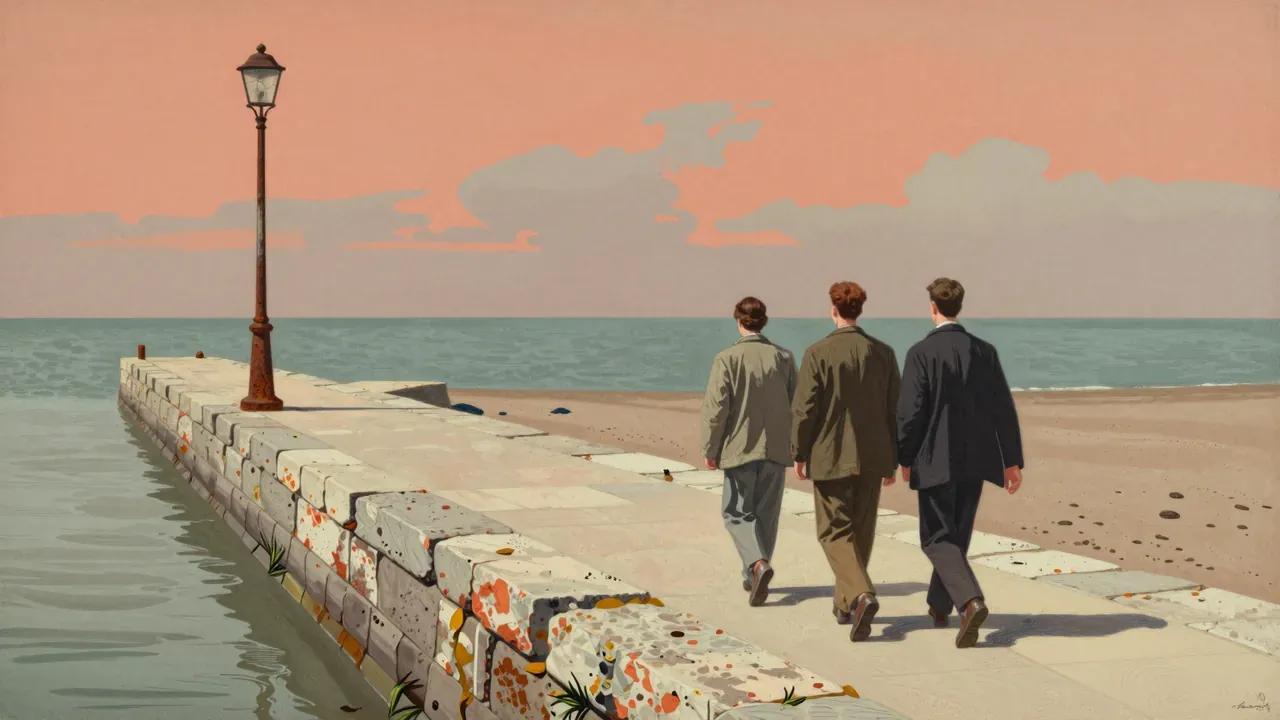
The story unfolds episodically, anchored by Fausto’s marriage and its hollow aftermath, while Moraldo’s quiet restlessness provides the only through-line of potential growth. Performances are grounded in specificity: Alberto Sordi’s Fausto is all swagger and evasion, his charm inseparable from his moral slackness; Franco Interlenghi’s Moraldo watches more than he acts, his silences calibrated with care; Leopoldo Trieste’s Leopoldo performs theatricality without irony, mistaking rehearsal for readiness. Otello Martelli’s cinematography avoids flourish: light falls flat on seaside pavements and café walls, interiors are dim and unadorned, and tracking shots move at the pace of a stroll, never a rush. Rolando Benedetti’s editing sustains this tempo — abrupt cuts separate vignettes, dissolves linger where feeling accumulates, and the final freeze-frame on Guido’s precarious balance is the only formal rupture, underscoring fragility rather than resolution. Nino Rota’s score is spare and wistful, rarely underlining emotion but often hovering just beneath it, like memory itself. There is no voiceover, no exposition, no flashbacks — only what is seen, heard, and endured in real time. (159 words)
What sticks, and why
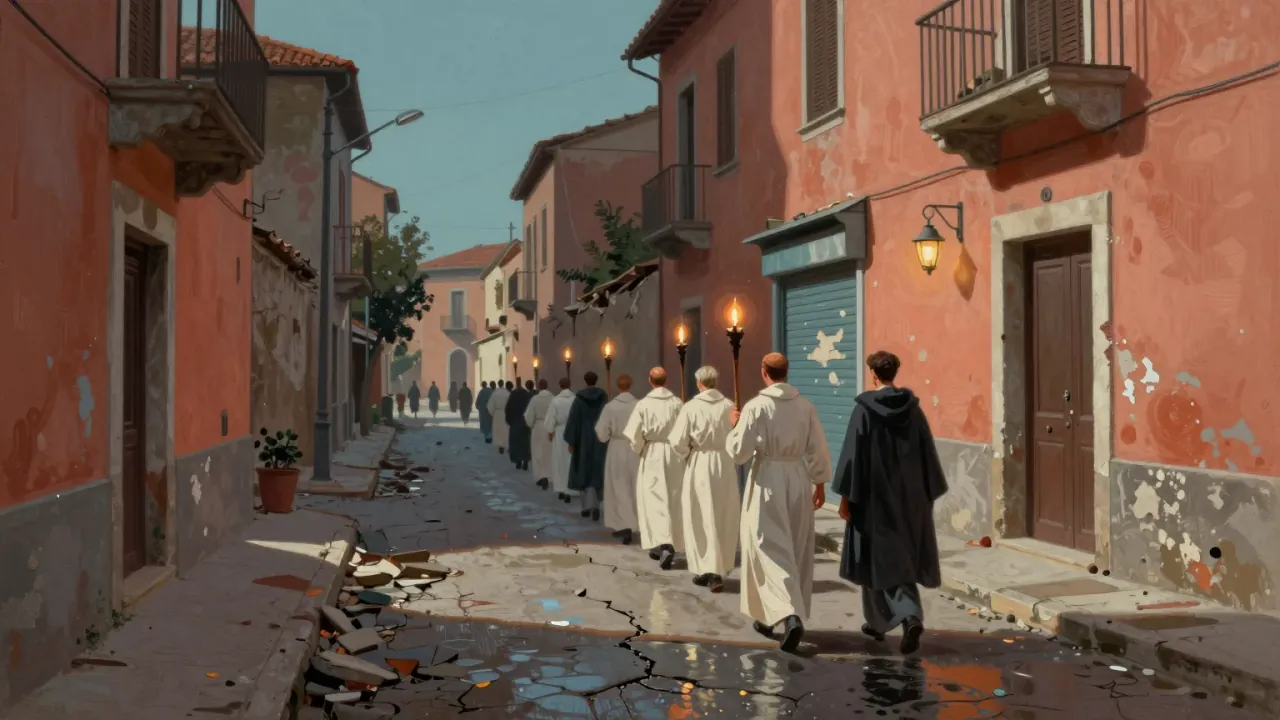
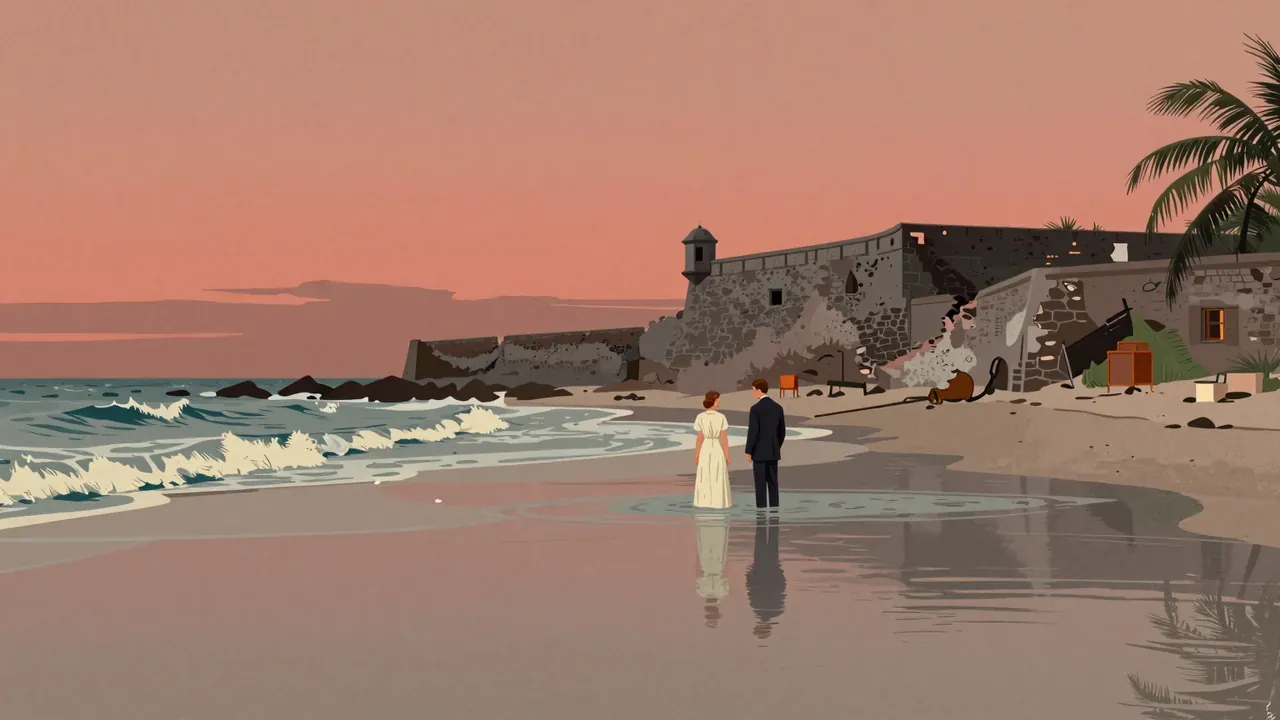
What lands is the texture of stasis: the way a cigarette smoke hangs in a sunlit café, the hollow echo of footsteps on an empty quay, the awkward pause before a lie is told and accepted. The masquerade ball sequence works because it distils the film’s central tension — performance as both refuge and exposure — in a single, sustained set piece: Alberto’s drunken dance in drag is absurd yet vulnerable, a moment of release that ends in private devastation. Fausto’s gradual erosion — from wedding guest to stockroom clerk, from flirt to cuckold — feels inevitable, not plotted. Even minor figures register: Vira Silenti’s Giulia Curti carries presence without dialogue, her glance enough to derail a marriage; Achille Majeroni’s Sergio Natali embodies faded grandeur without caricature. The film’s restraint allows small gestures to carry weight — a mother’s hand resting on a son’s shoulder, a suitcase left unpacked for weeks, a train platform glimpsed but never boarded. These are not symbols but facts of behaviour, rendered with patience and precision. The cumulative effect is not catharsis but recognition: this is how drift feels, how time accrues when there is no destination. (157 words)
Where the frame slips
What does not land is the attempt to grant Riccardo and Alberto equal dramatic weight with Moraldo and Fausto. Riccardo’s baritone aspirations remain vague, his scenes functional rather than revealing; his arc evaporates after the masquerade. Alberto’s subplot — his sister Olga’s elopement — arrives late and resolves too neatly, its emotional impact undercut by the film’s own detachment. The framing device of the opening beauty pageant feels slightly overstated, its downpour more symbolic than organic, and Sandra’s fainting — the inciting incident — is narratively necessary but emotionally thin, lacking the interiority granted to others. Some episodes, particularly the road-workers prank and its beating, rely on broad physical comedy that sits uneasily beside the film’s prevailing tone of muted realism. The absence of deeper engagement with class — beyond the fact of parental support — leaves certain tensions unexamined: Michele Curti’s religious shop, Francesco’s respectability, even Fausto’s shame, are presented as givens rather than interrogated. A viewer attuned to psychological causality may find the characters’ inertia unmoored from sufficient context — not because it is untrue, but because the film declines to explain what holds them still. (156 words)
What it keeps returning to
The themes that matter are not ambition or rebellion but their absence: the weight of unchosen continuity, the quiet violence of expectation deferred, the slow attrition of selfhood in environments that offer no friction. It treats masculinity not as ideology but as posture — Fausto’s bravado, Riccardo’s vocal projection, Leopoldo’s scriptwriting — all forms of rehearsal for roles they will never inhabit. Family functions not as sanctuary but as infrastructure: a system of maintenance that enables stasis. The sea appears constantly, not as metaphor but as fact — vast, indifferent, always present but never entered. Time is cyclical, not linear: holidays recur, parties repeat, seasons turn without consequence. There is no political critique here, no lament for lost tradition or celebration of modernity — only attention to how people inhabit the interstices between eras, neither fully of the past nor ready for the future. The film’s most persistent theme is duration itself: how long it takes to realise you are waiting, and how much longer it takes to decide to stop. (152 words)
Who it meets, and who it passes by
This film is for viewers who value observation over explanation, mood over momentum, and accumulation over climax — those comfortable with ambiguity and untroubled by unresolved arcs. It suits readers of Italo Calvino or viewers of early Éric Rohmer: attentive to gesture, patient with silence, receptive to irony that never tips into satire. It is not for those who require narrative propulsion, clear stakes, or character development measured in change rather than endurance. Anyone expecting a bildungsroman with decisive turning points will find it frustrating; anyone seeking social commentary with explicit argument will find it evasive. Those who dislike long takes, natural light, or Italian spoken without subtitles may struggle — though the film’s visual clarity compensates. A viewer who values craft over plot, and who finds resonance in the ordinary, will engage deeply; one who equates significance with event will leave unmoved. The verdict does not hinge on whether the film is ‘good’, but whether its particular kind of stillness matches the viewer’s appetite for it. (159 words)
The evening it earns
Yes, it is worth your evening — provided you watch it without agenda, without demand for payoff, and with willingness to sit inside its rhythms for their own sake. It rewards attention not with revelation but with recalibration: after I Vitelloni, a pause feels heavier, a glance more loaded, a decision more consequential precisely because so few are made. It is not urgent, not flashy, not easily summarised — but it lingers, like the taste of salt air or the memory of a conversation that ended without conclusion. Those who dismiss it as ‘slow’ or ‘dated’ are not wrong about its pace or period, but miss its purpose: it is not trying to move forward, but to hold still long enough for you to notice what is already there. A viewer who prefers tightly wound plots or psychological exposition will find it thin; one who trusts slowness as a form of honesty will find it rich. Its value lies not in what it says, but in how faithfully it shows — and how long the showing stays with you. (159 words)