The look of it
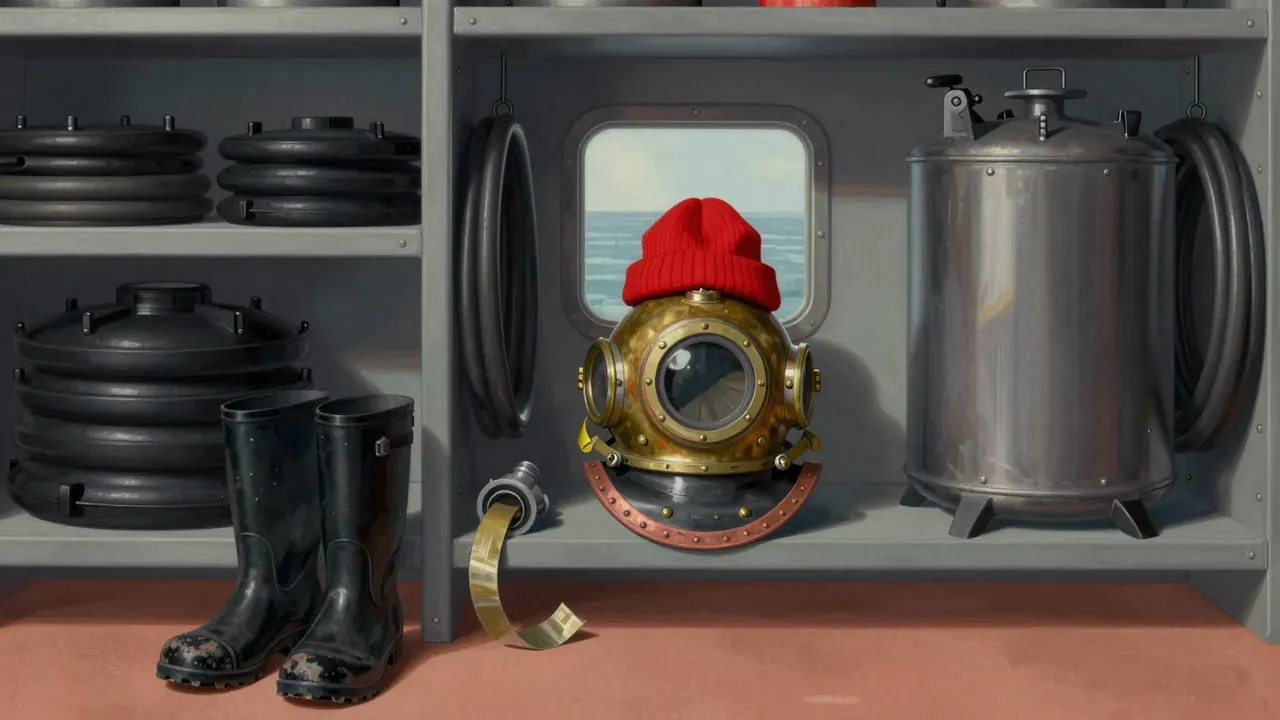
The Life Aquatic with Steve Zissou is a self-aware maritime fable that positions itself between parody and elegy — not mocking oceanographic documentary as a form, but holding its conventions at arm’s length while mourning the loss of heroic myth-making in an age of diminishing returns and compromised ideals. It tries to dramatise the late-stage reckoning of a man whose public persona has outlived his authority, whose crew sustains him more through habit than belief, and whose quest for vengeance against a jaguar shark functions less as plot engine than as structural metaphor: a vessel for circling grief, paternal failure, and the quiet collapse of narrative certainty. The film does not seek realism, nor even consistent internal logic, but a tonal architecture where every prop, costume, and line reading reinforces a shared condition of suspended disbelief — one sustained by craft, not conviction. Its ambition lies in sustaining that suspension long enough for the viewer to mistake melancholy for whimsy, then realise the difference too late to look away. (159 words)
The sound of it
The story follows Steve Zissou’s expedition aboard the Belafonte, structured around set-piece encounters rather than causal progression: a pirate raid, a helicopter crash, a rescue mission, a submersible encounter — each staged with symmetrical framing, flat dialogue delivery, and deliberate pacing. Bill Murray plays Zissou with minimal inflection, anchoring the film’s affective restraint; Cate Blanchett’s Jane Winslett-Richardson and Owen Wilson’s Ned Plimpton provide contrasting registers of earnestness and vulnerability, though neither breaks the film’s formal containment. Robert Yeoman’s cinematography favours wide shots and shallow focus, flattening depth without sacrificing clarity; the underwater sequences rely on studio tanks and matte paintings, their artificiality foregrounded, not concealed. Mark Mothersbaugh’s score is sparse and synthetic, punctuated by Seu Jorge’s Portuguese Bowie covers — diegetic performances that double as emotional counterpoint. Henry Selick’s stop-motion creatures are inserted with clinical precision, reinforcing the film’s taxonomy of invented life as both joke and lament. Every element serves the same grammar: repetition, distance, control. (158 words)
The rhythm of it
What lands is the cumulative weight of its design choices: the colour-coded uniforms, the deadpan delivery of absurd exposition, the way grief accumulates in silence between characters who rarely touch or raise their voices. The Belafonte itself becomes legible as a character — its peeling paint, mismatched equipment, and cramped interiors functioning as physical manifestations of institutional decay. The film’s most resonant moments are those where performance and production converge without explanation: Klaus Daimler’s quiet deference, Pelé dos Santos’ guitar strummed mid-crisis, Eleanor’s silent return to the ship after abandoning it. These are not revelations but recognitions — small confirmations that the world built here operates by its own unspoken rules, and that those rules hold. The ending, where Zissou abandons vengeance for awe, works because it arrives not as catharsis but as exhaustion: the dynamite is gone, the shark is beautiful, and nothing else needs saying. That restraint, repeated across 119 minutes, earns its payoff not through emotion but through accumulated fidelity to its own terms. (157 words)
The shape of it
What does not land is the film’s attempt to sustain narrative momentum across its second half. The pirate sequence feels abruptly inserted, its stakes unmoored from earlier character logic; the rescue mission lacks urgency, its geography vague, its moral weight diluted by stylisation. Ned’s death arrives without sufficient groundwork — his relationship with Zissou remains emotionally schematic, his paternity question resolved off-screen by Eleanor’s late exposition, leaving little room for the audience to grieve alongside the crew. The love triangle with Jane never acquires texture beyond triangulation as motif; her presence reads more as structural necessity than lived entanglement. Some supporting roles — particularly Waris Ahluwalia’s Alistair Hennessey and Jeff Goldblum’s Oseary Drakoulias — remain underwritten, their function limited to exposition or ironic contrast. The film’s refusal to grant psychological access to its characters becomes a liability when plot demands consequence: we see Ned buried at sea, but do not feel the weight of his absence in the crew’s routines or silences. That distance, so effective elsewhere, here hollows out what should be the film’s emotional centre. (159 words)
The weight of it
The themes that matter are inheritance without lineage, authorship without authority, and exploration without discovery. Zissou’s documentary practice is no longer about revealing the ocean but about preserving himself within its frame — his films are monuments to a version of himself he can no longer inhabit. The jaguar shark is not a predator but a mirror: a creature he cannot name, control, or finally understand, yet one he must confront to confirm his own obsolescence. Parenthood recurs as fiction — Ned’s belief in biological kinship, Eleanor’s quiet correction, Zissou’s sterile body — all pointing to family as performance rather than biology. The Mediterranean setting, deliberately non-specific, functions as a liminal zone: neither land nor deep sea, neither past nor future, where characters float in suspended time, rehearsing roles they no longer believe in but cannot discard. Even the stop-motion creatures — rhinestone bluefin, electric jellyfish — exist as taxonomic jokes, naming things that do not exist, asserting order over chaos without pretending the order is real. This is a film about maintaining form when meaning has leaked out. (156 words)
The audience for it
It is for viewers who respond to architectural storytelling — those who value consistency of tone over emotional escalation, who find comfort in repetition, who read mise-en-scène as argument. It rewards attention to texture: the stitching on a uniform, the grain of a film stock, the pause before a line. It is not for those who require narrative propulsion, psychological plausibility, or cathartic release — viewers who expect Ned’s death to reshape the crew’s dynamic, or Zissou’s epiphany to alter his behaviour, will find the film withholding. Those who disliked Rushmore or The Royal Tenenbaums for their affective detachment may find this even more resistant. A change in verdict would follow greater investment in Ned’s interiority or clearer grounding for the pirates’ motives — not to make the film ‘realistic’, but to let its artifice serve feeling, not just style. Without that, its cult status rests on admiration, not attachment. (158 words)
The time it takes
Yes, it is worth your evening — provided you watch it on its own terms, not as a story to be followed but as a system to be absorbed. Its 119 minutes unfold like a slow calibration: each scene adjusts the viewer’s tolerance for stillness, irony, and unresolved tension. It repays rewatching not because it hides clues, but because its repetitions reveal shifts in emphasis — a glance held longer, a prop repositioned, a line delivered with fractional variation. Those who approach it expecting narrative satisfaction will leave fatigued; those who accept its invitation to dwell in surface, pattern, and restraint will find it quietly insistent. It does not ask for belief, only attention — and in return, offers a rare kind of coherence: a film whose form and feeling are inseparable, even when neither resolves. That coherence is its value, and its limit. (157 words)