What it is
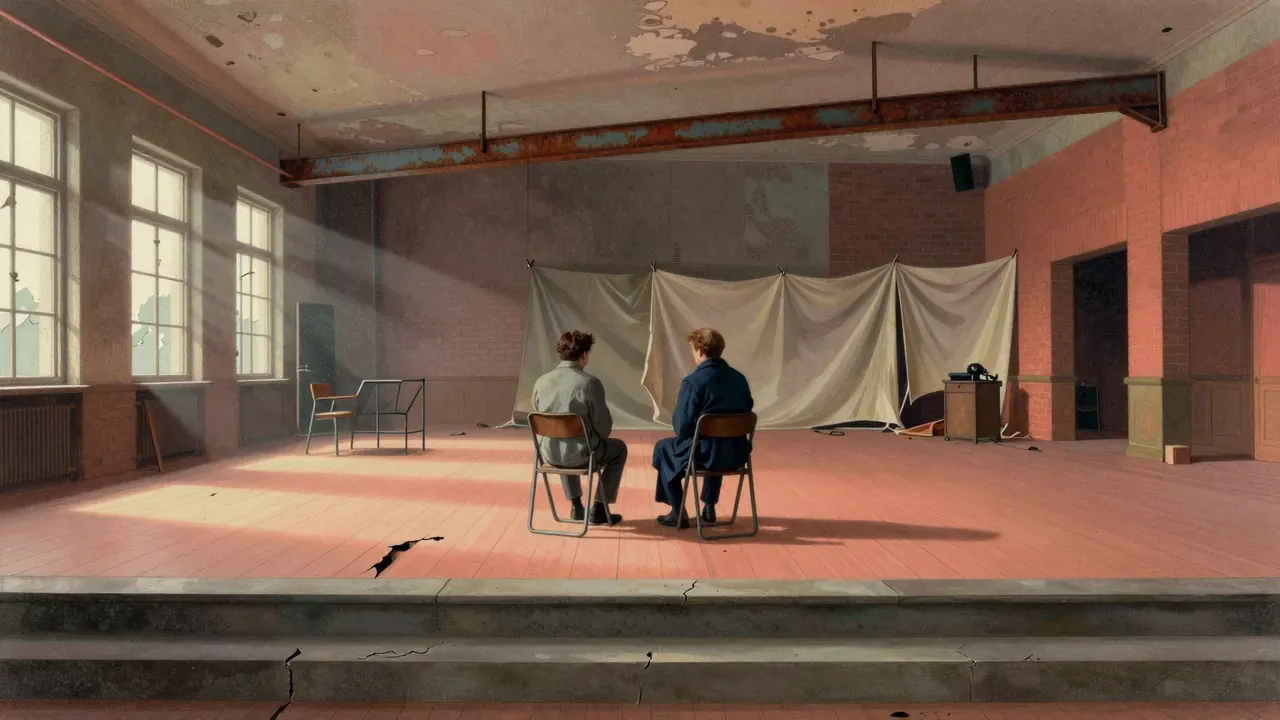
Vanya on 42nd Street is a filmed record of an uncommercial, long-form rehearsal process for Anton Chekhov’s Uncle Vanya, adapted by David Mamet and shaped collaboratively by Andre Gregory and a group of actors over three years. It does not attempt to translate the play into conventional cinematic narrative, nor does it disguise its origins: there are no sets beyond the bare orchestra floor of the derelict New Amsterdam Theatre, no costumes beyond street clothes, no lighting design beyond what Declan Quinn captures in available light and practicals. The film’s aim is not fidelity to Chekhov’s text as stage directions prescribe, but fidelity to a sustained, collective inquiry — into rhythm, silence, hesitation, the weight of unspoken feeling, and the friction between intellectual clarity and emotional exhaustion. It treats rehearsal not as preparation for performance but as performance itself: a space where meaning accrues slowly, through repetition, doubt, interruption, and mutual attention. Louis Malle, directing his final film, frames this as an act of quiet witness rather than interpretation.
How it works
The story follows Chekhov’s structure — Vanya’s disillusionment, Astrov’s weariness, Yelena’s restlessness, Serebryakov’s vanity — but the emphasis falls on how the actors inhabit those roles in real time, often halting, questioning, adjusting. Wallace Shawn’s Vanya is less a tragic figure than a man perpetually recalibrating his own despair; Julianne Moore’s Yelena moves with a physical unease that reads as both attraction and recoil. Andre Gregory appears as himself, guiding, interrupting, listening — his presence anchors the film’s self-reflexive mode. Declan Quinn’s cinematography avoids flourish: he holds medium shots, lets scenes breathe, keeps focus shallow but never showy, and allows ambient sound — distant traffic, creaking floors, rustling pages — to remain audible. Joshua Redman’s saxophone score is sparse, lyrical, and deliberately unobtrusive, entering only at transitional moments. There are no edits that accelerate or compress time; the film’s 120 minutes unfold at the pace of thought.
What lands
What lands is the cumulative effect of sustained attention — to voice, to pause, to the way a line changes when spoken for the tenth time, or when interrupted by a cough or a shift in posture. The film’s power resides in its refusal to resolve ambiguity: characters do not become clearer, only more present. Shawn’s monologues gain gravity not from rhetorical force but from their vulnerability — the slight tremor in his hands, the way he looks away mid-sentence, the seconds he waits before answering. Moore’s stillness reads as intelligence rather than passivity; her glances hold layered contradiction. The setting — water-stained plaster, exposed beams, dust motes in slanted light — does not function as metaphor but as shared condition: decay as neutral fact, not symbol. The absence of theatrical artifice makes the emotional stakes feel immediate, not stylised. This is not Chekhov performed ‘well’; it is Chekhov held, examined, questioned, and kept alive in real time — and that holding is what resonates.
What does not
What does not land is any sense of dramatic propulsion or structural surprise. The film assumes familiarity with Chekhov’s themes — futility, wasted talent, the quiet violence of routine — and offers no exposition, no biographical context, no visual shorthand to orient a viewer unfamiliar with Uncle Vanya. Its pacing resists accommodation: long takes without cutaways, minimal camera movement, dialogue delivered at conversational volume with no re-recording or ADR. Some performances — particularly those of supporting actors less accustomed to this register — occasionally flatten under the weight of repetition, their line readings becoming procedural rather than revealing. The decision to retain workshop interruptions — Gregory’s questions, actors’ hesitations, offhand remarks about the theatre’s history — deepens authenticity but risks diffusing focus for viewers seeking narrative cohesion. There is no score swell, no close-up punctuation, no editorial nudge toward significance: if a moment fails to register, the film does not try again.
The themes that matter
The themes that matter are endurance, irrelevance, and the dignity of minor persistence. Vanya’s crisis is not that he has failed, but that he has succeeded in ways that no longer mean anything — his life’s work, his devotion, his very capacity for care now appear absurd in a world that has moved on. The decaying theatre mirrors that condition: grand architecture emptied of purpose, ornate detail obscured by grime, history reduced to anecdote. The film treats time not as linear progression but as sediment — past choices, unspoken regrets, deferred hopes all coexisting in the same room. Class is present not as conflict but as quiet asymmetry: Astrov’s exhaustion is medical and moral; Vanya’s is existential and domestic. There is no politics here beyond the politics of attention — who gets heard, who is allowed to hesitate, whose fatigue is legible as thought rather than weakness. The central tension is between articulation and silence, and the film insists that both carry equal weight.
Who should watch it
This film is for viewers who value duration over revelation, who find resonance in hesitation and depth in repetition, and who approach Chekhov not as literature to be decoded but as psychological terrain to be walked. It suits those familiar with the play or with Malle’s earlier My Dinner with Andre, and those attuned to the textures of live performance — breath, gesture, vocal grain. It is not for viewers seeking narrative momentum, visual spectacle, or clear character arcs. Those who rely on editing rhythms or musical cues to orient emotional shifts may find the film inert or opaque. It also assumes patience with American English spoken in a particular cadence — Mamet’s adaptation leans into staccato phrasing and abrupt stops — and with a production aesthetic that refuses to flatter or guide. A viewer expecting a ‘film version’ of Uncle Vanya will be disappointed; one open to a document of sustained artistic inquiry will find it rich.
Is it worth your evening
Yes, it is worth your evening — but only if you grant it your full, unhurried attention. Its value lies not in what it delivers, but in what it permits: space to listen, time to reconsider a line, permission to sit with discomfort without resolution. It rewards nothing but presence, and repays it with a rare kind of intimacy — not between characters, but between performer and viewer, across decades and decay. Those who watch while distracted, or who expect payoff in plot or catharsis, will find it thin. Others — particularly those who have felt the weight of unacknowledged labour, or who recognise the quiet tragedy of competence without consequence — may find it startlingly precise. Its 120 minutes do not pass quickly, but they do accumulate: by the end, the silence between lines feels charged, the emptiness of the theatre feels inhabited, and the ordinariness of the actors’ clothes begins to look like costume after all.