The look of it
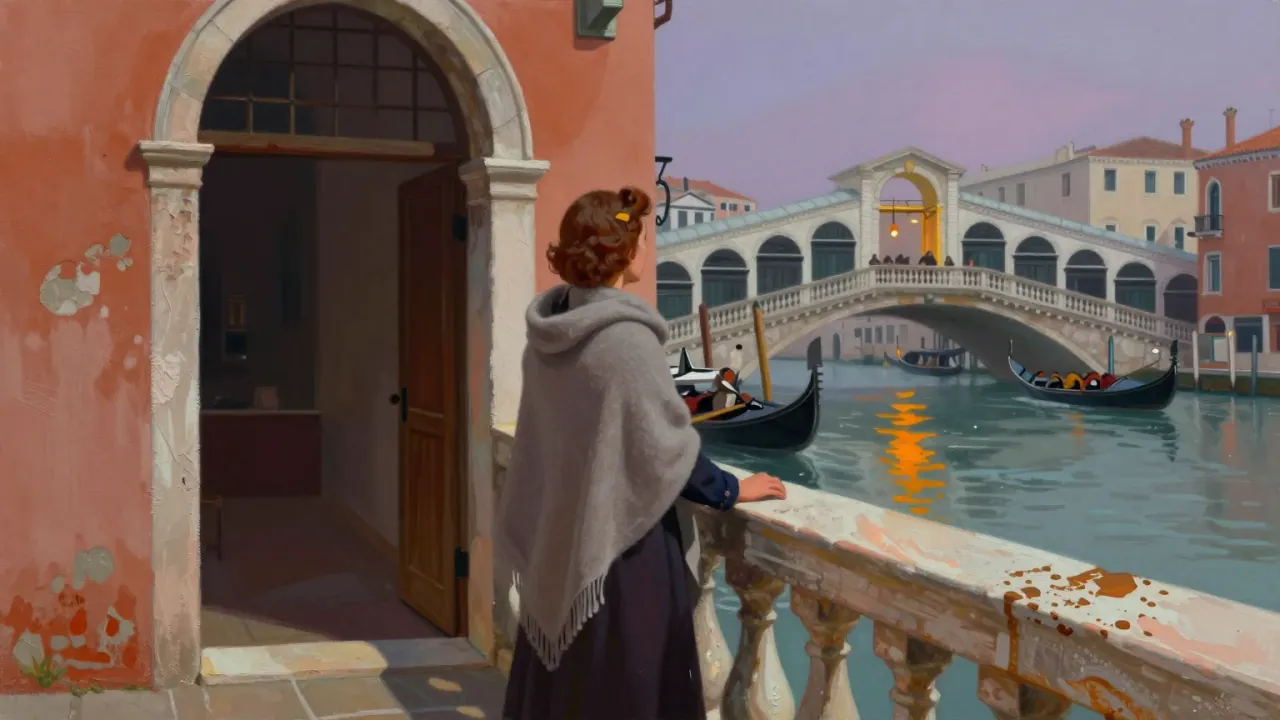
Death in Venice is Luchino Visconti’s 1971 adaptation of Thomas Mann’s 1912 novella, recasting its writer protagonist as a composer to anchor the film in Gustav Mahler’s music. It aims to translate Mann’s dense psychological and philosophical meditation—on beauty, decay, discipline, and forbidden desire—into visual and sonic terms. Visconti does not seek realism but a heightened, ritualised surface: Venice is not a city but a stage set for moral dissolution; Aschenbach’s decline is not medical but metaphysical, charted through posture, light, and silence. The film treats Mann’s text not as source material to be dramatised but as architecture to be inhabited—every composition, cut, and musical cue calibrated to echo the novella’s cadence and restraint. It is less about telling a story than sustaining a mood: one of suspended judgment, where aesthetic reverence and erotic fixation blur beyond distinction. This is not an interpretation but an embodiment—slow, deliberate, unblinking. Its ambition is formal fidelity to Mann’s tone, not narrative expansion or psychological exposition. That ambition is absolute, and it governs every choice.
The pace of it
The story unfolds with glacial precision: Gustav von Aschenbach (Dirk Bogarde) arrives in Venice seeking rest, sees Tadzio (Björn Andrésen), and unravels. There are no subplots, no secondary arcs—only the tightening coil of obsession, mirrored in Pasqualino De Santis’s Technicolor cinematography, which holds interiors in amber gloom and exteriors in bleached, sun-scorched clarity. Bogarde’s performance is internalised, almost sculptural: his face tightens, his gait slows, his breath grows shallow—not through gesture but through stillness. Andrésen is framed not as a character but as a motif: his profile, his back, his bare feet on hot sand recur like musical phrases. Ruggero Mastroianni’s editing avoids rhythm in favour of duration—shots hold until discomfort sets in. Mahler’s Adagietto bookends the film and recurs as emotional punctuation, while Franz Lehár and Beethoven appear diegetically, grounding the score in period texture. The production design, costumes, and sound all serve this same principle: accumulation over exposition, weight over speed.
The weight of it
What lands is the film’s physical presence—the way light falls across marble, how sweat gathers at Bogarde’s temple, the grain of sand on Tadzio’s shoulder, the muffled clang of a distant bell. These details do not signify; they accumulate, forming a tactile world that feels both opulent and suffocating. The final beach sequence works because it refuses climax: Aschenbach does not speak, does not touch, does not even fully see—his death is registered in the slackening of his jaw, the slow tilt of his head, the way his hand slips from the armrest. The Mahler Adagietto swells, but the image remains static, then cuts to black. This restraint makes the ending land not as tragedy but as inevitability—a conclusion written into the film’s first frame. The casting of Andrésen, too, lands precisely: his youth is neither sentimentalised nor sexualised in dialogue, only observed, measured, held in frame long enough for the viewer to feel the weight of looking. Nothing here is explained; everything is presented, and the presentation is exacting, unsparing, and complete.
The breaks in it
What does not land is the attempt to dramatise Aschenbach’s inner debate through flashbacks to Alfred, his student. These scenes feel inserted rather than integrated—stilted, talky, and tonally dissonant against the film’s prevailing silence. They introduce exposition where the film otherwise trusts implication, and their theatrical lighting and framing jar against De Santis’s naturalistic palette. Similarly, the hairdresser sequence—where Aschenbach submits to cosmetic rejuvenation—strains credibility without granting thematic payoff: it signals vanity, yes, but the film already conveys that through Bogarde’s increasingly rigid bearing and the growing pallor of his skin. The cholera subplot also falters: though it supplies narrative urgency, the threat remains abstract, reported second-hand, never felt in the air or on the skin. Visconti’s decision to keep disease off-screen drains it of visceral consequence, reducing it to metaphor when the film’s power lies in its physical specificity. These are not failures of craft, but of calibration—moments where the film steps outside its own logic.
The thought in it
The themes that matter are mortality as aesthetic condition, beauty as destabilising force, and discipline as both shield and prison. Aschenbach’s rigor—his compositional control, his moral self-restraint—is what makes his collapse legible: he does not fall into chaos but into surrender, and the film treats that surrender as neither shameful nor redemptive, but inevitable. Venice itself is a theme: not as setting but as agent—a city sinking, decaying, masked in grandeur, mirroring Aschenbach’s body and art. The film also treats time as non-linear: memory, dream, and present moment bleed together not through editing tricks but through repetition—the same corridor, the same beach, the same glance, each recurrence deepening the sense of entrapment. Sexuality is present but not central; it is one current among many in a wider current of dissolution. What matters most is not who Aschenbach desires, but how desire unmakes him—not as sin, but as entropy. The film’s enduring power lies in this refusal to moralise: it watches decay with the same attention it gives to a sunlit wall.
The audience for it
This film is for viewers who value sustained mood over plot, who find meaning in duration and texture, and who accept ambiguity as structural principle rather than flaw. It rewards patience, familiarity with Mann’s novella, and tolerance for stillness. It is not for those who require narrative propulsion, psychological exposition, or emotional resolution—its pacing will feel inert, its silences oppressive, its ending unsatisfyingly quiet. Those unsettled by the film’s treatment of adolescent beauty may find it ethically uneasy, particularly given Björn Andrésen’s later reflections on his experience. A viewer expecting a conventional drama about repressed homosexuality will be disappointed: the film is not about identity but about dissolution. Someone who values Roger Ebert’s objection—that the film lacks ambiguity—would reject its very premise. To change that verdict, Visconti would have needed to abandon his method entirely: to cut faster, explain more, humanise Tadzio, or dramatise Aschenbach’s crisis externally. None of that serves the film’s aim.
The time in it
Yes, it is worth your evening—if you approach it as a sensory object rather than a story to be followed. Its 130 minutes pass slowly, but never emptily: every frame contains information, every pause has weight. You will not leave with answers, but with impressions—of light on water, of heat on skin, of music swelling then cutting to silence. It repays close attention, not passive viewing. Those who dislike slow cinema, or who find its subject matter ethically fraught, will not find compensation in its craft. Its value lies in its singularity: few films so rigorously sustain a single tone across such length without slipping into mannerism or monotony. It is not ‘entertaining’ in any conventional sense, but it is absorbing—like watching paint dry on a fresco, or listening to a clock tick inside a cathedral. To dismiss it as ‘empty’, as some critics did, is to mistake austerity for vacancy. Its emptiness is deliberate, architectural—and full of meaning for those willing to sit within it.