The timing of it
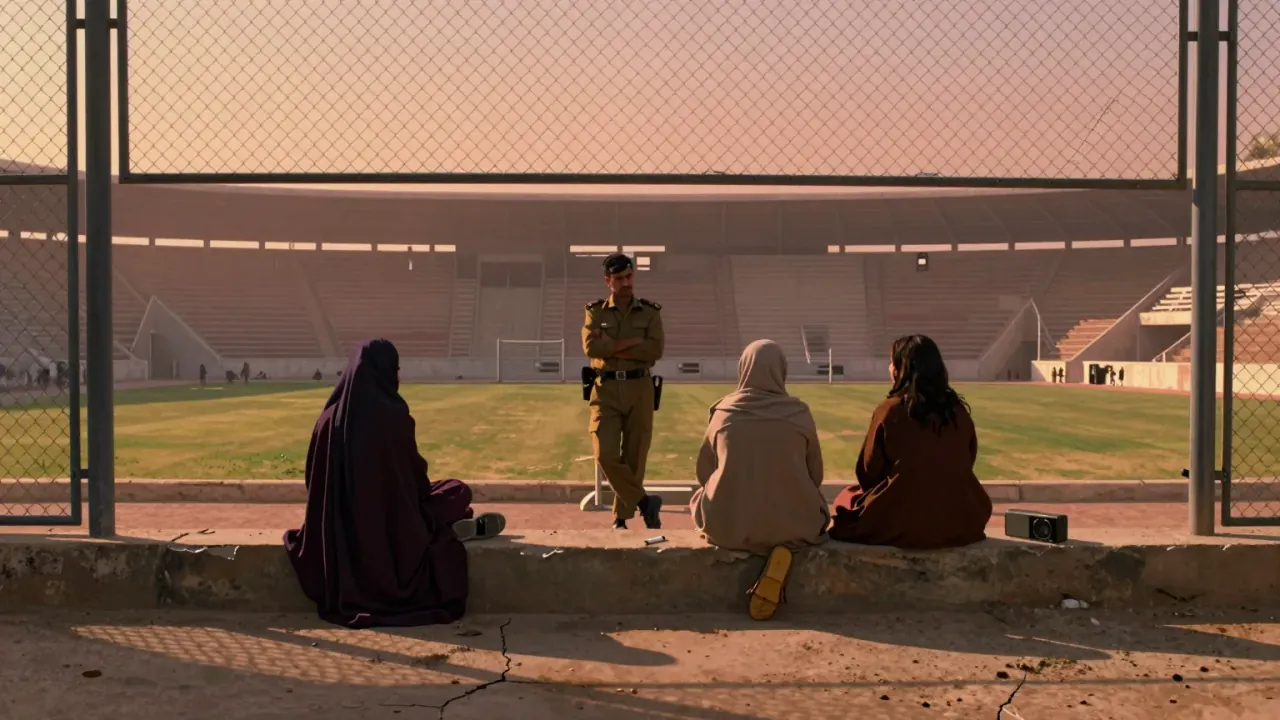
Offside is a 2006 Iranian drama that tests the boundary between documentary and fiction by staging its central conflict inside a real football stadium during an actual World Cup qualifier. It does not dramatise resistance as spectacle or martyrdom, but as a series of small, unheroic negotiations: a girl’s plea for a ticket, a soldier’s shrug at protocol, a shared cigarette passed through bars. Jafar Panahi and Shadmehr Rastin wrote it to examine how gender exclusion operates not through grand ideology alone, but through routine enforcement — bored conscripts, flimsy barriers, arbitrary rules enforced without conviction. The film avoids polemic by refusing to name its characters, treating each woman in the holding pen as a presence rather than a symbol. Its aim is not to argue for access, but to show what access looks like when denied — not as absence, but as proximity: a window onto the match just out of sight, commentary heard second-hand, celebration felt through vibration in the floor. It works within Iran’s legal and physical constraints to make those constraints visible, not as fixed law, but as fragile, human, and quietly absurd. (158 words)
The look of it
The story unfolds over the duration of a single match, its eighty-eight minutes calibrated to the rhythm of live sport — pauses, surges, off-the-ball tension. Mahmoud Kalari’s camera stays low and close, often handheld, moving with the girls through bus aisles and stadium corridors; light falls unevenly, favouring texture over clarity. Performances are understated and unvarnished: Sima Mobarak-Shahi’s first girl speaks little but registers every shift in mood through posture and glance; Mohsen Tanabandeh’s ticket seller negotiates price and principle in the same breath. Panahi edits with restraint — no flash cuts, no score beyond diegetic radio commentary and crowd noise — letting scenes breathe long enough for awkwardness to settle. The soldiers are not caricatures but conscripts from Tabriz or Tehran, their uniforms ill-fitting, their authority undercut by fatigue and indifference. Even the farcical toilet sequence avoids slapstick: the disguise, the eviction, the escape — all feel grounded in logistical panic, not comic timing. The craft serves the premise without embellishment: this is how things happen when no one is watching closely enough to stop them. (159 words)
The sound of it
What lands is the cumulative weight of proximity without participation. The women hear the goal before they see it; they dance before they know the score; they sing along to the radio broadcast while confined in a metal cage on the roof. These moments do not resolve the injustice, but they reframe it — not as total exclusion, but as partial, leaky, and therefore contestable. The soldiers’ reluctant commentary, the shared sparklers at the end, the quiet exchange between the Azeri boy and the first girl — none of these are victories, but they are recognitions: of shared youth, shared national feeling, shared boredom under orders. The film’s patience pays off in micro-expressions: a smile suppressed, a glance held too long, a hand resting briefly on a barred gate. It trusts the audience to register significance in silence and hesitation, not speeches or confrontations. The final street party does not feel earned as triumph, but as inevitable overflow — the energy of the match, the city, the suppressed, all breaking containment at once. That release feels authentic because it is unscripted in tone, unchoreographed in motion, and entirely unexplained. (157 words)
The names of it
What does not land is the structural reliance on the match’s outcome as narrative anchor. When Iran scores, the film pivots — but the emotional pivot depends on the viewer sharing the national investment, or at least understanding its contours. For audiences unfamiliar with Iranian football culture, or indifferent to sport, the climax risks flattening into generic celebration. The film’s refusal to name characters also works against intimacy in the second half: the revelation about the friend killed at the Japan match arrives late and without prior setup, making it feel like exposition rather than culmination. The soldier from Tabriz is sketched with care, but his arc ends where it begins — he returns to his farm, unchanged — which leaves his function ambiguous: is he a bridge, a contrast, or merely another placeholder? Some scenes — the poster disguise, the blocked men’s toilet — verge on contrivance, not because they are implausible, but because their mechanics outweigh their meaning. The film’s strength is its accumulation of detail, yet a few beats sacrifice texture for plot convenience, trading lived ambiguity for narrative neatness. (158 words)
The rules of it
The themes that matter are not gender equality in the abstract, but the daily architecture of exclusion: how rules are applied, deferred, bent, or forgotten by those tasked with enforcing them. It treats national service not as duty but as limbo — young men suspended between civilian life and state power, uncertain whether they are guarding order or merely occupying space. Football here is less sport than social infrastructure: a site where class, region, language, and generation intersect without needing to name themselves. The film’s quietest theme is translation — not of language, but of experience: the soldiers translate the match for the women, the women translate their desire into disguise, the city translates collective joy into street chaos. There is no single voice of authority; instead, there are overlapping registers of permission — the ticket tout’s price, the chief’s unseen presence, the radio’s verdict — none of which fully overrides the others. What matters most is how easily the system frays when no one is invested in holding it taut. (159 words)
The light of it
This film is for viewers who value precision over propulsion, who find tension in stillness and politics in posture. It rewards attention to gesture, to sound design, to the way light falls on a concrete wall. It is not for those who need clear protagonists, resolved arcs, or explicit moral framing — the film refuses to tell you whom to root for, or why. Anyone expecting satire will be disappointed; anyone seeking documentary realism will notice the scripted scaffolding beneath the live footage. Those put off by slow pacing, uncredited performers, or films that withhold explanation may find it frustrating, not elusive. A viewer who values narrative efficiency over atmospheric accumulation would likely disengage before the bus reaches the traffic jam. But for those accustomed to the rhythms of Iranian arthouse cinema — or to any tradition that treats time as material, not just measure — Offside offers a rare balance of rigour and warmth. Its accessibility lies not in simplification, but in its refusal to condescend to either its characters or its audience. (159 words)
The leaving of it
Yes, it is worth your evening — not as escapism, but as calibration. It takes ninety minutes to show how quickly a rule can become habit, and how slowly habit can soften under pressure. Its value is in its specificity: the exact shade of dust on the stadium roof, the pitch of a soldier’s laugh, the way a sparkler’s light catches on a chador. That specificity resists generalisation, yet invites reflection on any context where access is conditional, contested, or quietly revoked. Someone who prefers tightly plotted thrillers or emotionally declarative dramas may find its restraint alienating — but that is not a flaw in the film, it is a mismatch of expectation. Nothing in Offside changes if you watch it on a large screen or a phone, alone or with others; its power is in its quiet insistence on being witnessed, not consumed. It asks only that you sit with its contradictions — and in doing so, makes the familiar feel newly strange. (158 words)