The dance card
Un carnet de bal is a French drama from 1937 that traces the emotional aftermath of a single night—Christine’s debut ball at sixteen—through the lives of the men who danced with her, twenty years later. It is not a romance nor a mystery, but a structural experiment in time and consequence: the film uses Christine’s rediscovery of her dance card as a device to revisit each partner in turn, mapping how youthful promise, desire, and expectation curdle or settle across decades. Julien Duvivier and his co-writers do not seek to resolve or redeem; they observe. The film’s ambition lies in its refusal of narrative momentum in favour of cumulative portraiture—each episode a self-contained vignette, held together by tone, repetition, and Marie Bell’s quiet, anchoring presence. It treats memory not as nostalgia but as archaeology: careful, partial, and inevitably misleading. Its form mirrors its subject: life does not build to a climax, but accumulates, disperses, and repeats in quieter keys. The film tries to hold space for regret without sentimentality, for loss without lamentation, and for time’s erosion without despair. It is a study in what remains when the music stops.
The look of it
The film works through restraint: Philippe Agostini’s cinematography avoids flourish, keeping light even and interiors softly defined, never theatricalising poverty or grandeur. There are no dramatic close-ups to cue emotion; instead, performances are calibrated to mid-shot naturalism—Louis Jouvet’s nightclub owner wears cynicism like a well-broken-in coat, Fernandel’s hairdresser radiates unselfconscious contentment without broadening into caricature. Marie Bell moves through the frame with minimal inflection, letting silence and hesitation do the work. The episodic structure relies on tonal consistency rather than plot linkage: each man’s story lands because it feels lived-in, not scripted—Brémond’s petty corruption, the composer’s monastic retreat, the doctor’s dockside ruin. Maurice Jaubert’s score does not underscore but punctuates, often withdrawing entirely during dialogue. The art direction by Jean Douarinou gives each setting precise social texture—the mayor’s cluttered office, the monastery’s bare corridors, the ski lodge’s functional wood—without exposition. Even the Little Singers of Paris appear not as spectacle but as ambient sound, part of the world’s grain, not its ornament.
The men in the margins
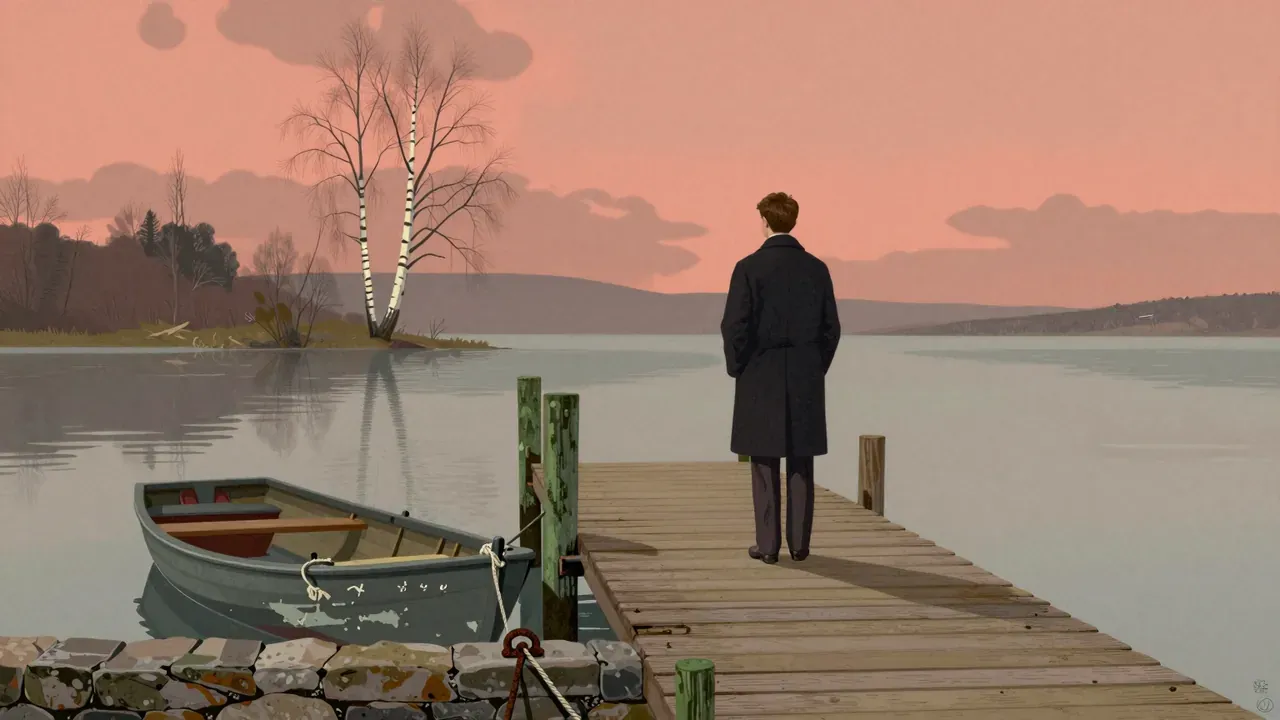
What lands most firmly is the film’s moral neutrality. It refuses to rank the men’s fates: the suicide’s mother’s denial is neither mocked nor pitied; the hairdresser’s domestic ease is not elevated above the lawyer’s decline. This evenness makes the cumulative effect unsettling—not because any one story shocks, but because the pattern reveals how little control any of them had over their trajectories. The final sequence, where Christine meets Gerard’s son across the lake, lands precisely because it offers no revelation, only quiet symmetry: the past repeats not as tragedy or farce, but as gentle, inevitable echo. The ballroom scene, where Christine watches a teenage girl experience the same awe she once felt, works because it avoids irony—it presents wonder and disillusionment as coexisting states, not successive stages. The film’s patience pays off in moments like these: small, unemphatic, and emotionally exact. It trusts the audience to register the weight of a pause, the significance of a glance held a beat too long, the exhaustion in a hand resting on a table. Nothing is underlined; much is felt.
The widow’s search
What does not land is the framing device’s internal logic. Christine’s decision to track down her partners rests on a premise the film never interrogates: why these men, and why now? Her motivation remains opaque, less psychological necessity than narrative convenience. When she sails across the lake to find Gerard, the gesture feels structurally necessary rather than emotionally earned—there is no prior indication she has been searching for him, nor any explanation for why he alone evades her reach until the end. The film’s autumnal mood, as Graham Greene noted, wavers: some episodes lean into comedy (Raimu’s mayor) or pathos (the doctor’s collapse) without fully integrating them into a unified sensibility. The transition between settings occasionally feels abrupt, relying on intertitles rather than visual or rhythmic continuity. And while the lack of love interest is a virtue, it also leaves Christine’s interiority underdeveloped—she observes more than she feels, and the film never quite bridges the gap between her curiosity and her grief. The result is distance where intimacy was intended.
The weight of twenty years
The themes that matter are time’s asymmetry, the illusion of agency, and the quiet violence of memory. The film treats time not as linear progression but as sedimentary layering: Christine’s past is not gone, but buried beneath present routines, ready to shift the ground beneath her. Each man’s life demonstrates how early choices—often trivial, often coerced—compound into irreversible conditions. There is no villain, no system named, yet systemic forces press in: economic precarity, social expectation, medical failure, colonial war (implied in the doctor’s backstory). Ageing here is not decline but redistribution: energy shifts from ambition to endurance, from desire to duty, from self to role. Nostalgia is exposed as a misreading—the ‘magic’ of the ball was never in the room, but in Christine’s youth, and the film knows this before she does. The central tension is between memory as record and memory as fiction: the dance card is factual, but the stories attached to it are reconstructions, shaped by shame, pride, and silence. What matters is not what happened, but how each man has learned to live inside the story he tells himself.
Who sits with it
This film is for viewers who value sustained attention over propulsion—who will sit with stillness, tolerate ambiguity, and find resonance in understatement. It suits those familiar with interwar French cinema’s pacing and moral gravity, or those willing to adjust to its unhurried syntax. It is not for viewers who require clear character arcs, narrative payoff, or emotional catharsis; those expecting psychological exposition or thematic resolution will find it withholding. People who rely on music or editing to signal feeling may feel adrift—the film communicates through posture, duration, and silence. Those put off by static compositions or long takes may mistake its stillness for inertia. A viewer who values craft over plot, nuance over clarity, and observation over judgment will find it rich. Someone who needs the film to declare its meaning, or to offer comfort, will leave unsatisfied. Its pace is deliberate, not slow—it assumes the viewer’s willingness to meet it halfway, and refuses to compensate for disengagement.
Is it worth your evening?
Yes, it is worth your evening—if you are prepared to give it your full attention and accept its terms. At 144 minutes, it asks for time, but repays it with density: every scene contains social detail, psychological precision, and formal control rare even among its contemporaries. It rewards rewatching, not for hidden clues, but for the way minor gestures accrue meaning across episodes—the way a hand trembles, a door closes, a song repeats. It is not ‘entertaining’ in the conventional sense, but it is deeply absorbing, and its emotional impact grows in retrospect. Those who dislike films that withhold closure or resist interpretation should skip it. But for anyone interested in how cinema can map inner life without voiceover or flashbacks, or how performance can convey decades of weariness in a single glance, it remains essential. Its power lies in what it refuses: simplification, judgement, and haste.