What it is trying to do
Katzelmacher is a low-budget, black-and-white West German drama made in 1969, written and directed by Rainer Werner Fassbinder as an expansion of his own stage play. It sets out to expose the brittle social surface of a Munich tenement block by isolating a group of young, idle, working-class Germans whose routines and self-regard collapse when a Greek migrant labourer named Jorgos arrives among them. The film does not aim for psychological realism or narrative momentum but for structural exposure: it arranges its characters like specimens under glass, letting their prejudices, insecurities and unexamined hierarchies emerge through repetition, static framing and deliberate theatricality. There is no backstory, no exposition beyond what the characters say or do — no voiceover, no flashbacks, no music cues to guide feeling. Its method is forensic rather than empathetic, using the constraints of its production — minimal locations, non-professional-feeling performances, flat lighting — not as compromises but as instruments of critique. It treats xenophobia not as an aberration but as a reflex embedded in routine, habit and shared boredom.
How it works
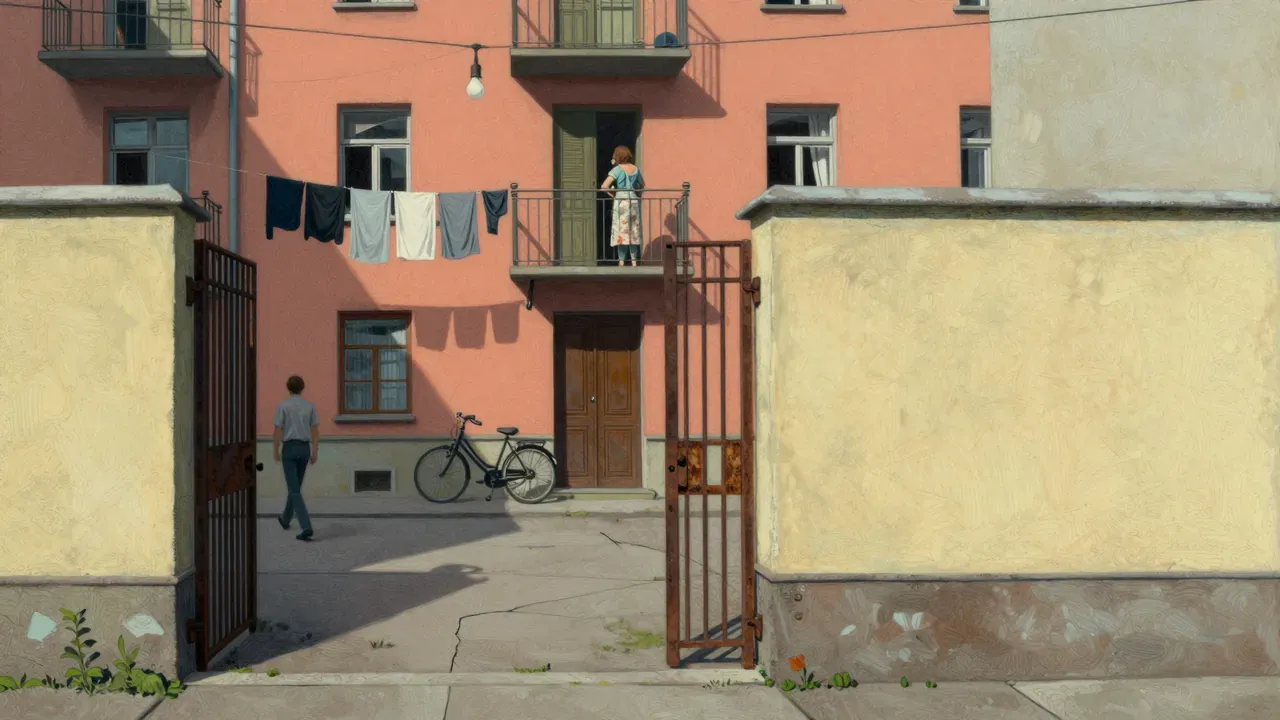
The story unfolds across a few days in a single apartment building courtyard and adjacent flats, with Jorgos’s arrival acting less as a plot catalyst than as a diagnostic probe. Performances are stylised and deliberately uneven: Hanna Schygulla’s Marie is watchful and coiled; Irm Hermann’s Elisabeth is shrill and brittle; Rudolf Waldemar Brem’s Paul is slack-jawed and inert. Fassbinder himself plays Jorgos with impassive stillness, refusing pathos or explanation. Dietrich Lohmann’s cinematography keeps the image tight and shallow, often using medium shots that flatten space and deny escape. Peer Raben’s sparse score appears only in fragments — a few dissonant chords, then silence. Editing, handled by Fassbinder, favours long takes and abrupt cuts, avoiding rhythm or flow. Dialogue is delivered flatly, sometimes overlapping, sometimes trailing off; pauses are held too long, not for tension but for discomfort. The craft does not serve immersion but estrangement: every choice reinforces the sense that this is not life observed but behaviour recorded, then reassembled to reveal its architecture.
What lands
What lands is the film’s unblinking calibration of group dynamics — how quickly consensus forms around contempt, how easily intimacy curdles into accusation, how little provocation is needed for collective cruelty. The scene where the group gathers to mock Jorgos’s accent and gait, repeating phrases without meaning, lands with clinical precision. So does the way Marie’s tentative curiosity toward him is read as betrayal before it becomes action. The film’s austerity pays off in moments of quiet revelation: Helga’s sudden, wordless retreat after being challenged; Rosy’s nervous laughter turning sour mid-sentence; the repeated shot of the courtyard gate, always open but never crossed by anyone except Jorgos. These are not dramatic climaxes but accumulations — small, exact observations that gather weight because they refuse interpretation. The film trusts the viewer to sit with discomfort rather than resolve it, and that trust is repaid in clarity: you see, unmistakably, how prejudice functions not as ideology but as punctuation — a way of marking time, filling silence, asserting belonging.
What does not
What does not land is the film’s reliance on repetition as both strategy and limitation. Some scenes loop variations of the same argument or gesture without sufficient shift in subtext or power balance, risking monotony rather than intensification. The character of Gunda — listed in the encyclopedia context but absent from the official cast sheet — appears inconsistently in available prints, suggesting editorial uncertainty that weakens narrative cohesion. Fassbinder’s performance as Jorgos, while conceptually sound, lacks the physical specificity that might anchor the film’s abstraction: he remains more symbol than person, which works for the thesis but limits emotional traction. The absence of any Greek-language dialogue or cultural detail beyond costume and name risks flattening Jorgos into pure function — the Other as mirror, not subject. And while the flat lighting and static compositions serve the film’s aims, they also drain texture from the environment: the Munich setting feels generic, its postwar housing blocks stripped of historical or material particularity, making the critique feel portable but also slightly untethered.
The themes that matter
The themes that matter are not immigration per se but the mechanics of exclusion as social maintenance — how groups use difference to shore up identity when nothing else holds. Class is present but muted: these characters have jobs but no work ethic, wages but no ambition, apartments but no domesticity. Their shared condition is stasis, and Jorgos disrupts not because he is foreign but because he moves — literally, across the courtyard; figuratively, outside their script. The film treats language as a tool of control: mispronunciation, translation failure and silence all become sites of power. Gender operates as another axis of constraint — Marie’s curiosity is policed more harshly than Paul’s inertia; Helga’s volatility is dismissed as hysteria, not resistance. There is no redemption arc, no moral pivot, no suggestion that awareness leads to change. The final image — Jorgos walking away, unseen by the group now absorbed in their own renewed routine — confirms that the system absorbs disruption without altering its logic. The theme is not racism as error but as grammar: unremarkable, automatic, grammatically correct.
Who should watch it
This film is for viewers who value formal rigour over emotional accessibility, who can sit with unresolved tension and find insight in repetition rather than progression. It suits those familiar with early New German Cinema’s aesthetic economy or with Brechtian distanciation as a mode of engagement. It is not for viewers seeking narrative propulsion, psychological depth or moral resolution — those will find it cold, repetitive or didactic. Someone who values character-driven storytelling or naturalistic performance may reject its artificiality outright. A change in verdict would follow if the film offered even one sustained moment of subjective interiority — a letter, a memory, a private gesture — that let Jorgos exist beyond function. Without that, it remains a brilliant diagnosis, not a portrait.
Is it worth your evening
Yes, it is worth your evening — provided you approach it as a precise, compact study in social mechanics rather than a story to be followed. Its eighty-eight minutes pass with unnerving efficiency, each scene calibrated to expose a different facet of group psychology. You will not leave moved, but you may leave recalibrated: noticing how often real-life conversations pivot on exclusion, how easily consensus forms around dismissal, how silence functions as complicity. Those who expect catharsis or narrative payoff will feel short-changed; those who appreciate films that operate like diagrams — clear, schematic, unsentimental — will find it indispensable. Its value lies not in what it resolves but in how thoroughly it refuses resolution, holding up a mirror that reflects not individuals but structures. That refusal is deliberate, and it holds up.