The frame of it
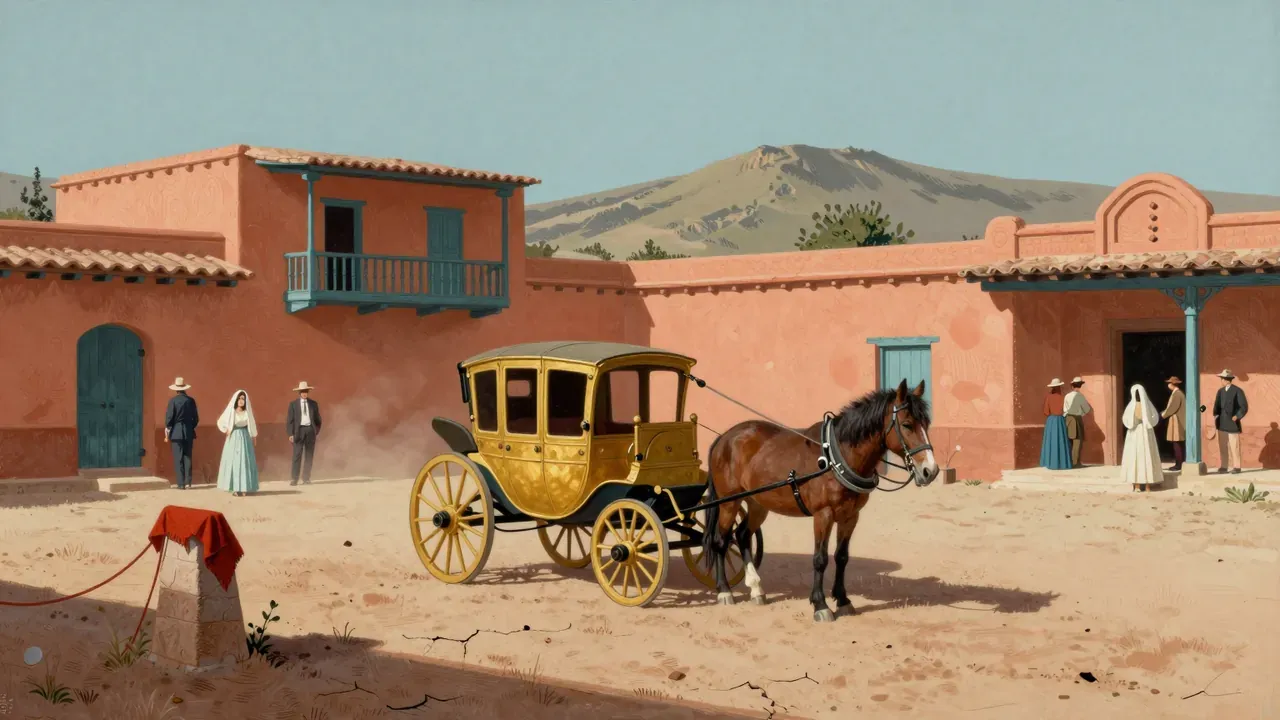
The Golden Coach is a French-Italian co-production directed by Jean Renoir in 1952, adapted from Prosper Mérimée’s 1829 play and set in colonial Peru. It is not a historical drama in the conventional sense, nor a satire of empire or power, but a self-conscious meditation on theatrical artifice — how performance sustains identity, how roles outlive their players, and how spectacle can hold truth more reliably than realism. Renoir frames the story as a commedia dell’arte troupe’s arrival in a provincial viceroyalty, using that premise not to dramatise cultural clash or colonial critique, but to stage a series of mirrored encounters between life and role, desire and duty, possession and surrender. The film’s ambition lies in its refusal to resolve those tensions: it treats narrative not as a vehicle for character development but as a scaffold for visual and musical recurrence. Its structure is circular, its psychology implied through gesture and costume, its moral weight carried less by plot turns than by the repeated reappearance of the golden coach — object, gift, prop, relic, sacrament.
The look of it
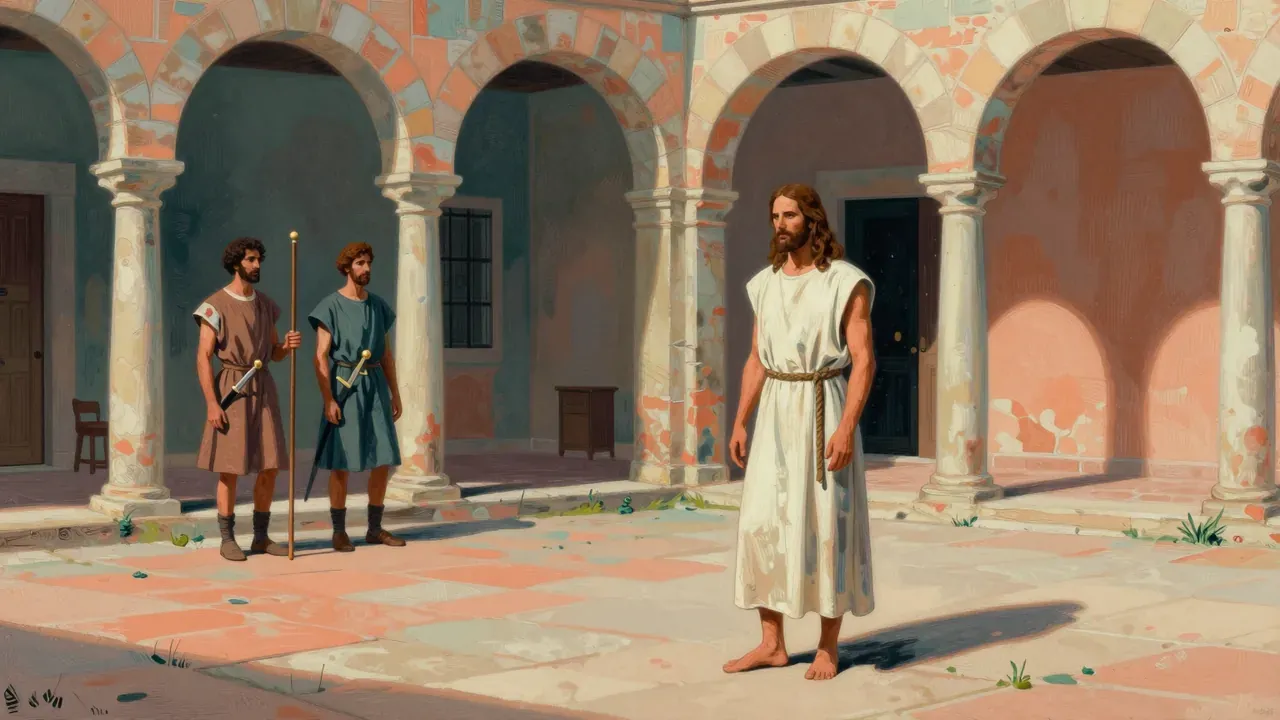
The story unfolds in episodic tableaux, each built around a key tableau: the troupe converting an inn courtyard into a theatre; Camilla’s command performance before the Viceroy; the backstage brawl over the necklace; the Viceroy’s offer of the coach; her final departure with Felipe. Anna Magnani anchors these moments with physical precision — her Columbina is neither naive nor calculating, but perpetually calibrated between sincerity and show. Duncan Lamont (Ramón) and Odoardo Spadaro (Don Antonio) perform with deliberate stylisation, avoiding naturalism in favour of rhythmic timing and spatial awareness. Claude Renoir’s Technicolor cinematography avoids deep focus or dramatic contrast: instead, he uses shallow depth, saturated primaries, and painterly framing — often staging action across tiers of balconies or archways to flatten perspective. Vivaldi’s music does not underscore emotion but punctuates rhythm, sometimes cutting mid-phrase to match a door slam or curtain drop. Mario Serandrei’s editing favours duration over pace: scenes breathe, linger, repeat motifs without explanation.
The making of it
What lands most firmly is the film’s sustained tonal coherence — its refusal to choose between comedy and gravity, between artifice and feeling. The transformation of the inn courtyard into a theatre remains vivid not because it is miraculous in plot terms, but because Renoir films it as an act of collective will made visible: ropes tighten, canvas flaps, actors step into light without fanfare, and the space simply becomes a stage. The use of colour is unforced but exacting: gold recurs not just in the coach but in embroidery, candlelight, dust motes, and the glint off a sword hilt — never symbolic, always material. Magnani’s performance lands because she never breaks the surface of Columbina’s composure, even when the character is most exposed: her ‘A little’ at the end carries no irony, only the quiet exhaustion of having inhabited three men at once and found none sufficient. The film’s wit resides in its economy — a glance, a pause, a shift in posture — never in dialogue or situation.
The gaps in it
What does not land is any attempt to read the film as social commentary on colonial Peru. The setting remains ornamental, its politics underdeveloped: the insurgency, the nobles’ grievances, the Church’s intervention — all arrive as functional plot devices, not as lived conditions. The Viceroy’s crisis lacks psychological texture; his fall and restoration happen off-screen, resolved by the Bishop’s pronouncement rather than earned through action. Some performances falter under the stylistic demand: Ralph Truman and Jean Debucourt appear stiff, their line readings unmoored from the film’s internal tempo. The English-language version — which Renoir preferred — suffers from inconsistent diction and flat intonation in secondary roles, making exposition feel laboured. The simultaneous French dub was abandoned mid-production, and though the surviving English track has clarity, it lacks the vocal nuance Renoir achieved in his French-language work. The film’s resistance to psychological motivation works against itself in moments requiring emotional pivot — notably Camilla’s decision to leave with Felipe, which feels abrupt rather than inevitable.
The idea in it
The themes that matter are not those of empire or gender per se, but of artistic continuity — how roles persist beyond the actor, how objects outlive their owners, how ritual sustains meaning where belief falters. The golden coach functions not as a symbol of corruption or vanity, but as a vessel for collective attention: first desired by the Viceroy, then contested by the nobility, then offered to Camilla, then surrendered to the Church — each transfer marking a shift in who holds authority over meaning. The film treats performance not as deception but as a form of fidelity: Don Antonio reminds Camilla she exists fully only onstage, and the final curtain call confirms that the characters dissolve when the lights go down. This is not escapism, but a proposition about ontology — that identity is relational, provisional, and sustained only through repetition. Nature appears only as backdrop: dusty plazas, sun-baked walls, the distant Andes — never as force or metaphor, but as stable ground against which human artifice plays out.
The watching of it
This film is for viewers who value compositional intelligence over narrative propulsion, who find pleasure in the weight of a costume, the cadence of a harpsichord phrase, or the geometry of a courtyard framed by arches. It rewards patience with visual and musical recurrence, not revelation. It is not for those who require psychological causality, linear stakes, or moral resolution — viewers expecting a critique of colonialism or a study of female agency may find its detachment frustrating. Those drawn to Renoir’s earlier naturalist work — like La Règle du Jeu — may be unsettled by its stylised remove. A viewer who values acting as interior excavation will likely resist Magnani’s surface discipline. But someone attuned to the physical grammar of theatre — how a mask shapes breath, how a prop dictates movement — will find it richly sustaining. It asks for attention, not empathy; observation, not identification.
The time of it
Yes, it is worth your evening — provided you watch it without expectation of momentum or closure. Its ninety-four minutes unfold like a series of variations on a theme: same gestures, shifting contexts, recurring colours, returning music. It repays slow viewing, not because it hides secrets, but because its pleasures are cumulative and tactile — the rustle of silk, the glint of gilt, the way light pools in a stone courtyard. Those who dislike films that withhold exposition or refuse catharsis may find it inert. Critics like Tony Richardson admired its visuals while dismissing its construction; others, like Truffaut, placed it at the apex of Renoir’s achievement. The verdict rests on whether you accept that art’s purpose can be to hold a mirror to itself — not to explain, but to persist. If that proposition interests you, the time is well spent.