The look of it
Benny’s Video is a 1992 Austrian psychological horror film that uses the mechanics of surveillance, recording, and domestic banality to examine how mediated perception hollows out moral response. Michael Haneke does not dramatise trauma or catharsis; he constructs a clinical architecture in which violence occurs off-centre, recorded but not witnessed, and absorbed without recoil. The film’s purpose is not to horrify through shock or gore, but to test the viewer’s capacity to locate agency — in Benny, in his parents, in the camera itself — when all three are insulated by layers of technical mediation and emotional deflection. It rejects psychological exposition in favour of structural repetition: the pig slaughter tape, the party game, the news broadcast, the police interview — each a looped frame within a system that absorbs atrocity as data. Haneke treats video not as a tool of revelation but as a solvent for consequence, dissolving cause and effect into playback, pause, rewind. The film’s ambition is precise: to make the viewer complicit not through identification, but through sustained, unbroken attention to what is shown, and what is withheld, and how the two are indistinguishable on screen. (158 words)
The shape of the story
The story unfolds in Vienna across a series of flat, symmetrical interiors lit with neutral precision by Christian Berger, whose camera rarely moves and never lingers. Arno Frisch plays Benny with a stillness that reads less as performance than as calibration — every glance, blink, and pause measured against the rhythm of the VCR counter. Ulrich Mühe and Angela Winkler as Georg and Anna speak in clipped, functional sentences; their parenting is enacted through purchases, permissions, and silences. Marie Homolkova’s editing sustains this austerity: cuts land on empty doorways, paused tapes, static monitors. Sound design is sparse and diegetic — no score, only the hum of appliances, the whirr of tape, the muffled thud of a body being moved. The handheld footage Benny records is grainy, slightly off-kilter, yet never sensationalised; it sits alongside static wide shots of living rooms and hallways as if all were equally objective. There are no flashbacks, no voiceover, no music cue to signal dread — only the accumulating weight of duration, repetition, and the refusal to editorialise. The craft does not serve mood; it enacts a logic, one where image precedes meaning and meaning is deferred indefinitely. (159 words)
What sticks
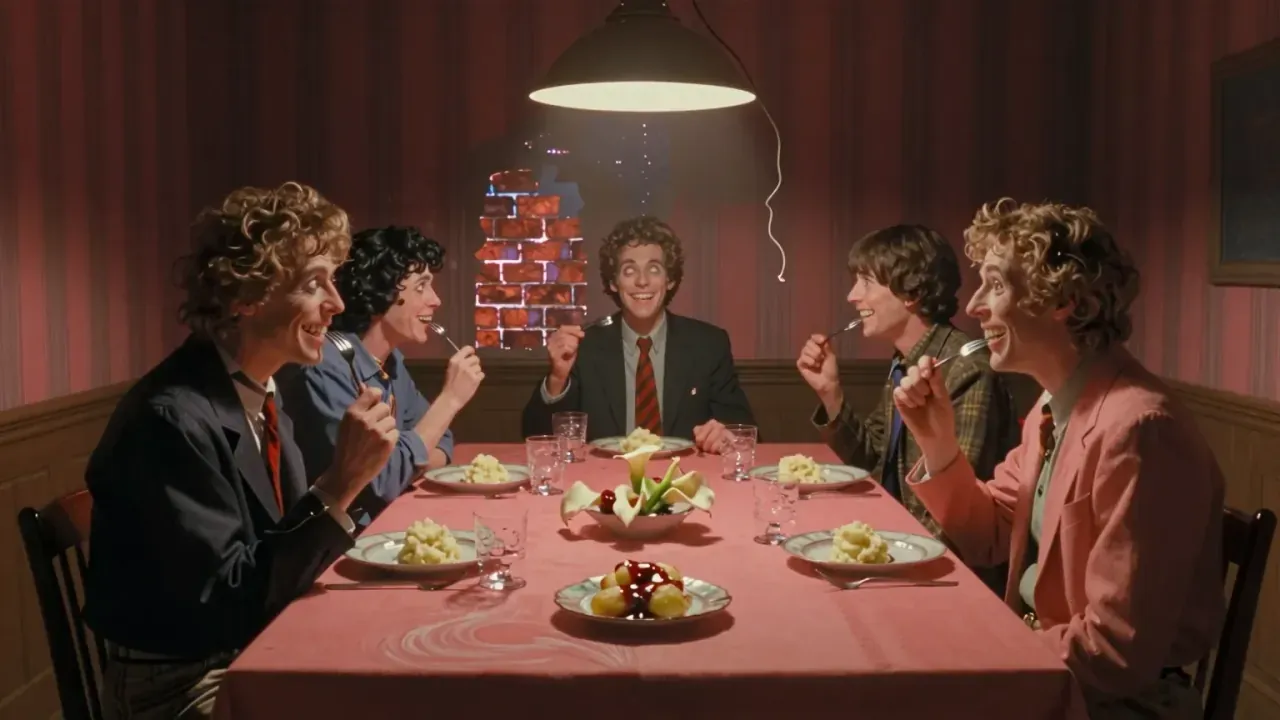
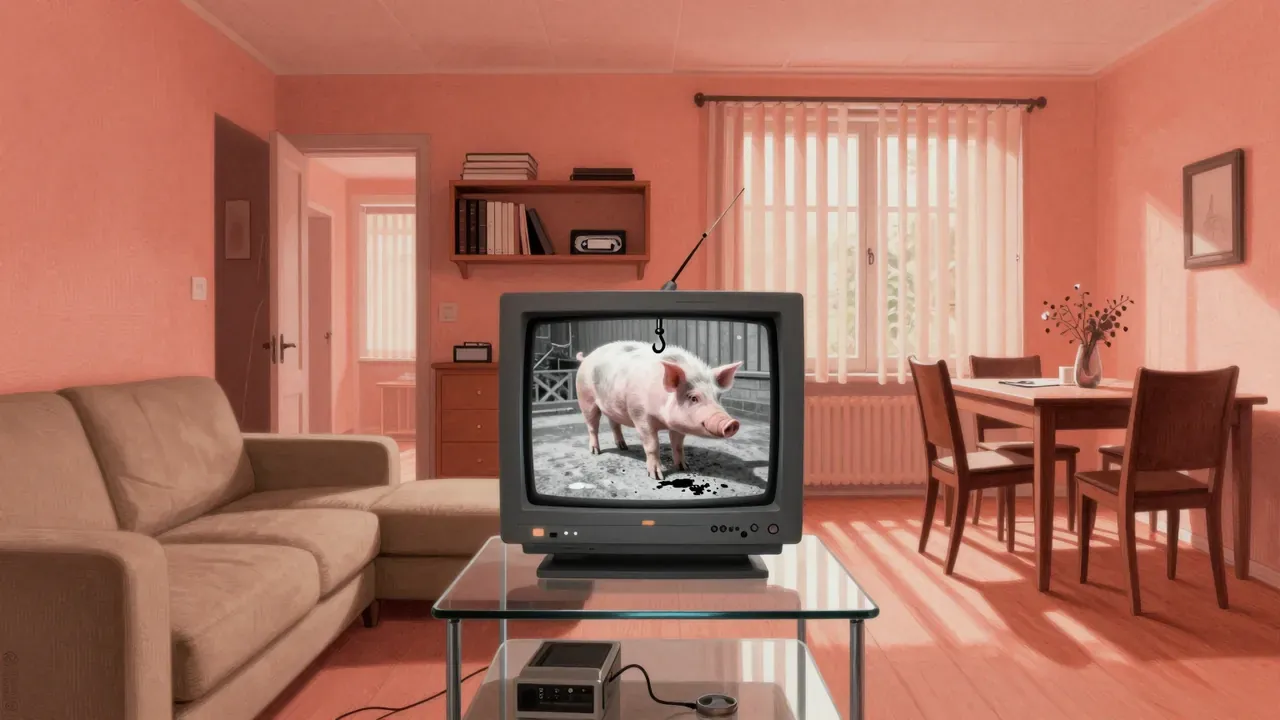
What lands is the film’s cumulative pressure — the way ordinary spaces become sites of quiet dread not because they are threatening, but because they are so thoroughly emptied of affect. The pig-slaughter tape works not as spectacle but as baseline: a recorded act of violence that Benny watches like weather report or cooking show. The scene where Benny kills the girl is shot from behind, then cut to the monitor showing the act — a double remove that makes the act feel both inevitable and alien. Later, when Georg and Anna dismember the body while watching television, the horror lies in their calm coordination, their shared vocabulary of logistics over grief. The final police interview lands because it offers no resolution: Benny says ‘Because’, then asks to leave. The film refuses to pathologise him, and in doing so forces the viewer to sit with the inadequacy of explanation. The repeated use of the Pilot and Passengers game — first disrupted, then sanctioned — lands as a chilling metaphor for consent as performance, authority as ritual, and normality as rehearsal. Nothing here startles; everything accumulates until the air feels thick with unspoken implication. (157 words)
Where it holds back
What does not land is any sense of urgency or stakes beyond the structural. The film’s rigour becomes its limit: its refusal to grant Benny interiority, motive, or even consistent psychology leaves some viewers stranded in abstraction rather than provoked by ambiguity. The parents’ passivity reads less as indictment than as vacuum — their dialogue is so stripped of subtext that their complicity feels procedural rather than culpable. Some critics have found the film’s tone monotonous, its repetitions mechanical rather than meaningful — a charge that holds weight if one expects narrative propulsion or character arc. The absence of a musical score, while deliberate, can flatten emotional texture to the point where detachment blurs into indifference. The film also assumes fluency in its visual grammar: those unfamiliar with Haneke’s early work may mistake its stillness for inertia, its silence for emptiness. Its critique of media saturation presumes the viewer already shares its suspicion of image-as-substitute — a premise that weakens the film’s force for anyone who experiences video not as alienation but as language. Without that shared assumption, the film risks reading as diagnosis without symptoms. (156 words)
What it’s really about
The themes that matter are not about technology per se, but about the erosion of thresholds — between life and image, action and record, responsibility and observation. The film interrogates how domestic comfort enables moral suspension: Georg and Anna do not ignore Benny’s obsession; they fund it. Their wealth buys silence, space, and equipment — tools that turn violence into content. The pig tape is not a trigger but a reference point, a precedent that conditions Benny’s understanding of death as something that happens on screen, to others, and can be replayed without consequence. Surveillance here is not state power but familial habit — cameras in hallways, recordings of choir practice, footage of dinner conversations. The real horror is not that Benny kills, but that no one in his world registers the killing as an event requiring rupture. The film’s central question is not ‘Why did he do it?’ but ‘What kind of environment makes the question irrelevant?’ It treats adolescence not as a phase but as a condition of deferred personhood — one sustained by adults who mistake provision for care and permission for presence. (158 words)
Who it’s for
This film is for viewers who tolerate long takes, distrust exposition, and find discomfort in unresolved causality. It suits those accustomed to Haneke’s early style — particularly fans of The Seventh Continent — and those interested in how form encodes ideology. It is not for viewers seeking narrative momentum, emotional release, or psychological insight into the killer. Anyone expecting catharsis, motive, or even sustained tension will leave frustrated. Those who read video culture as inherently dehumanising may find the film persuasive; those who see it as vernacular, expressive, or politically porous may find it reductive. A viewer who values craft over character, structure over sensation, will engage deeply. But someone who relies on empathy as an entry point — or who needs moral clarity to sustain attention — will likely disengage before the midpoint. The film’s value depends on whether one accepts its premise: that the most dangerous violence is the kind that looks like routine. Without that acceptance, the film feels like a diagram without a key. (159 words)
Is it worth your evening
Yes, it is worth your evening — but only if you approach it as a forensic exercise, not a story. Its 105 minutes unfold with the deliberation of evidence being catalogued, not drama being staged. It rewards patience, not investment; attention, not attachment. Those who watch it waiting for Benny to break, for Georg to rage, for Anna to weep, will feel cheated. But those who watch it noting how often doors close off-screen, how long the camera holds on an empty chair, how the tape counter advances during silence — those viewers will find it rigorously, unsettlingly alive. It is not enjoyable in any conventional sense, but it is exacting, coherent, and morally unblinking. Critics who call it smug misunderstand its method: it does not judge Benny — it shows how judgment itself has been outsourced to the machine. To dismiss it as cold is to miss that its temperature is the point. Anyone who believes cinema should provoke thought before feeling will find it indispensable. (158 words)