The shape of it
The Devil Is a Woman is Josef von Sternberg’s final collaboration with Marlene Dietrich at Paramount, a self-contained, stylised fable set during Seville’s Carnival. It adapts Pierre Louÿs’s 1898 novel The Woman and the Puppet, but strips away naturalism to pursue something sharper: a ritualised dissection of romantic surrender. Sternberg does not aim to persuade or move in the conventional sense; he constructs a closed world where desire functions like gravity—inescapable, indifferent, and structurally fatal. The film refuses psychological realism, treating its characters as archetypes in motion: the young revolutionary, the ruined aristocrat, the governor, the mother, the bullfighter—all orbiting Concha Pérez without ever penetrating her. Its ambition is formal and philosophical: to render love not as connection but as asymmetry, not as reciprocity but as performance, and not as tragedy but as farce dressed in velvet and smoke. It is less a story about a woman than a demonstration of how narrative itself collapses under the weight of unanswerable allure. Sternberg treats the screenplay—by John Dos Passos—as scaffolding, not scripture, reshaping it to serve his visual and rhythmic logic.
The look of it
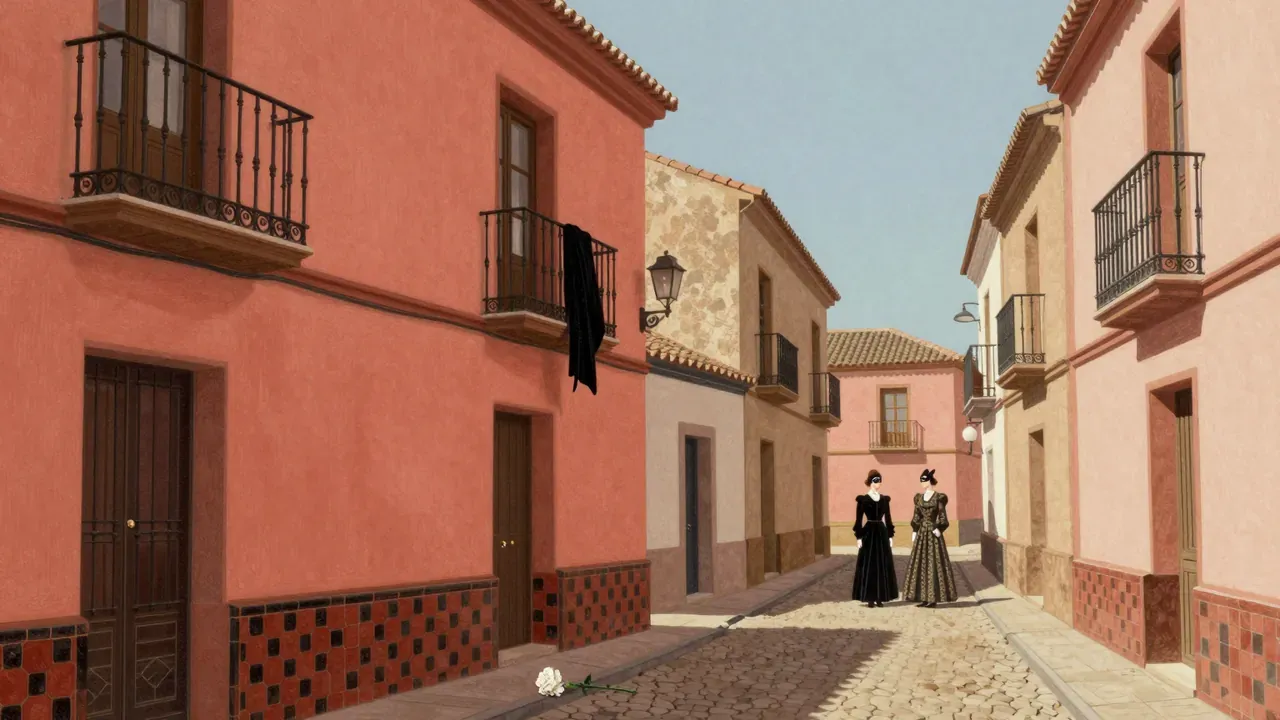
The film works through absolute control of surface and rhythm. Sternberg and Lucien Ballard compose each frame as a still life in motion: deep shadows pool around faces, costumes gleam with deliberate artificiality, and movement is measured—not urgent, but ceremonial. Marlene Dietrich’s Concha is never caught off-guard; every glance, gesture, and pause is calibrated to withhold rather than reveal. Lionel Atwill’s Don Pasqual moves with stiff-backed dignity that slowly unravels into pathos, while Cesar Romero’s Antonio carries youthful arrogance like a costume he hasn’t yet learned to shed. John Leipold and Heinz Eric Roemheld’s score leans on Rimsky-Korsakov’s Capriccio Espagnol—not for local colour but for its ornamental precision, its repeating motifs mirroring the cyclical futility of male devotion. Editing avoids continuity in favour of juxtaposition: a close-up of a fan snapping shut cuts to a pistol cocking; a slow pan across a masked crowd precedes a sudden, silent duel. There are no establishing shots that orient; instead, space is felt through texture—the grit of cobblestones, the sheen of satin, the dry heat of a Sevillian afternoon rendered in studio light.
What holds
What lands is the film’s tonal consistency and its refusal to flinch. The irony is sustained, unbroken, from the opening parade to the final train platform—never winking, never softening. Concha’s final decision to stay behind is not a twist but the inevitable conclusion of a system built on asymmetry; it lands because it is earned by every prior choice, every withheld glance, every cutaway to a clock or a mirror. The performances land not as psychology but as posture: Atwill’s rigid spine, Horton’s florid bluster, Skipworth’s sly, sideways glances—all function as precise instruments in Sternberg’s orchestration of vanity and vulnerability. The production design lands too: the sets are neither realistic nor fantastical, but theatrical—deliberately flat backdrops, painted skies, exaggerated props—reinforcing that this is not Spain but a stage where gendered power is rehearsed and restated. Even the censored musical number’s absence is felt as presence: its deletion sharpens the film’s austerity, making silence and suggestion more potent than song. Nothing here pleads for sympathy; everything earns its coldness.
What slips
What does not land is any attempt at emotional access. The film denies the viewer entry into interiority—not just Concha’s, but everyone’s. Antonio’s revolution is nameless, Pasqual’s disgrace is summarised in voiceover, the political context evaporates after the first reel. This is not ambiguity but erasure: the social world beyond the carnival float is treated as irrelevant noise. Viewers expecting motivation, backstory, or moral consequence will find only repetition and ritual. The pacing, too, resists engagement: long takes linger on static compositions, dialogue is delivered with detached formality, and scenes end before resolution arrives. The film’s aesthetic rigour becomes alienating when it overrides narrative momentum entirely—there is no build, no release, only recurrence. Some may read this as discipline; others will read it as distance so absolute it borders on indifference. The film assumes a viewer already fluent in its grammar of surfaces, and offers no translation. Without that fluency, what remains is beautiful but impenetrable—a gilded cage with no keyhole.
The weight of it
The themes that matter are self-deception as structural condition, desire as irreversible physics, and glamour as weaponised abstraction. Sternberg treats romantic love not as emotion but as hierarchy: Concha does not manipulate men so much as occupy a position they cannot reach, rendering their efforts absurd before they begin. The film’s central paradox—that Pasqual’s mercy proves his love, and therefore confirms his humiliation—is not resolved but repeated, varied, and deepened. Age, class, and nationality are all flattened into aesthetic variables: the Civil Guard uniform, the bullfighter’s cape, the revolutionary’s coat—all costumes in the same masquerade. There is no critique of patriarchy here, only its flawless execution and inevitable collapse. The film also insists on artifice as truth: the studio sets, the painted backdrops, the deliberately false Spanish accents—all declare that authenticity is a fiction we choose to believe in. What matters most is not what the characters want, but how the film frames wanting itself: as spectacle, as pattern, as inevitability. In this light, the title is not metaphor but diagnosis.
Who meets it
This film is for viewers who value precision over persuasion, who find pleasure in controlled surfaces and deliberate emptiness, and who approach cinema as architecture rather than storytelling. It rewards patience with pattern, attention with texture, and scepticism with clarity. It is not for those who seek narrative propulsion, psychological insight, or moral orientation—those who require cause-and-effect, growth, or closure will find it withholding to the point of hostility. Anyone expecting a romance, a drama of redemption, or even a satire with targets will leave unmoored. Those who admire Sternberg’s earlier work with Dietrich may be disappointed by its lack of warmth or irony; those unfamiliar with his style may mistake its stillness for inertia. A change in verdict would require accepting that the film’s purpose is not to involve but to expose—to hold up a polished, merciless mirror to the mechanics of infatuation, and to ask whether reflection counts as understanding.
What remains
Yes, it is worth your evening—if you arrive prepared to watch, not to follow. Seventy-five minutes is enough time to absorb its rhythms, to register the weight of a single fan closing, to notice how light falls on Dietrich’s collarbone in three successive shots. It is not entertainment in the usual sense, but it is an experience of sustained authorial intent, rare in studio-era Hollywood. To dismiss it as cold or remote is to miss its point: it is cold by design, remote by necessity. Those who find value in films that resist interpretation—films that prefer to pose questions as objects rather than answer them as arguments—will find it richly rewarding. Others may feel stranded, and that feeling is part of the film’s logic. It does not ask for empathy; it asks for observation. And observation, in this case, yields something rare: a vision of desire stripped of delusion, not through realism, but through relentless, elegant artifice.