What it sets out to do
Punch-Drunk Love is a ninety-five-minute romantic comedy conceived as a formal and tonal correction: Paul Thomas Anderson set out to make a film that held to the structural economy of genre while dismantling its emotional clichés. He wrote it for Adam Sandler not to ‘elevate’ him but to isolate and amplify the volatility, tenderness and rhythmic precision already present in his comic work — particularly the sudden shifts between vulnerability and rage seen in Saturday Night Live sketches. The film rejects the sprawling ensemble and narrative digressions of Magnolia in favour of tight focus on one man’s nervous system in love. It treats romance not as resolution but as destabilisation: Lena does not fix Barry Egan; she interrupts him. The project’s ambition lies in its restraint — no subplot runs longer than necessary, no scene lingers past its emotional pivot, and every visual or sonic decision serves either psychological fidelity or absurd contrast. Anderson called it an ‘art-house Adam Sandler film’, but that phrase misleads if taken as irony; he means it literally — a film built from Sandler’s own expressive grammar, then extended into unfamiliar registers of silence, colour and dissonance. (159 words)
How it holds together
The story follows Barry Egan’s brittle daily life — his novelty-plunger business, seven sisters’ taunts, compulsive phone calls — then fractures it with three incursions: a harmonium found on the street, a woman who has already chosen him, and a phone-sex scam that escalates into physical threat. Adam Sandler performs with calibrated physicality: shoulders hunched but never slumped, voice tight but never flat, eyes darting then locking with unnerving stillness. Emily Watson matches him with quiet insistence — her Lena is neither therapist nor saviour, but a person whose attention lands like gravity. Philip Seymour Hoffman’s mattress-store antagonist Dean is all surface charm and hollow authority, a foil whose menace collapses under Barry’s unscripted presence. Jon Brion’s score avoids melody in favour of pulsing, unresolved chords and percussive stabs; the harmonium appears only where Barry plays it, its wheeze and leak mirroring his own imperfect containment. Leslie Jones’ editing sustains a jagged rhythm — cuts land just before comfort, holds linger just past certainty. Jeremy Blake’s abstract interludes are not decoration but punctuation: bursts of saturated colour and motion that reset the film’s nervous frequency. (158 words)
Where it lands
What lands is the film’s precise calibration of tone: the way a scene of domestic humiliation can pivot into slapstick without losing emotional weight, or how Barry’s violent outburst at his sister’s party feels both shocking and inevitable, not cathartic but diagnostic. The blue suit — deliberately lifted from musicals — works not as costume but as visual anchor: a single, improbable note of confidence in an otherwise muted palette. The Healthy Choice pudding subplot lands because it is treated with documentary-level specificity — receipts, barcodes, warehouse aisles — making Barry’s obsession feel less absurd than methodical, a form of control in a world that offers none. Sandler’s performance lands because it refuses caricature: his stammer is not comic timing but physiological fact; his laughter is never broad, always startled. The film’s most effective moments are silent — Barry watching Lena across a room, or staring at his reflection after a confrontation — where Anderson trusts the audience to read what the script leaves unsaid. Even the car chase, brief and unglamorous, lands because it is shot at eye level, with real impact and no music, making Barry’s retaliation feel earned rather than heroic. (157 words)
Where it slips
What does not land is the phone-sex subplot’s escalation into physical threat — the four brothers arrive too late, behave too generically, and vanish too cleanly, their menace undercut by narrative convenience rather than sustained dread. Their function is structural — to separate Barry and Lena — but their execution lacks the texture given to other elements: they speak in unison, move as a unit, and dissolve once their purpose is served, feeling more like plot devices than people. The film’s compression also works against some supporting characters: Barry’s sisters are vivid in voice and gesture but remain archetypal, their cruelty never deepened beyond repetition. Luis Gómez’s character, though well-played, exists only to deliver exposition about the pudding loophole, and his scenes lack the rhythmic tension elsewhere. The film’s refusal to explain Barry’s psychology — no backstory, no diagnosis — is a strength, but it risks leaving some viewers adrift when his rages or silences lack contextual footholds. A few transitions between Blake’s interludes and live action feel abrupt rather than lyrical, their logic internal to the film’s nervous system but opaque to anyone not attuned to its rhythms. (156 words)
What it’s really about
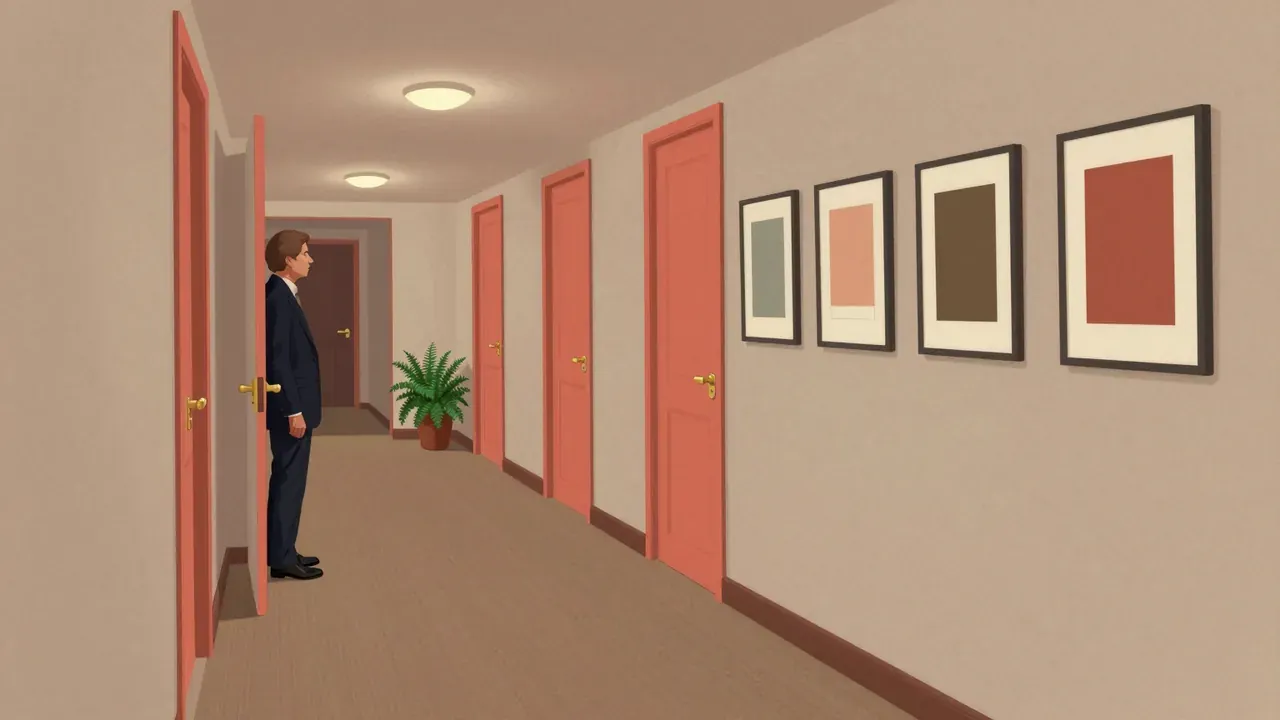
The themes that matter are loneliness as a physical condition, love as interruption rather than completion, and the quiet violence of familial expectation. Barry’s rage is never framed as pathology but as response — to being spoken over, misread, dismissed. His sisters do not abuse him out of malice alone but out of habit, their language so rehearsed it functions like ambient noise. The film treats social anxiety not as deficit but as heightened perception: Barry hears the hum of fluorescent lights, notices the grain of wallpaper, registers micro-expressions others miss. The harmonium becomes a motif for this — an instrument that requires breath, pressure, and patience to produce sound, much like Barry’s attempts to articulate himself. The Healthy Choice scheme reflects a broader theme of systems offering false promises of control: miles are quantifiable, but love is not. Even the film’s colour design — dominated by blues and greys punctuated by sudden reds — speaks to emotional regulation: cool tones as containment, warm ones as rupture. There is no redemption arc, only recalibration: Barry does not become ‘normal’, but learns to hold space for his own contradictions without collapsing them into shame. (159 words)
Who it’s for
This film is for viewers who value precision over exposition, discomfort over reassurance, and emotional honesty over narrative closure. It rewards attention to gesture, silence, and sonic texture — those who notice how a character’s posture changes mid-sentence or how a score drops out for three seconds will find its architecture deeply satisfying. It is not for viewers who require clear motivation, linear cause-and-effect, or characters whose inner lives are verbally explained. Those who rely on traditional romantic-comedy scaffolding — meet-cute, third-act misunderstanding, grand declaration — will find its structure alienating. It is also unlikely to satisfy fans of Sandler’s broad comedies expecting familiar rhythms or punchlines. A viewer who finds Magnolia emotionally exhausting may find Punch-Drunk Love equally demanding, albeit in different ways: its intensity is coiled, not sprawling. Someone who values psychological realism but dislikes abstraction may resist Blake’s interludes or Brion’s atonal score. The verdict would change if the film were re-cut to clarify the brothers’ motives or expand Barry’s interiority through voiceover — but that would violate its central principle: showing, not telling. (159 words)
Is it worth your time?
Yes, it is worth your evening — provided you approach it as a tightly wound mechanism rather than a story to be followed. Its ninety-five minutes pass with unusual swiftness because every frame serves a purpose: no establishing shot lingers, no line of dialogue repeats, no musical cue indulges. It asks for engagement, not passive reception, but repays it with cumulative emotional precision. Those who dislike it often do so not because it fails technically — the craft is exacting — but because it refuses to flatter the viewer’s assumptions about how love, anxiety or transformation should look. It is not a film to watch while distracted, nor one that yields its rewards on first viewing alone; its power accumulates in the spaces between scenes, in the way Sandler’s breathing changes when Lena touches his arm, or how the blue suit catches light differently each time it appears. To call it ‘difficult’ mistakes austerity for obscurity: it is clear, just not accommodating. Anyone willing to sit with its rhythms — its pauses, its jolts, its stubborn refusal to resolve — will find it quietly transformative. (158 words)