The language of it
Weekend is a 1967 French film by Jean-Luc Godard that sets out to dismantle the coherence of narrative, class, and cinematic convention in one sustained act of provocation. It does not tell a story so much as conduct an autopsy on storytelling itself — using a bourgeois couple’s road trip as scaffolding for a series of escalating ruptures: intertitles that comment on what has just occurred or what will not occur; characters who name their own actors or question whether they are in film or reality; abrupt shifts into allegory, history, and farce. Its ambition is not to entertain or even to persuade, but to expose the mechanisms of ideology embedded in everyday language, image, and movement. It treats cinema not as a window onto the world but as a weaponised surface — one that reflects, distorts, and sometimes refuses reflection altogether. The film’s structure is less linear than centrifugal: each scene spins further from plausibility, pulling at the seams of genre, decorum, and moral expectation. It is not satire in the service of reform, nor parody in the spirit of homage. It is negation made visible, and it proceeds with deliberate, unrelenting hostility toward its own medium and its audience’s habits of reception. (158 words)
The look of it
The plot follows Roland and Corinne Durand as they drive from Paris to the countryside, ostensibly to claim an inheritance, but the journey dissolves into a sequence of grotesque set-pieces: traffic jams that become mass graves, a piano recital interrupted by revolutionaries, a roadside murder that goes unremarked. Mireille Darc and Jean Yanne perform with studied detachment, their line readings flattened into bureaucratic monotone, as if reciting deposition transcripts. Jean-Pierre Léaud appears twice — first as Saint-Just, then as a man in a phone booth — his presence underscoring the film’s refusal of continuity. Raoul Coutard’s cinematography keeps the image raw: handheld, high-contrast, often lit by available sources, with long takes that refuse to flinch from discomfort. Agnès Guillemot’s editing inserts abrupt cuts and intertitles that interrupt rather than clarify. Antoine Duhamel’s score is sparse, dissonant, and rarely aligned with on-screen action. There are no establishing shots, no emotional cues, no diegetic logic holding scenes together — only juxtaposition, repetition, and escalation. The craft serves not to immerse but to estrange, making every frame feel like evidence in a case the film declines to argue. (159 words)
The rhythm of it
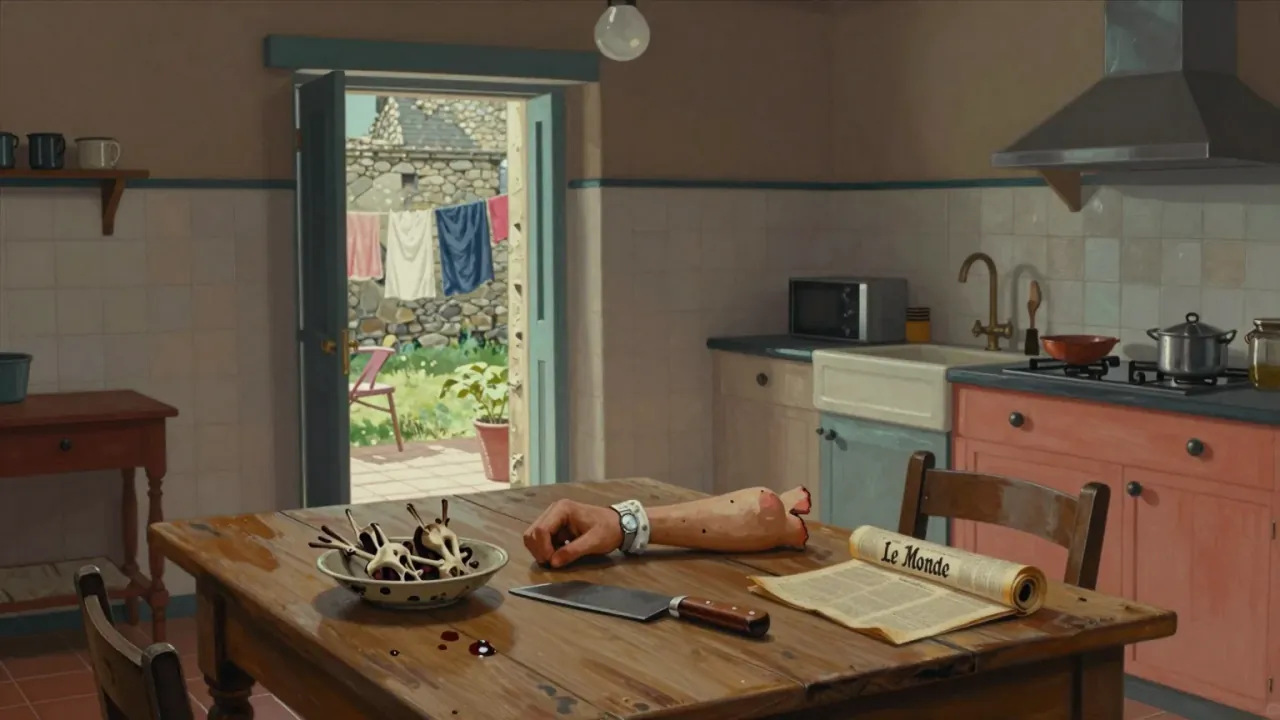
What lands is the sheer, unblinking consistency of its contempt — for bourgeois self-deception, for cinematic comfort, for the illusion of progress. The opening sequence, in which Corinne recounts a sexual fantasy laced with references to Bataille, establishes tone before plot: language is already unstable, desire already entangled with violence and transgression. The traffic jam — a ten-minute static shot of gridlocked cars, punctuated by off-screen screams and the sound of metal shearing — remains one of the most effective uses of duration-as-argument in French cinema. The skinned rabbit motif recurs with surgical precision, anchoring the film’s preoccupation with consumption and sacrifice. Even the cannibalism of the Seine and Oise Liberation Front feels inevitable, not shocking — the logical terminus of a society that treats people, animals, and meaning as interchangeable commodities. Godard does not ask the viewer to empathise, but he does compel attention through rhythmic insistence: the intertitles land because they arrive with the weight of verdicts, not explanations; the absurdism works because it never winks — it stares. The film’s power lies in its refusal to offer relief, aesthetic or moral. (157 words)
The limits of it
What does not land is the assumption that formal rupture automatically yields political insight. Some vignettes — the encounter with Emily Brontë, the digression into Tom Thumb — feel arbitrary rather than dialectical, their symbolism too loosely tethered to the film’s central critique of capitalism and complicity. The revolutionary group, though vividly staged, lacks internal logic: their rhetoric is Marxist, their practice cannibalistic, but the film offers no framework for reading that contradiction as anything other than nihilistic flourish. The animal slaughter, while undeniably graphic, risks collapsing ethical complexity into spectacle — its moral weight undermined by the absence of counterpoint or reflection within the film’s own structure. There is no space for doubt, hesitation, or ambiguity beyond the surface level of irony; the film’s certainty becomes its limitation. A viewer seeking historical specificity, psychological nuance, or even coherent satire may find the film’s repetitions exhausting rather than illuminating. Its refusal of exposition extends to its politics: it names the enemy — the bourgeoisie — but gives little sense of how power operates beyond caricature. The result is fury without friction, rage without resistance. (156 words)
The history in it
The themes that matter are not those announced in intertitles — ‘class struggle’, ‘revolution’, ‘cannibalism’ — but those enacted in the film’s grammar: the erosion of language as a tool for shared meaning, the collapse of time into simultaneity, the substitution of citation for experience. Weekend treats history not as sequence but as debris: Saint-Just appears not as a figure to be understood but as a costume, a prop, a name dropped alongside Emily Brontë and Tom Thumb. This is not pastiche but palimpsest — layers of reference scraped over one another until legibility fails. The film’s real subject is mediation itself: how images, texts, and sounds are repurposed, hollowed out, and reassembled to serve new ideologies — including the ideology of anti-ideology. Its treatment of animals is not merely about cruelty but about the category of the ‘non-human’ as a necessary fiction for sustaining human hierarchy. The final scene — Roland’s body carved up and cooked — is not metaphor but literalisation: the bourgeois subject consumed by the very system it helped build. The film’s urgency lies not in its diagnosis of 1967 France, but in its demonstration of how easily critique becomes ritual, and ritual becomes dogma. (159 words)
The audience for it
This film is for viewers who approach cinema as argument rather than accommodation — those willing to sit with discomfort, distrust exposition, and accept that coherence may be the first casualty of honesty. It rewards attention to texture over plot, to rhythm over resolution, to the grain of Raoul Coutard’s film stock over the gloss of performance. It is not for those who require emotional access points, narrative momentum, or moral clarity — nor for those who expect satire to offer alternatives, not just annihilation. Some critics have argued that its radical form masks political timidity; others insist its refusal of solution is its integrity. Either way, its demands are absolute: it asks for surrender to its logic, not alignment with its conclusions. A viewer who finds Godard’s earlier works like Breathless or Contempt too conventional may find Weekend exhilarating; one who values character psychology or social realism will likely reject it outright. Its value is not in universality but in extremity — and extremity, by definition, excludes. (158 words)
The time it takes
Yes, it is worth your evening — but only if you treat it as a forensic exercise, not entertainment. It occupies ninety minutes with such density of gesture, reference, and refusal that watching it once is insufficient; its rhythms and repetitions only reveal themselves on second or third viewing. It is not ‘enjoyable’ in any conventional sense, but it is rigorously, uncompromisingly alive — a film that insists on its own materiality, its own contradictions, its own exhaustion. Those who dismiss it as pretentious miss how precisely it engineers that response; those who praise it uncritically risk replicating the very dogmatism it attacks. Its worth lies in its ability to unsettle assumptions about what cinema can do — and what it owes the viewer. Anyone expecting narrative payoff or catharsis will leave frustrated. But anyone prepared to meet it on its terms — as a document of crisis, not a guide to resolution — will find few films from the 1960s that hold up with such ferocious, unblinking relevance. (157 words)