The look of it
The Living Skeleton is a Japanese black-and-white horror film from Shochiku, released in November 1968, that attempts to rework the kaidan — traditional ghost-story — tradition through maritime dread and Catholic-inflected guilt. It does not rely on gore or shock cuts but on sustained unease: submerged skeletons, fog-bound apparitions, and the doubling of identity across twin sisters. Its ambition lies in formal restraint — using monochrome cinematography, deliberate pacing, and sparse dialogue to evoke inherited sin rather than immediate threat. The film situates itself between postwar studio craft and genre experimentation, borrowing from gothic structure while anchoring its hauntings in tangible geography: a coastal village, a sunken ship, a parish church. It avoids psychological realism in favour of symbolic recurrence — chains underwater, repeated names, mirrored faces — treating horror as architecture of memory rather than symptom of trauma. This is not a film about solving a mystery but about enduring its echo.
The weight of two faces
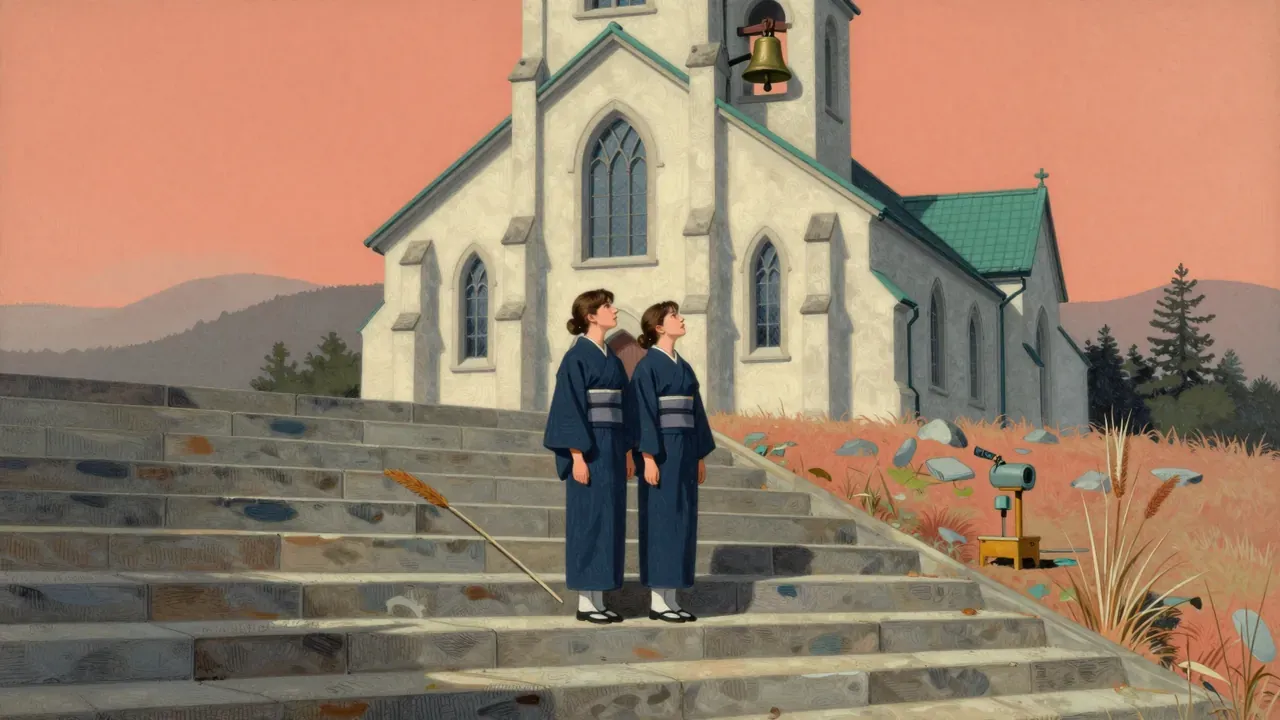
The story follows Saeko, sheltered by a priest after her twin Yoriko vanishes at sea; their shared face becomes the film’s central ambiguity. Kikko Matsuoka plays both roles with minimal differentiation beyond costume and framing, leaning into uncanny sameness rather than distinct characterisation. Masumi Okada’s priest carries quiet gravity, his dual role (as Father Akashi and the spectral Tanuma) left unexplained but felt in posture and silence. Kazuo Ōta’s editing sustains rhythm without emphasis — cuts land softly, holding shots just past comfort. There are no score cues to telegraph fear; sound design is sparse, dominated by wind, water, and distant bells. Lighting is low-contrast, interiors dimmed, exteriors bleached by coastal light. The underwater sequences — filmed with visible breath bubbles and grainy focus — feel tactile, not spectacular. Every technical choice serves atmosphere over exposition: the ghost ship appears without fanfare, the skeletons without commentary. The film assumes the viewer will sit with implication, not demand clarification.
The length of a held breath
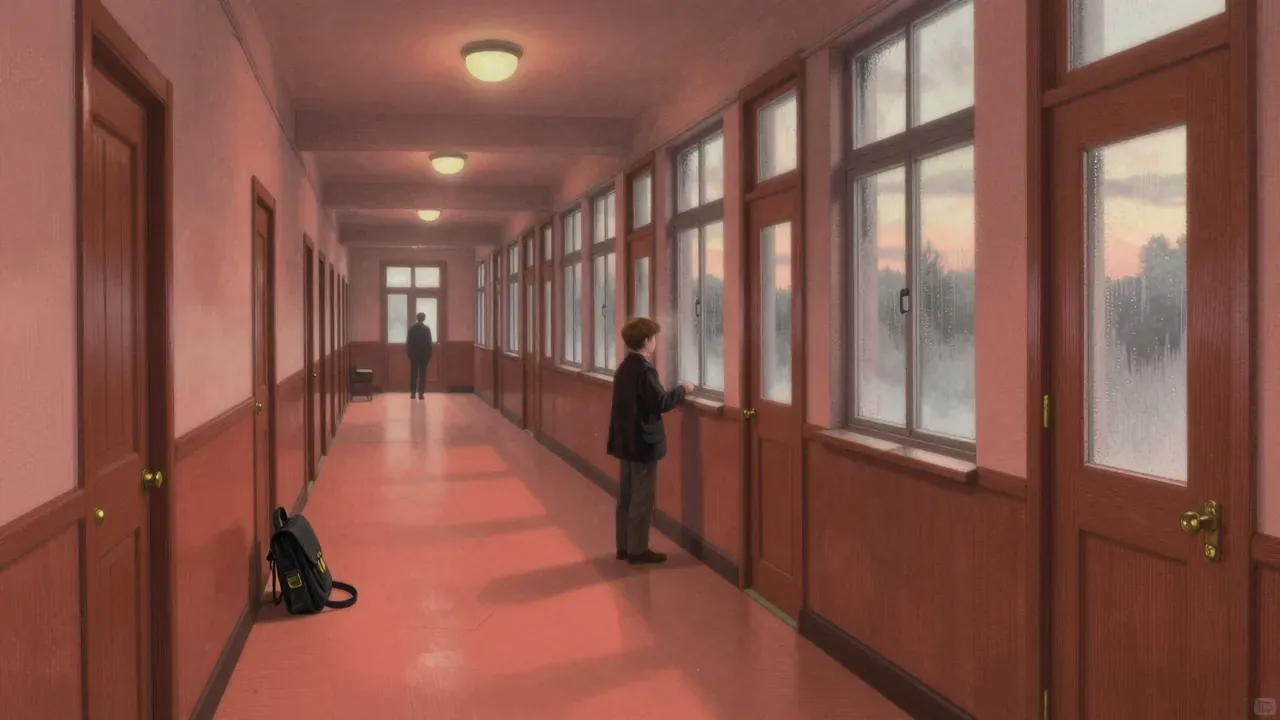
What lands most firmly is the texture of place: the salt-bleached wood of the village, the weight of wet diving gear, the way mist clings to the shoreline at dusk. These details accumulate without explanation and settle like sediment. The doubling motif works precisely because it refuses resolution — Saeko and Yoriko are not puzzles to be solved but conditions to be inhabited. The film’s restraint with exposition means its scares arrive through duration: a long take of Okada standing at a window, backlit by fog; a slow pan across skeletal remains tethered in silt; the delayed arrival of the ship’s voice, heard only after several seconds of silence. Even the Catholic imagery — crucifixes, confessionals, Latin phrases — feels grounded, not exoticised: it is part of the village’s fabric, not a stylistic flourish. The absence of musical punctuation makes the few diegetic sounds — a bell tolling, a diver’s regulator hiss — carry disproportionate weight. This is horror built on patience, not provocation.
What the tide does not carry away
What does not cohere is the narrative logic linking past and present. The pirates’ massacre is shown in flashback but never integrated into the characters’ understanding — it remains external lore, not internal consequence. The priest’s dual identity as Tanuma is suggested but not dramatised; his motives and history stay opaque in a way that feels less enigmatic than underdeveloped. Several supporting characters — the doctor, the policeman, the sailors — exist only to deliver exposition or occupy space, with no discernible interiority. The film’s refusal to explain leaves some gaps not as haunting ambiguities but as structural absences: we do not know why Saeko dives where she does, why the priest shelters her specifically, or how the villagers relate to the wreck’s legacy. These omissions work when they serve mood, but here they occasionally undermine emotional stakes. A tighter focus on three or four figures — Saeko, the priest, and one anchor from the village — might have sharpened the film’s moral weight without sacrificing its ambiguity.
The sea as archive
The themes that matter are inheritance, silence, and the sea as archive. The skeletons are not ghosts in the supernatural sense but physical evidence — bones chained, preserved, legible. Their presence suggests history cannot be drowned, only deferred. The twin motif extends this: identity as something split, repeated, and unreconciled — not a psychological fracture but a structural condition of survival. Catholicism enters not as doctrine but as ritual scaffolding: confession, intercession, the weight of vows made and broken. The film treats faith not as belief but as practice — something done daily, even when unanswered. There is also a quiet critique of modernity’s false separation from the past: the scuba gear, the police report, the medical diagnosis all fail to contain what rises from the deep. The sea is neither frontier nor resource here, but repository — holding what the land has disavowed. This is not ecological horror but historical hydrology: what sinks does not vanish, only waits for tide and light to make it legible again.
Who walks with it
This film is for viewers who value atmosphere over exposition, who find dread in stillness and resonance in repetition. It suits those accustomed to mid-century Japanese studio pacing — Naruse, early Oshima, or late Mizoguchi — and who accept ambiguity as a mode of meaning rather than a flaw. It is not for viewers who require causal clarity, strong character arcs, or visceral escalation; those expecting the rhythmic build of Western horror or the mythic sweep of later J-horror will find it withholding. Fans of atmospheric Euro-horror — Franju’s Eyes Without a Face, or early Polanski — may respond more readily than devotees of splatter or jump-scare conventions. The film’s slowness is deliberate, not inert: it asks for attention calibrated to texture, not plot. Those who dislike extended static shots, minimal dialogue, or unresolved doubling should look elsewhere — but that is not a failing of the film, only a mismatch of expectation.
What it keeps
Yes, it is worth your evening — provided you watch it on a screen large enough to register shadow gradation and in a room quiet enough to hear breath and tide. Its eighty minutes unfold with the weight of a held breath, and its power accumulates in retrospect: the final image lingers not because it shocks, but because it completes a pattern you only recognise after the credits. It rewards rewatching, not for hidden clues but for shifts in emphasis — how a glance changes meaning on second viewing, how silence thickens with implication. Those who dismiss it as ‘slow’ or ‘underwritten’ are not wrong about its surface traits, but they mistake economy for emptiness. The film’s achievement is structural: every shot, every edit, every pause serves the same tonal contract. To call it minor is to misread its scale — it is not small, but concentrated. Its value lies in what it refuses to say, and how precisely it holds that silence.