The look of it
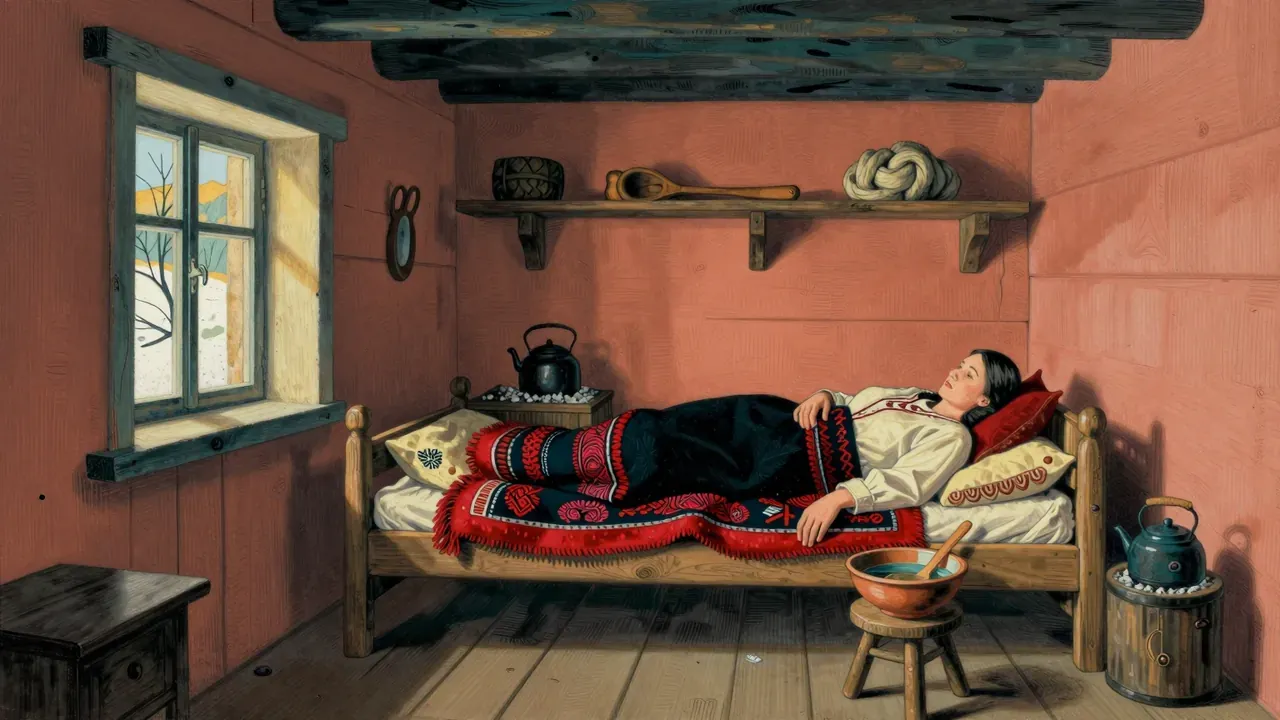
Shadows of Forgotten Ancestors is a Ukrainian-language film made at the Dovzhenko Film Studios in Kyiv, adapted from Mykhailo Kotsiubynskyi’s 1911 novella. It sets out to render a Hutsul world—not as ethnographic record, but as lived sensory reality: ritual, grief, love, and vengeance folded into landscape, costume, and sound. Sergei Parajanov does not dramatise the blood feud between two Carpathian families as social realism; he treats it as mythic architecture, where gesture replaces exposition and colour functions as syntax. The film avoids psychological interiority in favour of symbolic recurrence—repeated motifs of fire, water, embroidery, and procession anchor meaning outside dialogue. Though released under the Soviet banner, it resists assimilation: shot in the Hutsul dialect, scored with folk-derived orchestral writing and unaccompanied choral singing, it asserts cultural specificity as formal necessity. Its ambition is neither documentary fidelity nor narrative efficiency, but the reconstitution of a worldview through image and rhythm—a cinematic invocation rather than illustration. Word count: 142
How it moves
The story follows Ivan Mykolaichuk’s Ivan, a young Hutsul man whose love for Marichka (Nina Alisova) is severed by her accidental death, then rekindled in spectral form after his marriage to Palagna (Larisa Kadochnikova). Yuri Ilyenko’s cinematography moves between tight, frontal tableaux and fluid tracking shots across mountain paths and wooden interiors, often using shallow focus and saturated primary hues—crimson wool, indigo sky, chalk-white skin—to compress emotional weight into texture. Performances are stylised but not theatrical: faces remain still while hands, feet, and eyes carry narrative charge. Myroslav Skoryk’s score interweaves field-recorded folk fragments with atonal string writing, its leitmotifs binding character to place. Editing avoids continuity logic; dissolves and abrupt cuts align with ritual time, not clock time. Costume, choreography, and framing all derive from Hutsul material culture—not as backdrop, but as grammar. The film’s craft coheres as a single system: every decision serves the articulation of a world where spirit and soil are inseparable. Word count: 156
What stays
What lands most decisively is the film’s physical presence—the way fabric catches light, how breath steams in cold air, how a funeral procession winds like ink across snow. The wedding sequence, with its layered chants, rhythmic drumming, and slow-motion flour-throwing, achieves a density of sensation few films match. The use of non-professional extras from Kryvorivnia village grounds the stylisation in lived gesture: no actor mimes grief; they weep, stagger, or collapse with bodily conviction. Skoryk’s ‘Willow Board’ motif, sung by an anonymous choir, gains emotional force precisely because it is unattributed, communal, unrepeatable. The film’s refusal of Russian dubbing—insisted upon by Parajanov—means Ukrainian language and Hutsul intonation operate as musical instruments, not just carriers of plot. Even viewers unfamiliar with the culture register the weight of repetition: the same red shawl appears in birth, marriage, and burial scenes, not as symbol but as witness. This consistency of texture gives the film its haunting durability. Word count: 152
Where it slips
What does not land is the attempt to sustain narrative momentum across its ninety-five minutes. The second half, following Ivan’s descent into madness and possession, grows diffuse: visual invention remains high, but cause-and-effect dissolves into associative drift. Palagna’s arc lacks the anchoring specificity of Marichka’s; her motivations blur into archetype. Some transitions—between dream and waking, memory and present—rely on stylistic flourish rather than structural clarity, leaving gaps that feel unresolved rather than poetic. The film’s resistance to exposition works against accessibility: without prior knowledge of Hutsul mourning rites or folk cosmology, key scenes risk appearing decorative rather than consequential. A viewer expecting psychological causality or moral resolution will find neither. The film assumes immersion, not explanation—and while that deepens its power for some, it also erects a threshold many will not cross. Its rigour is also its barrier. Word count: 149
What it carries
The themes that matter are inheritance and erasure: how ancestral memory persists not in stories told, but in the grain of wood, the warp of cloth, the pitch of a chant. The title names what the film refuses to forget—ancestors not as figures in history books, but as presences embedded in landscape and custom. Blood feud here is less about grudge than about the inescapability of lineage: Ivan cannot choose outside his kin’s rhythms any more than he can breathe outside mountain air. Grief is not private but collective, performed in step, in song, in shared silence. The film treats time cyclically—seasons turn, rituals repeat, deaths recur—not as fatalism but as insistence on continuity. Even the Soviet context presses in obliquely: the film’s very existence, its linguistic and cultural specificity, becomes quiet resistance. Its magic realism is not escapism but a method of holding space for what official histories omit: vernacular belief, embodied knowledge, the sacredness of craft. Word count: 148
Who it meets
This film is for viewers who value image and sound as equal partners in meaning-making, who accept that narrative may unfold through pattern rather than progression, and who trust sustained attention over exposition. It rewards patience with cumulative intensity. Those who rely on spoken exposition, linear plotting, or psychological motivation will find it alienating—not because it is obscure, but because it operates by different rules. Viewers expecting Ukrainian cinema to conform to Soviet-era socialist realism or post-Soviet national allegory will misread its aims. It is not for those who need closure, explanation, or emotional signposting. A student of folklore or ethnomusicology may connect immediately; a casual viewer seeking entertainment may disengage within twenty minutes. Its demands are formal, not intellectual: it asks for receptivity, not interpretation. Word count: 147
Is it enough
Yes, it is worth your evening—if you grant it your full attention and suspend habits of narrative consumption. Its ninety-five minutes accumulate a physical and emotional resonance few films achieve. It repays repeated viewing: details missed first time—how light shifts on a wooden wall, how a hand trembles before a mirror—become anchors on return. It is not ‘difficult’ in the sense of being obscure, but demanding in its insistence on presence. Those who dismiss it as ‘too slow’ or ‘too strange’ are not wrong—but their verdict depends on expectations the film never invites. Change the condition—watch it on a large screen, in silence, without distraction—and the experience shifts fundamentally. Its value lies not in what it says, but in how thoroughly it inhabits its own terms. Word count: 145