The shape of it
Marriage Story is a domestic drama about the slow, mutual unravelling of a ten-year marriage under the pressure of separation, relocation, and custody negotiation. It does not aim to diagnose divorce as systemic failure or personal tragedy, but to track how two intelligent, affectionate people become instruments of each other’s distress through procedural rigidity, professional encouragement, and accumulated silence. Noah Baumbach writes from lived proximity to the subject — his own divorce, his parents’ — yet avoids autobiography by anchoring the film in craft: structure, rhythm, restraint. The script treats legal process not as backdrop but as narrative engine, with each filing, meeting, and courtroom exchange recalibrating emotional weight. It is not a film about whether Charlie and Nicole love each other, but about how love persists as memory, habit, and residue even as it ceases to be functional. Its ambition is narrow and precise: to show what happens when care becomes collateral in a system built for conflict. It makes no claim to universality; its specificity — New York theatre, LA television, MacArthur grants, mediation worksheets — is its method, not its limitation. (158 words)
The sound of it
The story unfolds across two coasts and twelve months, structured around key documents: a mediation worksheet, divorce papers, custody filings, and a final settlement. Adam Driver and Scarlett Johansson carry this without recourse to theatricality; their performances are calibrated in micro-shifts — a pause before answering, a hand withdrawing from a shoulder, a breath held too long. Laura Dern’s Nora Fanshaw operates with surgical clarity, her lines delivered with the quiet authority of someone who has memorised every loophole. Robbie Ryan’s cinematography avoids flourish: he keeps frames tight in apartments and offices, uses shallow focus to isolate faces mid-argument, and lets natural light decay across afternoon scenes in LA. Jennifer Lame’s editing sustains tension not through pace but through asymmetry — cutting away just before resolution, holding on a reaction after dialogue ends. Randy Newman’s score is sparse, mostly piano and strings, never underscoring emotion but marking transitions between states: from hope to fatigue, from anger to exhaustion. The craft serves accumulation, not climax. (159 words)
The weight of it
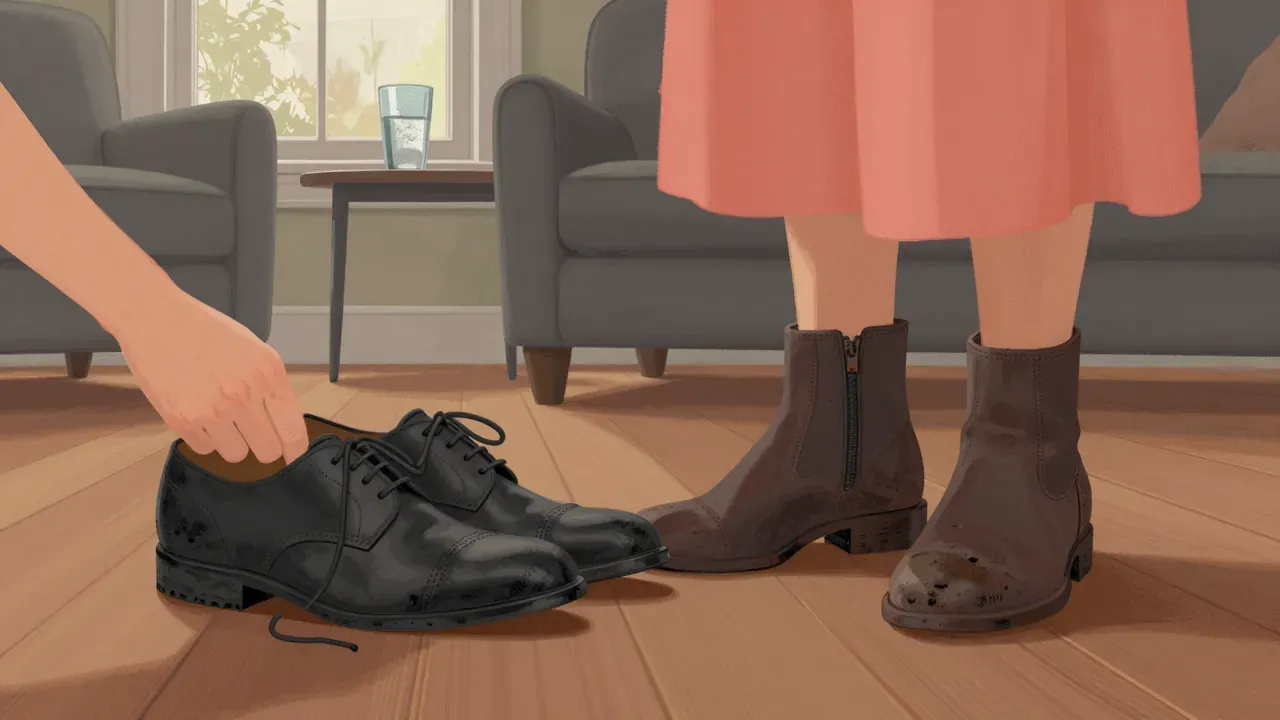
What lands is the cumulative weight of small betrayals — not infidelity alone, but the erosion of shared language, the way Charlie edits Nicole’s ideas in rehearsal, the way she stops correcting his mispronunciation of Henry’s teacher’s name. The Halloween argument in the kitchen lands because it arrives without music or cutaways, sustained over six uninterrupted minutes, its violence rooted in accuracy rather than volume. The final scene lands because it refuses catharsis: Nicole tying Charlie’s shoelace is not reconciliation, but continuity — a gesture that predates the divorce and survives it. The film’s restraint allows these moments to settle without interpretation. Even minor roles register: Merritt Wever as Charlie’s pragmatic sister, Alan Alda as Bert Spitz, whose kindness feels earned, not sentimental. The courtroom scenes avoid caricature by showing lawyers not as villains but as professionals doing a job shaped by incentives — Nora’s confidence, Jay’s aggression, Bert’s fading relevance. The film trusts the audience to hold contradiction: that love and resentment can occupy the same sentence, the same breath, the same room. (157 words)
The gaps in it
What does not land is the framing device of the opening montage — Charlie and Nicole listing what they love about each other, narrated over home-video footage. It sets up an expectation of symmetry that the film deliberately abandons, and its reappearance at the end feels less like resolution than structural obligation. The character of Ray Liotta’s Jay Marotta remains underdeveloped; his volatility reads as plot function rather than personhood, and his exit from the story leaves no echo. Some supporting figures — Julie Hagerty as Nicole’s mother, Wallace Shawn as Charlie’s producer — exist only to confirm traits already established, offering exposition rather than dimension. The film’s bi-coastal structure, while thematically coherent, occasionally flattens geography into shorthand: New York as artistic integrity, LA as compromise — a binary the script otherwise resists. There is also a slight imbalance in perspective: Charlie’s interiority is rendered with more granularity than Nicole’s, particularly in scenes where she is alone. This is not a flaw in performance — Johansson’s work is exacting — but in construction, where certain silences feel authorial rather than character-driven. (156 words)
The cost of it
The themes that matter are procedural dehumanisation, the gendered labour of emotional maintenance, and the difference between fairness and feeling fair. The film treats divorce not as rupture but as administrative accretion: each form filed, each email forwarded, each lawyer retained adds friction until intimacy becomes impossible. It shows how systems designed to resolve conflict instead reward escalation — Nora’s strategy works not because it is just, but because it is effective within the rules. Nicole’s quiet withdrawal of consent — her refusal to read the mediation list, her decision to hire counsel, her eventual silence during Charlie’s apology — is framed not as pettiness but as self-preservation. The film also examines how care is measured: Charlie measures it in time spent, Nicole in attention given. Their son Henry is neither symbol nor prop; his growing discomfort with their performative civility is the film’s moral compass. The theme of legacy — artistic, familial, emotional — runs beneath every scene, most plainly in Charlie’s theatre work and Nicole’s television directing, both acts of shaping narrative, both increasingly distant from their shared past. (159 words)
The audience for it
This film is for viewers who tolerate ambiguity, who find emotional precision more compelling than dramatic payoff, and who do not require redemption arcs or narrative closure. It suits those familiar with the texture of long-term relationships — the weight of unspoken assumptions, the fatigue of repeated explanations, the way grief and relief arrive simultaneously. It is not for viewers who need clear antagonists, rapid pacing, or tonal consistency; the film’s shifts between dry humour and raw confrontation may feel jarring without patience. Those expecting a polemic against the legal system or a feminist manifesto will find neither — the film declines to assign blame beyond the structural. People who dislike passive protagonists or films that withhold catharsis may leave frustrated. A viewer who values thematic coherence over plot momentum, or who finds resonance in restraint, will respond more readily than one who seeks propulsion or uplift. The verdict rests on tolerance for duration, not difficulty. (158 words)
The time it takes
Yes, it is worth your evening — provided you watch it undistracted, in one sitting, and without expectation of resolution. Its value lies in accumulation, not revelation: the third viewing reveals nuances the first misses, not because it hides meaning but because it trusts time to do its work. It rewards attention to gesture, silence, and repetition — Charlie adjusting his glasses before speaking, Nicole folding laundry while delivering legal terms, Henry’s costume changing three times in the final scene. Those who dislike slow-burn realism or find extended domestic conflict emotionally taxing may prefer to skip it; the film offers no escape hatch, no comic relief that lands outside its world. It is not ‘heavy’ in the sense of being oppressive, but it is dense — every line carries history, every frame contains memory. Its runtime is justified by its method: this is not a story told in beats, but in breaths. To ask whether it is ‘entertaining’ misunderstands its purpose. It is absorbing, exacting, and ultimately humane — not despite its sadness, but because of its refusal to simplify it. (159 words)