The shape of time
All We Imagine as Light is a drama set in contemporary Mumbai and Ratnagiri, following three women — two nurses and their hospital cook — as they navigate quiet longing, unspoken desire, and the slow erosion of stability in urban India. It does not aim for plot propulsion or social exposé but instead holds space for duration, gesture, and ambient resonance: the weight of silence between colleagues, the texture of monsoon light on concrete, the way a rice cooker’s German origin becomes a silent counterpoint to marital absence. Payal Kapadia’s film treats narrative not as a line to be followed but as a surface to be observed — like water reflecting sky, then cloud, then nothing at all. It seeks neither diagnosis nor resolution but attentiveness: to how care circulates among women who are professionally trained to tend others while receiving little in return. The film’s ambition lies in its refusal to translate feeling into exposition, trusting the viewer to sit with what is shown, not told.
The look of it
The story unfolds across two locations — Mumbai’s dense, vertical chawls and Ratnagiri’s coastal flatness — with Ranabir Das’s cinematography holding both in equal, unsentimental regard. Interior scenes are lit with low-contrast naturalism; exteriors absorb monsoon haze and sodium-vapour streetlight without stylisation. Kani Kusruti’s Prabha moves with contained tension, her stillness calibrated so precisely that a single blink registers as emotional event. Divya Prabha’s Anu offers contrast not through volume but through micro-shifts in posture and gaze — a shoulder dropping, a glance held half a second too long. Chhaya Kadam’s Parvaty grounds the film in physical presence: hands kneading dough, feet bare on wet earth, voice steady even when her world contracts. Clément Pinteaux’s editing avoids rhythm for its own sake; cuts land where breath pauses, not where emphasis demands. There is no score — only diegetic sound: distant trains, dripping taps, the hum of a fridge, the rustle of a sari against plastic chairs.
The weight of small things
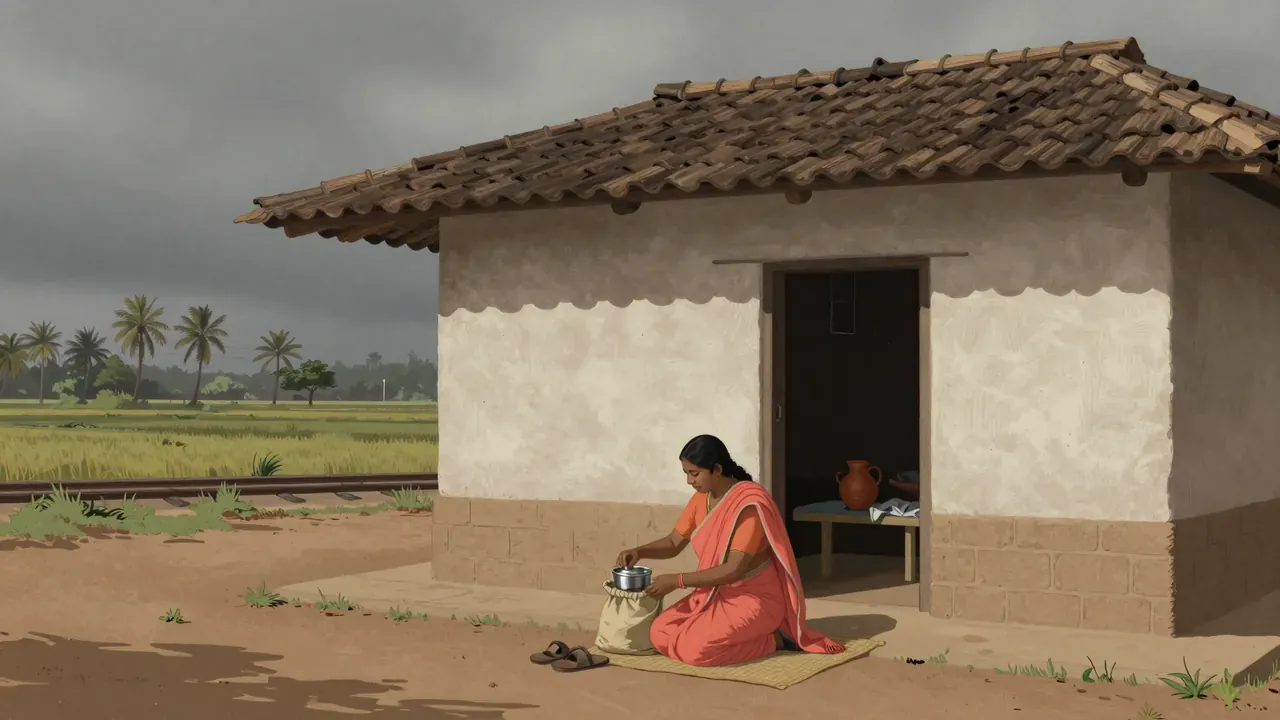
What lands is the cumulative weight of small, unremarkable acts: Prabha washing a stranger’s back after CPR, Anu folding laundry while listening to Shiaz’s voice on the phone, Parvaty packing a single steel tiffin into a cloth bag before leaving her home. These moments accrue without commentary, building a portrait of resilience that refuses heroism. The film’s restraint pays off in scenes where intimacy emerges not through dialogue but proximity — two women sharing a single towel, fingers brushing over a shared cup of tea, the way light catches sweat on a neck during a walk along the shore. The Cannes Grand Prix was earned not by spectacle but by this fidelity to the unperformed life: the life lived between shifts, between calls, between promises made and left unanswered. Its power resides in what it omits — no flashbacks, no voiceover, no explanatory cutaways — trusting the audience to read meaning in the grain of skin, the tilt of a head, the pause before a yes.
Where the light doesn’t fall
What does not land is the structural looseness around Dr Manoj’s subplot and the drowned man’s reappearance as Prabha’s husband. Neither character integrates cleanly into the film’s central triad; both arrive with narrative expectation — romantic interest, psychological reckoning — then recede without resolution or sufficient grounding. The husband’s scene on the beach feels tonally adrift, its emotional logic unearned by what precedes it. Similarly, the rice cooker motif, introduced with quiet significance, dissipates without returning as symbol or catalyst. These elements do not break the film but create minor gravitational inconsistencies — moments where attention drifts, not from disengagement, but from a sense that the film’s internal economy has momentarily misallocated weight. A tighter focus on the three women’s interdependence, without reaching for external male figures to anchor their interiority, would have sharpened its coherence without sacrificing ambiguity.
What the light reveals
The themes that matter are care as labour, displacement as condition, and visibility as privilege. The film treats nursing not as vocation but as embodied practice — hands washing wounds, backs bent over beds, eyes scanning monitors while exhaustion pools behind the lids. Displacement operates on multiple scales: Parvaty’s forced move from Mumbai to Ratnagiri, Prabha’s emotional exile within marriage, Anu’s navigation of religious difference in intimacy. Visibility is parsed through light and framing: characters often occupy doorways or windows, half-in, half-out of frame; shots linger on surfaces — walls, floors, ceilings — suggesting how environment shapes possibility. The title’s ‘light’ is never metaphorical illumination but literal, changeable, sometimes failing — the kind that flickers in a chawl corridor or glints off wet sand at dusk. These are not abstract concerns but material ones, rooted in housing policy, migration patterns, and the gendered distribution of domestic and professional responsibility.
Who it’s for
This film is for viewers who value sustained attention over exposition, who find emotional resonance in silence and texture rather than dialogue or incident, and who trust that a nurse’s tired smile or a woman’s hand resting on a windowsill can carry the weight of a chapter. It is not for those who require clear cause-and-effect storytelling, narrative payoff, or psychological explanation — viewers who need to know why a character chooses one path over another will leave unsettled. Those accustomed to tightly plotted dramas or films that signal thematic intent through music or montage may find its pace withholding. Its appeal rests entirely on tolerance for ambiguity and faith in the expressive capacity of the everyday. Change the verdict? Only if the film were re-cut to foreground plot mechanics — but that would dissolve what makes it distinct.
What it gives back
Yes, it is worth your evening — not as diversion but as recalibration. Its 118 minutes ask for patience, not passive consumption, and reward that patience with a rare kind of perceptual clarity: the sense of seeing Mumbai, and its women, anew. It does not offer catharsis or argument, but something quieter — recognition. You will not forget the way rain looks on a tiled roof at 3 p.m., or how a shared meal in near-darkness can feel like sanctuary. Those who watch for story alone may feel short-changed; those who watch for the shape of feeling, for the architecture of quiet lives, will find it generous. Its value lies not in what it says but in how it trains the eye and ear to attend — a skill increasingly rare, and increasingly necessary. That makes it more than worthwhile: it makes it essential viewing for anyone who still believes cinema can deepen perception.