The shape of time
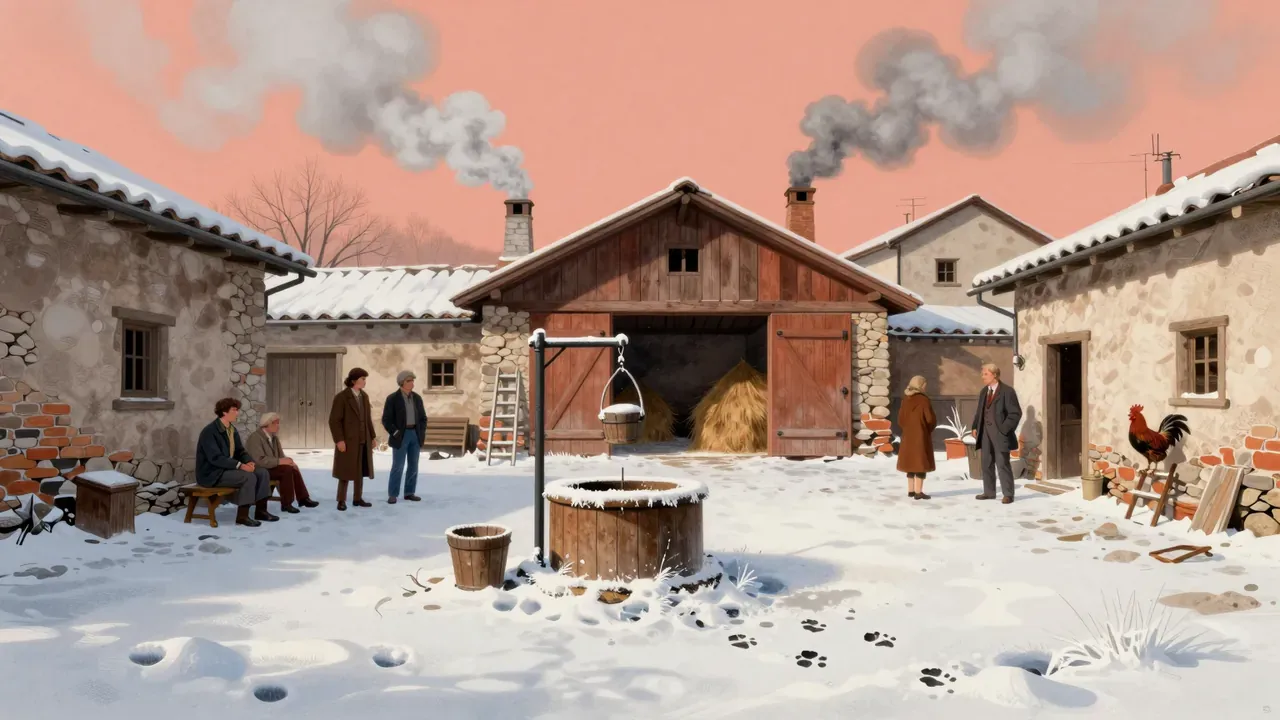
The Tree of Life is a film about scale: the span from cosmic genesis to a boy’s first memory of grief, held in the same frame. It attempts no conventional narrative arc but instead arranges time as resonance — childhood in 1950s Texas, the birth of stars, the emergence of single-celled life, all operating under shared grammar of light, weight, and silence. Terrence Malick does not dramatise ideas so much as immerse them in sensory logic: gravity as a father’s hand on a shoulder, entropy as dust motes in a sunlit hallway, memory as heat shimmer over asphalt. The film’s ambition is structural as much as thematic: to dissolve the hierarchy between human event and natural process, so that a boy’s tear and a nebula’s collapse occupy equivalent ontological ground. It treats cinema not as a window onto story but as a medium for duration itself — for the feeling of time passing before it coheres into meaning. This is not allegory; it is equivalence made visible, sustained across 138 minutes without exposition or pivot.
The look of it
Emmanuel Lubezki shoots almost entirely with natural light, using 35mm, 65mm, and IMAX stock to shift register without warning — from grainy intimacy to vertiginous grandeur. Hank Corwin edits from an estimated 350 hours of footage, cutting dialogue freely, discarding characters mid-scene, allowing silence to hold longer than speech ever could. Performances are understated to the point of erasure: Brad Pitt’s Mr. O’Brien moves through rooms like a weather system, Jessica Chastain’s Mrs. O’Brien barely speaks above breath, Sean Penn’s adult Jack appears mostly in glances and pauses. There is no score in the traditional sense: Alexandre Desplat’s music threads through Brahms, Couperin, Górecki, and Holst, treated as found sound rather than underscore. Douglas Trumbull’s visual effects avoid digital simulation, using milk, smoke, fluorescent dyes, and high-speed photography to render cosmic formation as tactile chemistry. The film’s craft is anti-theatrical: no fixed frame, no lighting rigs, no rehearsed blocking — only camera movement that follows impulse, not intention.
The weight of memory
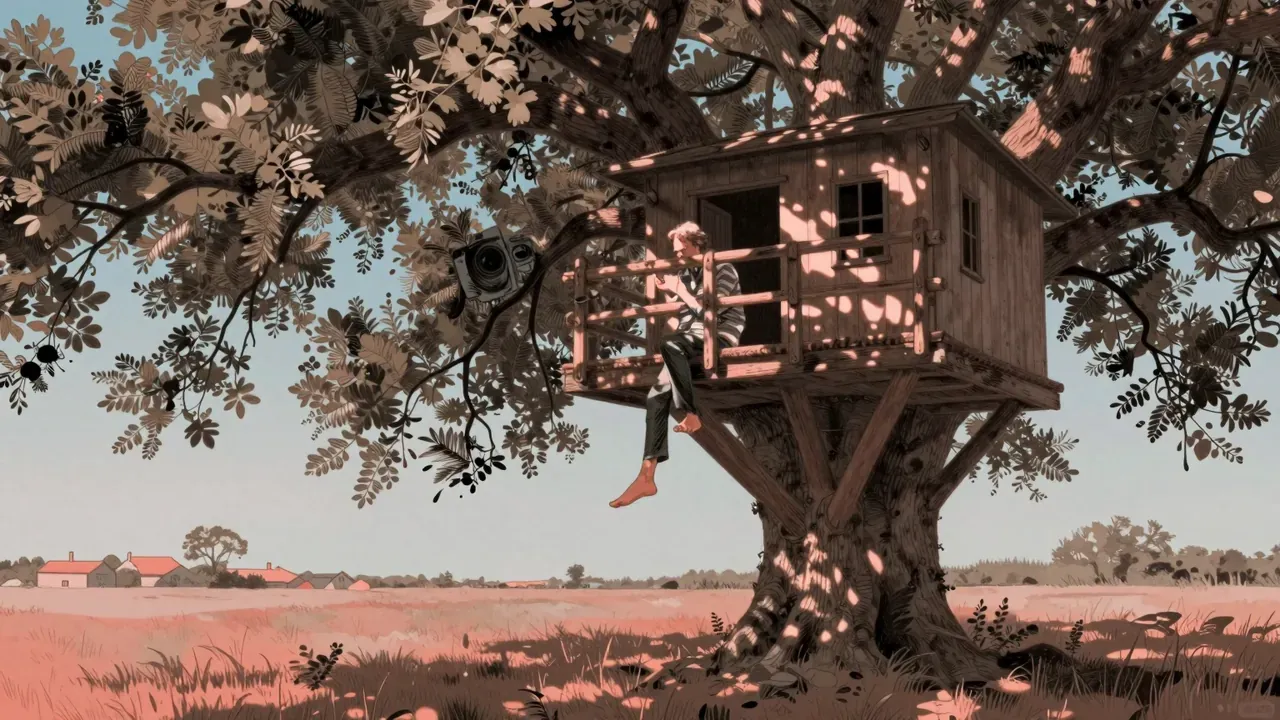
What lands is the texture of memory as physical fact: the way light falls across a kitchen floor at 4 p.m. in July, the weight of a father’s belt in a boy’s hand, the sudden hush when a bird stops singing. The film’s central triptych — cosmic origin, biological emergence, domestic life — holds because each section obeys the same laws of attention: slow accumulation, repetition with minute variation, emphasis on surface and substance over signification. The sequences of childhood — bare feet on hot concrete, a brother’s hand slipping from grasp, a mother’s voice humming off-mic — land with quiet authority because they are rendered without psychology, only presence. Even the universe sequence avoids spectacle: its power comes from slowness, from the refusal to explain what we see. The editing rhythm — long takes punctuated by abrupt cuts to black or to water — creates a pulse that feels less like narrative and more like respiration. This is not emotional manipulation; it is sensory calibration, calibrated over time until the viewer’s nervous system adjusts.
The risk of scale
What does not land is the film’s attempt to unify its scales through abstraction alone. The jump from a child’s grief to the death of a star remains associative, not argumentative — and for some viewers, that gap never closes. The adult Jack’s thread — his office life, his silences, his unspoken regrets — stays underdeveloped, functioning more as framing device than counterpoint. Sean Penn’s performance, though restrained, lacks the granular specificity of the childhood scenes; his face registers sorrow but not its source. The philosophical voiceover, delivered in murmured fragments, risks redundancy when the imagery already carries the weight: repeating ‘grace’ and ‘nature’ does not deepen their meaning so much as name it prematurely. Some transitions feel arbitrary — a cut from dinosaur to dinner table — not because they lack logic, but because the film declines to offer even the suggestion of connective tissue. It assumes a shared metaphysical vocabulary the viewer may not possess, and offers no glossary.
The tension between forces
The themes that matter are not stated but embedded: the tension between structure and surrender, between discipline and tenderness, between the father’s insistence on order and the mother’s faith in grace. These are not abstract ideals but lived forces — in the way a piano lesson collapses into tears, in the way a boy watches ants carry away a dead wasp, in the way a man stands motionless before a glass wall while reflections of trees move behind him. The film treats time not as line but as sediment: every moment contains its predecessors, not as memory but as physics. Childhood is not recalled but re-inhabited — not as story but as somatic echo. The question of meaning is not posed intellectually but physically: where does weight come from? Where does light end? What happens when a hand withdraws? These are not theological inquiries dressed as drama, but perceptual ones — about how attention shapes ontology, how looking changes what exists. The film’s deepest concern is not with origins, but with continuity: how a single life persists, however faintly, across geological and personal time.
Who it is for
It is for viewers who value duration over disclosure, who find patience a form of engagement, who do not require narrative resolution to feel addressed. It rewards those accustomed to listening to silence, to reading light as language, to accepting ambiguity as condition rather than failure. It is not for viewers who need causal clarity, psychological explanation, or consistent tone — those who expect character arcs to resolve, or who find extended abstraction emotionally withholding. A viewer who values tight plotting or explicit theme will likely feel adrift, not challenged. Those who respond to Malick’s earlier work — particularly The New World — will recognise the method, but this film pushes further into ellipsis. Nothing would change the verdict for such a viewer except a different film: one that names its terms, anchors its metaphors, or allows its human figures room to speak plainly. This is not evasion; it is commitment to a different contract.
What it gives back
Yes, it is worth your evening — but only if you arrive prepared to inhabit its rhythm rather than decode its symbols. Its value lies not in what it says but in how it recalibrates perception: after watching, ordinary light feels charged, ordinary silence feels thick with implication. It demands nothing but attention, and repays it with a subtle shift in how time is felt — slower, heavier, more layered. Those who leave disappointed have not misread it; they have simply declined its terms. The film does not fail if you do not ‘get’ it — it succeeds only if you allow it to unsettle your habits of seeing. It is not entertainment, nor instruction, nor therapy. It is a duration-based object, like a bell tolling once, or a tree growing. Its worth is not in consumption but in coexistence. To ask whether it is ‘worth your evening’ is to misunderstand its nature: it does not pass time, it occupies it — fully, quietly, without apology.