The look of it
The Last Wave is a 1977 Australian film that sets out to test the stability of rational consciousness when confronted with phenomena it cannot classify. It follows a Sydney corporate lawyer, David Burton, who takes on a murder case involving four Aboriginal men and begins experiencing dreams, premonitions and perceptual shifts that align with escalating weather anomalies — hailstorms, frog swarms, flooding — which local Aboriginal characters treat as cosmological signals. Peter Weir co-wrote and directed it as a deliberate inquiry into epistemological rupture: what happens when empirical habit collides with Dreamtime logic? The film does not present itself as ethnographic reportage or anthropological exposition; its interest lies in the disorientation of the protagonist’s worldview, not in explaining Aboriginal belief systems to non-Indigenous viewers. It avoids exposition, translation or framing devices that would stabilise meaning for the audience. Instead, it sustains ambiguity — between hallucination and revelation, between cultural misreading and genuine contact — as structural principle. Its ambition is not to resolve but to inhabit the tension.
The rhythm of it
The story unfolds through Burton’s narrowing field of perception: legal procedure gives way to dream logic, then to ritual geography, then to cataclysmic image. Richard Chamberlain’s performance anchors this descent with quiet rigour — his face tightens, his posture stiffens, his speech slows, all without overt theatricality. David Gulpilil, as Chris Lee, works in counterpoint: still, minimal, withholding, never performing ‘mystery’ but embodying presence as a condition of being. Russell Boyd’s cinematography keeps interiors dim and exteriors washed in flat, overcast light; rain is filmed not as drama but as persistent, low-grade pressure. Sound design isolates water — dripping, gurgling, rushing — until it becomes the film’s unconscious. Editing avoids continuity logic in the final third: tunnels, chambers and visions are linked by affect, not geography. There is no score beyond ambient texture and sparse, resonant percussion. The craft does not serve narrative clarity but deepens the sense of cognitive erosion — each department reinforcing the idea that reality is not fixed but contingent on attention, lineage and language.
The law of it
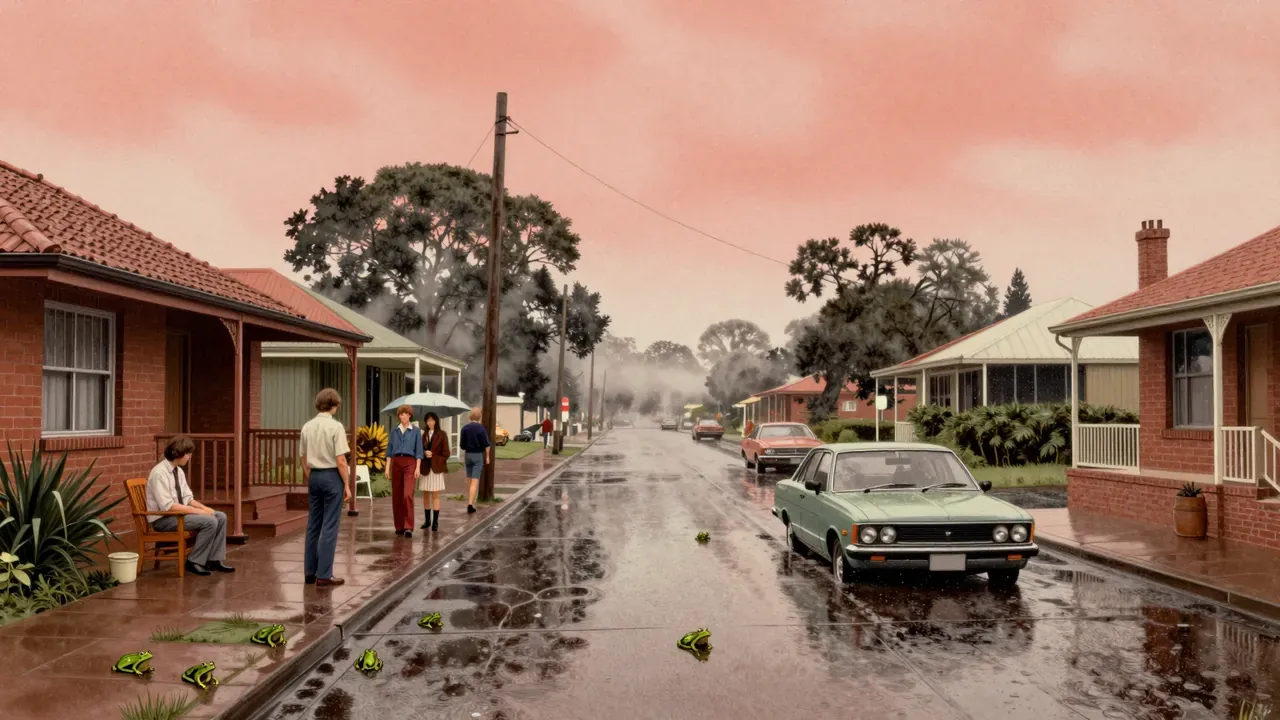
What lands is the film’s sustained atmosphere of ontological unease. The weather feels physically oppressive before it becomes symbolic: the weight of rain on a car roof, the unnatural silence after hail stops, the way floodwater rises without warning in a suburban street. These are not special-effects set-pieces but environmental facts rendered with documentary restraint. The courtroom scenes land because they show institutional friction — not racism as caricature, but as procedural exclusion: the accused speak little English, interpreters are absent or ineffective, legal categories fail to contain the act under scrutiny. Burton’s growing isolation lands because it is shown through small withdrawals: he stops answering the phone, skips meetings, stares too long at water stains on ceilings. The final sequence — the beach, the wave, the look on his face — lands not as resolution but as culmination: a moment where subjective and geological time collapse. It refuses explanation, yet feels inevitable, earned by every prior choice of framing, pacing and silence.
The silence of it
What does not land is the film’s attempt to imply equivalence between Burton’s professional crisis and Aboriginal spiritual sovereignty. The script treats Dreamtime as a metaphysical system accessible to Burton through intuition, not study or relationship — a gesture that risks appropriative mystification. The Aboriginal characters remain largely enigmatic not as a formal choice but as a limitation: their interiority is withheld from the audience as thoroughly as it is from Burton, and the film offers no counterpoint perspective. Olivia Hamnett’s Annie Burton is underwritten — her concern registers as mood rather than agency. The Reverend Burton (Fred Parslow) appears only in one scene, offering no theological counterweight, only paternal disapproval. The legal framework dissolves too quickly: once Burton abandons precedent, the trial ceases to function as dramatic engine. Some plot points — the bone-pointing curse, the shaman’s sudden violence — feel less like cultural logic and more like narrative shortcuts to raise stakes. The film’s refusal to clarify leaves room for ambiguity, but also for misreading — a risk it does not acknowledge.
The time of it
The themes that matter are colonial epistemology, temporal dissonance and the limits of translation. The film asks what happens when two knowledge systems — one built on precedent and evidence, the other on ancestral continuity and place-based memory — occupy the same geography but refuse commensurability. Time behaves differently: European time is linear, measurable, segmented; Aboriginal time is cyclical, layered, embedded in landforms and stories. The weather anomalies are not ‘disasters’ in the Western sense but markers of alignment — a recalibration that Burton’s mind cannot process without breaking. Ritual is not spectacle but infrastructure: the subterranean tunnels are not metaphor but actual pathways mapped onto Dreaming tracks. The film treats law, geology and cosmology as overlapping disciplines, each with its own grammar and jurisdiction. Its central question is not whether the apocalypse is coming, but whether Burton — and by extension, settler Australia — has the perceptual capacity to recognise it when it arrives not as event but as return.
The wave of it
This film is for viewers who tolerate slow accrual over exposition, who find dread in silence and resonance in repetition, and who accept that some films work by withholding rather than revealing. It rewards patience with texture: the grain of rain on glass, the echo in a tunnel, the weight of a stone mask held in trembling hands. It is not for those who require clear cause-and-effect, character motivation spelled out, or closure that confirms rather than unsettles. Viewers expecting a courtroom drama, a thriller or even a conventional mystery will find it frustrating — the murder case is a pretext, not a puzzle to solve. Those who approach it as allegory or anthropology will misread it: it is neither. Disagreement arises most sharply around its treatment of Aboriginal knowledge — some see reverence, others extraction. A different verdict would follow if the film gave equal narrative weight to an Aboriginal protagonist’s inner life, or if it showed the legal system adapting rather than collapsing under pressure.
The weight of it
Yes, it is worth your evening — not as entertainment but as calibration. Its 110 minutes do not pass quickly, but they accumulate density: the rhythm of water, the slowness of realisation, the gravity of unspoken things. It demands attention without rewarding it with answers, and that is its integrity. You will not leave understanding Dreamtime, but you may leave less certain about the solidity of your own categories — law, time, self, weather. It is not for casual viewing, nor for background consumption; it requires sitting still, watching closely, letting discomfort settle. Those who dismiss it as ‘slow’ or ‘obscure’ mistake its method for its failure. Its power lies in how little it explains — and how much it implies. To watch it is to accept an invitation to perceive differently, even if only for the duration of the film. That shift, however slight, is rare and valuable.