The shape of it
Hamlet is a 1948 British film adaptation of Shakespeare’s tragedy, directed by, written by, and starring Laurence Olivier. It is not an attempt to stage the full text on screen, nor to modernise the setting or psychology; it is a deliberate distillation — a cinematic argument for the play’s central thrust: Hamlet’s paralysed will, his inwardness, his delay as both flaw and necessity. Olivier cuts over half the lines, removes Fortinbras entirely, omits Rosencrantz and Guildenstern’s journey to England, and frames the action with a funereal prologue and epilogue that fix the story as a closed, fatal cycle. The film seeks coherence through emphasis, not completeness — narrowing focus to the prince’s consciousness, his relationship with Gertrude, and the moral weight of revenge in a world stripped of divine certainty. Its ambition is structural and psychological: to make Shakespeare legible in black-and-white film grammar, using camera movement, sound design, and performance rhythm as interpretive tools rather than decorative additions. It treats the play not as scripture but as material — malleable, urgent, and bound to the medium’s capacities.
The look of it
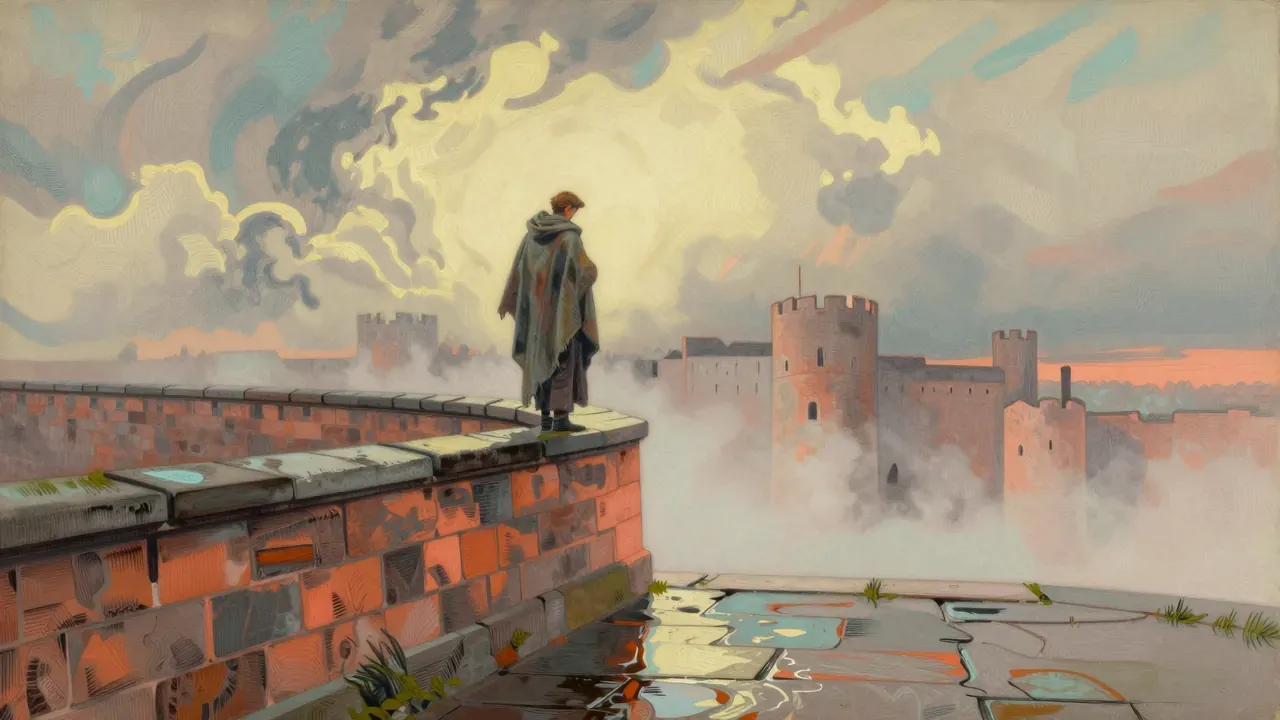
The story unfolds in stark, claustrophobic interiors and fog-draped battlements, lit by Desmond Dickinson with deep focus that holds foreground and background in equal, uneasy tension — a visual analogue for Hamlet’s divided attention. Olivier’s performance anchors the film: physically coiled, voice modulated between whisper and incantation, his Hamlet is less a scholar-prince than a man perpetually listening to himself think. Basil Sydney’s Claudius is all polished menace, Eileen Herlie’s Gertrude tremulous and uncomprehending, Jean Simmons’ Ophelia fragile without affectation. William Walton’s score pulses like a suppressed heartbeat, underscoring psychological pressure rather than illustrating action. Helga Keller’s editing sustains a slow, ritual tempo — pauses linger, dissolves are weighted, flashbacks are treated as memory, not exposition. Sound design is unusually precise: the Ghost’s entrance is built from layered shrieks, groans, and violin screeches, then punctuated by a slowed, amplified heartbeat — a decision made deliberately, with credit given to Jean-Louis Barrault. Every craft choice serves interiority over spectacle.
The weight of it
What lands is the film’s sustained atmosphere of psychic enclosure — the sense that Elsinore is less a castle than a skull, its corridors echoing with self-reproach. Olivier’s direction makes Hamlet’s soliloquies feel like involuntary reflexes, not rhetorical set-pieces; the ‘To be’ speech, delivered lying on a bare rock outcrop under grey sky, strips away theatricality and leaves only raw, exhausted questioning. The Ghost sequences work because they are tactile: the sound design unsettles before the image appears, and the blurred focus syncs with the pulse so that vision itself seems compromised. The duel’s final minutes avoid melodrama by keeping the camera close, handheld almost, catching the confusion of poisoned wine, switched rapiers, and collapsing bodies as physical collapse rather than symbolic climax. Even the omissions serve clarity: removing Fortinbras sharpens the focus on consequence without resolution, and cutting Polonius’s sententiousness makes his death land as sudden, brutal, and morally ambiguous. The film’s austerity — its refusal to flatter or explain — gives its emotional moments weight without sentimentality.
The strain in it
What does not land is the film’s occasional stiffness in transition — scenes sometimes end with abrupt cuts that break rhythm rather than deepen it, as if the editing hesitates between theatrical cadence and cinematic flow. Some supporting performances feel under-served by the script’s truncation: Peter Cushing’s Horatio is loyal but muted, Anthony Quayle’s Laertes lacks the fiery grievance that would make his alliance with Claudius credible. The production design, while nominated for an Oscar, leans heavily on gothic cliché — dripping stone, vaulted shadows — without varying tone enough to suggest a world beyond decay. Olivier’s own Hamlet, though compelling, can feel too consistently cerebral; the boyish impulsiveness or reckless humour of the early court scenes is largely absent, flattening the arc from prince to avenger. And the decision to age Gertrude down — casting 29-year-old Eileen Herlie opposite 40-year-old Olivier — creates an unintended dissonance in their fraught intimacy, one the film never acknowledges or uses. These are not failures of intent, but of execution under constraint.
The thought in it
The themes that matter are delay, perception, and the unreliability of language as a tool for truth. Hamlet’s hesitation is neither cowardice nor calculation, but a crisis of epistemology: how to act when evidence is spectral, motive obscured, and justice indistinguishable from vengeance. The film stresses this through repeated framing — characters seen through archways, behind curtains, reflected in tarnished mirrors — all suggesting fractured or mediated reality. Gertrude’s inability to see the Ghost becomes a metaphor for generational blindness: she inhabits the same space but not the same moral universe. Claudius’s prayer scene is shot not as piety but as physical strain — sweat on his brow, hands clenched — exposing the hollowness of ritual without conviction. The film also treats mourning as performance: the opening and closing processions are identical in composition, implying grief has become ceremonial, not felt. There is no redemption here, only consequence — and the quiet horror of realising, too late, that action taken in certainty may be no truer than inaction taken in doubt.
The audience for it
This film is for viewers who value precision of intention over completeness of text — those willing to meet Shakespeare through a single, forceful cinematic interpretation rather than a neutral record of the play. It suits students of adaptation, practitioners of craft, and anyone attentive to how sound, light, and rhythm shape meaning. It is not for those who require fidelity to the Folio text, or who expect psychological realism to extend to historical plausibility — the compressed timeline, flattened relationships, and stylised delivery will read as omission, not emphasis, to some. Nor is it for viewers who prefer narrative propulsion over contemplative pacing: its 150 minutes unfold like a slow exhalation, not a chase. Those who found Olivier’s Henry V too declamatory or too ornate may find this more austere but no less mannered. A viewer who values textual richness above all would reasonably prefer Kenneth Branagh’s 1996 version — longer, fuller, and more generous to secondary voices.
The time for it
Yes, it is worth your evening — but only if you watch it as a film, not as a substitute for reading the play. Its power lies in what it chooses to omit and how it renders what remains: a study in moral suspension, rendered in monochrome texture and acoustic unease. It rewards attention to detail — the way Walton’s strings drop out before Claudius speaks, the slight tremor in Herlie’s voice when she says ‘I doubt it is no other but the main’ — details that accumulate into something heavier than plot. It is not for casual viewing, nor for those seeking entertainment in the conventional sense; its pace demands patience, its silences demand listening. A viewer who expects Shakespeare to be ‘accessible’ through simplification will find it forbidding. But for those who accept that difficulty can be expressive — that ambiguity is not evasion but honesty — it remains singular. Its worth is not in what it explains, but in how thoroughly it embodies a question.