What it is
Marie Antoinette is a stylised, subjective portrait of adolescence under imperial constraint — not a biographical chronicle, but a mood piece built around Kirsten Dunst’s Marie as a girl displaced, observed, and gradually hollowed out by ritual and expectation. Sofia Coppola adapts Antonia Fraser’s sympathetic biography not to reconstruct history but to transpose its emotional architecture into a register of contemporary feeling: the boredom, the performative cheer, the quiet panic beneath powdered hair and silk. The film deliberately omits political machinery — no Estates-General, no fiscal debates, no pamphleteering — and treats Versailles less as a seat of power than as a gilded boarding school with lethal consequences. Its ambition is tonal fidelity over factual fidelity: to render the queen’s inner life as it might have registered to someone her age, unmoored from context but saturated with sensation. It privileges texture over exposition, repetition over progression, and silence over speech. This is not negligence; it is method. Coppola’s stated aim — to humanise, not instruct — shapes every choice, from casting to cut to costume.
How it works
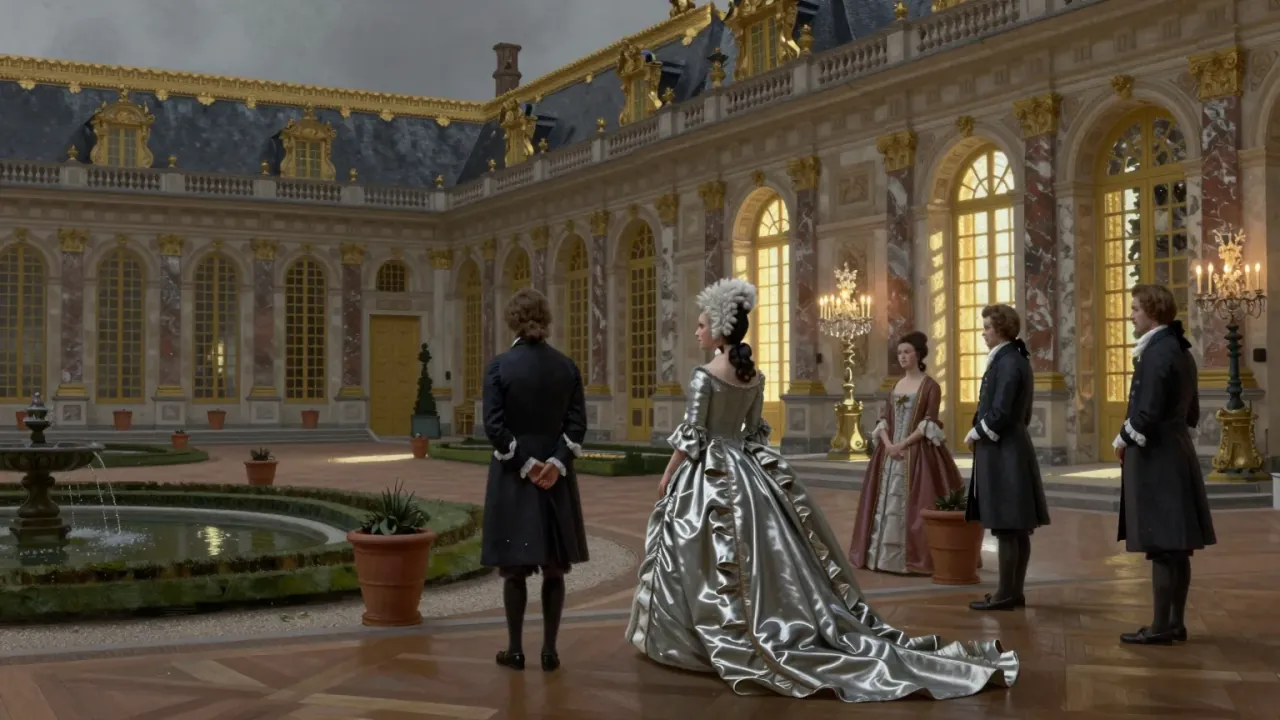
The story unfolds in episodic vignettes, skipping years without transition, trusting rhythm and recurrence — the rustle of taffeta, the chime of a bell, the slow pan across a banquet table — to imply time’s passage and emotional erosion. Dunst’s performance is restrained, often wordless, relying on micro-expressions and physical withdrawal; Schwartzman’s Louis XVI is gently awkward, his silence more telling than any soliloquy. Lance Acord’s cinematography favours shallow focus and diffused light, keeping faces soft and backgrounds blurred — a visual analogue to Marie’s narrowing world. Sarah Flack’s editing avoids conventional cause-and-effect sequencing; scenes bleed or abut without explanation, mimicking memory rather than narrative logic. Costume design by Milena Canonero dominates the frame — not as decoration but as character: each gown is a social contract, each wig a barrier, each shoe a restraint. Jean-Philippe Rameau’s harpsichord lines sit alongside New Order and Bow Wow Wow, not as anachronism but as sonic continuity — teenage restlessness unchanged across centuries. The music does not comment; it inhabits.
What lands
What lands is the cumulative weight of small exclusions: the way courtiers turn their backs mid-conversation, the repeated shot of Marie’s hand adjusting a glove she cannot remove, the hush that falls when she enters a room not because she commands it but because no one knows what to say. The Petit Trianon sequences succeed precisely because they feel like stolen breath — light, unstructured, momentarily free of surveillance. Dunst’s portrayal of growing detachment is persuasive: not rebellion, but retreat. The film’s most effective moments are silent — Marie staring at her reflection after childbirth, or watching fireworks from a balcony while servants rearrange furniture behind her. The costume design earns its Oscar not for extravagance alone but for how fabric becomes psychology: stiff brocade constricting movement, pastel silks signalling enforced innocence, mourning black arriving too late and too briefly. These choices cohere into a sustained, melancholy tone — less about what happened than how it felt to be inside that skin, at that age, in that cage.
What does not
What does not land is the film’s refusal to anchor its subject in consequence. Without political or economic context, the Revolution arrives as weather — sudden, violent, inexplicable — rather than culmination. The term ‘Madame Deficit’ appears without financial detail; bread shortages are implied through glances, not queues or ledgers. This omission risks aestheticising suffering, turning structural collapse into backdrop. Some performances falter under the weight of minimalism: Jason Schwartzman’s Louis XVI remains opaque where ambiguity was likely intended, but opacity without subtext reads as vacancy. The soundtrack’s bold juxtaposition works only when it serves interiority; elsewhere, Siouxsie and the Banshees over a montage of cake-eating can feel flippant rather than ironic. The film’s modern idiom — the pop-video pacing, the flat affect — assumes a shared cultural shorthand that not all viewers possess. When style carries all the meaning, any misalignment between intention and reception breaks the circuit entirely.
The themes that matter
The themes that matter are isolation within proximity, the performance of self under scrutiny, and the slow corrosion of agency masked as privilege. Marie Antoinette is less about monarchy than about girlhood under institutional gaze — how femininity is policed, how autonomy is rationed, how identity is negotiated through dress, diet, and decorum. The film treats Versailles as a total institution: every gesture is codified, every relationship transactional, every emotion subject to audit. Even intimacy is mediated — first by Maria Theresa’s letters, then by Joseph II’s locksmith metaphor, then by Fersen’s coded glances. The Petit Trianon is not escapism but a different kind of enclosure: curated, private, yet still watched. The film’s quietest theme is exhaustion — not of decadence, but of constant calibration. There is no villain, only systems: etiquette as discipline, motherhood as duty, fashion as labour, silence as survival. These are not period concerns. They are persistent ones.
Who should watch it
This film rewards viewers who value atmosphere over exposition, who accept ambiguity as rigour, and who respond to sensory immersion as argument. It suits those familiar with Coppola’s earlier work — particularly Lost in Translation — and comfortable with elliptical storytelling. It will frustrate viewers seeking historical clarity, causal plotting, or moral framing. Historians may object to its omissions; traditional biopic audiences may find it emotionally distant. Those who require clear stakes, defined antagonists, or narrative momentum will leave unsatisfied. A viewer who values thematic resonance over factual fidelity, who reads silence as meaning, and who trusts image and sound to carry psychological weight will find it rich. Anyone needing the French Revolution explained — or who finds stylistic consistency indistinguishable from emptiness — should look elsewhere. The film’s success depends on surrender, not scrutiny.
Is it worth your evening
Yes, it is worth your evening — provided you watch it on its own terms. It is not a history lesson, nor a thriller, nor a critique of aristocracy; it is a sustained tone poem about confinement, rendered with precision and restraint. Its 123 minutes pass with the quiet inevitability of a clock winding down — not rushed, not padded, but measured. Some will call it shallow; others will call it devastating. The difference lies not in the film but in what the viewer brings: patience for repetition, tolerance for unresolved tension, willingness to sit with discomfort without resolution. It repays attention not through revelation but through accumulation — a single glance, a repeated motif, a shift in lighting building toward something felt rather than stated. To dismiss it as frivolous is to mistake its discipline for indifference. To embrace it is to accept that some truths are held in the space between words, not inside them.