The shape of the story
The Dead is a filmed adaptation of James Joyce’s 1914 short story, set in Dublin on Epiphany night, 1904. It attempts to translate the story’s quiet accumulation of emotional weight — its slow pivot from social observation to interior revelation — into cinematic terms without recourse to exposition or psychological shorthand. The film does not dramatise Michael Furey’s death; it holds Gretta’s recollection as an unrepeatable, unverifiable event that lands with the force of fact because she tells it. Its ambition is structural and tonal: to sustain the hush of a snowfall over narrative action, to let silence and gesture carry what dialogue only hints at, and to treat Gabriel Conroy’s epiphany not as climax but as quiet dissolution — the moment he stops performing himself and begins to feel the cold weight of mortality, memory, and love’s asymmetry. It is not a biographical film about Joyce, nor a period spectacle; it is a chamber piece in which every detail — the piano’s resonance, the steam off a teacup, the way light falls across a starched collar — serves the slow erosion of certainty.
The look of it
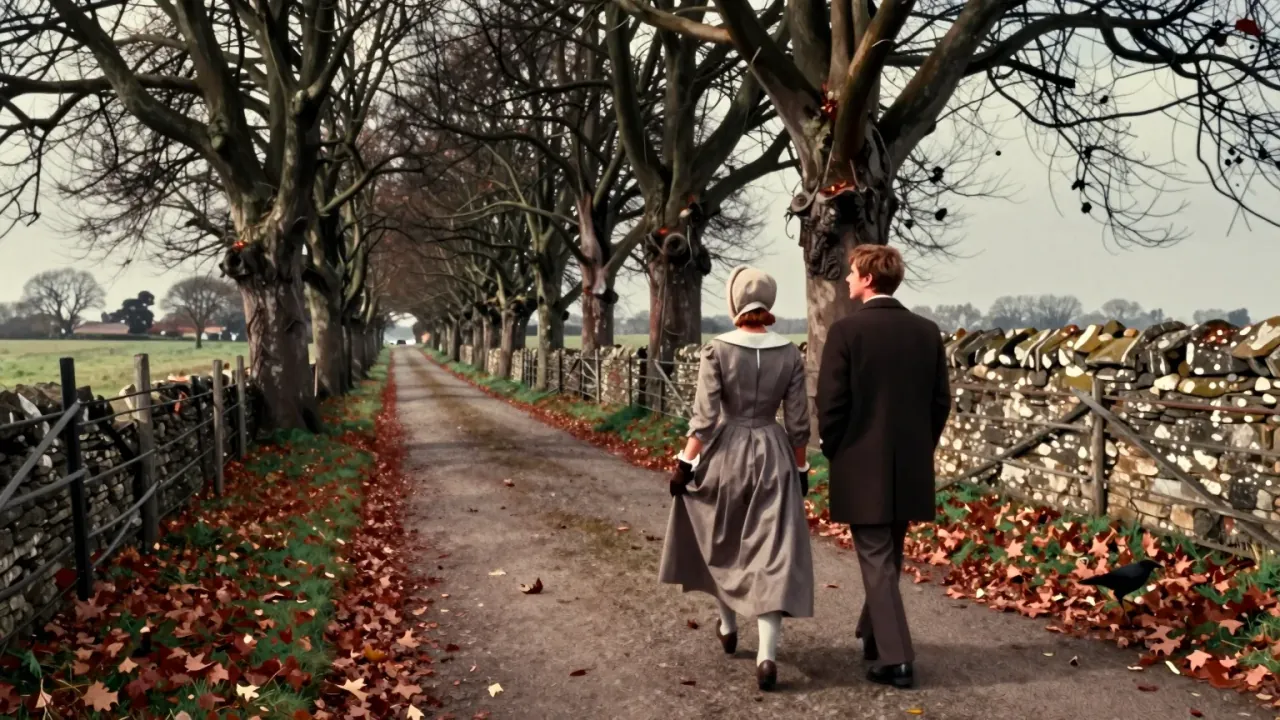
The story unfolds in near-real time across one evening, anchored by Fred Murphy’s cinematography: soft-focus interiors lit like candlelit oil paintings, with shallow depth of field that isolates faces in warmth while letting backgrounds dissolve into amber murk. Tony Huston’s screenplay tightens Joyce’s prose without flattening its rhythms, preserving the layered speech patterns of Dublin’s educated middle class — their politeness, their evasions, their sudden, unguarded slips. Anjelica Huston’s Gretta moves with contained physicality, her stillness gathering meaning across scenes; Donal McCann’s Gabriel is all controlled cadence until his final monologue, where breath and pause do the work of revelation. Alex North’s score avoids melody in favour of low strings and muted piano, underscoring absence rather than emotion. There are no cuts to flashbacks, no visual metaphors for memory — only the camera holding on eyes, hands, doorways. The ensemble cast speaks with regional precision, never performing ‘Irishness’ but inhabiting it as habit, as grammar.
What stays with you
What lands is the cumulative pressure of small failures — Freddy Malins’ drunkenness, Molly Ivors’ nationalist barbs, Gabriel’s misjudged toast, Julia Morkan’s tremulous singing — all of which coalesce into a portrait of dignity under strain. The party’s warmth feels earned, its exhaustion palpable: the way Mary Jane’s piano playing is both virtuosic and slightly brittle, how Bartell D’Arcy’s late, reluctant song triggers Gretta’s memory not through plot logic but through acoustic association. The film’s final ten minutes work because they refuse resolution: Gabriel does not weep, confess, or change course. He watches snow fall and understands, for the first time, that love and death are not opposites but textures of the same fabric. The pacing, often mistaken for slowness, is calibrated — each scene has a precise duration, neither rushed nor indulgent. Even the minor characters register as fully weighted: Helena Carroll’s Kate is fretful but never foolish, Cathleen Delany’s Julia frail but never pitiful. Nothing here feels decorative; everything persists in memory after viewing.
Where it slips
What does not land is the attempt to broaden the social canvas beyond Joyce’s original scope. Mr. Grace’s recitation of ‘Broken Vows’ — a new character and poem — sits uneasily, its English translation and theatrical delivery disrupting the naturalistic register of the rest. The film’s Dublin exteriors, shot separately in Ireland while interiors were built in California, create a subtle disjunction: the snow looks authentic, but the street lamps and carriage wheels lack the tactile consistency of the soundstage sets. Some performances, particularly Brendan Dillon’s Joseph Kerrigan and Frank Patterson’s Mr. Brown, remain sketch-like — functional but not resonant. The film’s refusal to dramatise Michael Furey means his presence depends entirely on Gretta’s telling; viewers who need visual confirmation of his existence may find the emotional pivot under-supported. And while Huston’s direction from a wheelchair is remarkable, the physical constraints show in a few static group shots where blocking feels tentative, as if the camera could not reframe without effort.
What it is really about
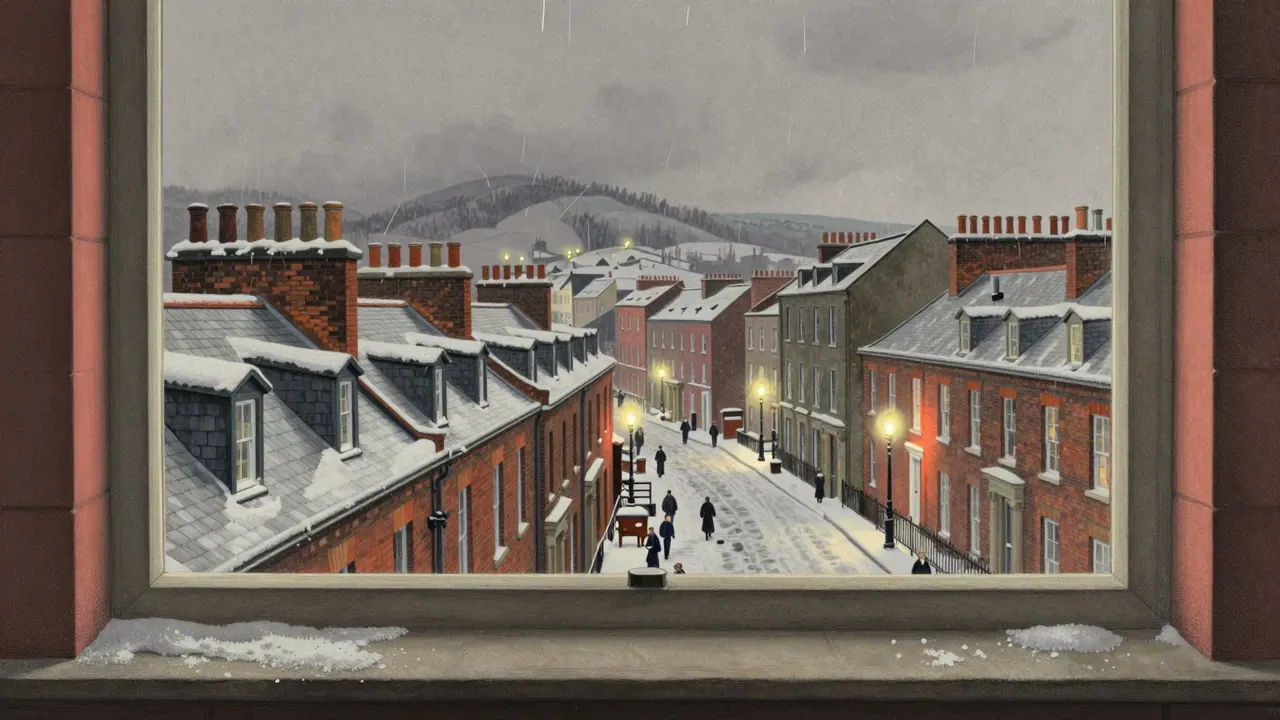
The themes that matter are not those of national identity or cultural revival — though they surface — but of temporal layering: how the past lives inside speech, posture, and silence. It treats memory not as retrieval but as recurrence — Gretta does not remember Michael Furey; she is visited by him. The film insists on the irreducibility of private feeling: Gabriel cannot share Gretta’s grief, nor can he replicate Michael’s devotion, nor does he need to. It explores the quiet violence of respectability — how manners preserve distance, how hospitality masks exclusion, how praise (in Gabriel’s speech) functions as self-protection. Ageing is present not as decline but as accrual: Julia’s voice cracks, Kate’s hands shake, Gabriel’s confidence thins — all are forms of accumulated life, not decay. And snow, recurring in the final image, is not metaphor but condition: it blankets difference, equalises surfaces, muffles sound, and makes movement deliberate — a physical correlative for the film’s central idea that consciousness is always arriving, always half-buried, always falling.
Who it is for
This film is for viewers who trust silence, who listen to pauses as carefully as dialogue, and who do not require narrative propulsion to feel engaged. It rewards attention to texture — the grain of wood panelling, the rustle of taffeta, the slight lag between thought and speech. It is not for those who expect exposition, clear motivation, or dramatic escalation; viewers who need Gabriel to confront Gretta, or to act on his epiphany, will find the ending unsatisfying. Those accustomed to rapid editing or psychological signposting may mistake its stillness for inertia. A viewer who values craft over incident, who finds emotional resonance in restraint, will find it deeply affecting. Someone who prefers adaptation as reinterpretation — rather than distillation — may object to its fidelity. Change the pacing, add flashbacks, or externalise Michael Furey’s story, and the film’s central argument — that some truths exist only in the space between speaker and listener — would collapse.
Is it worth your evening
Yes, it is worth your evening — provided you watch it without expectation of event, and with willingness to sit inside its rhythm. Its eighty-three minutes pass with the unhurried gravity of a winter dusk: not empty, but full of unspoken things. It asks for nothing more than your attention to what is said, what is withheld, and what lingers in the air after words end. Those who find value in films that deepen rather than distract, that settle rather than stimulate, will leave with a quietened mind and a sharpened sense of how much feeling lives beneath the surface of ordinary life. It is not entertainment in the conventional sense, but it is nourishment — of a particular kind, rare in cinema. Anyone who has ever felt unseen in a room full of people, or loved someone whose inner world remained just out of reach, will recognise something here. It earns its length not by filling it, but by measuring time as lived experience — not in beats per minute, but in breaths held and released.