The shape of the story
The Northman is a mythic revenge tragedy set in the Viking Age, adapted from Saxo Grammaticus’s Amleth legend—the same source that shaped Hamlet. Robert Eggers and Sjón treat it not as historical realism but as ritualised folklore: a world governed by fate, oaths, and ancestral memory, where gods are present in wind and fire, and language itself carries magical weight. It aims to reconstruct the sensory and spiritual texture of Norse cosmology—not through exposition, but through image, sound, and gesture. The film rejects psychological interiority in favour of symbolic action: every axe swing, every burial mound, every chant serves the logic of saga, not screenplay convention. Its ambition is structural as much as aesthetic: to make a film whose form—its pacing, its silences, its refusal of exposition—enacts the fatalism it describes. It does not explain belief; it immerses. It does not dramatise motivation; it enacts compulsion. This is not Viking history as taught in schools, but as recited at Yule, half-remembered, half-dreamt, thick with ash and blood. (159 words)
The look of it
The story follows Amleth’s vow, exile, and return as a thrall to his uncle’s Icelandic farm—a structure borrowed from classical tragedy, stripped of irony and padded subplots. Alexander Skarsgård plays Amleth with minimal inflection, his body doing most of the speaking: muscle, posture, gaze. Nicole Kidman’s Gudrún is calibrated in glances and withheld breath; Willem Dafoe’s Heimir moves like smoke in a longhouse. Jarin Blaschke’s cinematography favours low light, wide lenses, and shallow focus—faces often half-lost in shadow, landscapes vast and indifferent. Vessel’s score avoids melody in favour of drone, bone-rattle, and bullroarer hum, weaving folk instruments into something alien yet ancient. Louise Ford’s editing sustains a deliberate, almost liturgical rhythm: long takes, abrupt cuts only for violence or revelation. There are no flashbacks, no voiceover exposition, no explanatory dialogue—only what is seen, heard, or ritually enacted. The craft coheres around one principle: nothing is included unless it belongs to the world’s internal grammar of fate, sacrifice, and retribution. (158 words)
What holds the air
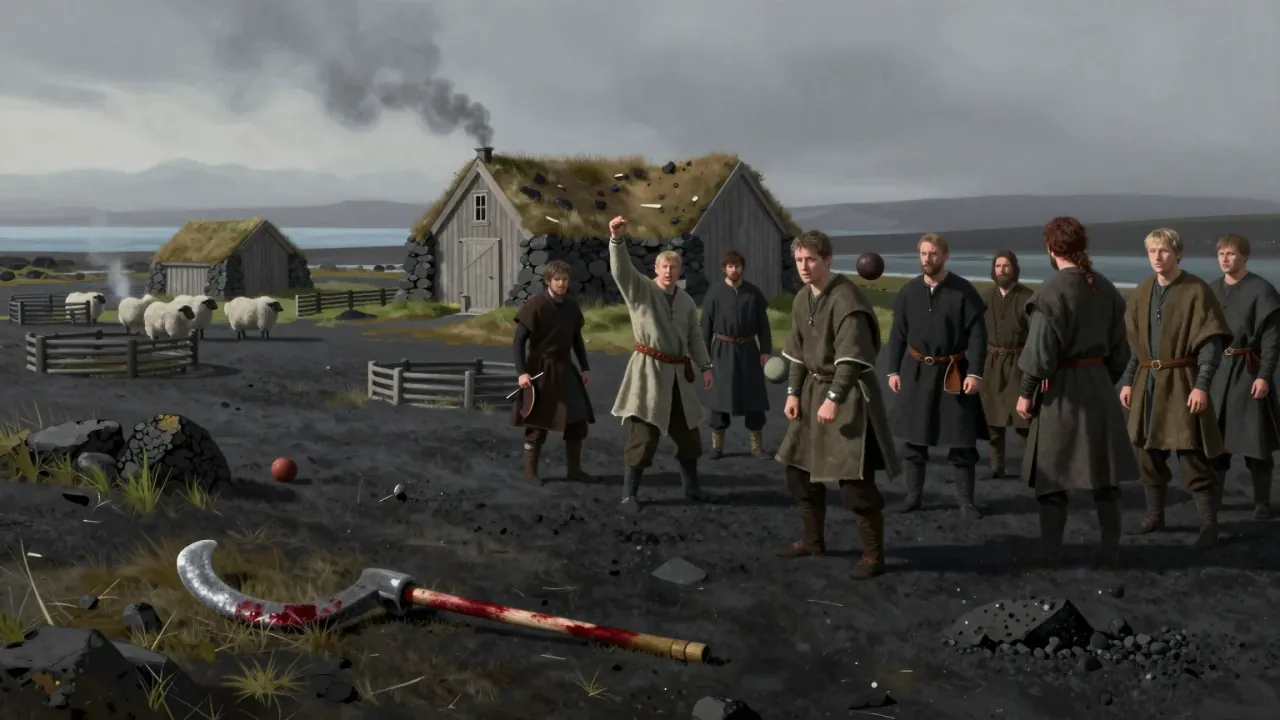
What lands is the film’s physical conviction: the weight of iron, the grit of volcanic soil under bare feet, the heat-haze above sheep pens, the stink of fermented milk and wet wool. The sequences on Hekla—Amleth’s final ascent, the duel in ash and steam—are unbroken in their grim, elemental force. The barrow sequence, where Amleth retrieves Draugr from the Mound Dweller, works not as horror but as sacred trespass: the camera stays close, the lighting stays dim, the silence before the blade is drawn lasts just long enough to feel like prayer. Björk’s seeress, though brief, occupies her frame like a figure carved into runestone—unhurried, unblinking, absolute. The knattleikr game lands too: its sudden escalation from sport to slaughter feels inevitable, not contrived, because the rules of this world permit no clean separation between play and bloodletting. These moments succeed because they trust the audience to read meaning from texture, not translation. They do not ask for empathy; they demand attention. And when the film commits fully to its own logic—ritual over realism, symbol over psychology—it achieves a rare kind of gravity. (157 words)
Where the ice cracks
What does not land is the film’s attempt to reconcile mythic abstraction with narrative clarity. Several key relationships—especially Amleth’s bond with Olga—remain emotionally opaque, not by design but by omission: her motives, her agency, even her survival logic are left unanchored in dialogue or gesture. The Seeress’s prophecy about the ‘Maiden-King’ arrives with portent but no payoff, dissolving into fog rather than function. Some performances suffer from the script’s austerity: Ethan Hawke’s Fjölnir, though physically imposing, lacks the layered resentment or self-deception that might make his tyranny legible beyond brute fact. The Old Norse dialogue, largely replaced in ADR, leaves a hollow echo—its absence undermines the very linguistic authenticity the film otherwise pursues. And the ending, while visually potent, offers no resolution beyond bodily annihilation: no reckoning with grief, no shift in consciousness, no release from the cycle. It is faithful to saga, but not always to dramatic necessity—and fidelity without function can feel like rigour mistaken for rigidity. (156 words)
What the runes say
The themes that matter are not vengeance alone, but the cost of binding oneself to fate. Amleth’s oath is less a moral choice than a metaphysical trap: once spoken, it cannot be unspoken, and every act thereafter is merely the working-out of inevitability. The film treats masculinity not as identity but as performance under divine scrutiny—every beard, every scar, every ritual bath is part of a script written before birth. Kinship is shown as both anchor and cage: Gudrún’s marriage to Fjölnir is neither betrayal nor submission, but survival within a system that offers no third option. The land itself is thematic: Iceland’s black sand and fissured earth mirror the characters’ fractured loyalties; the Rus sequences, filmed in Northern Ireland’s marshland, evoke a liminal space between life and death, civilisation and chaos. Mythology here is not backdrop but architecture—every god invoked, every rune carved, every animal sacrificed structures the moral physics of the world. There is no secular ground. No neutrality. No exit. (158 words)
Who walks this path
This film is for viewers who value formal discipline over emotional hand-holding, who find resonance in silence and weight more than in exposition or catharsis. It suits those familiar with Norse sources—or willing to sit with ambiguity—and who respond to cinema as embodied experience rather than narrative delivery system. It is not for viewers who require clear character arcs, psychological motivation, or tonal consistency: the shifts between berserker fury and funereal stillness may feel jarring, not intentional. Those who expect historical accuracy will be frustrated—the film privileges symbolic truth over archaeological fidelity. Anyone seeking levity, irony, or genre comfort will leave unmoored. A viewer who values strong female agency as central to narrative drive may find Olga’s arc underdeveloped, and Gudrún’s constrained by the text’s fatalism. That said, someone who disagrees—say, a scholar of Old Norse literature—might argue the film honours the source’s restraint. Change the editing rhythm or restore more Old Norse speech, and the balance shifts. But as it stands, it asks for surrender, not negotiation. (159 words)
Is it worth your evening
Yes, it is worth your evening—if you arrive prepared to watch, not consume. Its 137 minutes pass with the slow inevitability of tide turning, and that is the point: this is not entertainment as relief, but as confrontation. It rewards patience with texture, repetition with resonance, austerity with intensity. You will not leave humming a tune or quoting a line, but you may find yourself noticing the grain of wood in doorframes, the way light falls on a blade at dusk, the silence after a scream. It is not universally accessible, but it is uncompromisingly itself—rare in mainstream studio-backed work. Those who call it ‘cold’ or ‘impenetrable’ are not wrong, but they mistake tone for failure. The film’s power lies precisely in its refusal to soften. If your evening is measured in emotional payoff, skip it. If it’s measured in sustained attention to craft, in the thrill of a vision pursued without apology, then yes—it earns its length, its budget, its silence. It is not easy. It is exacting. And it is worth it. (159 words)