A whole film built from half a page
Aguirre, the Wrath of God is Werner Herzog’s 1972 film following Lope de Aguirre, a Spanish conquistador who seizes control of a splinter expedition drifting down the Amazon in search of the legendary city of gold, El Dorado, and steers it toward collective ruin. Herzog conceived the film after reading a half-page account of the historical Aguirre in a borrowed book, then invented almost the entire plot and most of the characters around that single reference; he has since acknowledged the film is essentially fiction rather than history. He wrote the screenplay in roughly two and a half days, much of it during a 200-mile bus trip with his amateur football team, and lost several pages of the draft after a drunk teammate was sick on them and Herzog threw them out the window.
A script written on a drunk football team’s bus
Klaus Kinski, who plays Aguirre, had lived briefly in the same boarding house as Herzog’s family years earlier, and his volatile behaviour then left enough of an impression that Herzog considered him the only possible choice for the role; when Herzog mailed him the script, Kinski called back within hours in a screaming fit that Herzog eventually realised was enthusiasm rather than rage. The two clashed constantly over how to play the part, Kinski favouring an openly ranting performance and Herzog insisting on something quieter and more unsettling, and Herzog would reportedly provoke Kinski deliberately before certain takes and wait for his fury to subside before rolling camera. Filming took five weeks on location in the Peruvian rainforest and around Machu Picchu, shot in chronological order specifically so the crew’s own physical progress down the river would mirror the expedition’s.
A quiet performance built through deliberate provocation
Kinski’s performance, restrained in exactly the way Herzog fought to make it, is what gives the film its unsettling quality: Aguirre barely raises his voice even as his authority curdles into pure delusion, and that quiet is more frightening than open ranting would have been. The decision to shoot with an international, sixteen-country cast and crew speaking only English as a common language, later dubbed into German after the production ran out of money for proper post-synchronisation, gives the dialogue an odd, detached quality that suits the story’s sense of men drifting outside any recognisable order. A storm that flooded the set and destroyed the production’s rafts was written directly into the film rather than worked around, and the resulting sequence feels indistinguishable from the disasters the fictional expedition is actually suffering.
A flood that became part of the film
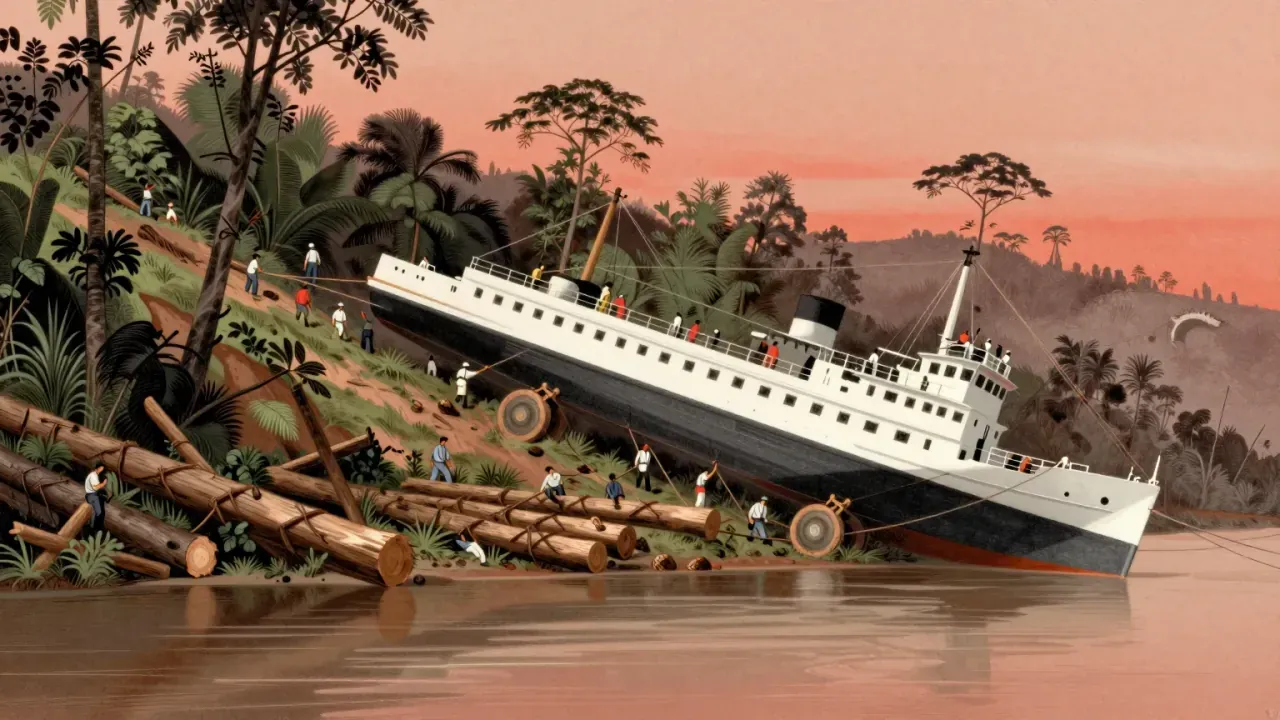
Herzog’s decision to cut all reference to a real earlier expedition, led by Francisco de Orellana, whose fate the surviving script had originally used to foreshadow Aguirre’s own, leaves one surviving image, a ship lodged in the jungle canopy, without the explanation the shooting script once gave it, so it now reads only as an unexplained hallucination. The low budget, with a third of it going to Kinski’s salary alone, ruled out stunt doubles or special effects, and several shots show the camera lens fogged or streaked by actual rainwater and mud rather than anything simulated, which occasionally undercuts the visual clarity of a scene without adding much beyond production hardship. The film’s final ending also departs substantially from what Herzog originally scripted, a change made during production that he has said he can barely reconstruct.
Conquest with no plan beyond appetite
Colonialism in the film is presented without any of the redemptive framing conquest narratives usually offer: Aguirre and his men have no plan beyond seizing gold and territory for themselves, and the film never suggests their mission had a coherent purpose even by the standards of empire, only appetite dressed as one. Power collapses almost immediately once removed from any real institutional check, and Aguirre’s takeover of the expedition demonstrates how quickly authority, once seized by force, degrades into pure self-delusion rather than functioning rule. Ambition here is presented as a kind of illness, spreading from Aguirre outward until the entire raft, and by the end nearly every man on it, has succumbed to the same fixation on a city that was very likely never there to find.
Who the slow collapse rewards
This suits viewers interested in the collision between a film’s fictional plot and the genuinely difficult conditions of its production, admirers of Kinski’s controlled intensity, and anyone drawn to stories about colonial ambition collapsing under its own weight rather than being defeated by an external enemy. It is a demanding watch for anyone wanting a conventional adventure narrative, since the film’s pacing is deliberately slow and its violence, when it arrives, is abrupt rather than staged for excitement. The film’s English-language production, later dubbed into German with some of Kinski’s own lines re-performed by another actor, may also read oddly to viewers expecting one consistent original-language track.
A five-week shoot that outlasted its own budget
Critics have rated the film highly and consistently, a 96 percent Tomatometer score and an average rating of 9 out of 10, and its reputation has only grown since its limited 1977 American arthouse release. At 91 minutes it is tightly paced despite its slow, drifting subject matter, and the making of the film, an under-resourced five-week shoot pushed through genuine jungle hardship, is inseparable from what ended up on screen. It is worth an evening for anyone willing to watch a historical epic made on a fraction of the resources such stories usually demand, and for Kinski’s performance alone, which remains one of the more genuinely unsettling in the genre.