The shape of history
Pearls of the Crown is a French historical comedy from 1937 that traces the fictional journey of seven pearls—four embedded in the English crown, three lost—across four centuries and multiple languages. Sacha Guitry co-directed and co-wrote it with Luigi Chiarelli; he also plays four roles, as do several others, including Arletty, Raimu and Marcel Dalio. The film uses nested flashbacks to move between Henry VIII’s court, Elizabeth I’s reign, Napoleon’s era and contemporary Paris, with Jean Martin (Guitry), a writer researching the pearls, serving as framing device. It attempts structural wit through linguistic multiplicity: scenes are performed in French, Italian and English, often within the same sequence, relying on subtitles for coherence. This is not multilingualism as realism but as formal play—part scholarly farce, part studio-era spectacle. Its ambition lies less in historical fidelity than in theatrical dexterity: to make history feel light, contingent and repeatedly re-performed. Jules Kruger’s cinematography captures both studio precision and location texture, from Royaumont Abbey to the S.S. Normandie’s decks. The film is an essay in repetition, translation and theatrical self-awareness, dressed as a caper.
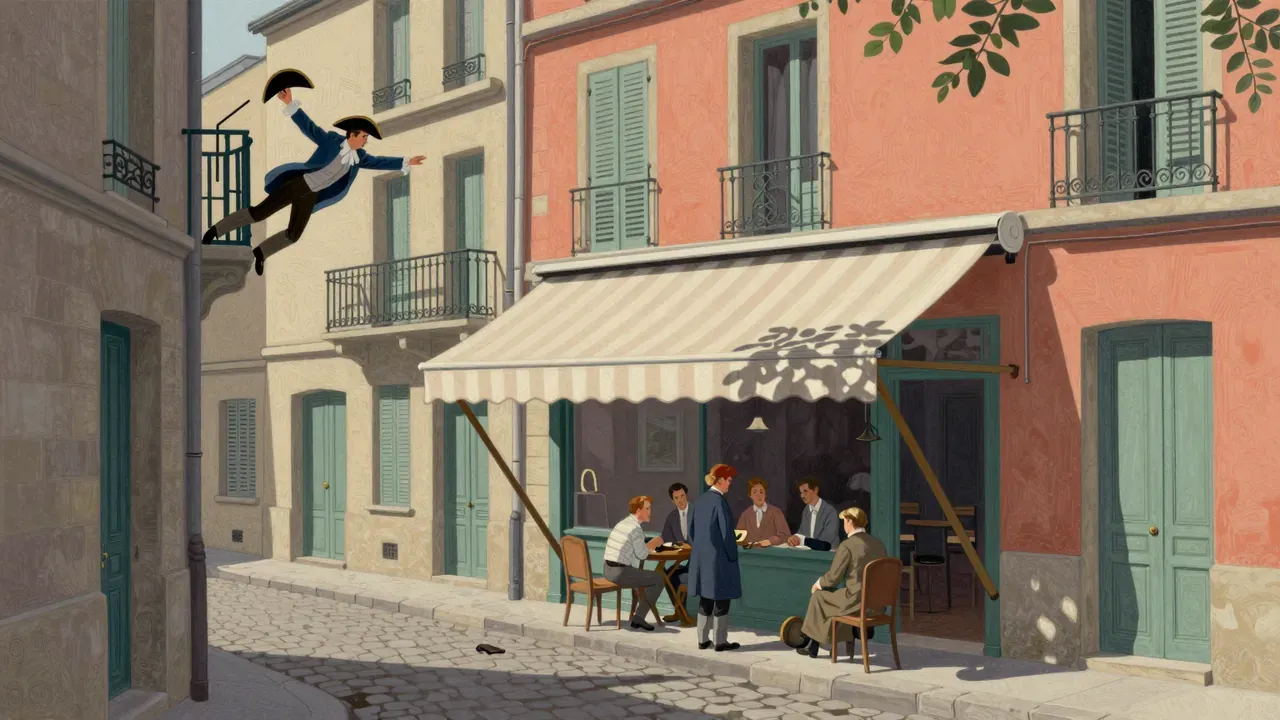
The look of it
The story unfolds as a chain of anecdotes, each pearl passing through hands royal, mercantile or criminal, always with irony about ownership, legacy and national myth. Performances lean into stylisation: Guitry’s delivery is brisk and declamatory, Arletty wry and poised, Raimu grounded even amid absurdity. Dalio and Dauphin bring timing that lands physical and verbal gags without broadening. Christian-Jaque’s co-direction adds rhythmic steadiness where Guitry’s instincts might rush. Kruger keeps lighting crisp but unshowy; sets by Jean Perrier balance period suggestion with theatrical legibility—no attempt at immersive realism, only enough detail to anchor the joke. Jean Françaix’s score is light, neoclassical, underscoring rather than interpreting. Editing favours clean cuts over montage, letting dialogue and gesture carry momentum. The three-language structure works because it is treated as a rule, not a gimmick: characters switch tongues mid-scene without explanation, trusting the audience to follow tone and context. This is craft in service of agility—not seamless illusion, but polished, self-conscious artifice.
What holds still
What lands is the film’s intellectual bounce: its pleasure in historical contingency, in how objects outlive intentions, and how power reshapes meaning across time. The repeated casting—Guitry as Henry VIII, Napoleon, a modern journalist and a Venetian jeweller—makes monarchy, empire and authorship feel like interchangeable costumes. Arletty’s turn as Elizabeth I combines regal poise with dry scepticism, undercutting reverence without dismissing it. The Normandie sequence, shot aboard the real liner, grounds the fantasy in tangible luxury and modernity. The pearls themselves function well as MacGuffins: inert, luminous, indifferent to the human dramas they witness. Scenes set in Louveciennes or Royaumont gain quiet authority from their actual historic weight—the stones and vaults speak louder than exposition. Even the linguistic shifts land when used precisely: a line delivered first in French, then Italian, then English, gains rhythm and slight absurdity, not confusion. The film’s best moments are those where history feels like rehearsal—where the past is not reconstructed but re-occupied, lightly, knowingly.
Where the thread frays
What does not land is the film’s insistence on its own cleverness when pacing slackens—particularly in the middle stretch, where the flashbacks begin to blur in tone and stakes. Some transitions between eras lack sufficient visual or tonal distinction, making the chronology harder to track than it needs to be. The triple-language device, while conceptually sound, occasionally strains credulity: characters converse across linguistic lines without friction, and the subtitles cannot always capture register shifts—irony or sarcasm gets flattened. A few performances, notably Ermete Zacconi’s, remain locked in late-19th-century stage mannerisms that jar against Guitry’s more mobile style. The satire of nationalism and dynastic vanity is present but diffuse; it gestures toward critique without sharpening it. And though the production design is elegant, it rarely surprises—the Abbaye and châteaux are handsome but familiar backdrops, not active participants in the narrative. The film assumes a level of historical literacy and tolerance for theatrical convention that may distance viewers unfamiliar with interwar French stage comedy.
What it is made of
The themes that matter are inheritance and impermanence: not just of jewels, but of language, sovereignty and narrative itself. The pearls endure while crowns crumble, treaties expire and empires rename themselves—yet their value is entirely assigned, never inherent. Guitry treats history as a series of overlapping performances, each generation restaging the last with minor costume changes. Colonialism appears obliquely, via trade routes and looted artefacts, but the film sidesteps moral reckoning in favour of ironic detachment. Class surfaces in the contrast between courtiers who debate legitimacy and artisans who cut gems without comment. Language is treated as both barrier and bridge: the film’s trilingualism is less about cultural exchange than about the arbitrariness of linguistic borders—English, French and Italian are all equally provisional vessels for the same vanities. There is also a quiet theme of archival fragility: Jean Martin’s research depends on documents that survive by chance, misreadings, or deliberate erasure. The film suggests that history is not recovered but assembled—and that every assembly carries its own bias, however lightly worn.
Who it speaks to
It is for viewers who enjoy structural play in historical fiction, who find pleasure in precise vocal delivery and ensemble timing, and who tolerate—or seek out—pre-war European theatricality. It rewards attention to repetition, costume cues and linguistic rhythm. It is not for those who require linear plotting, psychological realism or sustained emotional investment in characters. Viewers who dislike subtitles, or who expect historical films to prioritise accuracy over invention, will find its approach frustrating. Those accustomed to post-1960 editing rhythms may struggle with its studio-era pacing. A viewer who values thematic density over narrative propulsion will likely respond well; one who reads history as moral instruction rather than patterned recurrence may feel short-changed. The film asks for patience with its conceits—and repays it with wit, not warmth. Someone who found Jacques Tati’s later work too slow, or Ernst Lubitsch’s irony too brittle, would likely find Pearls of the Crown a bridge between the two.
What it asks of you
Yes, it is worth your evening—if you watch it as a crafted object, not a story to be followed. Its 118 minutes pass with clarity and occasional delight, especially if approached with awareness of its interwar context: a French film made at Billancourt Studios, asserting cosmopolitan fluency in the face of rising nationalism. It does not ask for empathy, but for recognition—of how easily power dresses itself in precedent, how objects accrue meaning like barnacles, and how language can be both weapon and wrapper. Someone who watches it expecting a conventional biopic or a tightly wound mystery will leave dissatisfied. But those open to a film that treats history as repertoire, not record, will find its intelligence and restraint quietly sustaining. It is not urgent, nor profound in the way of Bergman or Bresson—but it is coherent, confident, and uncommonly well-made for its moment. Its value lies in its refusal to simplify, not in its ability to resolve.