The shape of it
Withnail and I is a British black comedy set in London and the Lake District in 1969, following two unemployed actors — one volatile and self-destructive, the other watchful and withholding — as they flee Camden’s squalor for a disastrous weekend in a remote cottage. It is not a satire of acting life so much as a precise, unsentimental anatomy of male drift: of talent without outlet, intelligence without direction, and friendship sustained by shared exhaustion rather than mutual regard. Bruce Robinson writes and directs with autobiographical rigour, compressing years of his own early adulthood into a tight, episodic structure. The film avoids narrative propulsion in favour of accumulation: of slights, hungers, misread signals, and failed gestures toward dignity. Its ambition is not to resolve but to register — to hold still the texture of a particular kind of late-adolescent stasis, where every bottle opened is both a postponement and a small surrender. It treats its characters’ poverty, addiction and sexual confusion not as plot devices but as environmental conditions, like the rain that never lifts or the cold that seeps through floorboards.
The rhythm of it
The story unfolds in discrete, weather-bound episodes: the cramped flat, the pub, the train journey, the cottage, the walk to the pub again, the phone box, the final return. Richard E. Grant plays Withnail with unbroken velocity — voice, posture and timing calibrated to suggest a man holding himself together by sheer rhetorical force. Paul McGann’s ‘I’ (Marwood) watches, absorbs, reacts minimally; his performance rests on withheld reaction, on the weight of what he does not say. Peter Hannan’s cinematography is low-contrast and naturalistic, using available light and shallow focus to keep faces half-lost in shadow or glare. Lord David Dundas’s score is sparse, mostly diegetic — folk songs, radio fragments, silence punctuated by footsteps or wind. Dialogue dominates, but it is not conversational: lines are delivered as declarations, interruptions or incantations. The editing is unhurried, often holding on empty rooms or distant figures walking away. There are no flashbacks, no exposition beyond what the characters voice aloud — and even then, much remains ambiguous, including motive, history and the precise nature of Monty’s interest in Marwood.
The weight of it
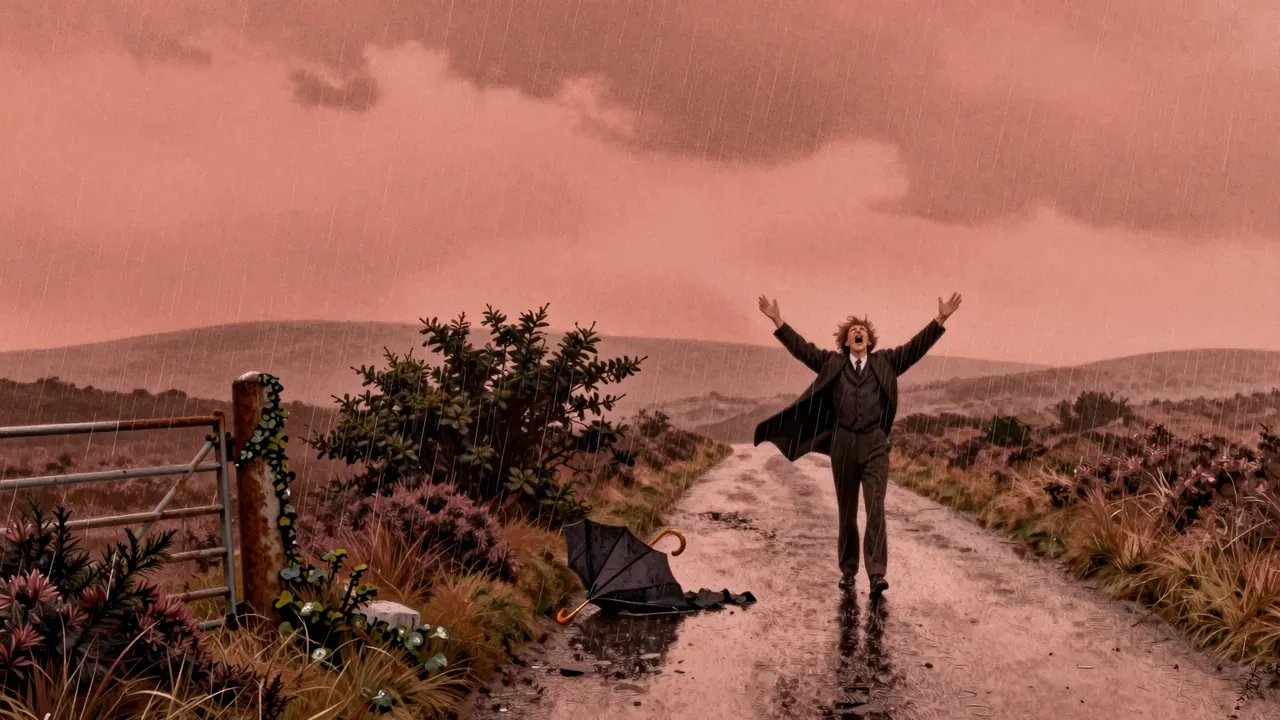
What lands is the film’s tonal consistency: its refusal to soften, explain or redeem. Withnail’s monologues — about Shakespeare, about wine, about the state of the nation — land because they are delivered with absolute conviction, even when absurd. The physical comedy — the lighter-fluid gag, the shotgun fishing, the rain-soaked trudge — works because it emerges from character, not setup. Richard Griffiths’s Monty is unsettling precisely because he is never caricatured: his charm is real, his loneliness palpable, his advances neither mocked nor excused. The Lake District locations feel lived-in and indifferent — not picturesque, but damp, inconvenient, beautiful only in glimpses. The soundtrack choices — ‘My Way’, ‘Streets of London’, ‘Black Mountain Side’ — are not ironic punctuation but period-accurate emotional ballast. Even the film’s famous lines — ‘We want the finest wines available to humanity’ — work because they are spoken as if they matter, within a world where nothing else does. The cumulative effect is less laughter than recognition: this is how certain kinds of despair sound when dressed in wit.
The gaps in it
What does not land is the film’s structural slack in the middle stretch — the long walk to the pub, the repeated returns to Crow Crag — which risks monotony without adding thematic weight. The Irishman subplot feels underdeveloped, introduced and dropped without consequence. Monty’s character, while compelling, lacks sufficient interior logic: his motivations shift between paternal concern, predatory desire and theatrical whimsy without clear through-line. The film’s resistance to explanation extends to its class politics: the characters’ entitlement — to Monty’s cottage, to cultural capital, to alcohol as sustenance — is observed but not interrogated. Some performances falter under the script’s density: Ralph Brown’s Danny is broadly drawn, his Cockney affectation leaning on stereotype. The ending — Marwood alone in Regent’s Park — is poignant but underprepared; the emotional pivot from shared collapse to solitary survival arrives without the necessary groundwork in his earlier passivity. A viewer expecting narrative payoff or moral resolution will find only atmosphere and aftermath.
The air around it
The themes that matter are abandonment — of place, of vocation, of self — and the brittle scaffolding of male camaraderie. Withnail and Marwood do not support each other so much as orbit each other’s crises, their bond held together by shared irony and mutual dependence on the other’s presence as proof they are not entirely alone. Class is present not as argument but as texture: the difference between Monty’s inherited ease and the pair’s rented squalor is never named, only felt in the cut of a coat or the absence of hot water. Addiction is treated as physiological fact — tremors, nausea, withdrawal — not moral failing. Sexuality is rendered as ambiguity: Monty’s advances are neither condemned nor welcomed, but registered as another form of pressure in an already pressurised world. Time itself is a theme: the late 1960s here are not nostalgic but terminal — a moment when old certainties have dissolved and no new ones have taken hold. The film’s quietest theme is failure as condition, not event: these men are not falling from grace; they have never been granted it.
The terms of it
This film is for viewers who value linguistic precision, behavioural realism and the weight of unspoken tension over plot mechanics or catharsis. It suits those familiar with British class inflection, mid-century social decay and the specific melancholy of creative unemployment. It is not for viewers who require narrative momentum, psychological exposition or moral clarity — or who find extended sequences of drunkenness, hunger and emotional evasion exhausting rather than illuminating. Those who dislike films where characters speak in complete sentences, where silence lasts longer than dialogue, or where the protagonist’s arc is measured in inches rather than miles will find it alienating. A viewer who values visual spectacle, genre conventions or emotional reassurance will leave unsatisfied. The verdict would change only if the film were re-cut to tighten its middle act or deepen Marwood’s interiority — but that would compromise its central aim: to show, not tell, what it feels like to be stranded at the edge of adulthood with nothing but language to hold on to.
The time it takes
Yes, it is worth your evening — but only if you are prepared to meet it on its own terms: as a slow, exacting, verbally dense portrait of arrested development, not as a farce or a coming-of-age story. Its 107 minutes pass without hurry, and its rewards are cumulative, not immediate: the way Grant’s voice cracks on ‘I demand a divorce from life’, the way McGann blinks once before turning away from Monty’s gaze, the way rain pools on the roof of the telephone box like a held breath. It repays attention, not distraction. Someone who watches while scrolling, or expects punchlines every ninety seconds, will find it interminable. But for those willing to sit with its rhythms — its pauses, its repetitions, its refusal to flinch — it offers something rare: a film that treats its characters’ flaws as inseparable from their humanity. It is not comforting, but it is true. And truth, in this case, is delivered with such specificity that it becomes a kind of solace.