The shape of obsession
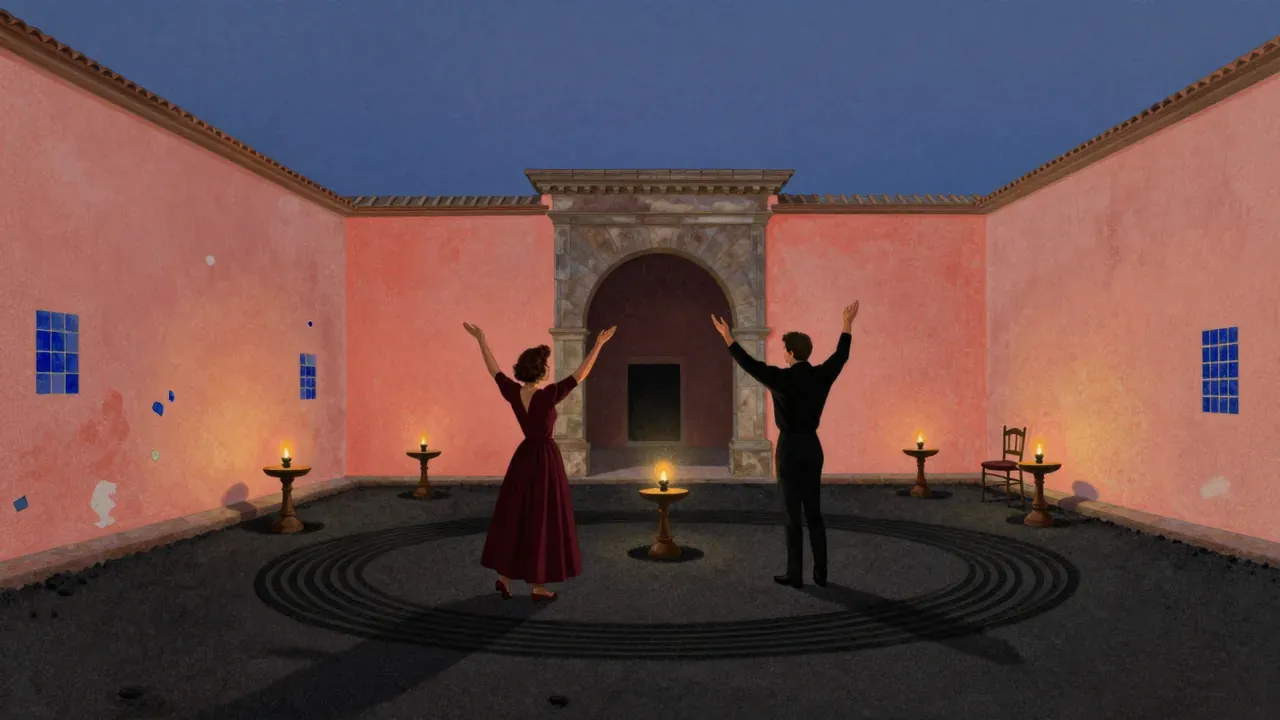
Él is a 1953 Mexican drama directed by Luis Buñuel, adapted from Mercedes Pinto’s novel Pensamientos. It sets out to anatomise pathological jealousy not as a plot device but as a systemic condition — one that corrodes perception, isolates the victim, and is sustained by social complicity. Buñuel does not frame Francisco’s paranoia as madness erupting from nowhere; rather, he embeds it in the textures of bourgeois life: church ritual, property law, dinner parties, confessional authority. The film treats obsession as a logic with internal consistency — warped, self-reinforcing, and socially legible enough to go unchallenged. Its ambition is clinical, not sensational: to show how belief in betrayal can become indistinguishable from reality when no institution — family, clergy, law — offers counter-evidence. This is not a thriller about whether Gloria is unfaithful, but a study of how certainty forms in the absence of proof, and how power makes that certainty enforceable. Buñuel anchors this in Mexico City’s mid-century architecture and Gabriel Figueroa’s precise, high-contrast lighting — not to evoke mood, but to fix the social surfaces through which Francisco reads threat.
The look of it
The story unfolds in two temporal layers: a present-day encounter between Gloria and Raúl, and the extended flashback of her marriage. This structure avoids exposition, trusting the audience to infer cause from consequence. Arturo de Córdova plays Francisco with restrained physicality — his menace lies in stillness, in the way he holds a glass or watches a doorway, not in outbursts. Delia Garcés conveys Gloria’s erosion without melodrama: her voice tightens, her posture retreats, her glances grow shorter and more furtive. Figueroa’s cinematography avoids expressionist distortion; instead, he uses deep focus and symmetrical framing to make domestic spaces feel like courtrooms — every corner legible, every object charged. Luis Hernández Bretón’s score is sparse, mostly absent during scenes of tension, letting silence and diegetic sound — a ticking clock, distant bells, footsteps on stone — carry psychological weight. Carlos Savage’s editing sustains unease through duration: shots hold past comfort, cuts land just after comprehension arrives. The surreal touches — the mock execution, the bell-tower tirade — are not dream sequences but breaks in Francisco’s control, rendered with the same realism as everything else.
What stays with you
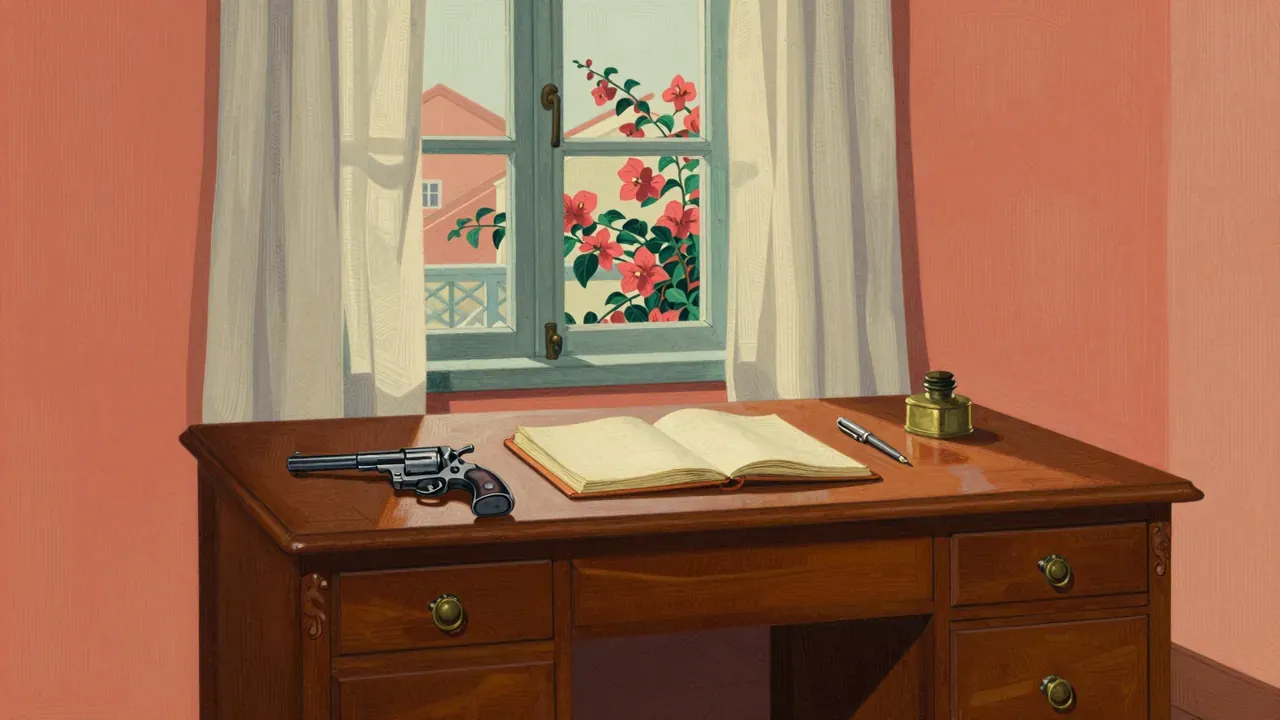
What lands is the suffocating plausibility of the abuse. Buñuel refuses to externalise Francisco’s pathology — there are no flashbacks to childhood trauma, no voiceover diagnosis. His jealousy reads as rational within its own premises: Gloria speaks to Raúl; therefore she must be plotting. Her isolation feels earned, not contrived — her mother’s dismissal, the priest’s moralising, the legal system’s indifference all follow real social logics. The film’s most effective sequence is not the strangle attempt or the hallucination, but the earlier scene where Francisco forces Gloria to write letters to Raúl under his supervision: the banality of the coercion, the pen held too tightly, the way she signs her name without lifting the nib. Figueroa’s lighting renders interiors as places where light falls unevenly — faces half-lost, doorways too dark to read — reinforcing Francisco’s selective attention. The final monastery coda lands precisely because it refuses catharsis: Francisco is neither punished nor cured, only contained, and his quiet assertion — ‘Time has proven my point’ — lands not as delusion but as the logical endpoint of a worldview that never needed disproving in the first place.
Where it slips
What does not land is the film’s pacing in its middle stretch, where Francisco’s escalating surveillance and Gloria’s muted resistance risk monotony. The courtroom subplot — his property lawsuit — remains underdeveloped, functioning more as ambient stress than narrative engine. Some performances falter under Buñuel’s restraint: Fernando Casanova’s lawyer feels functional rather than threatening, and Aurora Walker’s mother lacks the moral ambiguity the script implies — her disbelief reads as simple obtuseness, not the protective denial the theme requires. The film’s refusal to explain Francisco’s psychology may frustrate viewers seeking motive over mechanism; Buñuel gives no origin story, no trigger, only behaviour and consequence. The 1953 Mexican audience’s reported laughter suggests the tonal calibration missed its mark — not because the material is unfunny, but because the deadpan delivery of horror can read as absurdity when context is thin. Buñuel’s later dissatisfaction with the shoot speed shows here: some transitions between warmth and violence lack the cumulative weight they need, their rhythm feeling abrupt rather than inevitable.
What it is really about
The themes that matter are self-deception as social infrastructure, the weaponisation of respectability, and the erasure of women’s testimony within patriarchal institutions. Buñuel treats paranoia not as individual illness but as a relational system — one that requires Gloria’s silence, her mother’s deference, the priest’s doctrinal rigidity, and the law’s procedural slowness to function. The film interrogates how truth becomes negotiable when credibility is distributed by class and gender: Francisco is believed because he owns property, attends mass, and speaks calmly; Gloria is disbelieved because she weeps, contradicts herself, and seeks help outside sanctioned channels. The religious framework is not backdrop but active agent — Good Friday’s foot-washing ceremony opens the film not as irony but as structural parallel: both rituals involve submission, performed under scrutiny, with power disguised as humility. The monastery ending reframes the entire arc not as recovery but as containment — a solution that preserves social order while abandoning moral reckoning. Time does not heal; it bureaucratises.
Who it is for
This film is for viewers who value psychological precision over plot propulsion, who find tension in withheld information and sustained unease rather than set-pieces, and who accept that some films diagnose rather than resolve. It suits those familiar with Buñuel’s method — his distrust of exposition, his use of repetition as revelation, his belief that social norms are more revealing than aberrations. It is not for viewers who require clear moral alignment, narrative closure, or emotional release. Those expecting a conventional thriller or domestic drama will find its pace deliberate and its ending withholding. Critics who prioritise character motivation over behavioural observation may judge it underwritten. A viewer who needs Francisco to be monstrous in ways that signal his guilt — rather than credible in ways that obscure it — will reject the film’s central premise. The verdict changes only if one values diagnostic clarity over cathartic storytelling — a shift in priority, not a flaw in execution.
Why it holds up
Yes, it is worth your evening — provided you approach it as a forensic study, not an entertainment. Its 92 minutes accumulate quietly, each scene tightening the knot of implication without raising the volume. You do not leave stirred so much as recalibrated: the next time someone cites ‘common sense’ or ‘obvious intent’, you may pause longer before agreeing. It rewards attention to gesture, to silence, to what is omitted from dialogue. Those who watch for plot twists or emotional pay-offs will feel short-changed; those who watch for how power disguises itself in routine will find it exacting and unforgettable. Its endurance lies not in spectacle but in accuracy — in how little it exaggerates the mechanisms by which ordinary people are made invisible to themselves and others. To call it ‘difficult’ mistakes its clarity for austerity. It is not demanding attention; it is refusing distraction.