The number of it
24 Frames is Abbas Kiarostami’s final film, a posthumous work composed of twenty-four fixed-duration sequences, each lasting exactly one minute and thirty seconds. It is not narrative cinema in any conventional sense: there is no plot, no character arc, no dialogue, no score beyond ambient sound. Instead, it tests the threshold at which stillness becomes duration, and observation becomes contemplation. Kiarostami sets out to retrain attention — not by accelerating perception but by holding it steady, asking the viewer to watch what happens when nothing is directed to happen. The opening frame begins with Pieter Bruegel’s Hunters in the Snow, digitally animated to suggest faint avian motion within the painted surface; the remaining twenty-three abandon artifice for unbroken real-world footage, mostly of coastal landscapes, forests, and animals observed from a single static vantage point. This is not documentary realism, nor is it abstraction: it is a structural experiment in temporal fidelity, where the frame itself is both container and subject. (159 words)
The look of it
Each of the twenty-four frames functions as a self-contained unit governed by strict formal rules: fixed camera position, unbroken take, no editing, no intervention. The ‘story’ is the slow accumulation of micro-events — a seagull landing, a dog turning its head, rain falling on glass, deer moving in and out of view. There are no performances, only presence: animals behave without direction, often ignoring the lens entirely. Kiarostami’s craft lies in selection and framing — choosing locations, times of day, weather conditions, and durations that allow subtle shifts in light, movement, or chance interaction to register as event. Sound is recorded diegetically, with wind, waves, birdsong, and distant traffic forming an uncomposed acoustic field. The digital animation of Bruegel’s painting in Frame One is the sole departure from pure observation; every subsequent frame relies on patience over manipulation. The editing is non-existent in the traditional sense — the film is assembled by concatenating these uncut minutes, with black intervals between them functioning as breaths rather than transitions. (158 words)
The weight of it
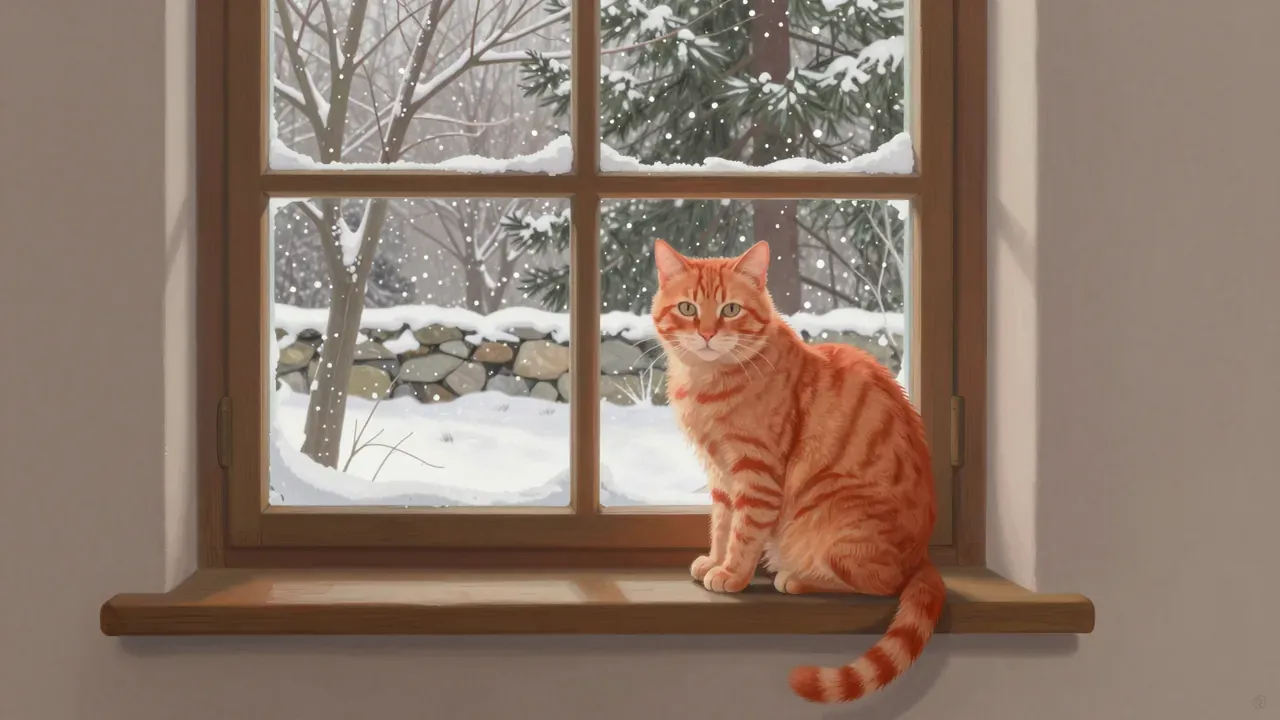
What lands is the quiet insistence of time as material. In Frame 7, a cat watches snow fall outside a window while its own reflection flickers in the glass; in Frame 12, two cows stand motionless for nearly a minute before one lowers its head to graze — the delay makes the action feel earned, almost ceremonial. These moments do not build toward revelation, but they recalibrate duration: a minute feels longer here than in most films because nothing distracts from its passage. The fixed perspective forces attention to peripheral detail — the way light changes on wet sand, how a bird’s wing catches wind before it lifts off. The film rewards sustained looking without promising payoff, and its success lies in how often it turns passive watching into active noticing. Even viewers unfamiliar with Kiarostami’s late work recognise the discipline behind the restraint — this is not emptiness, but economy. The absence of commentary, music, or explanation does not alienate so much as invite calibration: you adjust your rhythm to meet the film’s, not the other way around. (157 words)
The limit of it
What does not land is the assumption that stillness always implies significance. Several frames — particularly those set indoors or against featureless walls — risk monotony without yielding perceptual reward. Frame 16, showing a blank white wall with intermittent shadow-play from unseen sources, lasts its full ninety seconds without clarifying whether the shadows are cast by passing clouds, trees, or something else; the ambiguity feels less like invitation and more like omission. Similarly, Frame 19, a long shot of empty beach at dusk with no animal or human presence, sustains its silence but offers no pivot for attention to settle. These sequences test endurance more than engagement, and their inclusion seems less motivated by compositional logic than by adherence to the numerical premise — twenty-four frames, regardless of variance in density or resonance. A viewer expecting cumulative meaning may find the structure arbitrary rather than architectural. The film’s rigour occasionally reads as rigidity, especially in the second half, where variation in subject matter diminishes and the eye begins to anticipate repetition rather than discovery. (159 words)
The thought in it
The themes that matter are mortality, attention, and the boundary between representation and reality. Kiarostami died before the film’s release, and its finality is woven into its form: each frame is a finite, irreplaceable unit, like a life measured in breaths. The Bruegel animation in Frame One introduces the idea of breathing life into stillness — a gesture both tender and melancholic, as if the director is speaking across centuries to ask what persists in images once their makers are gone. Later frames return repeatedly to thresholds: windows, doorways, shorelines — edges where one state gives way to another. Animals appear and vanish without explanation, underscoring impermanence without sentimentality. The film also interrogates mediation: the camera is never hidden, yet it is never acknowledged; we see the world through a lens that refuses to interpret. This is not nature photography, nor is it surveillance — it is a sustained inquiry into how much meaning resides in the act of witnessing alone, without narrative scaffolding or emotional cueing. (158 words)
The audience for it
This film is for viewers who treat attention as a muscle to be trained, not a resource to be spent. It suits those accustomed to the durational logic of James Benning, Chantal Akerman, or early Tarkovsky — people who find value in slowness not as absence but as density. It is not for those who rely on narrative propulsion, character identification, or sonic or visual variation to sustain interest. Someone expecting thematic exposition or emotional crescendo will leave frustrated; the film offers no catharsis, only accumulation. Those who dislike long takes, ambient soundscapes, or films that refuse to signal their intentions will find it opaque. A viewer who values clarity over ambiguity, or who associates cinematic worth with dramatic stakes, would fairly reject it — but that rejection would stem from mismatched expectations, not failure of execution. Its worth depends entirely on whether one accepts that watching is itself a mode of thinking. (159 words)
The time of it
Yes, it is worth your evening — provided you arrive prepared to relinquish habitual viewing habits. It demands no more time than a standard feature, but asks for different energy: not absorption, but receptivity. You will not leave with a story, a quote, or even a clear impression — but you may notice how your own gaze lingers differently the next morning, or how silence sounds fuller after. It is not entertainment in the transactional sense, but it is rigorously honest about its aims and means. Those who dismiss it as ‘boring’ are not wrong in their response, but they are mistaking a condition of the film for a flaw: boredom here is the friction point where attention begins to shift. If you have ever wondered what cinema looks like when stripped of all but time, space, and presence, this is the closest answer Kiarostami left. (159 words)


