The weight of soil
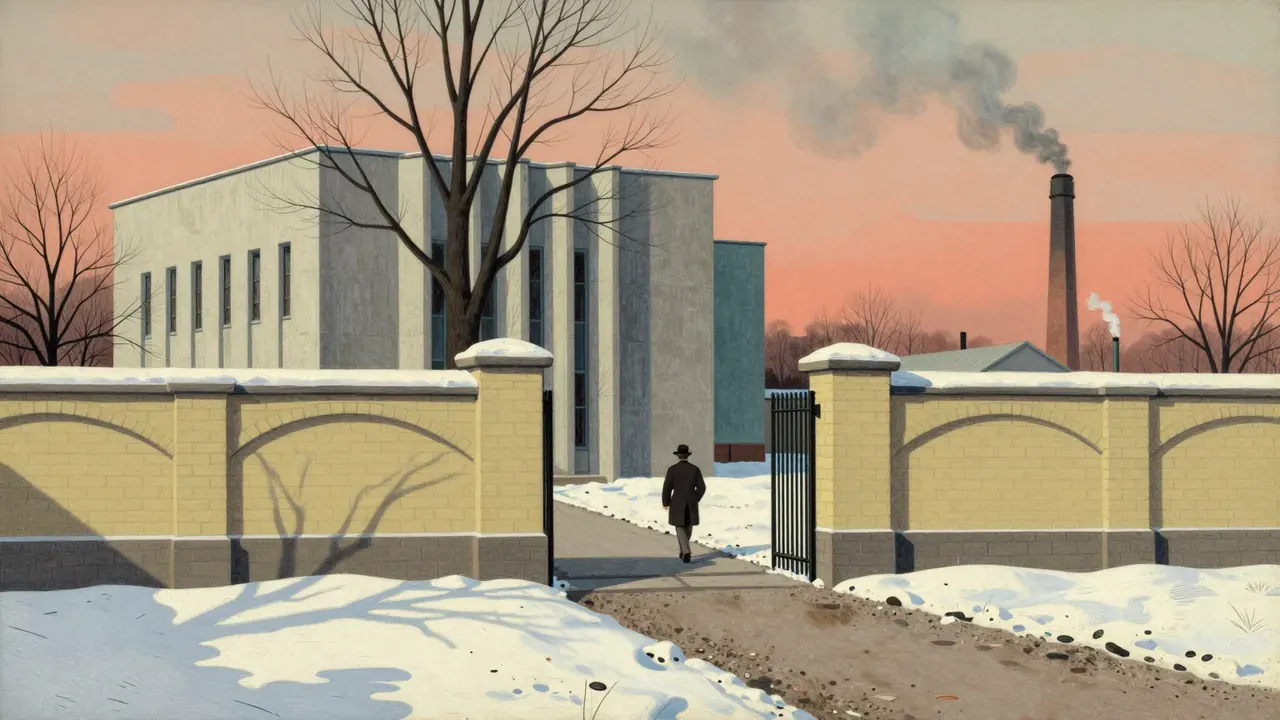
Earth is a silent Ukrainian film made in 1929 and released in April 1930, produced by the All-Ukrainian Photo-Cinema Administration under Soviet rule. It is the third part of Oleksandr Dovzhenko’s Ukraine Trilogy and attempts to dramatise collectivisation not as policy but as elemental transformation — of land, labour, belief and death. Its aim is neither documentary nor propaganda in the blunt sense, but poetic witness: to render the rupture between old peasant life and enforced modernity through image, rhythm and absence of speech. Dovzhenko wrote, directed and edited it; Danylo Demutskyi shot it on location in Poltava Oblast; Levko Revutsky composed its original score. The film was conceived during the First Five-Year Plan, amid violent resistance to collectivisation, and reflects that tension without simplifying it into hero-and-villain binaries. It does not argue for collectivisation so much as show its human cost and physical force — the tractor arriving like a machine-god, the orchard blooming before burial, the rain falling after mourning. Its ambition is lyrical, not didactic; its method is montage, not exposition. (158 words)
The rhythm of seasons
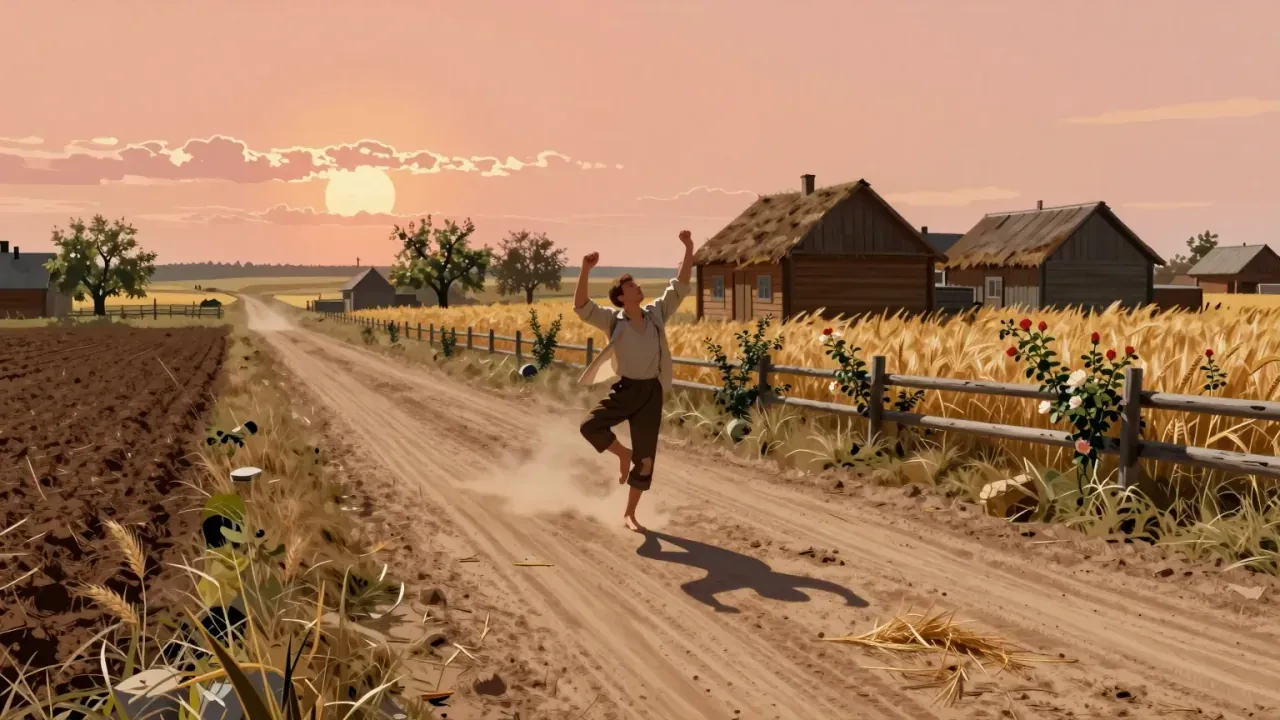
The story follows no single protagonist but a cycle: Semyon’s death beneath an apple tree, Vasyl’s energetic embrace of the collective tractor, his murder by Khoma, and Natalya’s quiet transition from grief to new love. Performances are restrained and grounded — Stepan Shkurat’s Opanas carries stoic doubt, Semen Svashenko’s Vasyl moves with unselfconscious physicality, Yuliya Solntseva’s sister appears in brief, watchful stillness. Demutskyi’s cinematography favours close-ups of faces and hands, soft focus at key moments — dawn dust rising from Vasyl’s dance, moonlight on embracing couples, rain on fruit at the end. Editing by Dovzhenko is rhythmic and associative: wheat fields cut to ploughed earth, then to bread baking, then to a coffin. There is no spoken dialogue, no intertitles beyond sparse, functional text. Music was newly composed by Revutsky, though most screenings now use later scores, including DakhaBrakha’s 2012 version. The film avoids psychological explanation: motives are implied, not stated; ideology is embodied, not debated. Its craft is unified — image, movement, silence and editing all serve a single visual grammar rooted in Ukrainian soil and seasonal time. (159 words)
The look of it
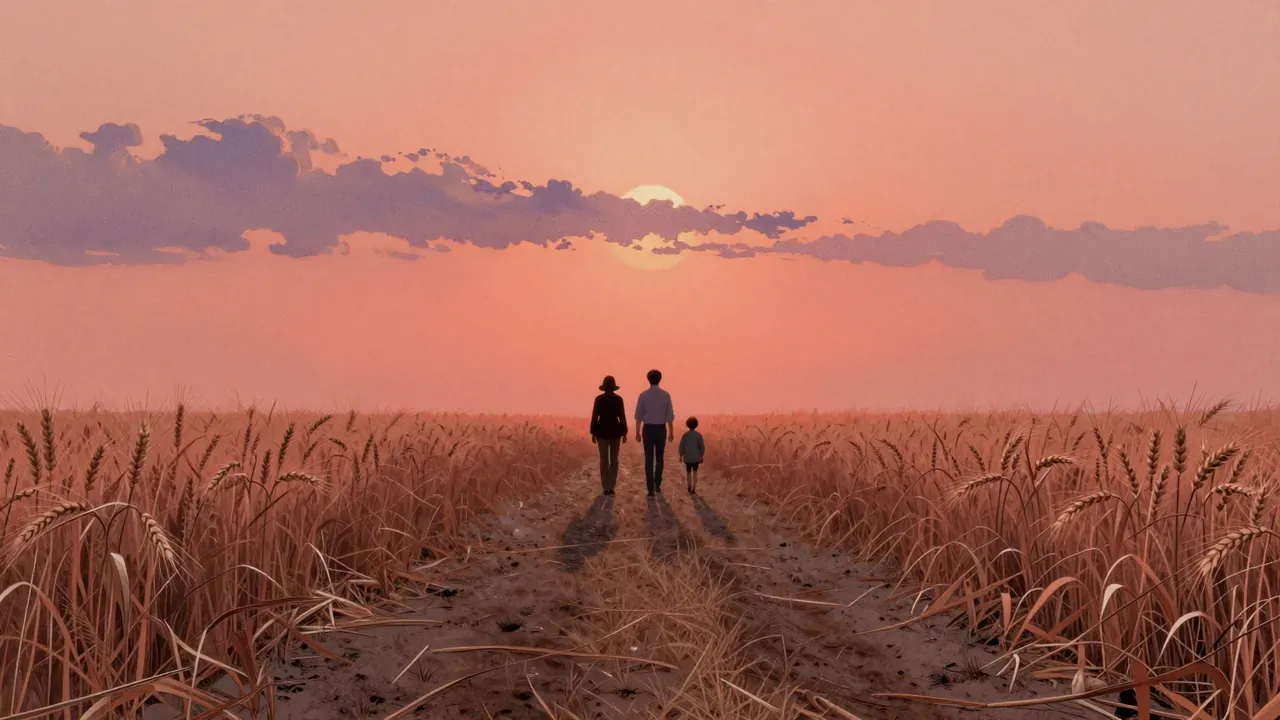
What lands is the film’s physical presence: the weight of wheat stalks bending in wind, the grit of dust kicked up by bare feet, the slow collapse of an old man beneath ripe apples, the sudden violence of a knife in shadow. These images do not illustrate ideas — they occupy space and time with such insistence that meaning arrives through sensation first. The sequence of Vasyl dancing alone on the road, lit by golden-hour sun, is unforgettable not for narrative function but for its sheer, unmediated aliveness — a young body asserting joy just before annihilation. The closing rain on fruit and Natalya’s embrace carry no moralising; they simply register renewal as weather, as biology, as inevitability. The film’s soft-focus passages — the orchard prelude, the moonlit couples, Natalya’s weeping — avoid sentimentality by holding stillness without commentary. Even the tractor scene works because it treats machinery not as symbol but as object: overheated, thirsty, urinated into, then roaring across earth. These moments land because they refuse abstraction. They trust the eye, not the caption. The film’s power is cumulative, built from repeated motifs — trees, hands, soil, light — rather than plot turns. Its lyricism is earned, not imposed. (157 words)
The silence around words
What does not land is the ideological scaffolding. The kulaks are present but thinly drawn — Arkhyp Bilokin speaks in generalities, Khoma’s motive remains opaque beyond inherited opposition. The Young Communist League orator delivers speeches that feel detached from the film’s visual world, their optimism unmoored from the grain of lived experience shown elsewhere. The film’s political argument is implied rather than articulated, and when it tries to name things — ‘collectivisation’, ‘kulak’, ‘tractor’ — those words arrive as labels, not insights. Some scenes meant to signify progress, like the montage of bread-making, feel schematic next to the visceral immediacy of Vasyl’s dance or Semyon’s death. The film’s refusal of psychology also leaves certain relationships unresolved: Opanas’s atheism is stated but not explored; Natalya’s shift to a new lover happens without transition, relying on the rain motif to bridge emotion and event. These gaps are not failures of craft but limits of form — silent cinema cannot carry the weight of complex political nuance without intertitles or voice, and Earth chooses not to supply them. Its silence serves poetry, not politics. (156 words)
The apple and the plough
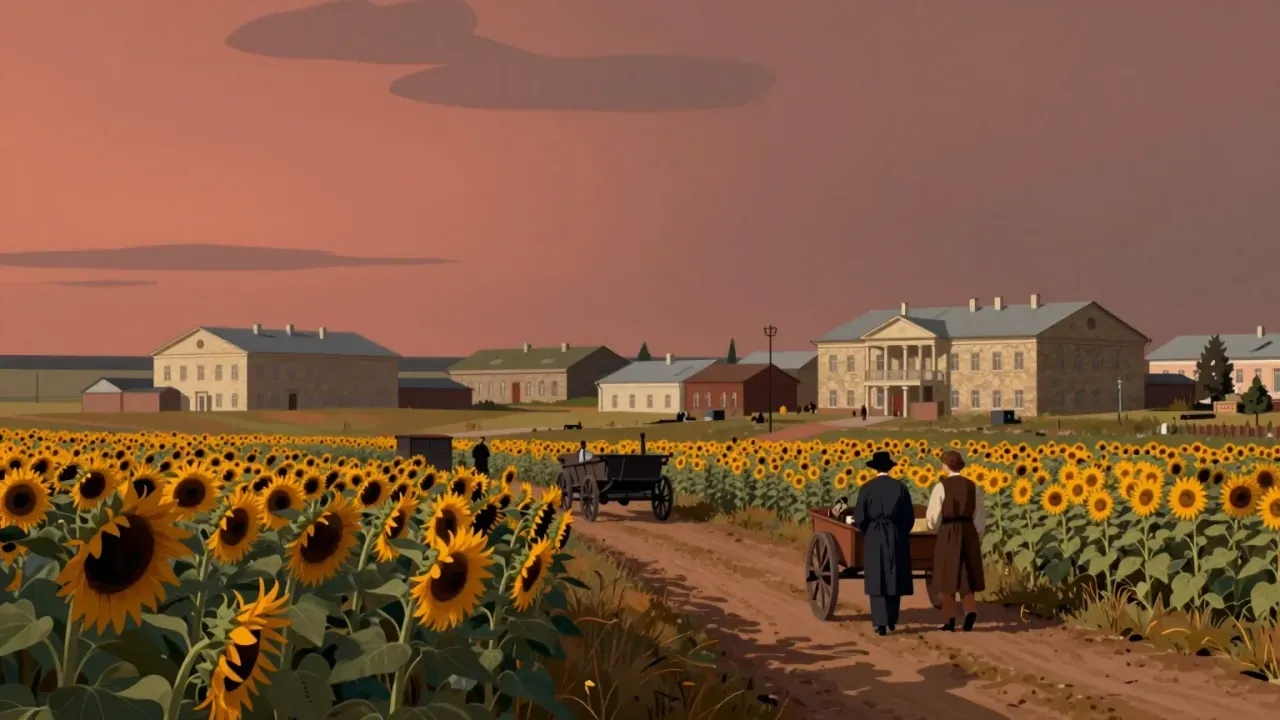
The themes that matter are mortality and continuity, not as abstractions but as agricultural facts: one generation dies beneath fruit-bearing trees while the next plants seed in the same soil. Earth treats land not as property but as memory — the orchard where Semyon dies is the same ground where Vasyl dances and where the tractor later cuts furrows. Time is cyclical, not linear: harvest follows burial follows rain follows planting. Secularism appears not as doctrine but as gesture — Opanas turning away the priest, the villagers singing new songs at the grave. Resistance is embodied, not rhetorical: the kulaks’ sabotage, the peasants’ urination into the radiator, Vasyl’s hopak as defiance of stillness. The film’s deepest theme is the irreducibility of life — its persistence amid violence, its sensuality amid scarcity, its quiet reassertion after loss. It is not about socialism as system but about soil as subject: what it yields, what it hides, what it remembers. The apple tree, the tractor, the rain — these are not metaphors but actors. Their agency is physical, not allegorical. The film refuses to separate human fate from natural process, treating both as governed by the same rhythms of growth, decay and return. (158 words)
The patience it asks
This film is for viewers who value image over explanation, rhythm over resolution, and silence over speech. It rewards patience with attention to texture — the sheen of sweat, the density of wheat, the way light falls on a face in half-shadow. It suits those familiar with silent cinema’s grammar or open to learning it anew. It is not for viewers who require clear causality, psychological motivation or verbal exposition. Those expecting narrative propulsion or ideological clarity will find it elusive. Anyone needing context to grasp collectivisation’s historical stakes may feel adrift, as the film assumes no prior knowledge and offers no gloss. A viewer who dislikes ambiguity, resists non-linear time or finds prolonged stillness alienating will struggle. That said, its power does not depend on political sympathy — one need not endorse collectivisation to be moved by Vasyl’s dance or unsettled by his death. What would change the verdict is sound: had Dovzhenko completed his planned sound version, the balance between image and idea might shift. As it stands, Earth asks for surrender to its visual logic — and gives back intensity in return. (159 words)
The evening it keeps
Yes, it is worth your evening — provided you watch it as a work of visual poetry, not historical document or political tract. Its 78 minutes unfold with the gravity of ritual, each shot weighted like a stanza. It repays close viewing: details accrue — the pattern of a shirt, the angle of a scythe, the way dust hangs in air — and cohere into something larger than sum. You will not leave with answers, but with impressions lodged in muscle and retina. Some will find its pace too deliberate, its silences too long, its politics too opaque. Others, particularly those drawn to filmmakers like Tarkovsky or Paradjanov, will recognise its lineage — a cinema of earth, breath and recurrence. It is not entertainment in the conventional sense, but it is deeply absorbing. Its endurance lies not in message but in materiality: the film feels grown, not built. To watch it is to stand in a field at dusk — aware of wind, light, decay and promise, all at once. That experience, rare and unrepeatable, justifies the time. (159 words)