The first film
Cronos is Guillermo del Toro’s first feature film: a Mexican Spanish-language horror drama that treats immortality not as spectacle but as slow, bodily corruption. It sets out to fuse alchemical myth with Catholic ritual, domestic tenderness with visceral transformation, and quiet moral dread with precise mechanical horror. The film avoids genre shorthand — no jump scares, no exposition dumps — and instead builds its logic from tactile detail: the weight of an antique statue, the sound of clockwork unwinding, the texture of peeling skin. Its ambition is structural as much as thematic: to make the uncanny feel earned, not imposed; to let horror emerge from character choice rather than plot convenience. It assumes the viewer will follow a story told in glances, silences, and physical change over time. That it does so without voiceover, without flashbacks, and with only one flashback sequence (a silent, static shot of the 1536 alchemist) confirms its commitment to restraint. This is not horror as release, but horror as consequence — patient, reverent, and unblinking.
The look of it
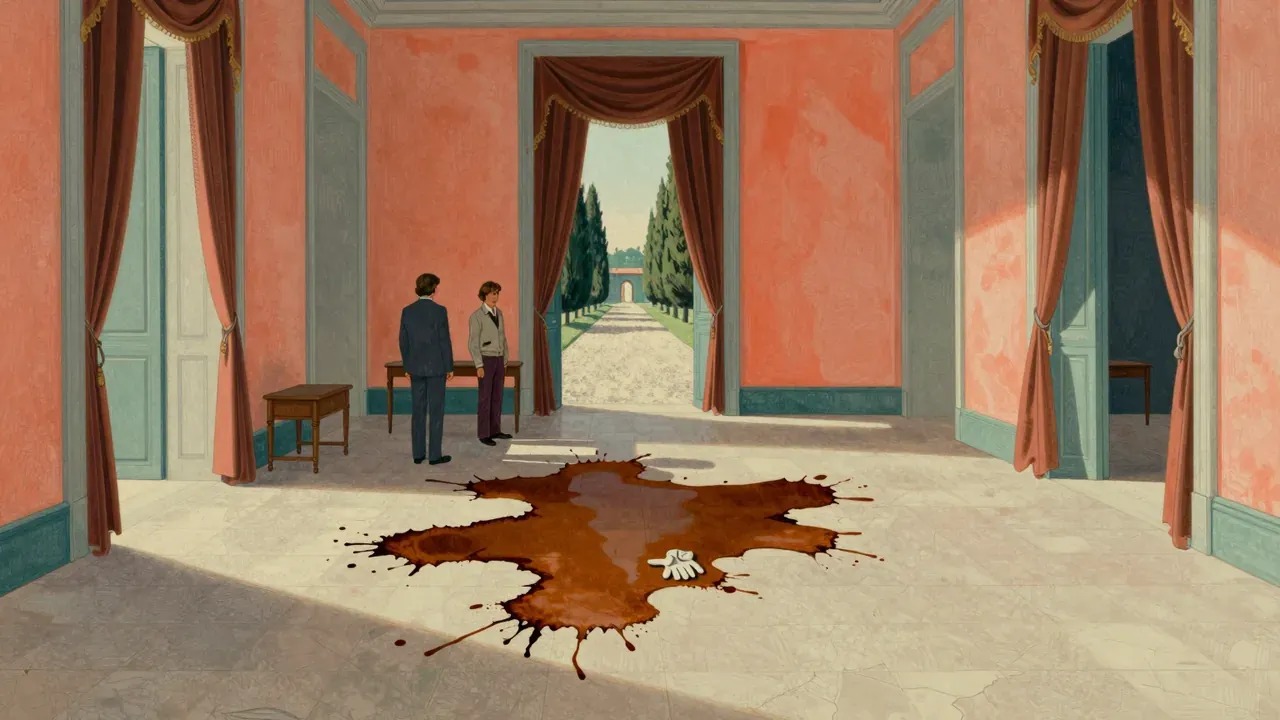
The story unfolds in three distinct temporal layers — 1536, 1937, and 1996 — linked by a single device and its consequences across centuries. Federico Luppi carries the film with minimal gesture: his Jesús Gris ages backward not with glee but with shame, confusion, and quiet prayer. Ron Perlman’s Angel is all coiled aggression and bruised entitlement, Claudio Brook’s Dieter a study in clinical avarice. Guillermo Navarro’s cinematography keeps interiors dim but legible, favouring shallow focus and deliberate framing — a close-up on a trembling hand, a long take on a bloodstain spreading across tile. Javier Álvarez’s score uses prepared piano and metallic percussion to suggest both fragility and mechanism. Del Toro’s script refuses explanation: we never learn how the device works, only what it does to flesh, faith, and family. The editing, by Carlos Puente, holds shots just past comfort, letting discomfort settle before cutting. There are no false notes in performance or craft — each element serves the central tension between grace and decay.
The turning point
What lands is the film’s moral gravity. The horror is never in the blood-licking or the rooftop fall, but in the moment Jesús Gris kneels to pray while his body betrays him — skin burning, pulse quickening, hunger rising — and still he recites the words. The relationship between Gris and his granddaughter Aurora is tender without sentimentality; her worry reads as observation, not melodrama. The device itself lands as both marvel and curse: ornate, insectile, ancient, yet utterly plausible in its function. Even minor characters register — Tito the Coroner appears for less than two minutes but anchors the film’s tone with weary professionalism. The ending lands not as resolution but as quiet reckoning: destruction of the device is neither victory nor surrender, but a final act of will against compulsion. The film’s restraint — no grand monologues, no exposition about alchemy or vampirism — makes its emotional beats land with unusual weight. It trusts the audience to read meaning into silence, into a hand held too long, into a glance held too tight.
The uncle and the nephew
What does not land is the subplot involving Angel’s inheritance motive. His cruelty feels under-motivated beyond narrative convenience, and his final confrontation with Gris lacks the psychological texture of earlier scenes. The New Year’s Eve sequence — Gris lapping blood from a sink — is conceptually strong but visually flat; the lighting flattens the space, and the pacing briefly stumbles. Dieter’s headquarters, though imposing, remain abstract: we see no staff, no operation, no evidence of the decades-long search beyond his word. The film’s refusal to explain the device’s origins also leaves some viewers stranded — not because it’s obscure, but because its rules are never quite codified. A few transitions rely too heavily on narration, which sits oddly against the film’s otherwise visual storytelling. And while the 1937 interlude establishes stakes, it feels detached from the main thread — more prologue than parallel. These are not flaws in execution, but limits of scope: the film chooses intimacy over exposition, and sometimes that costs clarity.
The prayer
The themes that matter are ageing, sacrifice, and the sacredness of the ordinary. Cronos treats time not as linear progression but as layered sediment — the past is not gone, it is buried, waiting. Immortality is framed as theological error: not transcendence, but dislocation from natural order. Gris’s prayers persist even as his body rebels, suggesting faith is not belief in outcome but fidelity to practice. The device is both sacrament and sin — it grants life by violating life. Blood here is neither metaphor nor gore but substance: sustenance, stain, and signature. The film’s Catholic texture is specific, not decorative: the rosary beads, the crucifix, the posture of prayer — all anchor the horror in lived ritual. Family is not refuge but responsibility: Aurora does not save Gris; she witnesses him, and her presence forces his final choice. There is no redemption arc, only a return to human scale — flawed, finite, and quietly courageous. The film asks not whether eternity is possible, but whether it is bearable — and answers with a single, unflinching ‘no’.
The last light
This film is for viewers who value atmosphere over action, implication over exposition, and moral ambiguity over moral certainty. It suits those accustomed to arthouse pacing, to Spanish-language dialogue without subtitles as crutch, and to horror that operates through restraint rather than escalation. It is not for viewers seeking catharsis, jump scares, or clear genre signposting — the vampire tropes are present but subverted, the fantasy elements grounded in bodily realism. Those who require narrative closure or psychological exposition may find its silences frustrating. Fans of del Toro’s later work may expect more visual flamboyance; Cronos is quieter, leaner, more austere. Its power lies in accumulation, not climax — so viewers who prefer immediate payoff over slow build will likely disengage. The film rewards attention to texture, to light, to breath — and that demands a certain kind of patience, one not everyone brings to the screen.
The final frame
Yes, it is worth your evening — provided you watch it whole, undistracted, and in its original Spanish. Its 94 minutes unfold with the weight of something inevitable, not rushed. You will not leave exhilarated, but unsettled in a way that lingers: the image of Gris lying in bed, skin raw, eyes open, holding his granddaughter’s hand — not as saviour or monster, but as man. It earns its quiet ending not through spectacle but through accumulated detail: the tremor in a hand, the shift in a gaze, the sound of a clock winding down. Those who find its pace too slow may argue it lacks momentum — but momentum is not the point. What changes the verdict is context: watched alongside del Toro’s later films, Cronos feels like a sketchbook — essential, but incomplete without the later volumes. Alone, it stands as a complete, coherent, and deeply humane meditation on what it means to be alive — and what it costs to stay that way.