The title is not literal
The Chorus is a 1982 Iranian short film in Persian, written and directed by Abbas Kiarostami. It is not a musical or choral work despite its English title; the Persian title Hamsorayan translates more precisely as ‘fellow travellers’ or ‘those who walk alongside’. The film attempts a quiet, observational distillation of collective presence — how individuals cohere, drift apart, or remain unconnected within shared space and time. It does not seek to narrate cause or resolve conflict, nor to diagnose social conditions. Instead, it holds a fixed frame on a group of children moving through an institutional setting, testing how much meaning can be held in duration, repetition, and minor variation. There is no exposition, no character introduction, no stated objective beyond registering movement and stillness in relation to one another. Its ambition is structural and rhythmic: to treat a group not as a sum of individuals but as a single, breathing unit whose internal logic emerges only through sustained attention.
The look of it
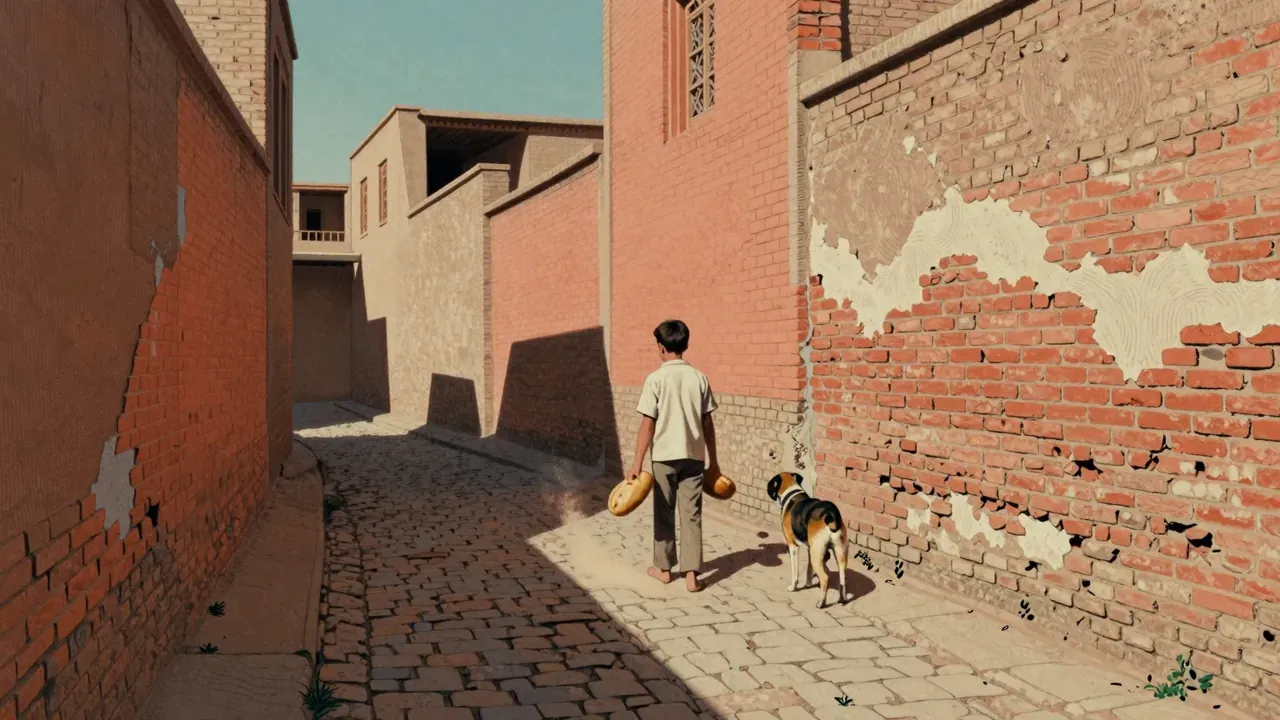
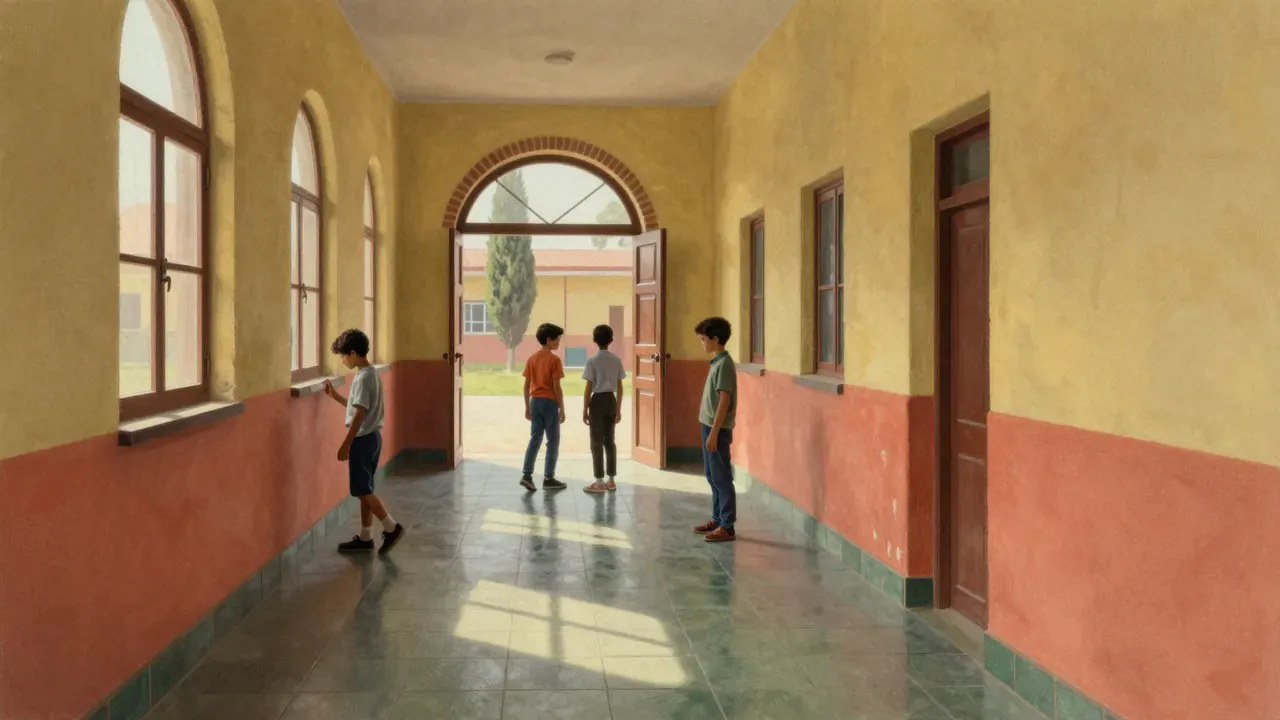
The film unfolds across a single location — a school corridor or courtyard — with children entering, pausing, passing, turning, or halting without instruction or apparent purpose. There are no professional actors credited; the performers are non-professional children, their behaviour unscripted in any conventional sense but shaped by Kiarostami’s direction into a loose choreography of arrival and dispersal. The camera remains static, medium-wide, at eye level, with natural light and minimal editing — long takes punctuated by subtle shifts in focus or framing rather than cuts. Sound is diegetic and sparse: footsteps, distant voices, wind, occasional off-screen bells. Gordon Willis is not involved; the cinematographer is not named in the fact sheet, so no attribution is made. The craft lies in restraint: no music, no voiceover, no close-ups, no narrative signposting. Every decision serves the central proposition — that coherence arises not from plot or psychology but from shared physical circumstance and temporal continuity.
What stays with you
What lands is the cumulative weight of attention. Over its short runtime, the film builds a palpable sense of shared vulnerability — not through pathos or sentiment, but through the sheer persistence of bodies in proximity, subject to the same light, the same floor, the same unspoken rules. The repetitions do not feel mechanical but ritualistic; small deviations — a child stopping to tie a shoelace, two glancing at each other, one turning back — gain significance because they interrupt a pattern we have begun to internalise. The lack of explanation makes space for the viewer to notice things they would otherwise overlook: how posture changes with fatigue, how groups form and dissolve without signal, how silence carries different densities depending on who is present and who has just left. This is not passive observation but active calibration — the film trains the eye and ear to register micro-shifts in collective rhythm, and that training pays off in moments of unexpected resonance.
What slips away
What does not land is any claim to psychological depth or social commentary beyond what the image and sound directly provide. Viewers expecting insight into Iranian childhood in the early 1980s — its politics, education system, or domestic life — will find no exposition, no context, no framing device to anchor the scene historically or culturally. The film offers no names, no dialogue that identifies motive or relationship, no visual cues to era beyond the clothing and architecture, which the fact sheet does not describe. Its refusal to name or interpret means it cannot serve as documentary evidence or sociological record. Those looking for narrative propulsion, character arcs, or thematic resolution will find the film withholding — not evasively, but structurally. It does not fail at these things; it simply does not attempt them. Its limitation is also its boundary: it asks only to be watched, not understood in conventional terms.
What it is really about
The themes that matter are presence, collectivity, and duration. Not identity, but adjacency. Not agency, but alignment. The film treats the group not as a vehicle for individual stories but as a condition — something one enters, moves within, and exits without necessarily changing. Time here is neither linear nor symbolic; it is measured in breaths, steps, shifts of weight. There is no hierarchy between foreground and background, leader and follower — everyone occupies the same plane, subject to the same light and gravity. The theme of silence is equally vital: not absence of sound, but the space in which sound acquires weight. These are not abstract ideas illustrated by action, but conditions enacted — the film’s form is its argument. It suggests that meaning resides less in what people say or do than in how they occupy time and space together, even when that occupation appears incidental or unremarkable.
Who it is for
This film is for viewers who value sustained attention over exposition, who find interest in repetition as a compositional principle, and who are comfortable with ambiguity as a mode of engagement. It suits those familiar with Kiarostami’s later work — particularly Where Is the Friend’s House? or Close-Up — and those drawn to structuralist or observational cinema. It is not for viewers who require narrative scaffolding, emotional payoff, or clear authorial intent. Anyone seeking historical context, cultural specificity, or psychological insight beyond what the frame contains will leave unsatisfied. A teacher using film to illustrate post-revolutionary Iran would find it inadequate; a student of film form studying duration and framing would find it essential. Its value depends entirely on whether the viewer accepts its terms: that watching is itself a kind of thinking, and that coherence can emerge from stillness as readily as from motion.
Is it worth your time?
Yes, it is worth your evening — provided you watch it on its own terms and not as a substitute for something else. At under thirty minutes, it asks little time but demands full attention: no scrolling, no pausing, no multitasking. Its reward is not revelation but recalibration — a subtle shift in how you perceive movement, grouping, and silence in everyday life. Those who dismiss it as ‘nothing happens’ have mistaken stillness for emptiness. Others, particularly fans of minimalist or pedagogical cinema, may find it quietly revelatory. It would not hold up as a standalone feature, nor does it intend to; its power lies in its concision and precision. To call it ‘minor’ is accurate but misleading — minor forms can carry major perceptual weight. If you expect entertainment, it will disappoint. If you accept it as an exercise in attention, it delivers.