The school as microstate
Zero for Conduct is a 44-minute French featurette from 1933 that stages childhood rebellion as anarchic theatre. Jean Vigo, drawing on his own years in Millau’s boarding schools and his father’s imprisonment at La Petite Roquette, constructs the institution not as backdrop but as compressed political allegory: a hierarchy of petty authority enforcing absurd discipline upon boys whose resistance is physical, poetic, and unmediated by adult logic. It does not seek realism but rhythmic inversion — turning dormitory rules into farce, classroom order into chaos, Sunday confinement into a pretext for revolt. The film treats childhood not as innocence to be preserved but as a site of uncorrupted agency, one already under siege by bureaucracy, surveillance, and punitive ritual. Its ambition is neither documentary nor satire alone, but a fusion of surrealist gesture and pedagogical provocation: to show how freedom might erupt not after liberation, but inside constraint, and not through speech, but through pillow fights, tin-can barrages, and rooftop marches in nightshirts. It is a film made with urgency, illness, and little money — and it refuses the calm of exposition or resolution.
The grammar of revolt
The story follows four boys — Caussat, Colin, Bruel, and Tabard — who coalesce against teachers named Bec-de-Gaz, Pète-Sec, and Mère Haricot, figures drawn from Vigo’s memory and sharpened into caricature. Boris Kaufman’s cinematography favours low angles, tight framing, and abrupt cuts; interiors are cramped and shadowed, corridors feel like cages, yet movement remains buoyant — boys sprinting down halls, Huguet balancing on desks, the camera tilting during pillow fights. Jean Dasté’s Huguet stands out not for naturalism but for calibrated physicality: his Chaplin-like grace contrasts with the stiff, jerking gait of other supervisors. Dialogue is sparse and stylised, often rhythmic or chanted, partly due to poor sound recording but also by design — meaning accrues through gesture, repetition, and timing rather than exposition. Editing, credited to Vigo himself, favours juxtaposition over continuity: a yawn cuts to a spitball; a zero-for-conduct notice dissolves into a skull-and-crossbones flag. Maurice Jaubert’s score is percussive and insistent, underscoring rhythm over mood. Non-professional actors perform with unselfconscious directness — their faces unpolished, their reactions uncalculated, which deepens the film’s sense of lived immediacy.
The clarity of the young
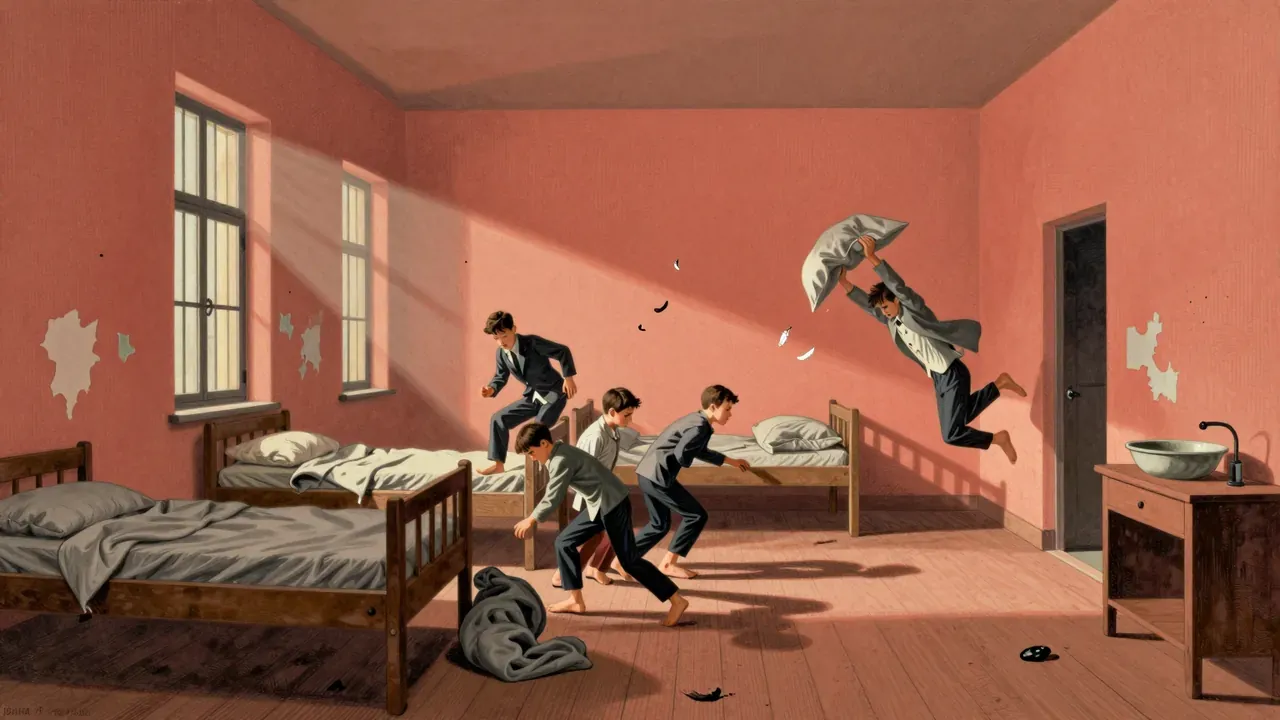
What lands most decisively is the physical grammar of revolt: the way a thrown loaf becomes political, a pillow fight a tactical manoeuvre, a rooftop ascent a declaration. The sequence where the boys march across roofs at the film’s close carries no dialogue, only wind and distant bells, and it lands with solemn, unironic weight — not as fantasy but as earned release. The casting of children who look and move like actual children, not stage-trained surrogates, gives the rebellion texture and credibility. Huguet’s brief, warm presence works because it is never sentimentalised; his solidarity is shown in action — taking the boys into town, doing handstands — not speech. The film’s brevity aids its impact: every scene serves the central tension between containment and eruption, and nothing lingers beyond its functional or symbolic purpose. Even the school’s absurd punishments — zeros for conduct, enforced silence, Sunday confinement — land precisely because they are rendered with deadpan specificity, not exaggeration. This is not whimsy; it is precision. The film’s energy feels less invented than channelled, as if Vigo transcribed childhood defiance before adult language could dilute it.
Surrealism as exposure
What does not land consistently is the tonal calibration between surrealism and social critique. Some transitions — from slapstick to menace, from quiet observation to sudden chaos — feel less like deliberate rupture and more like gaps left by budgetary or technical limitation. The science teacher’s intrusion before Tabard’s outburst reads less as narrative pivot than as an arbitrary trigger, and Tabard’s effeminate presentation, while clearly intentional, risks flattening into period-typical coding without deeper contextualisation. The film’s refusal of psychological explanation means certain motivations remain opaque: why this festival? Why these particular targets? The soundtrack’s poor fidelity, though turned to poetic advantage in places, occasionally obscures intent — not just words, but emphasis and irony. And while the anarchic spirit is coherent, the film’s political vocabulary is implicit rather than argued; viewers unfamiliar with Vigo’s biography or French interwar context may register the anger without grasping its anchors in prison reform, anarchist pedagogy, or the legacy of Miguel Almereyda. It assumes a shared understanding of repression as systemic, not merely personal.
Occupation, not escape
The themes that matter are childhood as political subject, not passive object; education as apparatus of control; and rebellion as embodied, collective, and non-teleological. Vigo treats the boarding school as a microstate: its uniforms, timetables, and punishment registers mirror state bureaucracy, its teachers stand in for police, judges, and clerks. The zero-for-conduct mark is not just a school rule but a metaphor for exclusion from civic life — withheld Sundays replicate withheld rights. Anarchism here is not doctrine but disposition: decentralised initiative, distrust of hierarchy, faith in spontaneous coordination. Surrealism functions not as decoration but as method — disrupting logic to expose the illogic of authority. The film’s enduring relevance lies in how it frames vulnerability not as weakness but as perceptual clarity: children see the arbitrariness of power because they have not yet internalised its justifications. That clarity is what the school tries to erase — and what the film preserves, not as nostalgia, but as forensic record. It is less about ‘growing up’ than about refusing assimilation, and its vision of freedom is not escape, but occupation: of rooftops, corridors, cafeterias, and, finally, the frame itself.
The texture of urgency
This film is for viewers who value formal daring over narrative polish, who find political resonance in physical comedy, and who accept that a 44-minute work can carry the weight of a manifesto. It suits those familiar with interwar avant-garde cinema, French anarchism, or the history of educational reform — but it also rewards newcomers willing to meet it on its own terms: as rhythm, gesture, and revolt-in-miniature. It is not for viewers who require psychological motivation, linear cause-and-effect, or polished sound design. Those expecting gentle nostalgia or character-driven drama will find it alienating; so will those who read its chaos as amateurish rather than strategic. A viewer who values coherence over contradiction, or who needs moral clarity in protagonists, may reject its ambiguity. The verdict would shift only if the film were re-cut to clarify causality or smooth its textures — but that would dissolve its core argument: that resistance is rarely tidy, and that clarity often arrives not through explanation, but through action.
Forty-four minutes, fully charged
Yes, it is worth your evening — not as relaxation, but as recalibration. Its 44 minutes offer a concentrated dose of cinematic nerve: a reminder that form can be political, that children’s bodies can be sites of theory, and that rebellion need not be loud to be consequential. It repays attention not because it explains itself, but because it insists on being felt first — in the tilt of a camera, the thud of a pillow, the silence after a tin can hits stone. Those who watch it once may miss its architecture; those who return find new patterns in its editing, new weight in its silences. It is not universally accessible — its historical specificity, its stylistic economy, its lack of exposition all demand engagement — but its influence on Truffaut, Anderson, and generations of filmmakers confirms its density of thought. To skip it is to miss a hinge moment in cinema’s relationship to power, pedagogy, and play. It earns its place not through scale, but through singularity: one short film, fully itself, entirely uncompromised.