The opening gear
Daisies is a formally disruptive satire from Czechoslovakia’s New Wave, co-directed by Věra Chytilová and Rudolf Jaroš in 1966. It sets out not to tell a story but to dismantle expectation — of narrative, of gender, of political propriety, of cinematic decorum. Its two protagonists, both named Marie, are not characters in a conventional sense but rhetorical devices: deliberately infantilised, mechanically voiced, and repeatedly framed as dolls or marionettes. The film’s stated aim, per Chytilová’s own description, is a ‘necrologue about a negative way of life’, and it fulfils that by refusing moral resolution, linear cause-and-effect, or psychological consistency. It treats bourgeois manners, socialist realism, and patriarchal assumptions with equal contempt, using absurdity not as relief but as scalpel. The opening montage — wartime footage spliced with a spinning flywheel — signals its preoccupation with systems of control and collapse. It does not argue; it demonstrates the rot by over-enacting it until the performance becomes indistinguishable from critique. Its ambition is structural, not expositional: to make form itself the argument. (158 words)
The look of it
The film works through radical discontinuity: black-and-white cuts to saturated colour, abrupt shifts in aspect ratio, jump cuts, and optical printing effects that fracture time and space. Jaroslav Kučera and František Uldrich’s cinematography alternates between clinical stillness and frenetic handheld movement, often within the same sequence. Jitka Cerhová and Ivana Karbanová — non-professionals at the time — perform with studied affectlessness, their voices flat, their gestures stiff and creaking, reinforcing the doll metaphor. Editing by Miroslav Hájek and Jitka Sulcová stitches scenes together like collage, rejecting continuity in favour of rhythmic and thematic echo. Jiří Šust and Jiří Šlitr’s score ranges from jaunty jazz to dissonant plucked strings, underscoring irony rather than emotion. Dialogue is sparse, repetitive, often nonsensical; motivation is withheld, cause erased. Even food — peaches, corn, milk baths, banquet wreckage — is handled as prop and symbol, not sustenance. The film’s coherence lies not in plot logic but in its unwavering commitment to this destabilising grammar: every frame insists on artifice, every cut refuses submission to realism. (159 words)
The shape of the chaos
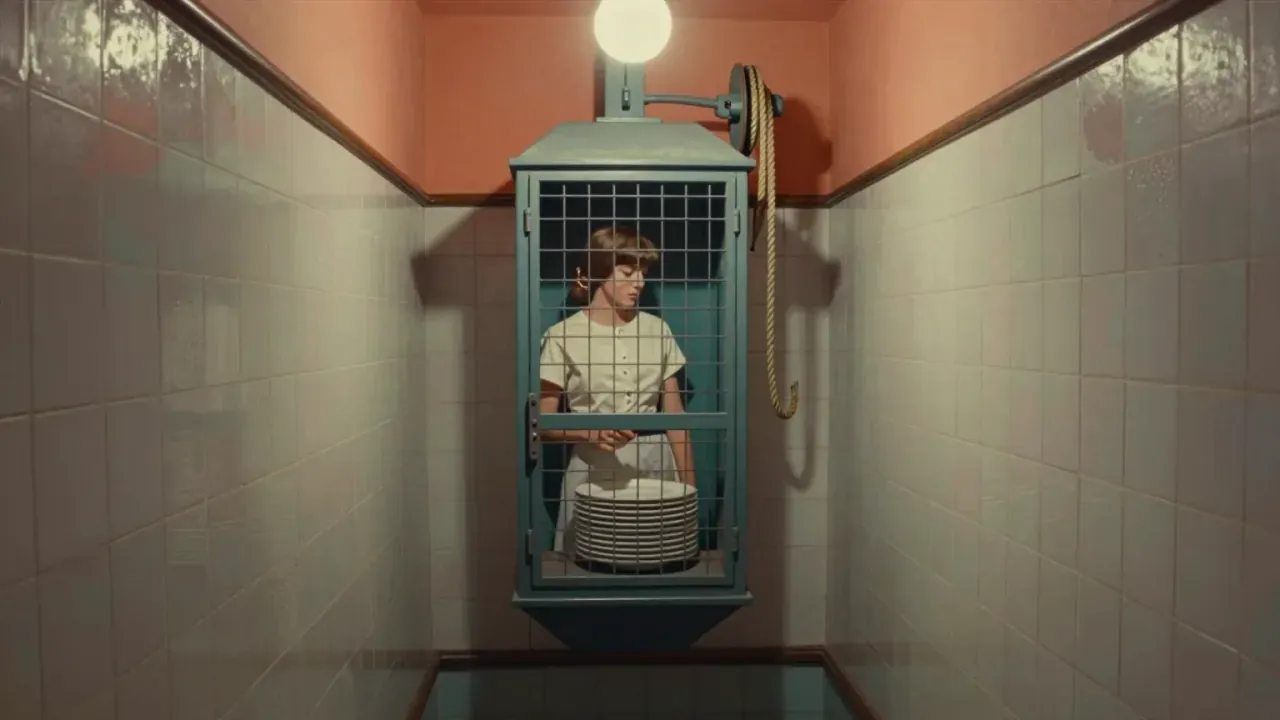
What lands is the sheer, sustained force of its refusal. The Maries’ escalating sabotage — of meals, men, manners, meaning — accumulates into something more than provocation: it becomes a physical grammar of dissent. Their laughter after crying over a departed suitor, their indifference to declarations of love while cutting phallic vegetables, their collapse of the chandelier into water — all land because they are precise, unapologetic, and rhythmically timed. The film’s visual wit holds up decades later: the fruit tree sequence, the milk-and-egg bath, the mechanical dumbwaiter ascent, the final table-laying with broken crockery — these are not gags but choreographed acts of symbolic reclamation. The editing’s jarring shifts do not confuse so much as recalibrate attention, training the viewer to expect rupture. Even the wartime bookends gain weight on repeat viewings, anchoring the Maries’ chaos not in whimsy but in historical exhaustion. The film’s energy is neither chaotic nor careless; it is tightly wound, precisely detonated. Its satire lands because it never explains itself — it assumes the audience will recognise the rules it breaks, and feel the relief of their breaking. (157 words)
What stays unsaid
What does not land is any attempt to read the Maries as psychologically legible or morally legible. Their motivations remain opaque, their relationship to each other unstable, their emotional register deliberately flattened. Viewers seeking character arcs, interiority, or even consistent tone will find only ellipsis. The film’s rejection of exposition extends to its politics: though widely read as anti-patriarchal and anti-authoritarian, it offers no counter-model, no solidarity, no vision beyond negation — which some may read as nihilism rather than strategy. The voice of Jiří Menzel, used sparingly, feels tonally disconnected from the rest, its dry narration landing awkwardly against the Maries’ physicality. Some sequences — the gas suicide attempt, the bathroom robbery — risk feeling arbitrary without the context of the film’s broader formal architecture. And while its stylistic volatility is central to its purpose, it can also fatigue: the relentless switching between filters, ratios, and palettes occasionally reads less as intention and more as exhaustion, especially in a single sitting. Its refusal to settle makes it resistant, not just to interpretation, but to absorption. (159 words)
What it eats and breaks
The themes that matter are not abstracted but embodied: the weaponisation of infantilisation, the politics of consumption under scarcity, the violence of enforced femininity, and the impossibility of sincerity within rigid ideological frameworks. The Maries are not rebels with a cause but symptoms — of a society that reduces women to decorative, obedient, consumable objects, then punishes them for failing to be either fully passive or fully functional. Their ‘spoiled’ behaviour is a mirror held up to a world already spoiled by war, bureaucracy, and dogma. Food is never just food: it is surplus, power, waste, desire, and taboo — especially in a socialist state where abundance was ideologically suspect. The film’s repeated fragmentation — of bodies, of rooms, of dishes — speaks to the dismantling of inherited structures, not just social ones but perceptual ones. Its attack on ‘well-mannered spectatorship’ is as vital as its attack on patriarchy: it insists that how we watch matters as much as what we watch. There is no utopian horizon here, only the visceral satisfaction of demolition — and the quiet, unsettling whisper at the end about becoming ‘good and hardworking’. (158 words)
Who it speaks to
This film is for viewers who treat cinema as a site of formal inquiry, not just storytelling — those comfortable with abstraction, willing to sit with ambiguity, and alert to the politics of editing, colour, and sound design. It rewards patience with pattern, not plot. It is not for those who require psychological realism, narrative payoff, or moral clarity — nor for those who mistake stylistic rebellion for lack of craft. Anyone expecting a comedy of manners or a feminist parable with uplift will be frustrated. Its ban in 1966 was not for obscenity but for its refusal to serve ideology, and that same refusal remains its core demand on the viewer today. A viewer who values coherence over collision, or empathy over estrangement, will find little purchase here. That is not a flaw but a condition: the film asks you to abandon certain habits of watching before it will let you in. Those who cannot — or will not — make that shift will see only chaos. (158 words)
The ending that begins again
Yes, it is worth your evening — but only if you approach it as an event in film history, not as entertainment. Its seventy-six minutes are dense, demanding, and deliberately exhausting; it repays attention but resists comfort. It is not ‘enjoyable’ in the conventional sense, yet its rigour, wit, and formal audacity remain unmatched in its era. Anyone who has watched mainstream cinema for too long will feel its shocks like fresh air — or like a slap. Those who dismiss it as pretentious miss how precisely its absurdity targets real power: the state, the studio, the patriarchal gaze. Its verdict depends entirely on whether you accept that cinema can be a weapon of perception, not just a vessel for story. To say it is ‘not for everyone’ is to misunderstand its purpose: it was never made for everyone. It was made for the few who would notice the creaking hinge — and hear, beneath it, the sound of a system straining. (159 words)