The look of it
Lone Wolf and Cub: Baby Cart to Hades is the third of six 1970s Japanese martial arts films adapting Kazuo Koike’s manga, directed by Kenji Misumi and produced by Shintarō Katsu. It follows Ogami Ittō — a disgraced former shōgun’s executioner turned wandering assassin — and his infant son Daigoro as they travel through Edo-period Japan in a baby cart rigged for combat. The film does not aim to innovate the genre but to deepen its moral architecture: it treats the samurai code not as dogma but as contested terrain, testing fidelity to bushidō through acts of violence that are both ritualised and pragmatic. It seeks coherence across brutality and stillness, using repetition — of gesture, framing, and narrative structure — to anchor ethical questions in physical consequence. The film’s ambition lies in sustaining tension between stoic restraint and explosive action, between filial duty and professional obligation, without resolving the contradictions. It assumes familiarity with the series’ premise but not its prior entries, offering self-contained episodes that accumulate thematic weight across encounters with rapists, yakuza, corrupt officials, and fellow rōnin. Its project is neither revisionist nor nostalgic; it is forensic.
The rhythm of it
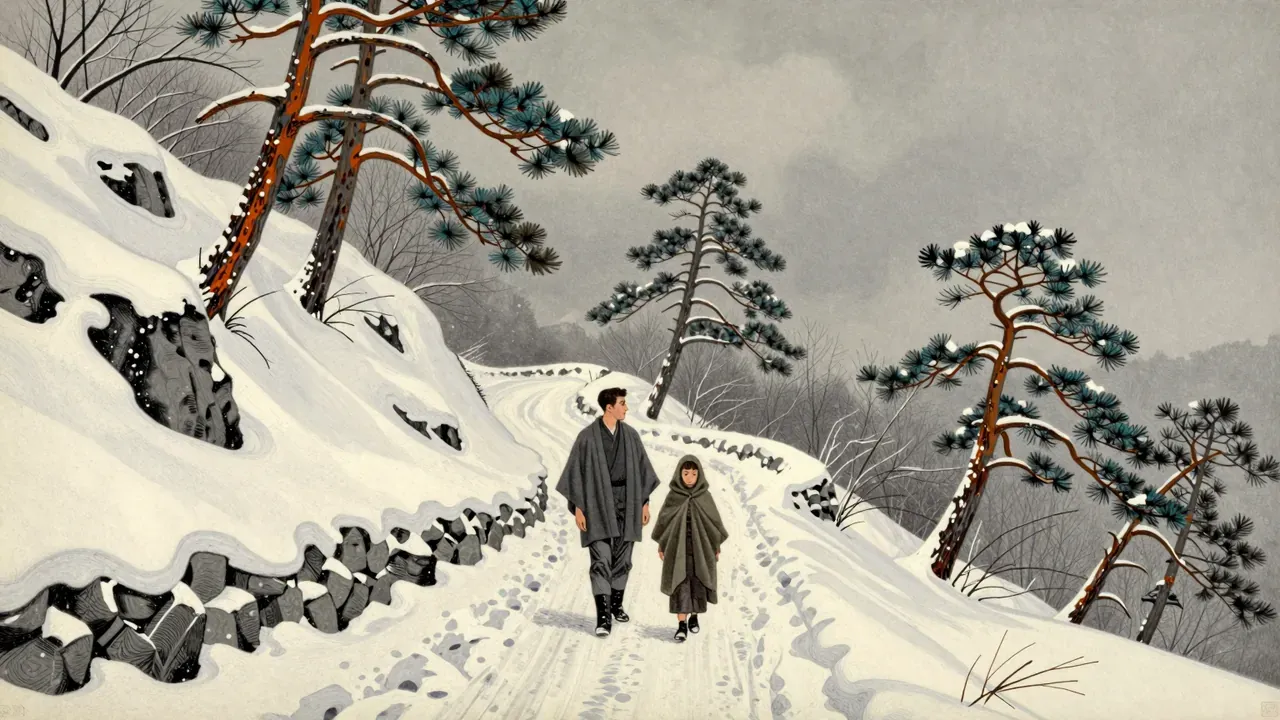
The story moves episodically, stitching together set pieces — river surveillance, bamboo ambush, buri-buri torture, multi-stage siege — linked by Ittō’s unbroken trajectory. Tomisaburō Wakayama’s performance is calibrated to near-zero affect: every glance, sheath-draw, and breath is measured, never expressive but always legible. Gō Katō as Kanbei provides the film’s sole counterpoint — a man whose honour is fractured by circumstance, not choice — and his arc gains weight from understated delivery and precise blocking. Yoshinobu Nishioka’s art direction frames interiors with shallow depth and narrow corridors, while exteriors use flat, sun-bleached compositions that flatten hierarchy between killer and victim. Kenji Misumi holds shots longer than narrative urgency demands, letting silence settle before violence erupts. The editing avoids cross-cutting during fights, favouring single-take choreography or abrupt cuts to aftermath — severed limbs, pooled blood, still faces. Sound design is sparse: no score swells, no non-diegetic music intrudes. The baby cart’s arsenal reveal is not spectacle but logic — functional, grim, inevitable.
The weight of it
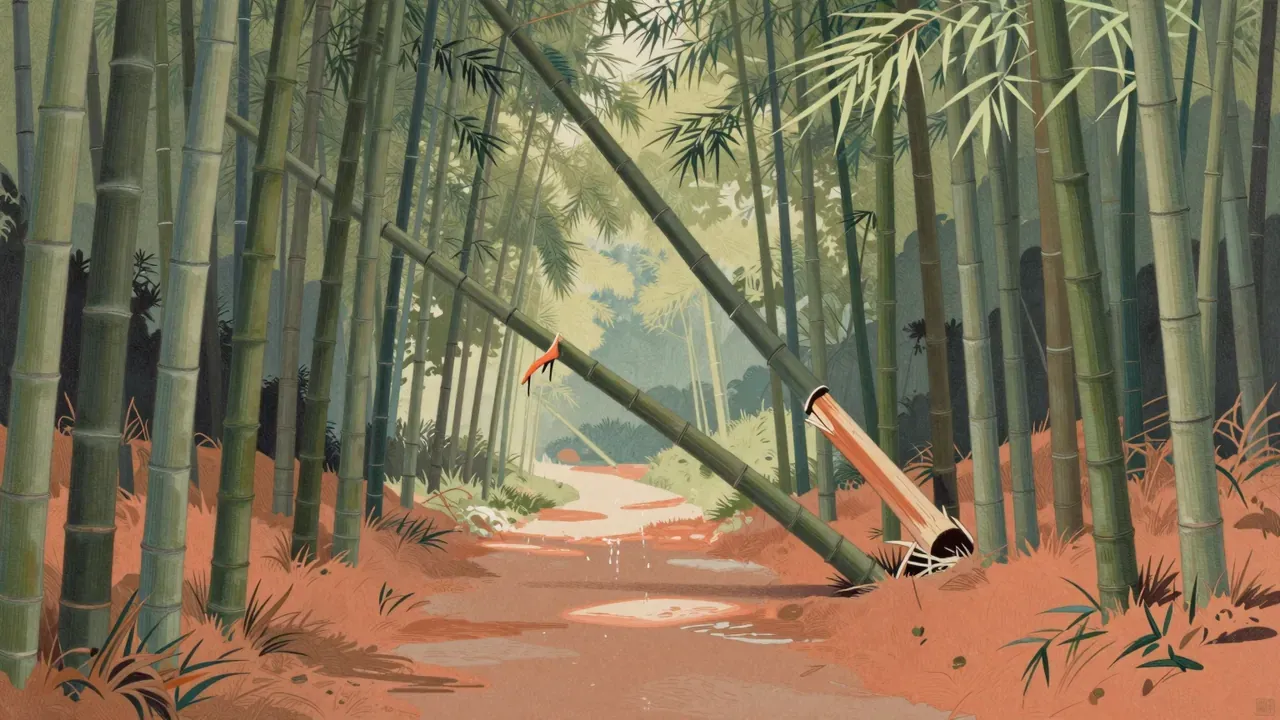
What lands most firmly is the film’s refusal to separate ethics from embodiment. Every act of violence carries procedural weight: Ittō’s sword draw is never casual, his endurance of buri-buri is not heroic but transactional, his final duel with Kanbei ends not in triumph but in shared exhaustion and quiet affirmation. The bamboo ambush works because it turns landscape into weapon and surveillance into geometry — the stalks sway just so, the fall is timed, the blood spatter is minimal but unignorable. The torture sequence lands not through suffering but through duration: the dunking repeats, the canes strike, Ittō blinks but does not flinch. Even the governor’s army assault gains force from its asymmetry — two hundred men versus one man and a child, yet the cart’s hidden guns do not feel like deus ex machina but like earned contingency. Wakayama’s stillness reads as discipline, not vacancy; Daigoro’s presence is never cutesy but structural — his cart is both cradle and armory, his silence a condition of survival. The film’s rhythm rewards attention to posture, timing, and negative space, not plot twists or emotional escalation.
The limits of it
What does not land is the film’s handling of female characters beyond functional roles: the young woman on the boat, the rape victims, Torizo — all serve as catalysts or vessels for male moral reckoning. Their interiority is withheld, their agency circumscribed by plot necessity rather than character logic. The yakuza subplot introduces Torizo as pistol-wielding and decisive, yet her arc collapses into silent awe at the end, her political grievance subsumed by myth-making. The rape sequence, though narratively pivotal, is staged with clinical distance that risks aestheticising violation without interrogating complicity — the camera observes but does not sit with consequence beyond Kanbei’s guilt. The American-dubbed title Lightning Swords of Death misrepresents the film’s tone entirely, and even the original Japanese title’s poetic abstraction — ‘Perambulator Against the Winds of Death’ — feels more coherent than some of the script’s abrupt transitions, particularly the pivot from torture to Miura’s backstory, which arrives without visual or tonal preparation. The film assumes a viewer already fluent in its grammar; newcomers may find the pacing opaque, the stakes diffuse.
The code of it
The themes that matter are endurance as ethics, violence as language, and fatherhood as transmission. Ittō does not teach Daigoro through speech but through exposure — to water, to bamboo, to drowning, to gunfire — each encounter a lesson in consequence. Bushidō here is not about loyalty to lord or clan but about fidelity to action: to draw the sword is to accept its weight, its cost, its irreversibility. The film treats honour not as status but as calibration — Kanbei’s error was not cowardice or cruelty but miscalculation of risk and timing, and Ittō’s verdict affirms that distinction. Stoicism is not suppression but economy: every blink, breath, and pause serves a purpose. The baby cart embodies this — a domestic object made lethal, a symbol of care repurposed for survival. The film also treats memory as physical residue: Miura’s missing arm, Ittō’s scarred hands, the governor’s fear of a man he once hired — history lives in tissue, not text. There is no redemption arc, only alignment: characters move toward clarity not through change but through elimination of contradiction.
The audience for it
This film is for viewers who value precision over exposition, stillness over speed, and moral ambiguity over resolution — those accustomed to Japanese period cinema of the 1970s, or to the structural rigour of late Ozu or early Kurosawa. It rewards patience with cumulative meaning, not immediate payoff. It is not for viewers who require psychological motivation, emotional catharsis, or narrative symmetry; those expecting character arcs with growth or closure will find the film withholding. It is also not for viewers unfamiliar with the conventions of chanbara — the sword-draw rituals, the spatial logic of duels, the weight given to silence — unless they are prepared to absorb them through repetition rather than explanation. A viewer who values strong female agency or layered secondary characters may find the film’s gender politics dated and its world-building selective. Someone who prefers tightly plotted thrillers or morally legible heroes would likely disengage before the bamboo ambush. The film asks for surrender to its rhythm, not engagement with its plot.
The time for it
Yes, it is worth your evening — but only if you watch it whole, without interruption, and without expectation of conventional pacing or resolution. Its 89 minutes accumulate like sediment: each scene deposits a layer of implication that only coheres in retrospect. The final duel with Kanbei lands not because it is choreographed well — though it is — but because it answers questions the film has posed silently for fifty minutes about what constitutes honour when institutions have failed. Those who find it inert are not wrong; the film refuses to flatter attention, and its austerity will alienate viewers trained on faster syntax or clearer stakes. A different edit — tighter cuts, explanatory dialogue, a score — would make it more accessible but less itself. Its value lies precisely in its resistance to accommodation. It is not entertainment as relief but as reckoning: a sustained inquiry into what remains when duty, grief, and survival converge.