The language of it
The Witch is a 2015 American folk horror film, Robert Eggers’s feature debut, set in 1630s New England and built around historical fidelity in language, costume, architecture and belief. It attempts not to frighten through sudden shocks or gore but to generate dread by tightening the pressure of isolation, religious absolutism and unspoken guilt. The film treats Puritan theology not as backdrop but as active, suffocating logic — every misfortune must be interpreted, assigned moral cause, punished or atoned for. Its ambition is structural: to make the audience feel the weight of a worldview in which unseen forces are real, omnipresent and morally legible only to God — and perhaps to witches. It avoids modern irony or psychological framing; there is no ambiguity about whether the witch exists, only about who among the family has already yielded to her. The film’s stylistic rigour — Early Modern English dialogue, candlelit interiors, period-accurate farming tools, no non-diegetic music until the final sequence — serves this aim: to erase the distance between viewer and the family’s lived reality. It is less a story about witchcraft than about what happens when a system of meaning collapses under its own internal contradictions. (158 words)
The making of it
The story follows a Puritan family banished from their settlement and settling near a vast, unmapped forest. After their infant son vanishes under Thomasin’s care, suspicion, grief and theological anxiety fracture the family. Performances are tightly controlled and physically restrained: Ralph Ineson’s William speaks with low, gravelled certainty; Kate Dickie’s Katherine moves from brittle piety to shattered hallucination; Anya Taylor-Joy’s Thomasin holds silence like a shield until it becomes a weapon. Jarin Blaschke’s cinematography uses natural light exclusively — exteriors are washed in grey overcast, interiors lit only by candles that flicker and gutter, casting long, unstable shadows. Louise Ford’s editing avoids conventional coverage, favouring static frames and slow reframings that withhold information rather than reveal it. Mark Korven’s score employs dissonant strings, nyckelharpa and waterphone, avoiding melody or resolution. Costume designer Linda Muir used wool, linen and hemp; the thatched roof and timber frame were built by specialists in period techniques. Every craft choice reinforces the film’s refusal to grant the viewer interpretive safety — no cutaway explains motivation, no close-up confirms intention, no musical cue signals danger. (159 words)
The weight of it
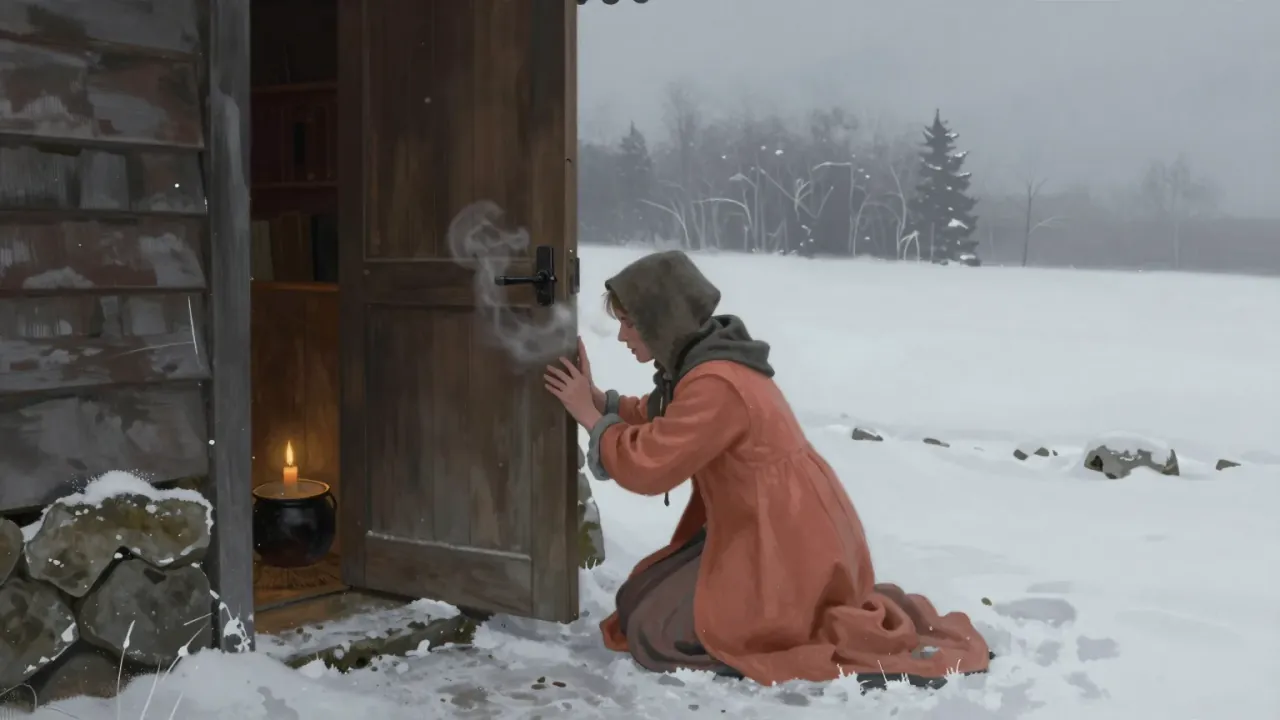
What lands is the cumulative erosion of certainty. The forest does not need to be shown in full to feel sentient; its presence is registered in sound design — wind through bare branches, distant animal cries, the unnerving silence beneath them. The goat Black Phillip’s stillness, his gaze held just too long, carries more menace than any jump scare. The film’s most effective moments are quiet ones: Thomasin’s breath fogging in the cold air as she stands alone outside the house; Katherine’s fingers trembling as she tries to nurse a raven; Caleb’s fevered whispering before he vomits the apple. The use of Early Modern English is never ornamental — it shapes rhythm, deference, and the weight of accusation. When Mercy says ‘Wouldst thou like to suck my teat?’, the line lands not because it is shocking in itself but because it emerges from a world where even childish mimicry is freighted with theological peril. The coven sequence works because it arrives after ninety minutes of withheld release — the levitation feels earned, not indulgent. The film sustains its tone without concession: no wink, no reprieve, no explanation beyond what the characters themselves could know or name. (157 words)
The limits of it
What does not land is the film’s reliance on sustained austerity when emotional texture thins. The twins’ dialogue, while historically plausible, lacks differentiation — they function more as a chorus than individuals, and their accusations against Thomasin feel schematic rather than urgent. The father’s moral collapse is implied rather than dramatised: his confession about the silver cup arrives late and without sufficient build-up in gesture or expression. Some viewers will find the pacing inert in stretches — the long takes on empty fields or silent interiors test patience without always deepening meaning. The film’s refusal to clarify whether certain events are supernatural or psychological may frustrate those seeking narrative clarity, though that ambiguity is deliberate. The ending’s ecstatic release risks feeling unearned to those who have not fully absorbed the preceding repression — the laughter as Thomasin rises is powerful, but it depends on the viewer having felt the full weight of her earlier silences. A few critics noted that the film’s rigour borders on self-parody: the candlelight is so dim in places that action becomes indecipherable, and the dialect, while authentic, occasionally obscures intent more than it reveals character. (159 words)
The meaning of it
The themes that matter are not witchcraft as fantasy but as symptom — of patriarchal control, reproductive anxiety, linguistic limitation and the violence of absolute belief. The film treats the witch not as an antagonist but as a mirror: she offers Thomasin autonomy, appetite, agency — all things denied her by scripture, gender and circumstance. The forest represents everything outside sanctioned order: wild nature, female knowledge, bodily desire, unmediated experience. Samuel’s disappearance initiates a cascade of interpretations, each more desperate than the last — a theological crisis made visceral. The film interrogates how systems of power manufacture guilt to maintain cohesion, and how easily that cohesion turns cannibalistic. It is also a study in epistemic collapse: when prayer fails, when crops fail, when children sicken, the family has no framework left but accusation. The goat Black Phillip embodies the slippage between symbol and entity — he is both domesticated animal and demonic familiar, a figure whose ambiguity exposes the fragility of categories. The film’s deepest concern is not evil, but the cost of believing too much — and too literally — in one way of knowing the world. (158 words)
The terms of it
This film is for viewers who value atmosphere over exposition, restraint over reaction, and historical texture over convenience. It suits those comfortable with ambiguity, patient with slow revelation, and attentive to how language, light and silence construct meaning. It is not for those who require clear moral binaries, narrative momentum, or emotional catharsis on demand. Anyone expecting jump scares, exposition dumps or character backstories will leave frustrated — the film assumes its audience will infer motive from posture, read fear in a glance, and sit with uncertainty. Some horror fans accustomed to genre conventions may find its pace glacial; some arthouse viewers may resist its lack of irony or authorial distance. Those who dislike subtitles — even for English — may struggle with the Early Modern diction. A viewer who values psychological realism over theological literalism may reject the film’s premise outright. But for those willing to meet it on its terms, the film rewards attention with a rare kind of immersion — one that lingers not in the memory of images, but in the residue of unease. (159 words)
The staying of it
Yes, it is worth your evening — provided you give it your full attention and do not expect entertainment in the conventional sense. It is ninety-three minutes of sustained tonal discipline, and its power accumulates in proportion to your willingness to inhabit its rhythms. The film repays rewatching: details missed first time — a glance, a prop, a shift in lighting — gain resonance on second viewing. Its budgetary modesty shows in the narrow scope, not in compromised craft; every frame feels intentional, every sound placed. Those who dismiss it as ‘slow’ or ‘cold’ are not wrong about its surface qualities — but they mistake austerity for emptiness. The film’s success lies in making its world feel materially real and spiritually claustrophobic at once. It is not a film to watch while distracted, nor one to consume lightly. But if you are prepared to sit in its silence, to parse its syntax, to feel the chill of its New England air — then yes, it is worth your evening, and likely several more after that. (158 words)