The look of it
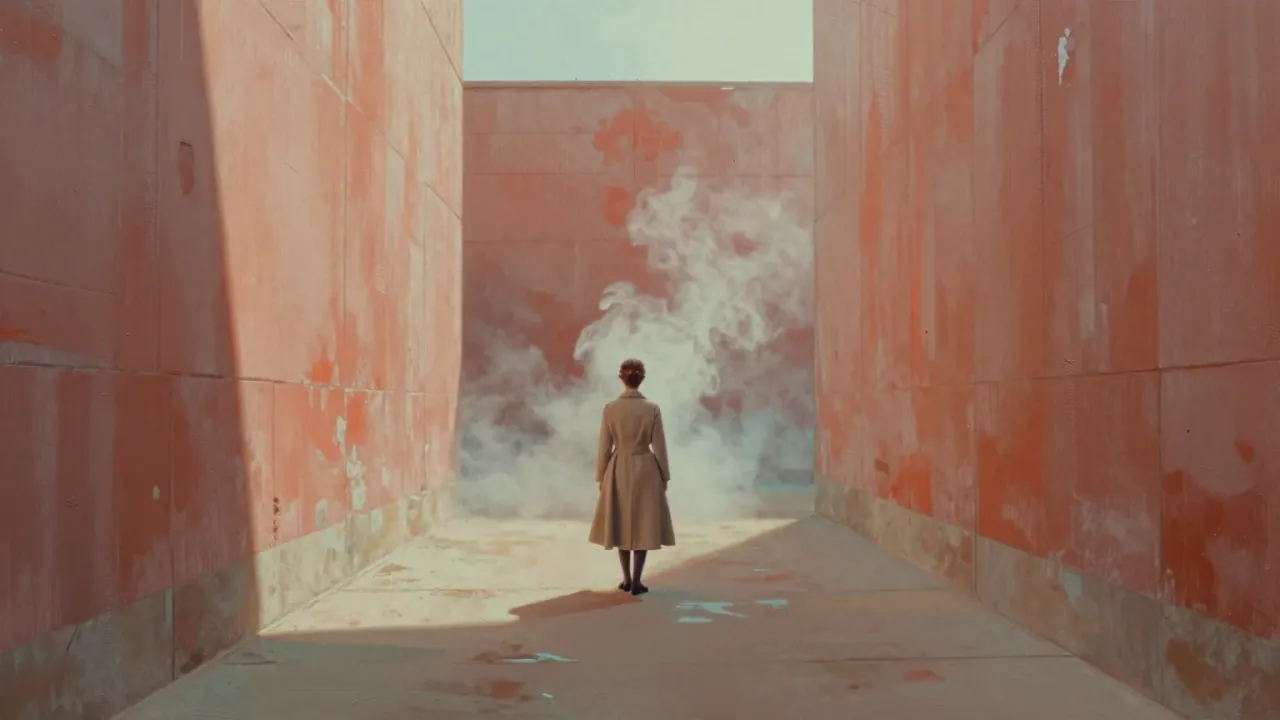
Red Desert is Michelangelo Antonioni’s first colour film and the fourth in a sequence of collaborations with Monica Vitti. It attempts to render psychological disorientation not as interior monologue or clinical symptom, but as an environmental condition — one legible through colour, architecture, sound and spatial arrangement. The film does not diagnose Giuliana’s distress as neurosis caused by industry, nor does it offer social critique as explanation; instead, it treats perception itself as unstable ground, where industrial structures, polluted air, flattened perspectives and manipulated hues become extensions of her unsettled consciousness. Antonioni said he wanted to ‘paint the film as one paints the canvas’, and that intention governs every compositional choice: trees are painted grey, smoke is choreographed, chromatic relationships are invented rather than recorded. This is not realism, nor surrealism, but a sustained experiment in translating subjective experience into objective form — a film less about what happens to Giuliana than how the world appears when her capacity to absorb it fractures. It is a work of deliberate, unrelenting formal control in service of emotional ambiguity.
How it holds a person
The story follows Giuliana, a woman recovering from a car accident but unable to settle back into domestic or industrial life in 1960s Ravenna. Her husband Ugo manages a petrochemical plant; her encounters with Corrado, a visiting recruiter, deepen her sense of isolation without resolving it. Monica Vitti’s performance is restrained, physically precise, built on hesitation and withdrawal rather than outburst — she occupies space like someone testing its density. Carlo Di Palma’s cinematography uses telephoto lenses to compress depth, flattening figures against walls and machinery; Eraldo Da Roma’s editing sustains long takes and avoids conventional punctuation, letting unease accrue through duration. Giovanni Fusco’s score is sparse and tonal, avoiding melody in favour of atmospheric pressure. Sound design layers industrial hum, distant horns and muffled voices, making the environment feel sentient. The fable sequence on Sardinia introduces a rare moment of narrative release, but even there, the pink sand and singing rocks remain abstracted — not escape, but another register of dislocation. Every craft decision serves the central proposition: that perception is never neutral, and that reality is always already mediated.
What the eye absorbs
What lands most firmly is the film’s visual grammar: the way colour functions as syntax, not decoration. The red pipes, blue railings and washed-out pastels do not merely signify anxiety — they produce it, through repetition, contrast and placement. A shot of Giuliana framed between two parallel factory walls, her face half-obscured by steam, conveys alienation more efficiently than any line of dialogue. The use of zoom to collapse distance — bringing faces abruptly close while leaving backgrounds eerily intact — makes intimacy feel invasive and exposure involuntary. The polluted estuary, the fog-bound pier, the radio observatory’s skeletal towers: these locations are neither backdrop nor metaphor, but active participants in Giuliana’s psychological state. Even minor details land: the half-eaten sandwich bought from a striker, the boy’s feigned paralysis, the Turkish sailor’s silence — all register as precise, unsentimental observations of how people try and fail to connect. The film’s power resides not in revelation but in accumulation: each frame adds weight to the sense that adaptation is not failure, but a kind of erasure.
Where it stays silent
What does not land is any clear articulation of Giuliana’s inner logic beyond its symptoms. Her motivations remain opaque, not because they are mysterious, but because the film declines to supply them — and that refusal, while consistent with Antonioni’s method, risks feeling withholding rather than rigorous. Richard Harris’s role is truncated and indistinct; his absence leaves a gap in the triangulation between Giuliana, Ugo and Corrado, weakening the relational tension the plot depends on. The ‘fable’ sequence, though visually striking, sits uneasily within the film’s otherwise grounded texture — its lyrical abstraction feels imported rather than earned. Some viewers will find the pacing inert, the dialogue elliptical to the point of opacity, the emotional temperature too low to sustain attention across 117 minutes. The film assumes a tolerance for ambiguity that borders on austerity; it offers no catharsis, no pivot, no shift in perspective that feels earned rather than imposed. Its resistance to interpretation is part of its design — but that design may read as evasion to those expecting narrative momentum or psychological exposition.
What it asks of the world
The themes that matter are adjustment, perception as embodiment, and the permeability of self and environment. Antonioni rejects industrialism-as-villain; instead, he treats the post-war Italian landscape — its factories, its polluted rivers, its newly built housing — as a field of aesthetic and existential possibility. Giuliana’s difficulty is not that the world is hostile, but that it refuses to cohere for her. Her son’s question about birds and yellow smoke is pivotal: she answers not with reassurance, but with accommodation — ‘they’ve learned not to fly near it’. That line distils the film’s central tension between resilience and resignation. Colour, sound and architecture are not metaphors for mental illness, but its material correlates: the world is literally reshaped to match her perceptual threshold. The film asks whether sensitivity to dissonance is pathology or perception — and refuses to choose. It also quietly interrogates motherhood as a site of unspoken strain, where care and exhaustion blur, and where a child’s play-acting can feel like betrayal. These are not themes argued, but held in suspension — present in composition, gesture, silence.
Who walks beside it
This film is for viewers who value sustained formal inquiry over narrative resolution, who find emotional resonance in composition and colour as much as in dialogue or performance. It rewards patience, attention to texture, and comfort with ambiguity. Those who rely on character motivation, plot propulsion or psychological exposition will likely find it frustrating or inert. It is not for viewers who need clarity of intent, moral framing or emotional payoff — nor for those unfamiliar with Antonioni’s style, which demands surrender to rhythm over explanation. Someone who values Jonathan Rosenbaum’s writing on cinema, or who responds to the paintings of Giorgio Morandi or the late chamber music of Webern, may find it deeply consonant. A viewer who prefers the psychological immediacy of Bergman or the social specificity of De Sica would likely leave unmoved. Its value lies in its singularity: it cannot be substituted, only accepted or declined on its own uncompromising terms.
Whether it stays with you
Yes, it is worth your evening — but only if you arrive prepared to meet it on its terms: as a painting in motion, not a story in time. Its 117 minutes ask for stillness, not engagement; for observation, not empathy. Those who watch it expecting drama in the conventional sense will feel short-changed. But for those willing to let its colours, silences and geometries settle, it repays attention with cumulative force. Its achievement is not in what it says, but in how thoroughly it reorients perception — so that afterwards, even ordinary urban spaces feel newly charged, newly strange. It is not entertainment, nor therapy, nor argument. It is an act of translation: from feeling to form. To dismiss it as cold is to miss how precisely it registers warmth — in a hand hesitating before touching, in steam catching light, in a child’s unguarded question. Its worth lies in that fidelity. Anyone who finds beauty in restraint, or meaning in unresolved tension, will find it time well spent.