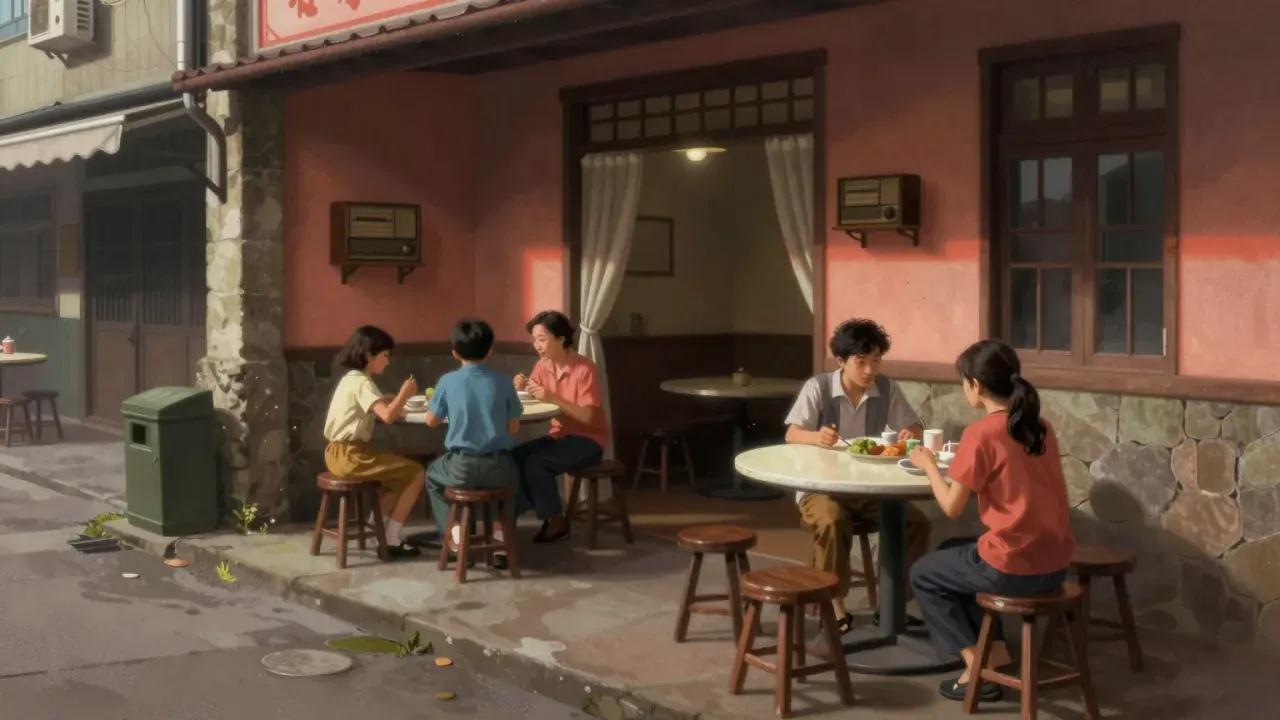
The look of it
A City of Sadness is a historical drama set in Taiwan between 1945 and 1949, centring on the Lin family as they navigate the collapse of Japanese colonial rule, the arrival of the Kuomintang administration, and the violent suppression of dissent that followed the February 28 Incident. It is not a didactic account of those events but an atmospheric reconstruction of how political rupture settles into domestic life — through silences, absences, deferred conversations, and the slow erosion of trust. Hou Hsiao-hsien made it at a precise historical hinge: martial law had just been lifted in Taiwan, and the 228 Incident remained officially unacknowledged. The film’s ambition is structural as much as narrative: to render history not as sequence but as sediment — layers of language, gesture, architecture, and sound that accumulate without explanation. It avoids exposition, biography, or moral framing, choosing instead to hold space for what cannot be spoken aloud, especially by those who are deaf, displaced, or disappeared. Its method is restraint; its subject, the weight of unprocessed time. (158 words)
The shape of it
The story unfolds across four brothers in a Jiufen-based photo studio and teahouse, with Tony Leung’s Wen-ching — mute and deaf — serving as both witness and formal pivot. His muteness, originally a pragmatic solution to linguistic limitations, becomes the film’s organising principle: dialogue is sparse, often off-centre, and frequently untranslated, reflecting the multilingual reality of postwar Taiwan — Hokkien, Japanese, Mandarin, Shanghainese, Cantonese — without privileging any one tongue. Chen Hwai-En’s cinematography favours fixed frames, long takes averaging 42 seconds, and deep, layered compositions: doorways frame faces, windows slice light, corridors recede into darkness. Liao Ching-sung’s editing sustains this rhythm, refusing emphasis or punctuation. Performances are internalised, understated — Li Tian-lu’s patriarchal stillness, Jack Kao’s simmering volatility, Ho Ai-Yun’s quiet endurance — all calibrated to a register where grief arrives not in outbursts but in the pause before a shutter clicks. S.E.N.S.’s score is ambient, sparing, never illustrative. The craft does not serve psychology or plot but duration, texture, and historical gravity. (157 words)
What stays
What lands is the film’s refusal to resolve. Its power resides in accumulation: the repeated image of train tracks leading into mist, the way a single photograph holds more narrative than a monologue, the cumulative weight of characters vanishing mid-scene without explanation. The hospital lobby sequence — arched doorway, static camera, figures entering and exiting like clockwork — crystallises Hou’s method: geometry as history, silence as testimony. The use of darkness in the opening — Hirohito’s surrender broadcast heard but unseen — establishes sound as primary evidence, a device that recurs when Japanese phrases surface unannounced in conversation, marking generational fracture. Jiufen’s steep alleys and wooden staircases do not merely locate the story; they embody its claustrophobia and isolation. Even the film’s pacing — deliberate, unhurried, resistant to climax — lands as ethical posture: history is not consumable, nor should it be. This is not immersion but adjacency — watching from the threshold, as Wen-ching does, notebook in hand, listening with his eyes. (156 words)
What slips away
What does not land is narrative legibility for viewers unfamiliar with the February 28 Incident or Taiwan’s post-1945 transition. There are no titles, no voiceover, no exposition — names, dates, and affiliations remain unclarified. Characters enter and exit without introduction; political factions are named only in passing, if at all. The film assumes a baseline familiarity with the historical context, or at least tolerance for sustained ambiguity. Some performances — particularly those requiring tonal shifts under extreme constraint — risk flattening into stoicism rather than restraint. The long-take discipline, while formally coherent, can feel withholding where emotional access is desired: Wen-ching’s muteness, though conceptually rich, occasionally distances rather than deepens empathy. Those expecting psychological exposition or moral clarity will find neither. The film declines to assign blame, name perpetrators, or offer catharsis — a choice that strengthens its historical integrity but may frustrate viewers seeking narrative closure or affective reward. Its austerity is consistent, but not universally hospitable. (155 words)
What it carries
The themes that matter are silence as inheritance, language as fracture, and family as archive. The Lin household functions less as a unit of affection than as a vessel for memory — photographs, letters, half-remembered songs — all fragile, incomplete, vulnerable to erasure. The film treats language not as transparent communication but as contested terrain: Japanese lingers in vocabulary and cadence, Mandarin arrives as alien imposition, Hokkien anchors local identity, and Wen-ching’s writing becomes a third, private tongue. Architecture matters too — Jiufen’s narrow lanes and stacked dwellings reflect social stratification and surveillance, while the recurring train motif signals both connection and displacement. Most enduringly, the film treats history not as event but as residue: the White Terror is felt in empty chairs, in delayed replies, in the way a character stops mid-sentence and looks away. It refuses allegory, insisting instead on the specificity of place, time, and loss — making its politics inseparable from its poetics. (154 words)
Who it meets
This film is for viewers who value formal rigour over narrative convenience, who read atmosphere as meaning, and who accept that some histories resist dramatisation. It rewards patience, attention to composition, and comfort with ellipsis. It is not for those who require exposition, clear cause-and-effect, or emotionally signposted arcs. Viewers expecting conventional character development or political argument will find it withholding. Those who associate ‘historical drama’ with biopic clarity or courtroom catharsis will misread its aims entirely. The film’s resistance to translation — linguistic, emotional, ideological — is deliberate, not accidental. A viewer who insists on knowing ‘what really happened’ to each brother will leave unsatisfied; one who accepts that some truths are held in posture, light, and absence will find it resonant. Its audience is narrow by design — not because it lacks importance, but because its method demands surrender to its own terms. (159 words)
What it costs
Yes, it is worth your evening — but only if you arrive prepared to watch, not consume. Its 158 minutes unfold with the weight of lived time, not plotted time; every shot asks for stillness, not speed. It repays close attention: the shift in light across a tatami mat, the rhythm of footsteps on wooden stairs, the way a cigarette smoke curls before a face disappears from frame. To call it ‘slow’ mistakes its purpose — it is measured, exact, calibrated to the tempo of memory. Those who dismiss it as opaque or inert are not wrong about its surface, but miss its insistence that history lives in the unsaid and the unseen. It is not entertainment; it is reckoning. And reckoning, like mourning, cannot be rushed. Anyone willing to sit with its silences, to let its images settle, will find it among the most consequential films ever made about how power enters the home — and how families endure, even when they do not survive. (159 words)