The nature of the monster
Godzilla vs. Hedorah is a 1971 Japanese science fiction film, the eleventh in Toho’s Godzilla series and Yoshimitsu Banno’s directorial debut. It attempts something distinct within the kaiju genre: to transpose the allegorical weight of the original 1954 Godzilla — nuclear dread — onto the emergent crisis of industrial pollution. Hedorah, an extraterrestrial lifeform from the Horsehead Nebula, arrives on Earth via comet and metabolises smog, acid rain, and detergent foam into mass and menace. The film frames ecological collapse not as backdrop but as origin, motive, and physical substance — its monster is literally made of waste. Banno conceived it after witnessing Yokkaichi asthma and foaming coastal waters; the script treats pollution as sentient, cumulative, and self-replicating. This is not metaphor dressed up as monster, but a literalisation: Hedorah grows by ingestion, mutates by exposure, and spreads by fragmentation. The film’s ambition is pedagogical and polemical — aimed at children, as Banno insisted, yet unflinching in its imagery of suffocation, corrosion, and societal paralysis. It seeks to make environmental harm visceral, immediate, and embodied — not abstract or distant.
The texture of the world
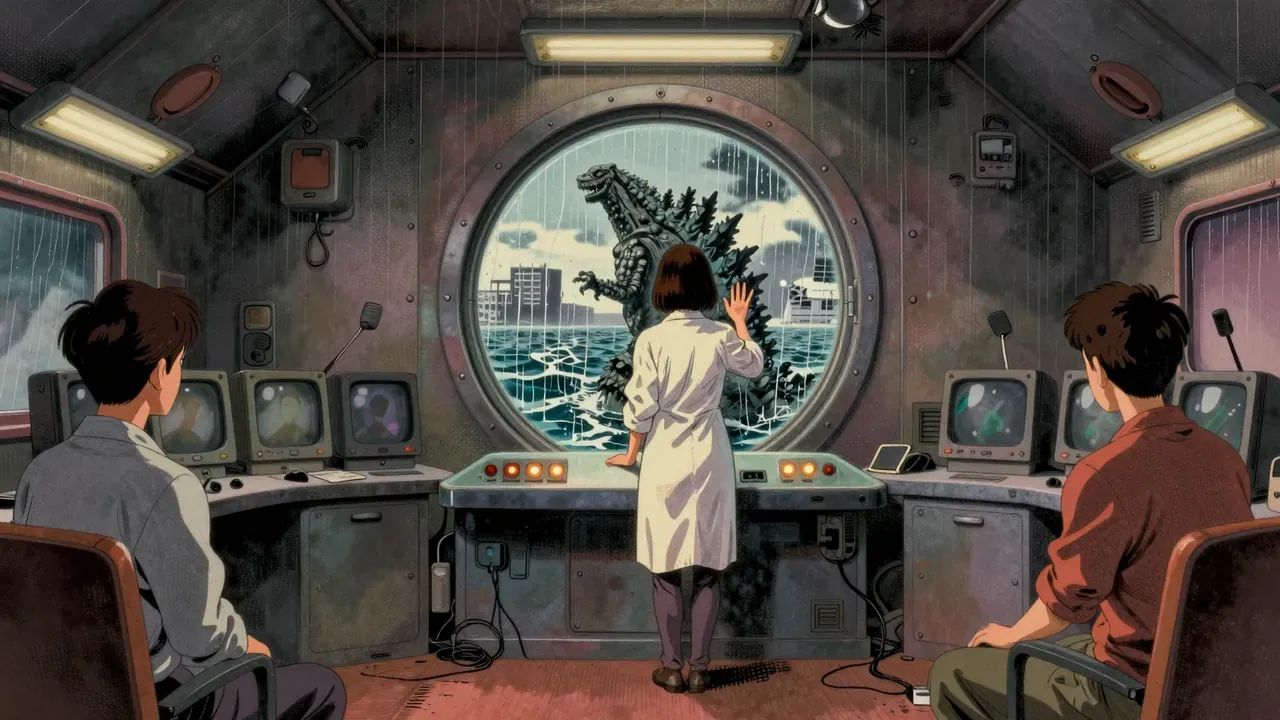
The story follows Dr. Toru Yano, his son Ken, and a small group of scientists as they document Hedorah’s escalation from sludge to flying leviathan, while Godzilla arrives as reluctant agent of planetary correction. Haruo Nakajima performs Godzilla with his customary physical gravity; Kenpachirō Satsuma, encased in heavy rubber and latex, gives Hedorah a lurching, viscous presence that resists heroic framing. Riichirō Manabe’s score alternates between theremin-led unease and jaunty, almost music-hall interludes — a tonal schism reflecting the film’s internal tensions. Yoshitami Kuroiwa’s editing stitches live action, stop-motion, and hand-drawn animation into a deliberately uneven rhythm. Teruyoshi Nakano’s special effects are resourceful but visibly constrained: miniature sets show smoke and fog machines pushed to their limits, and Hedorah’s transformations rely on layered opticals and forced perspective. The film was shot in 35 days with one crew handling both drama and effects — a logistical pressure that shows in the pacing, the repetition of locations, and the abrupt shifts between documentary realism and cartoonish spectacle. There is no attempt to hide the seams; instead, the seams become part of the argument.
What sticks in the memory
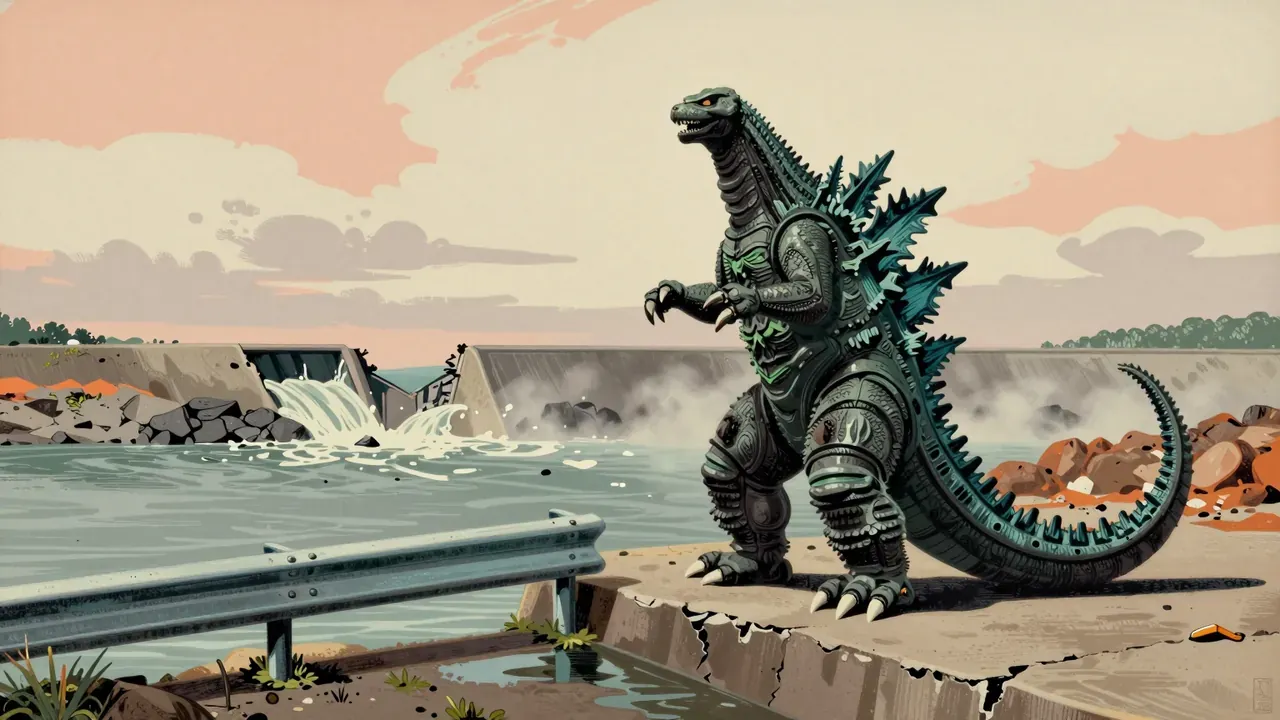
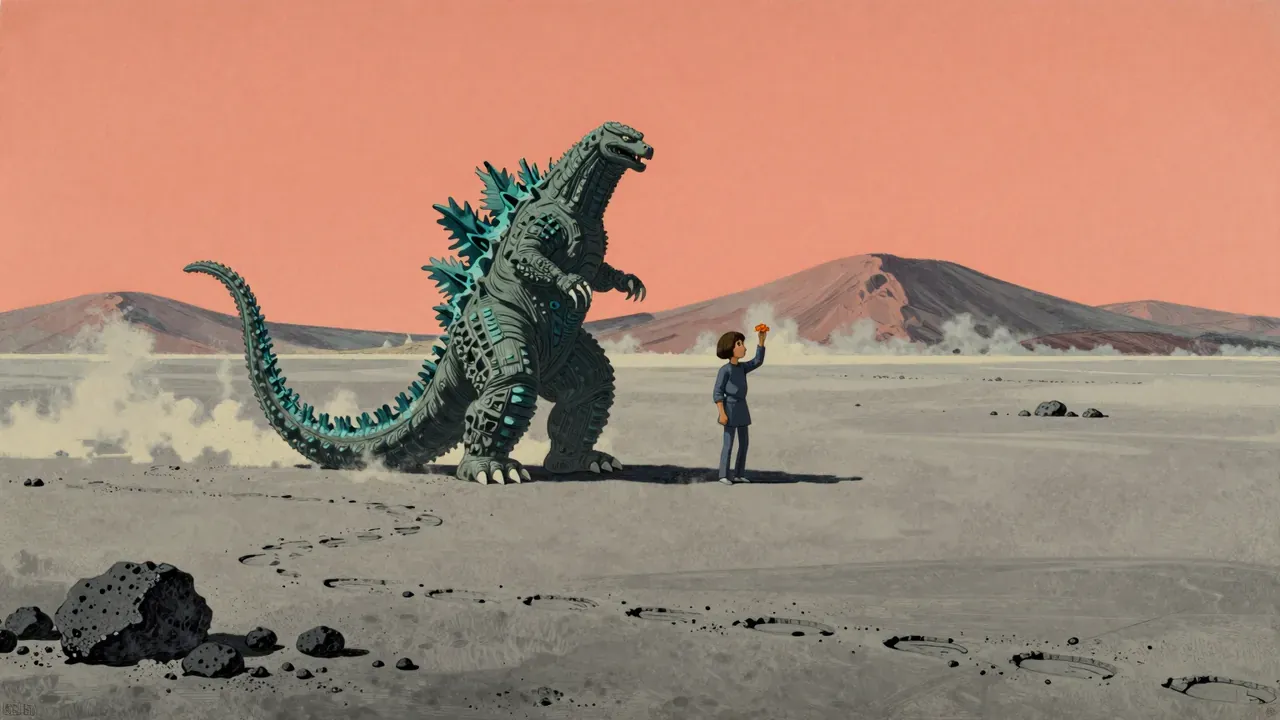
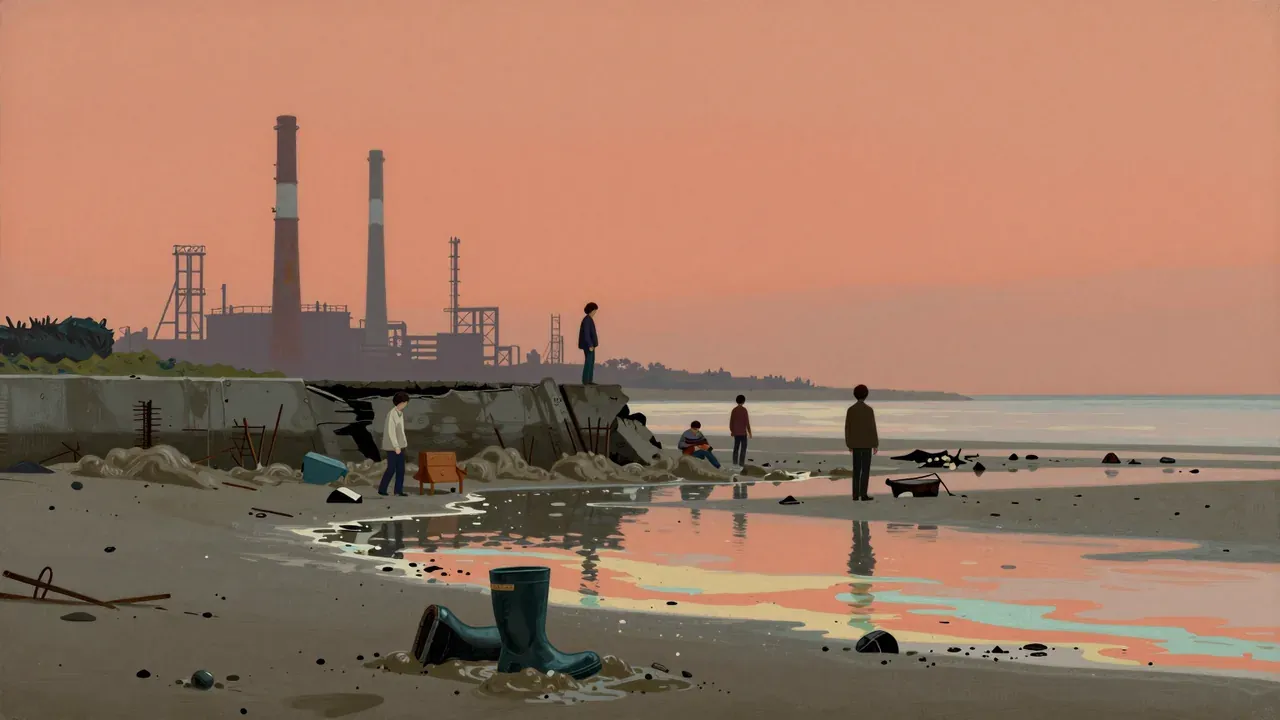
What lands is the film’s commitment to its own logic: Hedorah feels like a consequence, not a character. Its forms — gelatinous, acidic, airborne, crystalline — follow a grotesque internal consistency, each mutation tied to a new pollutant vector: sea, land, air, industry. The animated sequences, though rudimentary, clarify the environmental thesis without exposition: smokestacks exhale blackness, rivers curdle, lungs fill with grey. Ken’s visions of Godzilla as a cleansing force carry emotional weight because they’re rooted in childlike literalism — he doesn’t hope Godzilla will win; he expects him to undo. The final confrontation on Mount Fuji, where celebration and despair coexist, avoids triumphalism: Godzilla wins not through strength but by depriving Hedorah of its food source — a solution that is procedural, not heroic. The film’s most effective moments are quiet ones: a close-up of scalded skin, a silent shot of dead fish floating in iridescent foam, the slow creep of sludge over a railway line. These images do not argue — they accumulate.
Where it stumbles
What does not land is the tonal whiplash between didactic seriousness and forced levity. The comic relief — a bumbling police chief, slapstick office gags, a singing trio inserted mid-crisis — sits uneasily beside scenes of mass asphyxiation and children collapsing in schoolyards. The infamous atomic-breath flight sequence, added against Nakano’s advice and Tanaka’s later objections, undermines Godzilla’s physical authority without replacing it with coherent spectacle; it reads less as innovation than as narrative surrender. The human drama remains underdeveloped: characters function as mouthpieces or witnesses rather than agents, and their motivations rarely extend beyond exposition or reaction. Dialogue often names the theme outright — ‘Pollution is our enemy!’ — bypassing subtext for slogan. The low budget shows in repeated shots, flat lighting, and sparse crowd work, but these limitations are only forgiven when they serve the film’s raw, handmade urgency; elsewhere, they expose gaps in structure and performance. The film’s ambition outpaces its execution in places, particularly in its third act, where momentum dissolves into repetition and abstraction.
The idea beneath the skin
The themes that matter are not merely environmental, but metabolic: how systems absorb, transform, and reproduce toxicity — biological, social, industrial. Hedorah is not evil; it is adaptive, indifferent, inevitable — a mirror held up to human infrastructure. The film treats pollution not as negligence but as architecture: chimneys, refineries, and sewer outfalls are its organs. This reframes responsibility away from individual morality and toward collective design. Another persistent theme is intergenerational transmission: Ken inherits both trauma and vision from his father, and his insistence that Godzilla will come reflects a child’s faith in inherited myth as corrective tool. The film also explores the limits of language in crisis — scientists debate taxonomy while people choke; bureaucrats hold press conferences as cities darken. Animation and sound design become the film’s true syntax, conveying what dialogue cannot: the viscosity of sludge, the resonance of acid, the silence after a scream is dissolved. It is less about saving nature than about recognising that nature has already absorbed us — and begun digesting.
Who it speaks to
This film is for viewers who value conceptual rigour over polish, who find sincerity in awkwardness, and who respond to allegory that refuses to flatter its audience. It suits those familiar with the Shōwa-era Godzilla cycle but willing to sit with its outliers — fans of Banno’s later short films, students of eco-cinema, or anyone interested in how genre can carry urgent non-fiction concerns. It is not for viewers who require narrative cohesion, consistent tone, or polished effects; those expecting the measured gravitas of Honda or the operatic scale of later entries will find it jarring. It is also not for those allergic to didacticism — this film names its stakes early and often. A viewer who values ambiguity over message, or who finds moral clarity inherently reductive, may reject its directness. That said, its power lies precisely in that refusal to equivocate: if you believe ecological crisis demands forms that are strange, urgent, and unrefined, then this film meets that demand. If you do not, no amount of restoration will change your mind.
The verdict on the clock
Yes, it is worth your evening — provided you watch it on its own terms, not as a Godzilla film but as a 1971 Japanese environmental parable wearing kaiju costume. Its 96 minutes move quickly, its ideas remain startlingly current, and its formal risks — animation, tonal fracture, low-budget ingenuity — reward attention rather than distract. It is not ‘fun’ in the conventional sense, nor is it ‘deep’ in the academic one; it is insistent, tactile, and oddly tender in its belief that children might see solutions adults have stopped looking for. Those who dismiss it as camp or kitsch miss its discipline: every odd choice serves the central thesis. Critics who found it incoherent in 1971 were reacting to its refusal to conform — a refusal that now reads as prescient. It is not essential viewing for casual fans, but it is indispensable for anyone tracking how cinema translates real-world catastrophe into shared myth. You will not leave entertained — but you may leave unsettled in the right way.