A village, not a postcard
The Choice is Idrissa Ouédraogo’s first feature film, a drama set in rural Burkina Faso in the mid-1980s, shot in Mooré and grounded in the rhythms of subsistence farming, kinship obligation, and seasonal labour. It attempts to portray social life not as a series of individual decisions but as a web of interdependent actions shaped by scarcity, custom, and sudden rupture — a car strike, a pregnancy, a banishment. The film does not position itself as ethnographic exposition or political polemic; it avoids voiceover, explanatory titles, or didactic framing. Instead, it observes how authority shifts within a household after crisis, how rumour spreads across fields, how silence functions as consent or complicity. Its ambition lies in restraint: to hold space for what is unsaid, unrecorded, and unrecoverable in official accounts of development or tradition. It treats the village not as a relic but as a site of ongoing negotiation — between generations, genders, and geographies. The title’s irony emerges only gradually: ‘choice’ is named, but rarely exercised freely. (158 words)
The weight of routine
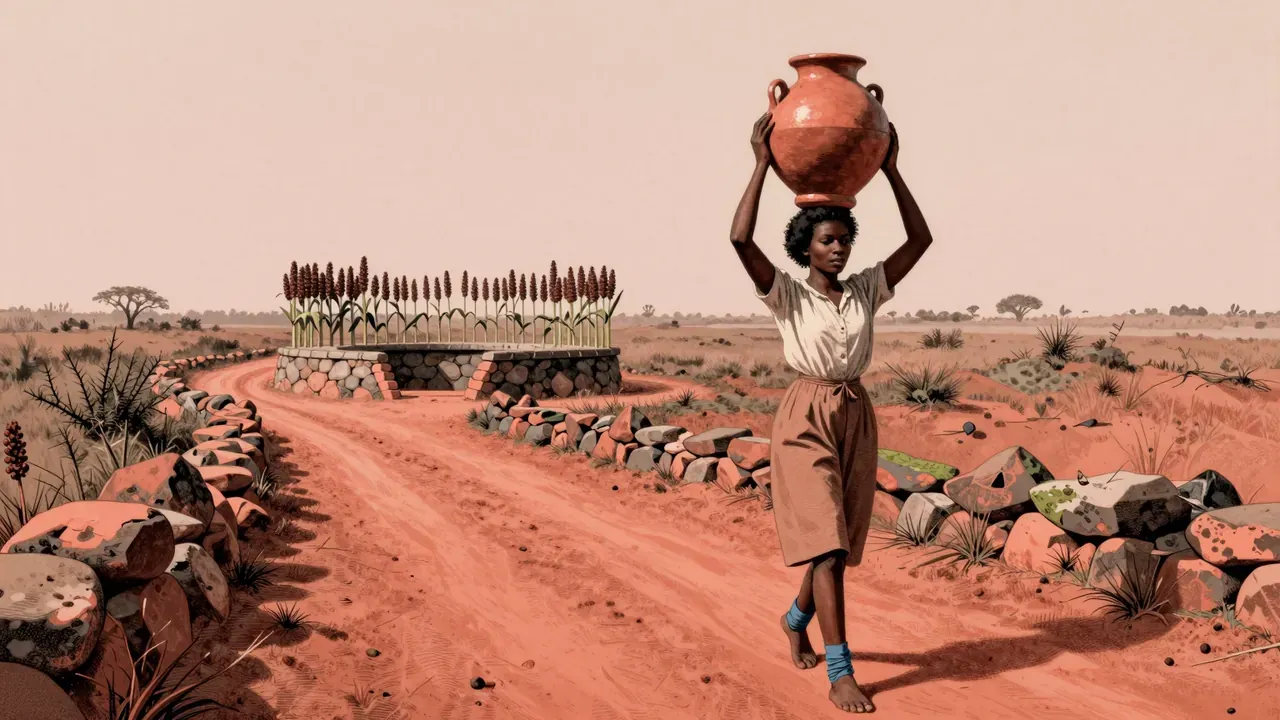
The story unfolds through accumulation rather than escalation: land is cleared, fish are gutted, a baby is born, a man flees. Aoua Guiraud’s Bintou registers emotion in glances and posture, never in monologue; Moussa Bologo’s Issa moves with quiet physical certainty, his presence stabilising scenes without commanding them. Jean Monsigny, Sékou Ouédraogo and Issaka Thiombiano’s cinematography favours medium distances and shallow focus — faces blur at the edge of frame, foreground action remains unemphasised. Francis Bebey’s score uses kora and flute sparingly, often dropping out entirely during dialogue or labour. Arnaud Blin’s editing sustains duration: a single take follows Bintou’s mother walking to fetch water, then returning, the weight of the pot visible in her shoulders. Sound design privileges ambient texture — wind, donkey brays, the scrape of hoe on earth — over dramatic punctuation. There are no close-ups of tears, no slow-motion gestures. The craft insists on continuity, not climax. Performance and image alike resist theatricality, favouring the habitual over the exceptional. (159 words)
What lands without sound
What lands is the film’s refusal to resolve its central tensions into moral binaries. Bintou’s father is neither tyrant nor sage; he acts from accumulated fatigue, not ideology. Tiga’s jealousy reads as consequence, not pathology — his urban flight feels inevitable, not irrational. The city appears not as abstraction but as physical contrast: concrete underfoot, reflected light off glass, the abruptness of traffic noise cutting across conversation. Ali’s death arrives without warning or musical cue, and its aftermath is shown not in grief rituals but in the family’s silent reorganisation of tasks — who now carries water, who tends the goats. The final reunion scene works because it is understated: no speeches, no embraces, just Raogo stepping into line beside the others, then the group turning as one toward the field. The film earns its humanism not through sentiment but through fidelity to gesture, repetition, and the weight of shared labour. It trusts the viewer to infer consequence from posture, not exposition. (157 words)
The loose thread
What does not land is the structural weight given to Raogo’s subplot. His return feels narratively tacked-on, arriving after the emotional core — Bintou’s birth, Issa’s reinstatement, Tiga’s expulsion — has already settled. His better clothes and gift lack sufficient grounding: we see no prior indication of his urban success, no explanation of how he acquired them, and no sustained engagement with the city’s logic beyond theft and flight. The film establishes economic pressure as motive elsewhere — the donkey sale, the price haggling in the market — but Raogo’s arc operates on different terms, closer to fable than social observation. Similarly, the dual-city framing — early tragedy, late banishment — risks flattening urban experience into symbolic function: place of death, place of failure. The film’s strength lies in specificity — the texture of woven mats, the sound of a forge — but Raogo’s journey trades that specificity for allegory. It is not implausible, but it is less rigorously anchored than the rest. (156 words)
Constraint as grammar
The themes that matter are not choice in the liberal sense, but constraint as condition; not tradition versus modernity, but how both are lived as practice, not principle. Agriculture is not backdrop but grammar: ploughing dictates time, harvest dictates movement, drought dictates migration. Kinship is material — who shares a sleeping mat, who inherits tools, who bears the cost of a son’s death. Gender roles are shown through division of labour, not debate: women process grain, men clear land, children fetch water — all without commentary. The film treats economics as bodily fact: the ache in a shoulder after hauling water, the thinness of rice gruel, the hesitation before selling a donkey that has pulled the family cart for years. Even the title’s irony deepens when viewed through this lens: ‘choice’ names the illusion that structures — debt, seasonality, patrilineal inheritance — permit autonomy. What endures is not decision but endurance: the same hands that dig, plant, carry, wash, and cradle also bury, mend, and wait. (159 words)
Who it is for, and who it is not
This film is for viewers who value narrative patience, who find meaning in duration rather than revelation, and who accept that social reality often resists resolution. It suits those accustomed to arthouse pacing — say, early Ozu or later Sembène — and who do not require psychological exposition or moral clarity. It is not for viewers who expect plot propulsion, character arcs defined by internal change, or visual polish calibrated to Western festival norms. Those seeking explicit political critique, historical context, or linguistic accessibility may find it withholding. Some will object that its quietism risks aestheticising poverty; others will argue its restraint is precisely its ethical stance. A shift toward tighter narrative integration — especially of Raogo’s arc — or more sustained attention to urban infrastructure might alter that verdict. But as it stands, its value lies in what it refuses to supply: explanation, emphasis, or uplift. (159 words)
Worth your evening
Yes, it is worth your evening — provided you arrive without demand for momentum or closure. Its seventy-eight minutes unfold with the inevitability of seasons: not rushed, not delayed, but paced to the rhythm of work and waiting. You will not leave with answers, but with a sharper sense of how decisions are embedded in soil, sweat, and silence. It rewards attention to detail — the way light falls on a mud wall at noon, how a woman adjusts her headscarf before lifting a child — not because these are ‘beautiful’, but because they are consequential. Those who mistake slowness for emptiness will misread it; those who mistake realism for neutrality may overlook its quiet insistence on dignity in constraint. Its power accumulates in retrospect: the opening forge scene gains meaning only after the final call to work. This is not entertainment, but reckoning — modest, unadorned, and exacting. (159 words)