The shape of it
American Utopia is a filmed record of David Byrne’s 2019 Broadway stage show, adapted from his touring concert of the same name. It is not a biographical film in the conventional sense — there is no narrative arc, no dramatised past, no exposition of Byrne’s life — but a live performance captured with cinematic intent. The film presents Byrne and eleven musicians moving freely across a bare stage, unanchored by sets or props, connected only by wireless instruments and choreographed motion. Spike Lee’s role is that of a disciplined observer: he does not interpret the material, nor interpolate context; he frames, edits, and sequences what was already staged. The aim is neither documentation nor reinvention, but translation — moving a theatrical concert into a filmic space while preserving its physical immediacy and communal pulse. The show’s structure follows Byrne’s own sequencing: songs from the American Utopia album sit alongside Talking Heads staples, covers, and politically charged interludes, all threaded by spoken-word reflections on democracy, connection, and civic responsibility. The film assumes familiarity with Byrne’s voice and worldview, but does not require it.
The look of it
The film works through strict formal coherence: Ellen Kuras’s cinematography uses steady, fluid tracking shots and precise framing to follow movement without distraction, avoiding cuts that would fracture rhythm. She and Declan Quinn shot on Sony Venice digital cameras, favouring shallow depth of field and consistent exposure — interiors are evenly lit, never dimmed for mood, so every performer remains legible. Spike Lee’s editing sustains duration: long takes hold on group formations, isolating individual dancers mid-step or holding on Byrne’s face during spoken passages. Annie-B Parson’s choreography treats the ensemble as a single organism — arms lift in unison, feet pivot in time, bodies shift weight without breaking contact. There is no hierarchy of attention: Byrne sings centre-stage, but the camera lingers just as long on Mauro Refosco’s hands or Jacquelene Acevedo’s stance. Sound mixing privileges clarity over spectacle — each percussion line is distinct, vocal harmonies remain tight and unblurred. The wireless instrumentation allows constant motion, and the film honours that mobility: no static close-ups, no cutaways to audience reaction, no establishing shots of the theatre. It is a film built on continuity, not contrast.
The movement of it
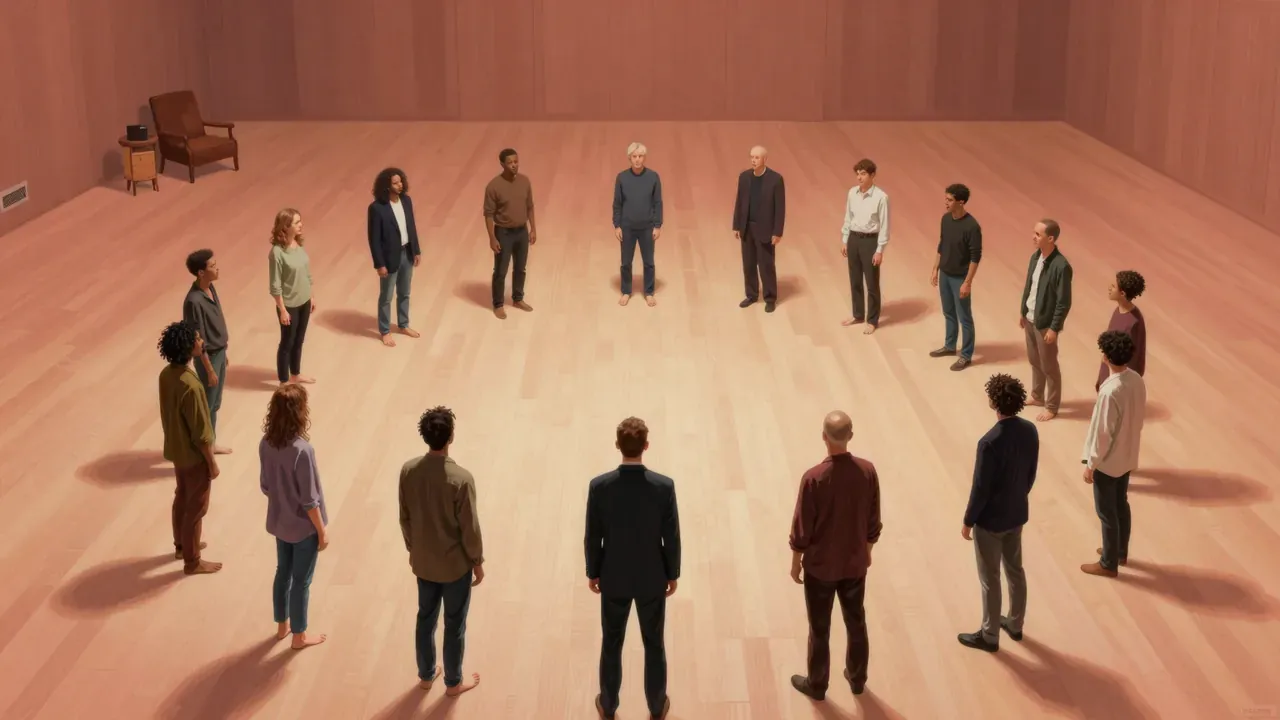
What lands is the cumulative effect of sustained human presence — the sight of twelve adults moving in shared time, breathing together, listening intently, responding physically to one another’s cues. The choreography’s restraint makes it more potent: small gestures — a palm turned up, a head tilted, a step back then forward — gain weight because they are repeated with exactness and offered without flourish. Byrne’s delivery avoids theatricality; his spoken interludes land because they are understated, even hesitant, delivered like thoughts being assembled aloud. The choice to include ‘Hell You Talmbout’, with its incantatory naming of Black victims of police violence, lands with quiet force precisely because it is embedded in the flow, not set apart as a ‘moment’. The Detroit School of Arts choir’s end-credits rendition of ‘Everybody’s Coming to My House’ lands not as uplift but as quiet insistence — voices layered, unadorned, unamplified beyond necessity. The film’s emotional register is not euphoria but steadiness: a refusal to look away from collective effort, even when that effort is modest, repetitive, or imperfect.
The speech of it
What does not land is the assumption that the film’s formal rigour alone constitutes argument. The spoken interludes about democracy and civic duty remain general — they name problems but do not locate them in specific institutions, histories, or contradictions. There is no interrogation of the very platform that hosts the show: Broadway’s economics, its gatekeeping, its relationship to the communities invoked in ‘Hell You Talmbout’ — none of this enters the frame. The film’s visual neutrality, while effective as aesthetic discipline, also functions as evasion: no shadows fall across the stage, no grain disrupts the image, no off-mic murmur breaks the polish. That consistency begins to feel like insulation. Some viewers may find the uniformity of tone monotonous over 105 minutes — the lack of dynamic range in lighting, pacing, or tonal variation means no passage feels earned by contrast. The film does not build, nor does it release; it sustains. That is its strength and its limit. It offers no catharsis, only continuation — which some will read as resilience, others as avoidance.
The politics of it
The themes that matter are those bound to embodiment and collectivity: how rhythm organises attention, how shared movement generates trust, how wireless technology enables both freedom and constraint. The film treats the body not as text to be read but as instrument to be tuned — hands, shoulders, torsos all calibrated to the same tempo. It treats democracy as practice rather than principle: voting, protesting, listening — all presented as physical acts requiring rehearsal, stamina, and mutual awareness. Utopia here is not a place but a posture: standing upright, facing outward, holding space for others without stepping on their feet. The recurring motif of unshackled movement — no cables, no fixed mics, no backing tracks — becomes a metaphor for agency, but one stripped of individual heroism. Even Byrne’s solos are framed within the group’s geometry. The film’s quietest theme is vulnerability: the risk of singing off-key in real time, of misstepping, of naming names and waiting for silence to hold. That silence is never filled with music — it is left empty, audible, shared.
The stillness of it
This film is for viewers who value precision in performance craft, who find resonance in repetition, and who are comfortable with political statements made through arrangement rather than rhetoric. It suits those who watch concerts not for spectacle but for evidence of labour — the sweat, the breath, the micro-adjustments of balance. It is not for viewers who require narrative propulsion, psychological revelation, or editorial commentary. Those who expect documentary context — interviews, archival footage, explanation of Byrne’s influences — will find the film withholding. Those who associate concert films with kinetic editing, crowd energy, or behind-the-scenes intimacy will find its austerity alienating. Its appeal depends on tolerance for stillness within motion, and willingness to accept that a political act can be as simple as standing in a circle and singing in unison. A viewer who needs irony, contradiction, or ambiguity to feel engaged will leave unmoved — the film offers none of those. Its conviction is its consistency, and that consistency is not negotiable.
The use of it
It is worth your evening if you are prepared to receive it as an act of sustained attention rather than entertainment. Its 105 minutes pass without hurry, without concession, without summary — it asks you to stay present in the same way the performers do. That demand is not trivial: it requires resisting the impulse to scan, to skip, to seek payoff. The film rewards patience not with revelation but with recalibration — a subtle shift in how you register group behaviour, how you hear rhythm as social glue, how you see choreography as ethics made visible. It is not urgent, nor is it dispensable. Those who dismiss it as ‘just a concert film’ misunderstand its ambition: it is a study in cohesion, filmed at a moment when cohesion felt scarce. To call it ‘joyful’ or ‘hopeful’ misses its quieter project — endurance. It is worth your evening if you believe that watching twelve people move as one is a political act. If you do not, it will feel like an exercise. The verdict does not change with better sound systems or larger screens — it rests on whether you accept that unity, however provisional, is worth filming straight on.