What it pretends to be
Certified Copy is a film about the instability of identity, relationship and authenticity, built around a single day’s conversation between two people whose status shifts without warning. Abbas Kiarostami does not aim to resolve that instability but to hold it in view — to test how much meaning adheres to labels like ‘husband’, ‘wife’, ‘stranger’, ‘author’, ‘reader’ when stripped of documentary proof. The film treats its premise — that copies are originals, originals are copies — not as an aesthetic theory but as a behavioural condition: if two people behave as though they are married, what changes? What remains unchanged? It avoids exposition, backstory and psychological explanation. Instead, it constructs a series of mirrored interactions — café, museum, restaurant, hotel — where tone, language and gesture realign incrementally, inviting the viewer to track not what is true but how truth is performed. This is not a puzzle to be solved but a surface to be observed, with the Tuscan light and architecture serving as neutral witnesses rather than expressive agents.
How it holds your attention
The story unfolds in real time across a single afternoon, anchored by Juliette Binoche and William Shimell’s performances, which pivot on micro-shifts in posture, hesitation and vocal register. Shimell, an opera singer with no prior film experience, delivers James Miller with quiet authority and deliberate flatness; his stillness becomes a counterweight to Binoche’s increasingly restless physicality. Binoche modulates her character’s emotional exposure with surgical precision — never overplaying frustration or vulnerability, yet making each adjustment legible. Luca Bigazzi’s cinematography keeps the frame composed but unadorned: long takes, shallow focus, natural light through Tuscan windows, no score beyond diegetic sound. Bahman Kiarostami’s editing sustains rhythm without emphasis — cuts land where breath pauses, not where drama peaks. Jean-Claude Carrière appears briefly as a gallery attendant, his lines delivered with dry, uninflected neutrality. The dialogue moves between English, French and Italian without translation or subtitle cueing, trusting the viewer to follow intent over literal meaning. There are no flashbacks, no voiceover, no music to signal significance.
What settles in the silence
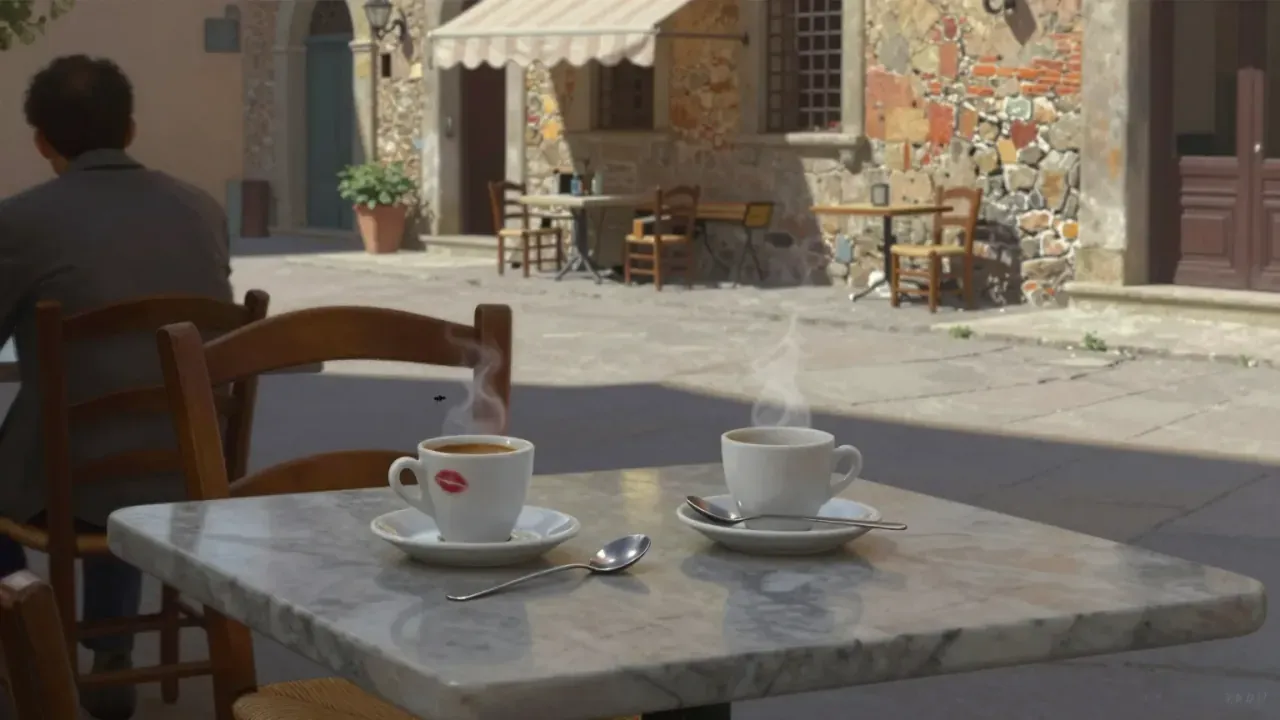
What lands is the cumulative weight of small, unexplained ruptures: the café owner’s assumption, the switch from English to French mid-sentence, the way Binoche’s hand trembles slightly as she applies lipstick in the restaurant bathroom. These moments do not announce themselves as turning points but settle retrospectively, like stones dropped into still water. The film’s structure — a slow drift from polite distance to intimate friction — gains force because it refuses to name its own mechanism. The Tuscan locations are neither picturesque nor symbolic; they function as neutral stages where behaviour is tested, not illustrated. When Miller and the woman walk past the statue and debate its meaning, the exchange works not because it reveals character but because it demonstrates how interpretation itself becomes a form of intimacy — or evasion. The final scene in the hotel room lands with quiet gravity because it offers no resolution, only a sustained ambiguity: the tolling bells, the mirror, the unspoken choice between departure and staying. Nothing is confirmed, yet everything feels earned.
Where the frame stays still
What does not land is the film’s reliance on a single conceptual hinge — the marriage fiction — without sufficient variation in its execution. Once the dynamic shifts, it repeats in diminishing returns: café, museum, restaurant, hotel, each echoing the last in tone and structure. There is little escalation in stakes or texture, and the absence of external pressure — no deadline, no consequence, no third party who might puncture the fiction — risks making the central conceit feel self-contained to the point of abstraction. The son, introduced early as a source of tension, vanishes after the first twenty minutes, leaving his earlier presence unanchored. Shimell’s performance, while controlled, lacks the granular specificity needed to sustain full belief in the husband role once the shift occurs; his reactions remain too evenly calibrated. The film also assumes fluency in its linguistic layering — switching between languages without subtitles — which may alienate viewers unfamiliar with French or Italian, not as a barrier to comprehension but as a structural exclusion. It asks for patience but offers few formal surprises beyond its initial premise.
What it says about being together
The themes that matter are not authenticity versus forgery in art — that is merely the book’s thesis, a framing device — but the daily labour of sustaining relational forms. Marriage, authorship, parenthood, expertise: all are shown as roles adopted, rehearsed, abandoned or resumed without clear origin or endpoint. The film treats identity as something worn, tried on, adjusted in response to context — not discovered but negotiated. Time is another theme: the 9 p.m. train looms as a fixed point, yet its importance erodes as the day wears on, replaced by the weight of accumulated gestures — a hand on a shoulder, a shared silence, the act of signing six copies of the same book. Memory is unreliable not because it is faulty but because it is secondary to performance: what matters is not whether they were ever married, but whether they can inhabit the shape of that relationship convincingly enough to make it real in the moment. The film’s quietest theme is loneliness — not as absence, but as the persistent hum beneath every interaction, the reason people reach for roles that fit, however loosely.
Who it waits for
This film is for viewers who value precision of gesture over plot mechanics, who find resonance in unresolved tension, and who trust silence and repetition as narrative tools. It suits those familiar with Kiarostami’s earlier work — particularly his use of non-professional actors and ambient realism — or with European arthouse traditions where duration and restraint are expressive choices, not omissions. It is not for viewers who require causal clarity, emotional payoff or psychological exposition. Those who expect character motivation to be stated, conflict to escalate visibly, or endings to confirm meaning will find the film withholding to the point of evasion. A viewer who values thematic coherence over emotional engagement may also resist its refusal to resolve the central question. The film’s pace and tonal consistency demand attention but offer no reward in conventional terms — no catharsis, no revelation, no twist. Its value lies entirely in the quality of attention it invites and sustains.
Why it stays with you
Yes, it is worth your evening — provided you arrive without expectation of resolution and with willingness to sit inside uncertainty. Its ninety-six minutes pass without hurry, yet accumulate density through repetition, not incident. The film rewards rewatching not because it hides clues but because its power resides in subtle shifts — a pause before a word, a glance held half a second too long, the way light falls across Binoche’s face in the hotel corridor. Those who find such moments inert will leave unmoved; those who recognise them as the material of lived connection may find the film quietly unforgettable. It is not a film to be consumed but inhabited — a space where questions linger longer than answers. Its success depends entirely on whether you accept ambiguity as a condition of human contact, not a problem to be solved. Without that acceptance, it feels thin; with it, it feels necessary.