The premise is a contract
The Inheritance is a 1962 Japanese drama directed by Masaki Kobayashi that sets out to dissect the moral vacuum of inherited wealth and the transactional logic of late capitalism through a tightly wound succession plot. It does not aim for psychological realism or redemptive arc, but instead constructs a closed system in which every character’s motive is legible as financial calculation, every gesture calibrated to advantage, every relationship reducible to leverage. Unlike Kobayashi’s better-known humanist works — the war trilogy, Harakiri — this film refuses empathy as a structural principle. Its ambition is surgical: to expose how legality, kinship and even mortality become instruments of appropriation when money is the sole metric of value. The film treats inheritance not as legacy but as a contested asset class, and its characters not as people but as claimants in a zero-sum distribution. This is not satire in the sense of caricature; it is diagnosis, delivered without anaesthetic. It assumes the audience will recognise the mechanisms — the legal proxies, the forged documents, the staged illnesses — not as plot devices but as ordinary tools of elite conduct. (158 words)
No one transforms
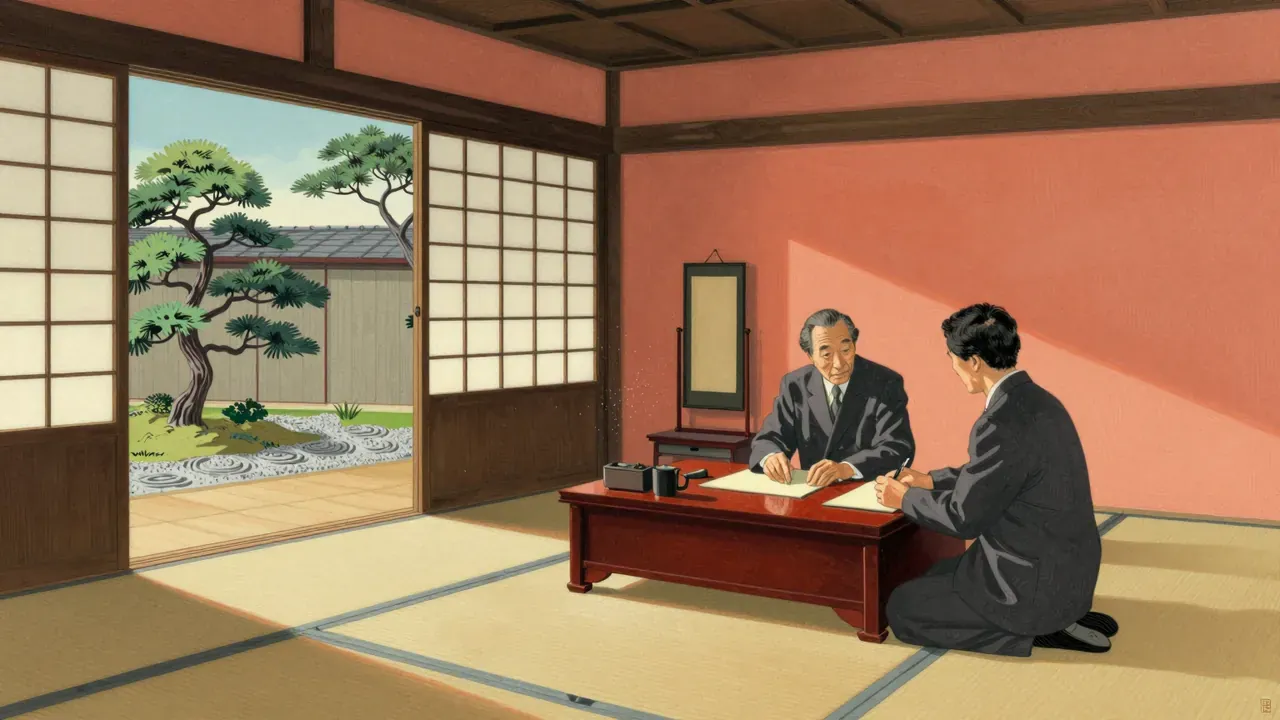
The story follows Senzo Kawahara’s six-month countdown to death and the scramble among his associates to locate and manipulate his three illegitimate children before he divides his estate. Keiko Kishi’s Yasuko moves with quiet precision through the machinery of deception, while Sō Yamamura’s Kawahara remains detached, almost clinical, in his final act of control. Tatsuya Nakadai’s Furukawa and Seiji Miyaguchi’s Yoshida operate with bureaucratic menace, their authority rooted in procedural familiarity rather than charisma. Takashi Kawamata’s cinematography avoids expressionist flourishes: interiors are lit with flat, even clarity, faces rarely shadowed, compositions balanced but unyielding. Tōru Takemitsu’s score is sparse, often absent — silence functions as punctuation, not atmosphere. Keiichi Uraoka’s editing sustains a deliberate pace, cutting on action but never on emotion; reactions are withheld, not amplified. There are no flashbacks, no voiceover, no music cue to signal irony. The craft serves the film’s central refusal: to let the viewer rest in interpretation. Every shot, every line, every pause insists on literal reading. (159 words)
The look of it
What lands is the film’s unblinking consistency. Its moral architecture holds: no character softens, no revelation reshapes desire, no moment of conscience interrupts the calculus. Yasuko’s success is not triumphant but chillingly logical — she wins because she understands the rules better than anyone else, not because she is exceptional in spirit or skill. The film’s austerity pays off in cumulative weight: by the third act, even minor exchanges — a glance across a conference table, a delayed signature, a folded letter handed over without comment — carry the density of contract law. The BAFTA United Nations Award was justified not for humanitarian sentiment but for formal rigour in depicting systemic corruption. The performances land because they avoid interiority: Kishi does not ‘play’ cunning so much as embody its syntax — posture, timing, the precise hesitation before a lie. The film’s power lies in what it denies: pathos, ambiguity, redemption, even narrative surprise. It offers no counterpoint to greed, only its perfect, unbroken reflection. That coherence is rare, and it lands with the force of a verdict. (157 words)
The world is procedural
What does not land is any sense of social texture beyond the boardroom and the lawyer’s office. The world outside Kawahara’s circle — the tenants, clerks, servants, neighbours — exists only as background noise or functional props. There is no depiction of post-war Tokyo beyond what serves the plot: no street life, no labour, no housing shortage, no cultural shift. The film’s focus is so narrowly concentric that its critique of capitalism feels abstracted from material reality, more allegorical than analytical. Some viewers may find the absence of warmth or vulnerability alienating not as a choice but as a limitation — particularly those accustomed to Kobayashi’s later work, where suffering is rendered with tactile specificity. The film also assumes fluency in Japanese corporate and legal custom; without context, certain manoeuvres — the role of the chief secretary, the weight of a notarised affidavit — register as opaque rather than incisive. And while the lack of music is a deliberate strategy, it occasionally flattens tonal contrast, making scenes of high-stakes negotiation indistinguishable in rhythm from routine paperwork. (156 words)
The measure of time
The themes that matter are inheritance as coercion, legitimacy as performance, and time as a negotiable commodity. The film treats bloodline not as biological fact but as documentary evidence — something to be sourced, verified, falsified or discarded. Worthiness is not moral but evidentiary: who can produce the right birth certificate, the right witness, the right photograph. Mortality is not tragic but contractual: Kawahara’s six months are a deadline, not a lament. Class operates not through visible disparity but through differential access to procedure — the lawyers know which forms to file, the secretary knows which stamps to forge, the wife knows which clauses to invoke. The film’s most persistent theme is the erasure of personhood under capital: characters are defined solely by their relation to the estate — beneficiary, executor, obstacle, accomplice. Even grief is outsourced: Kawahara’s wife receives her legally guaranteed portion, not mourning but entitlement. There is no theme of justice, only of allocation; no theme of memory, only of record-keeping. The film’s coldness is thematic, not incidental: it argues that when money becomes the sole grammar of relation, language itself contracts to the vocabulary of possession. (159 words)
Who it is for
This film is for viewers who value structural precision over emotional resonance, who read contracts for pleasure and find moral clarity in austerity. It suits those familiar with 1960s Japanese studio drama, or with Kon Ichikawa’s satires, and who do not require catharsis to feel satisfied. It is not for those who seek character-driven development, historical grounding, or tonal variety — viewers expecting the gravitas of Harakiri or the intimacy of Early Summer will find it arid. Those who believe cinema must offer some counterweight to despair — a gesture of resistance, a flicker of solidarity — will leave unrewarded. A viewer might disagree if they prioritise thematic ambition over execution: one could argue the film’s narrow scope strengthens its argument, that its refusal to widen the frame is itself a political act. But that would change only the interpretation, not the film’s texture — which remains deliberately, uncompromisingly confined. (159 words)
The ending is a filing
Yes, it is worth your evening — provided you approach it as a study in form, not feeling. Its 107 minutes pass without slack, its logic never falters, and its restraint is exacting rather than withholding. It rewards attention not with revelation but with recognition: the slow dawning that no one here is mistaken, deluded or misled — they all understand the game perfectly and play it without hesitation. Those who dislike it tend to cite its emotional austerity, its lack of ‘heart’, its refusal to judge. But that is the point: the film judges nothing because the system it depicts has already abolished judgement. To call it cruel is accurate, but incomplete — cruelty is not its tone, it is its operating system. It is worth watching once, attentively, then setting aside. Not because it exhausts its meaning, but because its meaning is singular, sealed, and complete. (158 words)