What the film is
Eyimofe is a Nigerian drama in two parallel chapters — Spain and Italy — following Mofe, a printing technician, and Rosa, a hairdresser, both attempting migration from Lagos to Europe. It does not frame their journeys as quests for success but as acts of endurance under pressure: economic precarity, familial rupture, bureaucratic indifference. The film avoids exposition or voiceover, refusing to explain Lagos to outsiders or justify its characters’ choices. Instead, it treats migration as a structural condition rather than an individual aspiration — desire named in the subtitle (This Is My Desire) only to be quietly undermined by what follows. Shot on 16mm across 48 locations in Lagos, with brief passages in New York, it grounds its narrative in texture: peeling paint, humid light, the grain of skin and film stock. Its ambition is modest in scope but precise in aim: to show how ordinary lives persist when the ground shifts beneath them, without recourse to uplift or indictment.
How it works
The story unfolds in restrained, episodic increments, each scene calibrated to accumulate weight rather than propel plot. Jude Akuwudike’s Mofe moves through grief with quiet physicality — a pause before answering, a hand resting on a doorframe — while Temi Ami-Williams’ Rosa carries expectation and exhaustion in the same breath. Supporting performances are unshowy but exact: Chioma Omeruah as Mama Esther, Sadiq Daba as Jakpor, Ejike Asiegbu as Goddey — all inhabit their roles without embellishment. The 16mm photography renders Lagos in warm, slightly desaturated tones; interiors are lit with natural sources, exteriors often overexposed at midday, resisting picturesque composition. Editing is unhurried, favouring duration over rhythm — a bus ride lasts long enough to register fatigue, a hospital corridor feels like a corridor, not a metaphor. Sound design is sparse: ambient Lagos noise sits low in the mix, dialogue never heightened. There is no score. The craft serves observation, not emphasis.
What lands
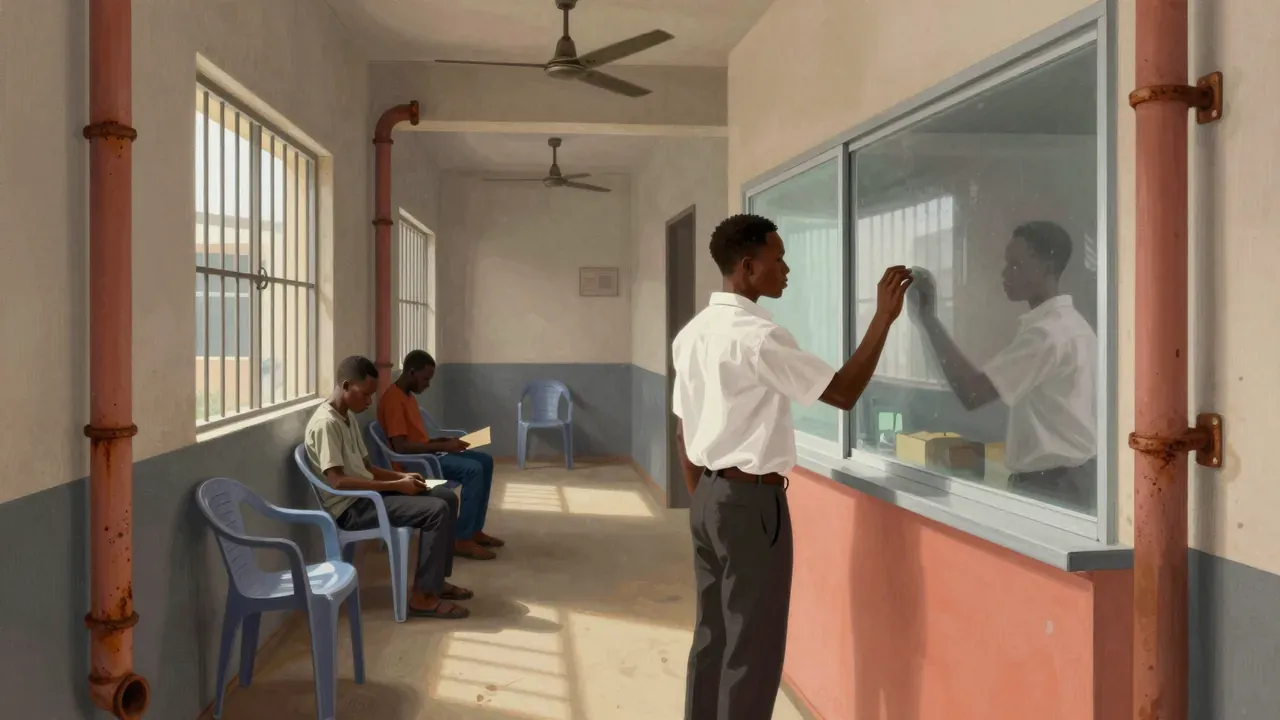
What lands is the cumulative effect of small, unremarkable moments: Mofe adjusting his collar before a consular interview; Rosa braiding her sister’s hair while listening to a voicemail; the way light falls across a tiled floor in a Lagos clinic. These details accrue without commentary, letting the viewer absorb context through repetition — the repeated refusal of documents, the repeated delay of buses, the repeated use of the phrase ‘next time’. The film’s moral clarity lies in its refusal to assign blame — not to individuals, not to institutions, not even to Europe — but to the sheer, grinding inertia of systems that demand constant adaptation from those least equipped to sustain it. The dual structure avoids symmetry: Spain and Italy are not equivalent destinations but placeholders for hope, each chapter ending not with arrival but with suspension. That restraint sustains credibility where other films would reach for catharsis or irony.
What does not
What does not land is the film’s occasional drift into abstraction at the expense of specificity. A few scenes — particularly in the Italy chapter — feel detached from Rosa’s immediate concerns, lingering on surfaces or gestures without clarifying their emotional or narrative function. The New York interludes, though brief, lack integration: they do not deepen character or contrast, and their presence feels more logistical than compositional. Some supporting characters — notably Seyi and Peter — remain underdeveloped, their arcs truncated without clear dramatic purpose. The film’s resistance to exposition occasionally tips into opacity: motivations for certain decisions (a sudden marriage, an unexplained departure) rely on inference rather than dramatisation, which may distance viewers unfamiliar with the social codes of Lagos working-class life. This is not a flaw in intent — the film deliberately avoids didacticism — but it does narrow its accessibility without compensating through other means.
The themes that matter
The themes that matter are endurance, dignity under erosion, and the quiet violence of administrative neglect. Migration here is not framed as choice but as attrition: Mofe’s loss of family and Rosa’s surrender to marriage are not failures of will but recalibrations under pressure. Class operates not as backdrop but as physics — shaping who waits, who is believed, who is seen as disposable. The film treats Lagos not as a setting but as a participant: its traffic, its electricity cuts, its informal economies all exert force on the characters’ decisions. Religion appears not as doctrine but as ritual — a prayer said quickly, a hymn hummed while folding laundry — anchoring characters without resolving their dilemmas. There is no critique of Nigeria as nation-state, nor of Europe as ideal; instead, the film isolates the friction point between individual aspiration and collective indifference. What endures is not hope, but habit — the daily work of staying upright.
Who should watch it
It is for viewers who value observational realism over narrative propulsion, who trust silence and duration as expressive tools, and who approach cinema as a mode of attention rather than entertainment. It is not for those who require clear cause-and-effect, psychological exposition, or resolution — the film offers none. Those expecting a polemic about immigration policy or a portrait of ‘Nigerian resilience’ will find neither; its focus is narrower, quieter, more particular. A viewer who values tightly plotted arcs or emotionally explicit performances may find the pacing inert or the characters opaque. The film assumes familiarity with Lagos as lived space, not as postcard — but this is not exclusionary so much as documentary: it records what is there, without translation. Change the verdict? A tighter edit of the Italy chapter and clearer dramatisation of Rosa’s turning points would sharpen its impact without compromising its ethos.
Is it worth your evening
Yes, it is worth your evening — not as diversion but as calibration. Its 114 minutes ask for patience, not surrender; its rewards are cumulative, not climactic. You leave not with answers but with a recalibrated sense of scale: how much effort goes into holding things together, how little room there is for error, how deeply place shapes possibility. It is not a film to be consumed but inhabited — for those willing to sit with its rhythms, its silences, its refusal to shout. Someone who watches primarily for plot mechanics or emotional payoff may feel unrewarded; someone who watches to understand how lives are lived, not just what happens in them, will find it exact and unsparing. Its value lies in its fidelity — to Lagos, to 16mm, to the unspoken weight of ordinary days. That fidelity is rare, and worth the time it asks.