The shape of time
The Eight Mountains is a two-man drama set across thirty years in the Italian Alps, adapted from Paolo Cognetti’s novel by its co-directors Felix van Groeningen and Charlotte Vandermeersch. It attempts to trace the slow erosion and quiet persistence of male friendship through absence, miscommunication, and divergent life choices — not as conflict but as drift. Its ambition is structural as much as emotional: to treat landscape as grammar, time as weather, and silence as syntax. The film does not seek to resolve the tension between rootedness and wandering, but to hold both in equipoise — Bruno anchored to Grana’s slopes, Pietro moving between Turin, Nepal, and the margins of commitment. It avoids psychological exposition, preferring gesture over confession: a shared glance at a summit book, the weight of a tool left on a windowsill, the way Bruno’s hands move when stacking stone. This is not a film about decisions made, but about habits kept or abandoned, and the geography those habits inscribe on a life. It asks whether fidelity to place can be as demanding, and as tender, as fidelity to a person. (159 words)
The look of it
The story unfolds in three distinct temporal layers, each anchored by Ruben Impens’ cinematography: the bleached clarity of childhood summers, the muted greys of adult return, and the high-altitude stillness of Nepal and the Alps in winter. Alessandro Borghi and Luca Marinelli carry the film with restraint — Borghi’s Pietro never quite settles into himself, Marinelli’s Bruno never quite loosens his grip on the mountain. Their performances avoid crescendo; instead, they accumulate meaning through repetition: the same path taken at different ages, the same phrase repeated with altered weight. Impens keeps the frame wide but rarely empty — even in solitude, the mountains press in, their scale measured against human posture. Daniel Norgren’s score is sparse, acoustic, often absent for minutes at a time; sound design foregrounds wind, stone, breath. Nico Leunen’s editing resists montage, favouring duration over compression — a walk lasts as long as the walk, a silence as long as the silence. The adaptation tightens Cognetti’s interior monologue into physical action, trusting the actors’ bodies to bear what the script leaves unsaid. (158 words)
The weight of two men
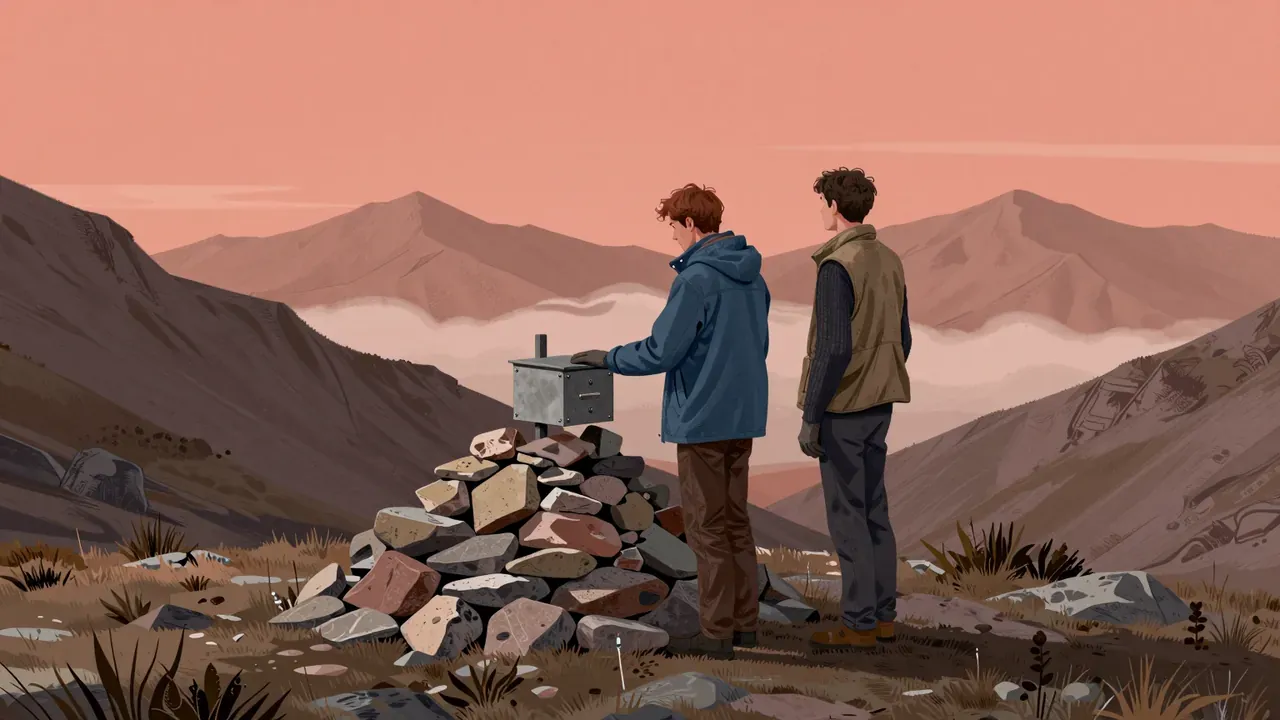
What lands most firmly is the film’s tactile sense of place: the grit under fingernails, the chill of granite at dawn, the way light pools in alpine valleys before rising. These are not backdrops but participants — the mountain is neither antagonist nor muse, but a constant, indifferent presence that shapes rhythm, speech, and memory. The friendship between Pietro and Bruno lands because it refuses symmetry: their bond is asymmetrical in duration, intensity, and consequence, and the film honours that imbalance without moralising. The scenes in Nepal do not exoticise; they extend the film’s central question — what does it mean to belong somewhere? — without offering answers. The final sequence, where Pietro plays football with children while holding grief, lands precisely because it refuses catharsis. There is no reconciliation with loss, only continuation. The David di Donatello wins for cinematography and sound reflect this success: the image and the ear are treated as equal witnesses, not decorative supports. The Jury Prize at Cannes was awarded for this sustained, unshowy attention — not to spectacle, but to the grain of lived time. (157 words)
The risk of the sky
What does not land is the film’s occasional drift into abstraction without sufficient grounding. The Buddhist cosmology framing — eight mountains, eight seas, Mount Meru — remains ornamental rather than integrated; it names a structure the film does not fully inhabit or interrogate. When Pietro recounts the Nepalese parable, it feels like an idea borrowed rather than earned. Similarly, the subplot involving Lara’s departure and Bruno’s financial instability arrives late and underdeveloped; her arguments with Bruno lack the texture given to his exchanges with Pietro, reducing her to a narrative function — the voice of practicality — rather than a full counterpoint. The film’s resistance to exposition works against itself in these moments: we see Bruno’s isolation, but not the social scaffolding that made it possible. Some viewers will find the pacing inert rather than patient — the 147-minute runtime demands surrender to its tempo, and those unwilling to cede that control may register the film as withholding rather than deliberate. The consensus on Rotten Tomatoes calls it ‘a bit ponderous’, and that verdict holds weight for anyone who finds stillness indistinguishable from stasis. (156 words)
What is carried forward
The themes that matter are inheritance and refusal: what is passed down — land, language, silence, stoicism — and what is deliberately discarded — ambition, urbanity, nuclear family norms, linear progress. The film treats fatherhood not as instruction but as echo: Giovanni’s presence lingers in summit books and half-built houses, not in speeches. It treats writing not as vocation but as belated translation — Pietro’s book is less an act of creation than of transcription, turning memory into something legible to others. Friendship here is not chosen daily but re-encountered across decades, each meeting testing whether the old terms still hold. The mountain is not metaphor but condition: it dictates labour, limits mobility, determines who stays and who leaves. This is not environmental determinism, but ecological realism — humans shaped by altitude, snowmelt, pasture boundaries. The film’s quietest theme is endurance without reward: Bruno does not triumph over the mountain, nor does Pietro master his restlessness. They persist, and that persistence is the subject. The David di Donatello for Adapted Screenplay was rightly awarded — the script finds philosophical weight in concrete detail, never in pronouncement. (159 words)
Who walks with it
This film is for viewers who value duration over revelation, who find resonance in repetition, and who accept that some questions — about loyalty, belonging, silence — have no resolution, only recurrence. It suits those accustomed to arthouse pacing, to films where a character’s decision is registered in a pause before answering, not in dialogue. It is not for viewers who require narrative propulsion, clear stakes, or emotional pay-off within a scene. Those who rely on plot mechanics — escalation, reversal, climax — will find the film frustrating, its structure more geological than dramatic. Anyone expecting a conventional coming-of-age arc or a romance-driven narrative will leave unmoored. The film assumes familiarity with European arthouse conventions: long takes, ambient sound, minimal scoring. A viewer who dislikes Daniel Norgren’s folk-inflected guitar work or Ruben Impens’ preference for natural light may find the sensory palette alienating. That said, its accessibility lies in its emotional directness beneath the restraint — the ache of missed connection is legible without explanation. (158 words)
What remains after the snow melts
Yes, it is worth your evening — provided you arrive prepared to sit with it, not through it. Its 147 minutes ask for attention, not endurance; the slowness is calibrated, not indulgent. The film earns its length by refusing shortcuts: every silence has weight, every landscape shot purpose. Those who dismiss it as ‘ponderous’ are not wrong, but their objection reveals a mismatch of expectation, not failure of craft. Someone who values tightly plotted thrillers or emotionally explicit dramas would fairly judge it lacking — but that is a difference of kind, not quality. What would change the verdict? A tighter edit of the Nepal sequences, or deeper integration of the cosmological framing, might sharpen its intellectual architecture. But its power resides precisely in its resistance to tidiness — in the way Bruno’s final solitude feels inevitable, not tragic, and Pietro’s wandering feels necessary, not evasive. It is a film that stays with you not because it resolves, but because it refuses to. (159 words)