What it is
Hero is a martial arts film set in the Warring States period, built around competing accounts of an assassination attempt on the King of Qin. Zhang Yimou directs, writes and produces; Christopher Doyle photographs; Tan Dun scores. It does not aim to reconstruct history or simulate combat realism. Instead, it uses the wuxia framework as scaffolding for a formal experiment: dividing narrative into colour-coded versions of the same event — red, blue, white, green, black — each altering tone, motive and moral weight. The film treats story not as fixed fact but as malleable material, shaped by perspective, memory and political necessity. Its ambition is structural and chromatic before it is dramatic: to make perception visible through controlled shifts in palette, composition and rhythm. It assumes the viewer will notice how a shift from green to red changes not just mood but credibility — how desire bleeds into evidence, how reason narrows vision. It is less about who killed whom than about how truth contracts and expands depending on who tells it, and to whom.
How it works
The plot unfolds in nested frames: Nameless, a nameless prefect, recounts his deeds to the king, who then offers a counter-narrative. Jet Li plays Nameless with minimal inflection — a vessel for shifting interpretations. Tony Leung’s Broken Sword and Maggie Cheung’s Flying Snow carry emotional weight through stillness and glance more than dialogue; Zhang Ziyi’s Moon moves with contained volatility. Doyle’s cinematography avoids handheld urgency. He holds wide shots over duels, lets wind move silk banners for thirty seconds, frames faces against monochrome backdrops. Each colour sequence uses distinct film stock (Kodak for red, Fuji for green), lighting ratios and costume design — not as metaphor but as grammar. Tan Dun’s score blends guqin, chorus and orchestral strings, often holding silence between phrases. Editing is rhythmic but unhurried: cuts land on breaths, not impacts. The calligraphy school scene lingers on ink bleeding into rice paper; the lake fight suspends motion mid-air. This is choreographed restraint, not spectacle for its own sake.
What lands
What lands is the film’s visual architecture — how colour governs credibility. The red sequence feels urgent and subjective: jealousy distorts time, sharpens edges, tightens framing. The green flashback — shot in Jiuzhaigou — breathes with mist and water, its soft focus suggesting memory’s haze. The white version strips away ornament, leaving only posture and distance; it reads as both resolution and erasure. These shifts are legible without explanation. The duel scenes avoid close-ups of impact, favouring long-lens compositions that turn bodies into glyphs moving across flat planes — making violence abstract, ceremonial, inevitable. Zhang Ziyi’s Moon, though given little dialogue, registers through gesture: a hand tightening on a sword hilt, a pause before stepping into light. The king’s final monologue lands because it arrives after three visual arguments have already laid bare the cost of unity — not as triumph, but as subtraction.
What does not
What does not land is the English-language dub and the American-subtitled translation of ‘tianxia’ as ‘our land’. That flattens the film’s central philosophical pivot — from national sovereignty to universal order — into parochialism. The Miramax poster’s substitution of a katana for the historical jian misplaces cultural reference without irony or intent, breaking immersion for viewers familiar with Chinese arms. The framing device — Nameless approaching the king — risks monotony in its repetition: the ten-pace rule becomes structural scaffolding rather than dramatic tension. Some performances suffer from the script’s austerity; Chen Daoming’s king, though commanding, remains opaque where ambiguity was likely intended, not achieved. The film’s refusal to anchor emotion in psychological cause — why Snow kills Sword, why Moon seeks vengeance — leaves gaps that feel like omission, not ellipsis. It assumes fluency in a visual language some viewers simply do not speak.
The themes that matter
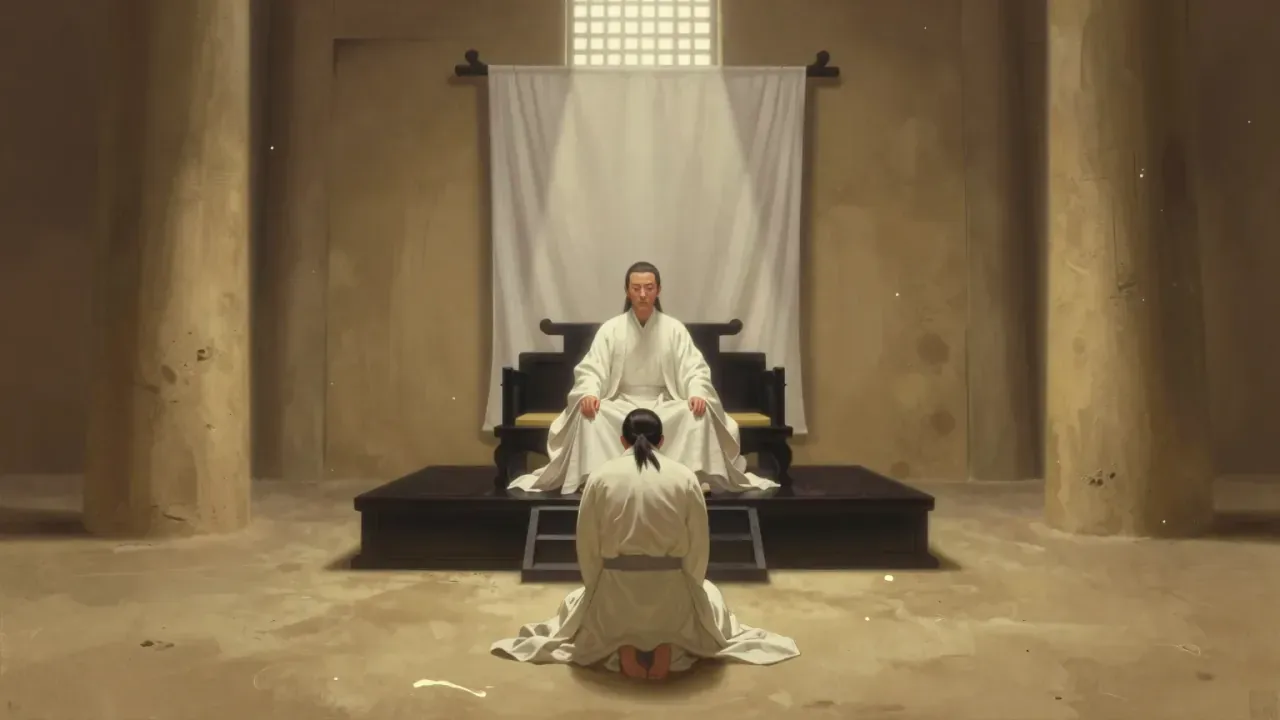
The themes that matter are authority and interpretation, not loyalty or revenge. The film asks what happens when narrative becomes statecraft — when the official version of events is not the truest, but the most useful. It treats ‘peace under heaven’ not as pacifism but as enforced coherence: the sacrifice of individual truth to collective stability. Colour functions as epistemology: red is passion-as-evidence, blue is logic-as-protocol, white is synthesis-as-silence. The guqin music in the courtyard scene is not background; its sparse, resonant notes mirror the idea that meaning resides in what is withheld. The film’s quietest moment — the king alone in black robes, looking at a scroll — carries more weight than any duel. It suggests power is not held in the hand but in the right to name, to frame, to edit. This is not a celebration of empire, but a study of how unification requires the dissolution of competing stories — and how that dissolution looks, sounds and feels when rendered in saturated light and suspended motion.
Who should watch it
This film is for viewers who attend to composition before character, who find meaning in duration and hue, who accept that a fight scene may be about gravity, not grievance. It rewards patience with texture: the grain of Kodak film in red, the way wind lifts a single strand of hair in green, the echo of a single violin note in an empty hall. It is not for those who require causal clarity, psychological exposition or kinetic escalation — viewers who expect motivation to precede action, or who read silence as vacancy. Those who associate martial arts cinema with momentum and escalation may find its pacing withholding, even withholding to the point of abstraction. A viewer who values narrative propulsion over formal control will leave dissatisfied. The film assumes you are willing to sit with uncertainty, to let a shot hold past comfort, to treat colour as syntax. Without that willingness, it remains ornamental, not operative.
Is it worth your evening
Yes, it is worth your evening — provided you watch it as Zhang Yimou and Doyle made it: on a screen large enough to register chromatic shift, with sound that carries Tan Dun’s silences, and without expectation of conventional payoff. Its 99 minutes unfold with the weight of ritual, not plot. You will not leave humming a twist, but remembering how white light fractured into red, how green dissolved into black, how a single scroll changed hands and changed history. It is not entertainment in the transactional sense; it is encounter. Those who disagree — critics who called it ‘empty spectacle’ or ‘style over substance’ — mistake its discipline for detachment. What would change the verdict? A viewing without subtitles, or on a small screen with compressed audio, where colour bleeds and silence collapses into noise. In the right conditions, Hero remains a benchmark: not of what wuxia can do, but of what cinema can withhold, and still mean.