The look of it
Sing a Song of Sex is a 1967 Japanese New Wave film that treats adolescent male desire not as psychology but as social and historical pressure—compressed into a single day, February 11, 1967, National Foundation Day’s first official observance. Nagisa Ōshima does not dramatise character development or moral consequence; he constructs a series of loosely linked episodes in which singing, fantasy, interruption, and failed action accumulate without resolution. The film’s ambition is structural and conceptual: to stage desire as a collective, rhythmic, often dissonant activity—less about what the four boys want than how their wanting echoes older songs, state rituals, colonial histories, and suppressed voices. It refuses narrative causality in favour of associative logic, using music not as ornament but as architecture. The title’s English rendering obscures its scholarly root—Nihon shunka-kō means ‘A Treatise on Japanese Bawdy Songs’—and that framing matters: this is not a story about sex, but an inquiry into how erotic folk forms encode power, resistance, and erasure. Ōshima’s stated aim—to film ‘the imaginary’—is pursued through deliberate instability: of tone, chronology, language, and agency. (158 words)
The shape of the day
The film follows four high school seniors—Nakamura, Ueda, Hiroi, Maruyama—as they wander Tokyo after university entrance exams, fixated on a girl identified only by her seat number, ‘469’. Their fantasies of her are repeatedly stalled, diverted, or undercut—not by conscience, but by distraction, misdirection, or the sheer weight of competing sounds. Performances are deliberately unpolished; much was improvised, and the actors’ physical ease with each other feels lived-in rather than rehearsed. Hikaru Hayashi’s score operates as counterpoint: over a dozen songs appear, from American protest standards sung in English to the recurring Yosakoi Bushi, a shunka whose lyrics enumerate erotic rules with deadpan enumeration. Gordon Willis is not involved; the cinematography is by Shinsaku Himeda, who keeps daylight scenes flat and overexposed, interiors dim and grainy, matching the film’s refusal of visual hierarchy. Editing favours abrupt cuts and overlapping sound, especially during group singing, where multiple songs clash in real time. The camera rarely lingers; it observes, shifts, reframes—never interprets. Teacher Ōtake’s drunken monologue on bawdy songs as ‘voices of the oppressed’ is delivered without irony or emphasis, making its political claim land not as argument but as provocation. (159 words)
The sound of it
What lands is the film’s sonic texture—the way singing becomes both release and trap, communal and isolating. When the four boys chant Yosakoi Bushi in unison, then break into competitive counterpoint, the rhythm carries the weight of ritual, even when the content is absurd or offensive. The scene at the folk song rally, where Sachiko Kaneda—a Korean-Japanese woman—sings a Korean-language prostitute’s song that the crowd fails to comprehend, lands with quiet force: her voice is cut off not by censorship but by incomprehension, then by physical removal. That moment crystallises the film’s central tension between expression and erasure. The final classroom scene, in which Akiko Koyama’s character traces Japanese imperial lineage to Korean conquerors, lands not as revelation but as destabilisation—history offered not as fact but as counter-narrative, spoken plainly amid adolescent boredom. The film’s refusal of catharsis works: frustration is sustained, not resolved, and that persistence makes the viewer feel the weight of unprocessed desire and inherited violence. Its collage structure avoids didacticism while still insisting on connections—between national myth and sexual fantasy, between protest songs and bawdy ones, between Japanese formalwear and Korean subjugation. (157 words)
The weight of wanting
What does not land is the film’s treatment of its central female figures as functional rather than fully realised. ‘Number 469’ remains abstract, a cipher for projection; her silence is structural, not symbolic. Sachiko Kaneda’s interruption at the rally is powerful, but her subsequent removal is handled with such narrative haste that her personhood recedes behind her function as catalyst. The film’s improvisational method shows here: the male ensemble’s chemistry is palpable, but the women—Koyama, Miyamoto, Yoshida, Masuda, Tajima—are given little space to develop beyond their roles in relation to the boys or Ōtake. There is no attempt to render their interiority, nor to explore how they navigate the same political and sexual terrain. The film’s thesis—that desire runs up against limits and leaps into the imaginary—applies only to the male protagonists. When Ōtake sings, when the boys fantasise, when they compete in song, those acts are framed as generative. But when Kaneda sings in Korean, or when Koyama delivers her history lesson, those moments are framed as interruptions to be absorbed, dismissed, or abruptly ended. This asymmetry weakens the film’s claim to radical imagination: it imagines male frustration thoroughly, but imagines women mostly as surfaces upon which that frustration is projected. (159 words)
The silence between the notes
The themes that matter are not sexuality per se, but the transmission of cultural forms across generations and borders—how songs migrate, mutate, and carry submerged histories. The film treats shunka not as folklore but as contested archive: their bawdiness encodes class resentment, gendered constraint, and colonial memory. National Foundation Day provides the temporal anchor, but the film’s real subject is foundation myths themselves—how they are sung, enforced, parodied, or forgotten. The Korean presence is not incidental: Kaneda’s erased song and Koyama’s closing lecture position Korea not as ‘other’ but as constitutive of Japan’s own origin story—a claim made quietly, without fanfare, in a room full of bored students. Generational conflict appears not as ideology but as acoustic difference: the boys sing American protest songs with imperfect English, while Ōtake invokes pre-war folk traditions, and Kaneda sings in a language the film leaves untranslated. This is not a film about rebellion against authority, but about the impossibility of speaking outside inherited forms—even when those forms are oppressive, even when they are borrowed, even when they are sung drunk in a restaurant at midnight. (158 words)
Who gets to be heard
This film is for viewers who approach cinema as a site of historical listening—not just watching, but attending to how sound carries memory, how silence marks erasure, how repetition reveals power. It rewards patience with abstraction, comfort with unresolved tension, and familiarity with Japanese postwar history and New Wave aesthetics. It is not for those who require psychological coherence, moral resolution, or character-driven arcs. Some critics argue its political urgency is diluted by aesthetic detachment; others say its refusal to moralise is precisely its rigour. A viewer who expects narrative propulsion or empathetic identification will find it alienating. But if you accept that a film can be a treatise built from song, snow, and stammered fantasy—if you are willing to sit with discomfort that never resolves into clarity—then it repays attention. Its value lies not in what it explains, but in what it insists you hear, even when you cannot translate it. (159 words)
The lesson that isn’t taught
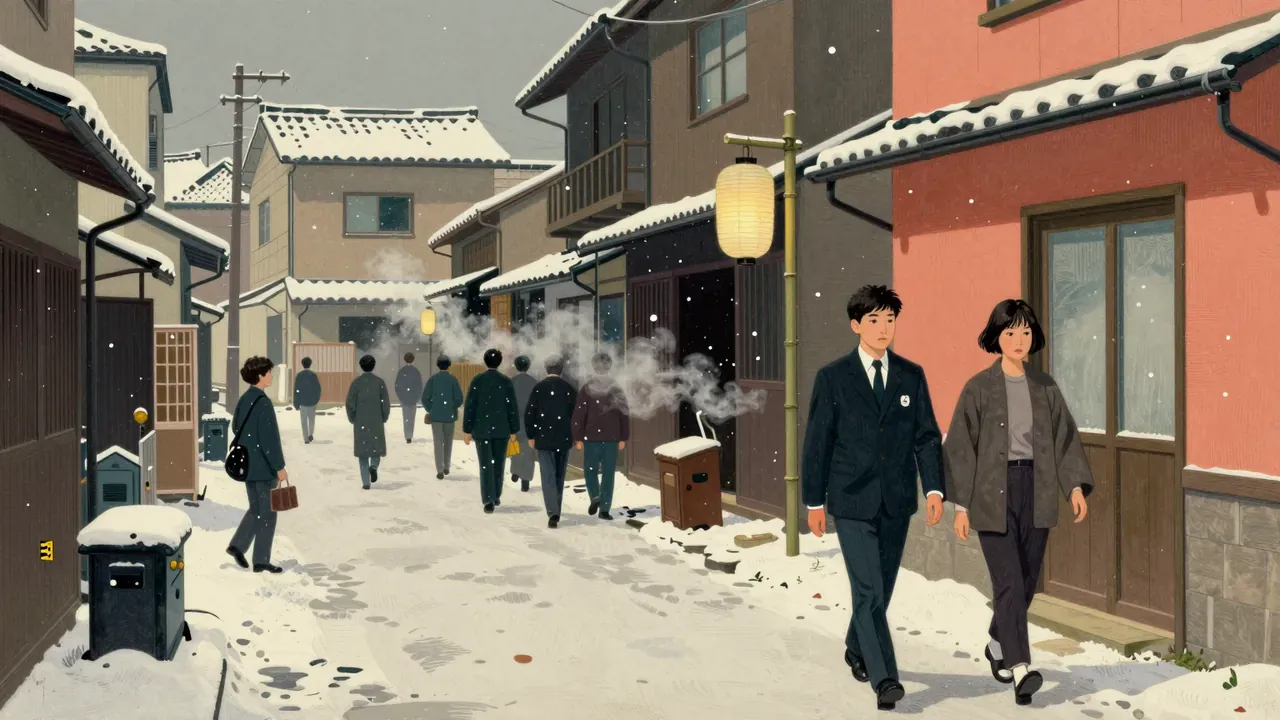
Yes, it is worth your evening—if you watch it as a musical essay, not a drama. Its 103 minutes pass with a lightness that belies its density: the snow, the singing, the casual cruelty, the sudden shifts in language and register all accumulate without heaviness. It does not ask for agreement, only attention—and it repays that attention with layers that reveal themselves on second viewing: the way Hiroi’s exam-day fantasy dissolves into a shot of red liquid, the recurrence of haori and hakama in the Yosakoi lyrics, the precise moment the boys stop singing together and begin singing over each other. Those who dismiss it as formless miss its discipline: every cut, every lyric, every untranslated phrase is placed. It is not for fans of conventional storytelling, nor for those who need films to affirm rather than unsettle. But if you believe cinema can hold contradiction without resolving it—if you trust rhythm as argument—then this remains urgent, strange, and singular. (159 words)