The weight of things
Gervaise is a French literary adaptation of Émile Zola’s 1877 naturalist novel L’Assommoir, transposed to the screen in 1956 by René Clément. It sets out to render Zola’s unflinching social anatomy in cinematic form: not as period costume drama but as a sustained study of how poverty, gendered labour, and inherited disadvantage constrain individual agency. The film locates its moral weight not in judgment of its characters but in the cumulative pressure of their material conditions — the damp walls of Paris tenements, the weight of wet laundry, the slow erosion of dignity through repeated small failures. It attempts fidelity to Zola’s method: observation over interpretation, cause-and-effect over catharsis, environment as determinant. Its ambition is structural rather than psychological — to show how alcoholism, debt, and social exclusion compound like sedimentary layers, not as personal flaws but as systemic outcomes. This is not a story about fall and redemption but about descent without inflection, where resilience is exhausted, not tested. It presumes no prior knowledge of the novel, yet assumes the viewer will attend to texture over plot turns — to the rhythm of work, the silence after shouting, the way light falls on a cracked floorboard. (158 words)
The body’s ledger
The narrative follows Gervaise’s decade-long struggle from hopeful independence to abject dependency, anchored by Maria Schell’s physically precise performance — her posture shifts with each stage of exhaustion, her voice tightens before breaking, her hands never stop moving until they can’t. François Périer charts Coupeau’s decline with equal rigour: the slump of shoulders after his roofing accident, the slackening jaw as drink takes hold, the way he avoids eye contact even when sober. Robert Juillard’s cinematography avoids pictorial beauty; interiors are cramped and low-contrast, street scenes washed in grey daylight, faces lit from below by gaslight or stove flame. Georges Auric’s score is restrained, often absent — when music appears, it is diegetic, from barrel organs or street singers, underscoring how little room there is for artifice in this world. Henri Rust’s editing moves with deliberate slowness, holding on reactions longer than comfort allows, refusing to cut away from shame or fatigue. The script by Aurenche and Bost compresses Zola’s sprawl without softening its edges: dialogue is functional, often terse, rarely explanatory. There are no monologues of self-awareness — only gestures, silences, and the sound of water dripping in an unheated room. (159 words)
The look of it
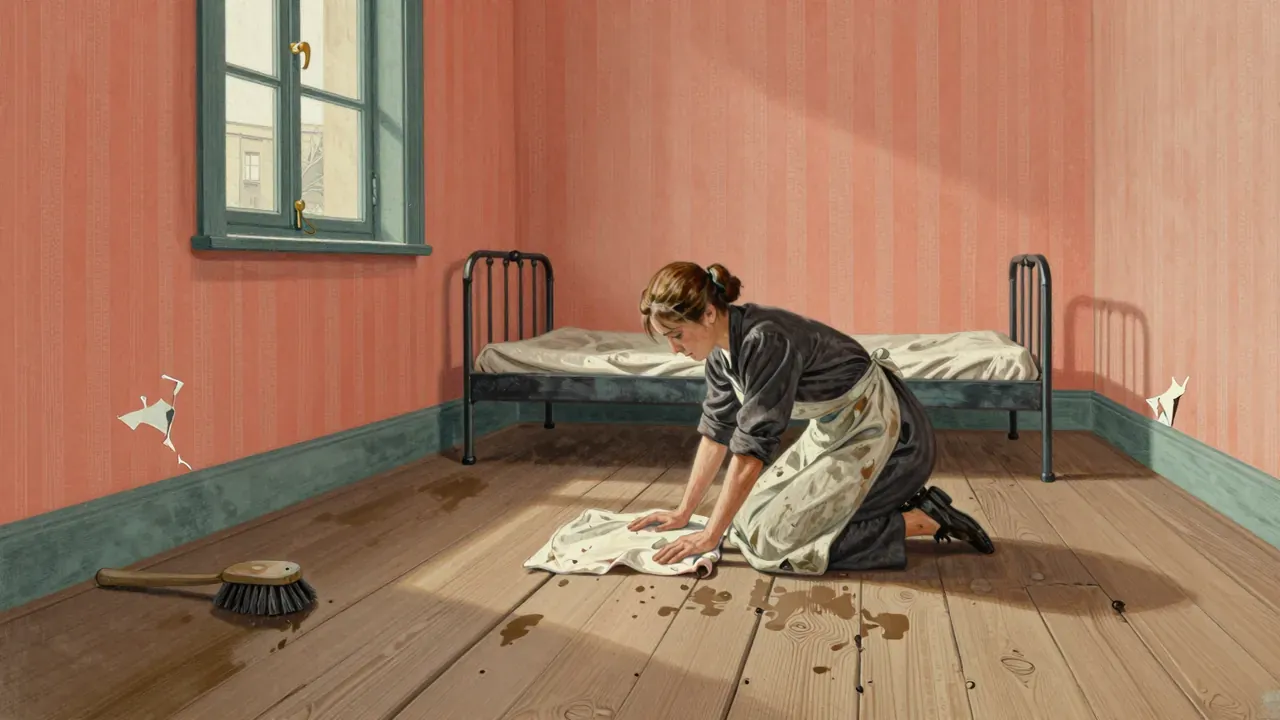
What lands is the sheer physicality of survival: the weight of a laundry basket, the sting of lye on chapped hands, the way Gervaise’s breath hitches when she lifts a heavy iron. Schell’s performance remains the film’s central anchor — not because it is ‘brilliant’ in any conventional sense, but because it refuses theatricality. Her Gervaise does not plead for sympathy; she calculates, bargains, mends, and fails, all with the same quiet concentration. The film’s most effective sequences are those that withhold commentary: Gervaise scrubbing floors while her daughter Nana watches silently from a doorway; Coupeau sleeping upright in a chair, mouth open, coat stiff with dried sweat; the slow dismantling of the laundry shop — first the sign removed, then the counter stripped bare, then the empty space left echoing. Juillard’s camera stays at eye level, never rising to pity or descending to condescend. The social detail feels sourced, not staged: the way women share buckets, how men gather near tavern doors, the precise hierarchy of tradesmen in the courtyard. These are not ‘characters’ but occupants of a documented world — and that occupancy is what convinces. (157 words)
The cost of accuracy
What does not land is the film’s attempt to condense Zola’s sprawling social canvas into a single domestic trajectory. Several supporting figures — Virginie, Goujet, even Nana — remain schematic, their motivations flattened into functional roles: obstacle, ally, consequence. Armand Lurville’s Virginie lacks the venomous calculation of her literary counterpart; her malice arrives without antecedent, as if summoned by plot necessity rather than social logic. Goujet’s devotion reads more like narrative convenience than earned loyalty, and his final gesture feels unearned because the film gives him no interior life beyond his hammer and anvil. The mid-section sags under the weight of repetition — Coupeau’s relapses follow near-identical beats, diminishing their impact. Worse, the film’s naturalism occasionally slips into determinism: every setback arrives with such mechanical inevitability that agency seems illusory rather than eroded. There is no moment where Gervaise chooses wrongly — only moments where choice is structurally unavailable. That is true to Zola, but cinematically it risks numbing the viewer rather than implicating them. The result is less indictment than inventory — accurate, but not always urgent. (159 words)
The architecture of want
The themes that matter are not abstract but embedded in routine: the gendered division of labour, where Gervaise’s skill as a laundress is both her sole asset and the reason she cannot escape exploitation; the false promise of upward mobility, embodied in the ill-fated laundry shop — a venture built on credit, goodwill, and borrowed time; the intergenerational transmission of vulnerability, visible in Nana’s silent withdrawal and eventual abandonment. Class is not discussed but measured: in the height of doorways, the thickness of floorboards, the distance between apartments and workplaces. Addiction here is not a moral failing but a symptom of idleness enforced by injury, of dignity stripped by debt, of hope worn down by daily indignity. The film treats alcoholism not as a disease but as a habit formed in the absence of alternatives — a coping mechanism indistinguishable from breathing. There is no critique of medicine, religion, or politics as institutions; the critique is architectural, economic, temporal. Time itself is hostile: days blur, seasons pass without change, years accrue without progress. What matters is not what the characters believe, but what their bodies remember — cold, hunger, fatigue, the ache of standing too long. (156 words)
Who it holds
This film is for viewers who value precision over pace, who find tension in stillness and moral weight in accumulation. It suits those accustomed to post-war European realism — Bresson, early Truffaut, or the British kitchen-sink films of the late 1950s — and who do not require narrative propulsion to sustain attention. It is not for viewers who need clear motivation, psychological exposition, or resolution of any kind; those expecting a ‘character arc’ will find only erosion. It is also not for those who mistake naturalism for neutrality: the film’s refusal to editorialise is itself a political stance, one that some may read as fatalism rather than fidelity. Anyone seeking historical colour, romantic subplots, or stylistic flourish will leave unsatisfied. A viewer who values emotional clarity over atmospheric density, or who prefers moral argument to sociological demonstration, would find the film withholding rather than rigorous. Change the framing — add voiceover, tighten the timeline, deepen Goujet’s role — and the verdict shifts. As it stands, it asks for patience, not empathy. (159 words)
The time it takes
Yes, it is worth your evening — but only if you accept its terms. It demands attention to texture over event, to duration over development, to implication over explanation. Its 112 minutes pass slowly, deliberately, without concession — and that slowness is the point, not a flaw. To watch it impatiently is to misunderstand its design. It rewards close viewing: the way Schell’s knuckles whiten when gripping a washboard, the shift in Juillard’s lighting as winter deepens, the recurrence of certain sounds — dripping water, distant hammers, children’s voices fading up alleys. Those who dismiss it as ‘dour’ or ‘unrelenting’ are not wrong, but they are responding to its method, not misreading it. Others may find its lack of rhetorical flourish alienating — no score swells, no camera soars, no speech clarifies. Yet its restraint is its strength: it does not tell you how to feel, because it trusts you to feel the weight of the wet cloth, the chill of the unheated room, the silence after the last coin is spent. Worth it, yes — if your evening permits gravity. (159 words)