The world it lives in
The Age of Innocence is a period romance adapted from Edith Wharton’s 1920 novel, set in 1870s New York high society. It attempts to translate Wharton’s precise social anatomy — her scrutiny of restraint, ritual, and unspoken power — into cinematic form. Martin Scorsese directs not as an outsider to the material but as someone who recognises his own preoccupations in it: codes of conduct, the weight of expectation, love that remains unconsummated by design rather than chance. The film does not seek to dramatise rebellion in the usual sense; there are no riots, no declarations, no breaking of doors. Instead, it traces how pressure accumulates in silence, how a glance or a pause carries more consequence than a shouted line. It treats manners as machinery, and emotional suppression as labour. Its ambition is structural: to make the audience feel the architecture of propriety — not as backdrop, but as force. It asks the viewer to register what is withheld, deferred, or erased — not through exposition, but through rhythm, framing, and duration. This is not a story about passion overcoming convention, but about convention absorbing passion until only its echo remains. (158 words)
The look of it
The story unfolds with deliberate pacing, anchored by Daniel Day-Lewis’s Newland Archer — a man whose interior conflict is conveyed less through outbursts than through stillness, hesitation, and the slow tightening of his jaw. Michelle Pfeiffer’s Ellen Olenska registers as both presence and absence: luminous in close-up, then receding into doorways or fogged glass. Winona Ryder’s May Welland is written with subtlety — her passivity is never passive, her compliance never simple. Michael Ballhaus’s cinematography avoids flourish: light falls evenly, compositions are balanced and symmetrical, movement is minimal. Thelma Schoonmaker edits with a near-invisible hand, holding shots just long enough for discomfort to settle. Elmer Bernstein’s score is restrained, often absent — strings enter only when emotion threatens to breach the surface. Costume design (which won the Academy Award) functions as narrative: lace, brocade, and structured silhouettes articulate hierarchy and containment. The production design — filmed largely in Troy and Kinderhook — privileges authenticity over ornament: rooms feel lived-in, not staged. Every craft choice serves the same principle: nothing must distract from the quiet violence of self-denial. (159 words)
What stays silent
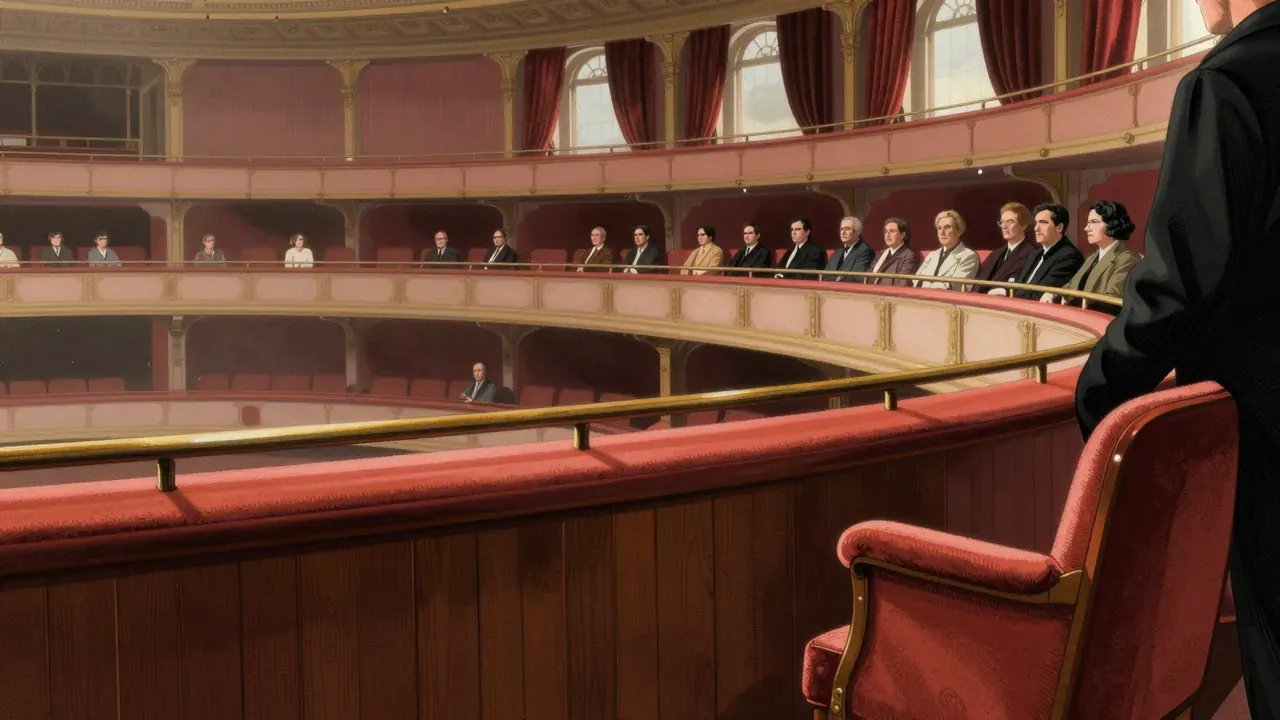
What lands is the cumulative weight of implication. The film succeeds in making etiquette feel consequential — a dinner invitation, a delayed engagement, a cancelled visit, all carry the gravity of moral decisions. The opera scenes, shot at the Philadelphia Academy of Music, use sound and space to convey social surveillance: characters do not speak freely because they are always within earshot of someone who matters. Miriam Margolyes’s Mrs. Mingott operates like a weather vane for the group’s mood — her approval or disapproval shifts scenes without a raised voice. The final Paris sequence works because it refuses catharsis: Archer does not go upstairs, does not knock, does not speak. His walk away is not resignation but recognition — of time passed, of roles fulfilled, of love preserved precisely because it was never enacted. The film’s restraint becomes its strength: it trusts the viewer to infer motive, to read silence as strategy, to understand that May’s pregnancy announcement is not disclosure but closure. There is no melodrama, only consequence — and that feels earned. (156 words)
Where the edges blur
What does not land is the occasional flattening of historical texture into aesthetic shorthand. Some supporting characters — Richard E. Grant’s Lawrence Lefferts, Jonathan Pryce’s Julius Beaufort — remain types rather than individuals, their function purely illustrative of social rot or hypocrisy. The law office scenes, filmed in the Victorian Gothic Rice Building, visually assert rigidity but rarely deepen our understanding of Archer’s profession beyond its symbolic role as enforcer of the status quo. A few transitions feel abrupt: the shift from Archer’s early idealism to his resigned conformity lacks a clear pivot point in performance or editing. The film’s commitment to understatement occasionally borders on opacity — a viewer unfamiliar with Wharton’s irony may mistake stillness for inertia, or decorum for dullness. The cameo appearances — Scorsese’s parents, his daughter — are charming but narratively inert, serving neither theme nor character. And while the title sequence (by Elaine and Saul Bass) is formally striking, its metaphors — blooming roses, dissolving lace — risk feeling too literal next to the film’s otherwise oblique language. (157 words)
What innocence really means
The themes that matter are those embedded in Wharton’s original critique: the coercive power of consensus, the gendered asymmetry of freedom, and the way institutions preserve themselves by policing desire. The film treats ‘innocence’ not as naivety but as enforced ignorance — May’s innocence is curated, Ellen’s is forfeited, Archer’s is performed. Class is not backdrop but grammar: every gesture, from how one holds a teacup to where one sits at table, signals belonging or exclusion. Time itself is thematic — not linear, but cyclical and recursive. The opening opera scene mirrors the closing Paris street; the wedding photographs echo the earlier train station meeting. Memory is not nostalgic but forensic: Archer remembers not moments of joy but thresholds crossed and uncrossed. The film also quietly interrogates authorship — Wharton wrote as an insider who had left, Scorsese as an outsider who entered with reverence. Neither romanticises the era; both treat it as a laboratory for observing how people consent, however reluctantly, to their own containment. (158 words)
Who it speaks to
This film is for viewers who value precision over propulsion, implication over exposition, and who find emotional resonance in what is withheld. It rewards attention to composition, cadence, and subtext — not just what characters say, but how long they wait before speaking, or whether they look away mid-sentence. It suits readers of Wharton, students of Gilded Age history, and anyone attuned to the politics of restraint. It is not for those who require narrative momentum, overt conflict, or psychological exposition — the film offers no voiceover, no flashbacks, no explanatory dialogue. Those expecting Scorsese’s usual kinetic energy may find the pacing alienating. A viewer who prefers moral clarity over ambiguity, or who reads silence as emptiness rather than density, will likely disengage. The verdict changes if the film were re-cut to tighten its middle act or if performances leaned more into irony — but as it stands, its rigour is inseparable from its appeal. (159 words)
Why it lasts
Yes, it is worth your evening — provided you approach it as a study in compression, not diversion. Its 139 minutes unfold with the deliberation of a legal document or a formal letter: every word, every pause, every costume stitch has been weighed. It repays rewatching not for plot revelation but for recalibration — noticing how May’s posture shifts after her pregnancy announcement, or how Ellen’s gloves are removed only once, in private. It is not entertainment in the transactional sense, but it is deeply humane: it understands that dignity often resides in endurance, and love in refusal. Those who dismiss it as ‘slow’ misunderstand its method — it is not slow, but exact. A viewer who demands urgency will leave unsatisfied; one who values emotional accuracy will find it rare. Its value lies not in what it gives quickly, but in what it leaves behind: a quiet, persistent ache for all the lives lived inside the lines. (159 words)