The length of the break
Breaktime is a fourteen-minute Iranian drama film written and directed by Abbas Kiarostami in 1972. It belongs to his early period of work with the Institute for the Intellectual Development of Children and Young Adults (Kanun), where he made short, observational films about children’s daily life in Tehran. The film does not attempt narrative resolution or character exposition; instead, it holds steady on the unscripted rhythms of a school break — the dispersal into courtyards, the clustering and drifting apart, the small negotiations of play and possession. There is no voiceover, no score, no editorial emphasis beyond duration and framing. Its intention is neither didactic nor sentimental: it treats the break as a social microcosm, a neutral field where hierarchy, cooperation, boredom and impulse unfold without commentary. It assumes the viewer’s willingness to attend to what is ordinary, unremarkable and unmediated — a quiet insistence that attention itself is the subject. This is not documentary in the sense of testimony or argument, but in the sense of sustained, uninflected witness.
The children are not actors
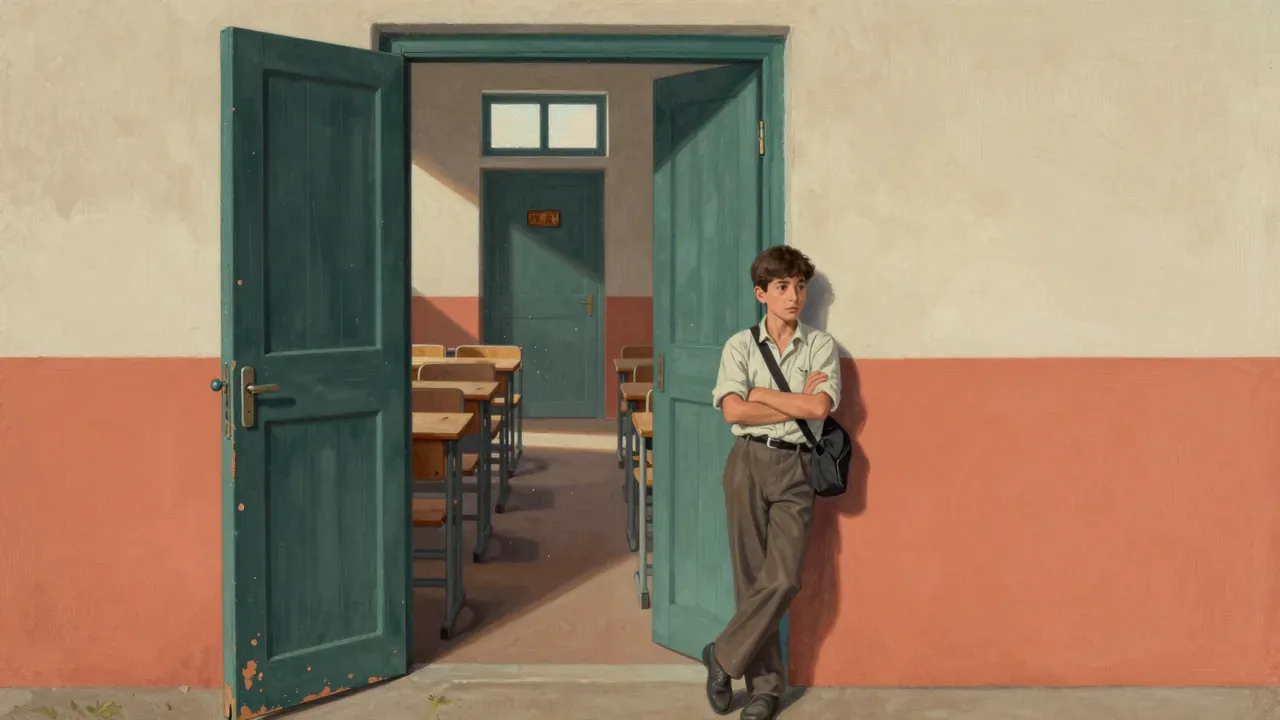
The film works through strict formal economy: static camera positions, natural light, diegetic sound only, and performances that are indistinguishable from behaviour — because they are the behaviour of real children filmed during an actual school break. Kiarostami does not direct the children; he observes them. There is no plot, no arc, no scripted dialogue — only the accumulation of small actions: a boy kicking a ball, another adjusting his cap, two girls walking side by side then stopping to talk, a group gathering around a dropped pencil. The editing is sparse and functional, cutting only to reframe or shift ground level, never to heighten or interpret. Sound design is minimal: distant shouts, footsteps on gravel, the rustle of clothing, occasional laughter. Cinematography avoids contrast or composition-as-metaphor; frames are balanced but unadorned, often placing figures at the edge or centre without symbolic weighting. The craft is one of subtraction: removing authorial intervention until only the scene remains, intact and unvarnished.
The look of it
What lands is the cumulative weight of authenticity. Over fourteen minutes, the film builds a quiet authority through consistency of tone and refusal of manipulation. The children’s gestures feel unselfconscious — not because they are unaware of the camera, but because their attention is elsewhere, absorbed in the immediate business of being ten years old in a Tehran schoolyard in 1972. Their physical ease, the way they occupy space without performance, carries a persuasive realism that few fiction films achieve. The absence of music or narration does not leave the film hollow; instead, it makes room for ambient detail — the texture of concrete underfoot, the way light shifts across brick walls, the cadence of overlapping Persian speech. These are not flourishes but facts, rendered with patience. The film lands not as entertainment but as calibration: it resets the viewer’s threshold for what counts as event, what qualifies as meaning, and how much can be said without saying anything at all.
What it leaves out
What does not land is any claim to dramatic momentum or psychological revelation. Viewers expecting narrative development, thematic exposition or even clear focal characters will find the film withholding — not as a provocation, but as a matter of method. There is no climax, no pivot, no moment that reconfigures what has preceded it. Some may read this as inertness rather than discipline; others may mistake its stillness for emptiness. The film offers no context — no title cards identifying the school, no credits listing child participants, no explanation of why this break, this day, this courtyard matters. That refusal is structural, not accidental, but it denies the viewer conventional footholds. Those accustomed to expository clarity or emotional signposting may feel adrift, not because the film is obscure, but because it declines to translate its subject into familiar cinematic grammar. It asks for surrender to duration, not interpretation — and that ask is absolute.
How time behaves
The themes that matter are time, presence and the unremarkable as site of truth. Breaktime treats the interstitial — the pause between lessons — not as downtime but as dense social terrain: where rules loosen, hierarchies blur, and identity is rehearsed in gesture rather than speech. It implies that childhood is not a preparation for adulthood but a fully realised condition, with its own logic, ethics and friction. The film also engages with visibility: who is seen, who moves freely, who lingers at the margins — all observed without naming. There is no overt critique of education or authority, yet the structure of the school day, the bell’s command, the enforced return to classrooms, forms an implicit frame against which the break’s autonomy briefly asserts itself. This is not political allegory, but material fact rendered visible: the tension between institution and individual, order and improvisation, is held in the children’s bodies, not in dialogue or montage.
Who it is for
This film is for viewers who value precision of observation over propulsion of plot, and who accept duration as expressive material rather than dead air. It rewards patience, familiarity with Kiarostami’s later work, or prior engagement with structuralist or ethnographic film traditions. It is not for those who require narrative scaffolding, emotional cues or clear authorial intent — viewers who rely on music to signal mood, editing to indicate importance, or dialogue to explain motivation will likely find it unrewarding. Someone who values clarity above ambiguity, or who watches film primarily for immersion in story, would reasonably reject it. A change in verdict would follow not from altering the film, but from shifting the viewer’s contract: if you come prepared to watch, not to be carried, Breaktime delivers. If you expect to be guided, it offers nothing.
What it gives back
Yes, it is worth your evening — provided you set aside the expectation that ‘worth’ means narrative payoff or emotional release. Fourteen minutes is less time than most people spend deciding what to watch next; within that span, Breaktime recalibrates perception, slows habitual scanning, and insists on the dignity of the unremarkable. It does not ask for investment in characters or stakes, but for attention as practice — and that practice yields returns in heightened awareness long after the credits. Those who dismiss it as ‘just kids playing’ have missed its rigour: every frame is chosen, every cut deliberate, every silence calibrated. It is not demanding in the way of complexity, but in the way of honesty. To call it slight is to misunderstand its ambition: it seeks not to fill time but to restore its texture. For anyone willing to meet it on its terms — which are few, exact and unwavering — it repays attention with quiet certainty.