The shape of it
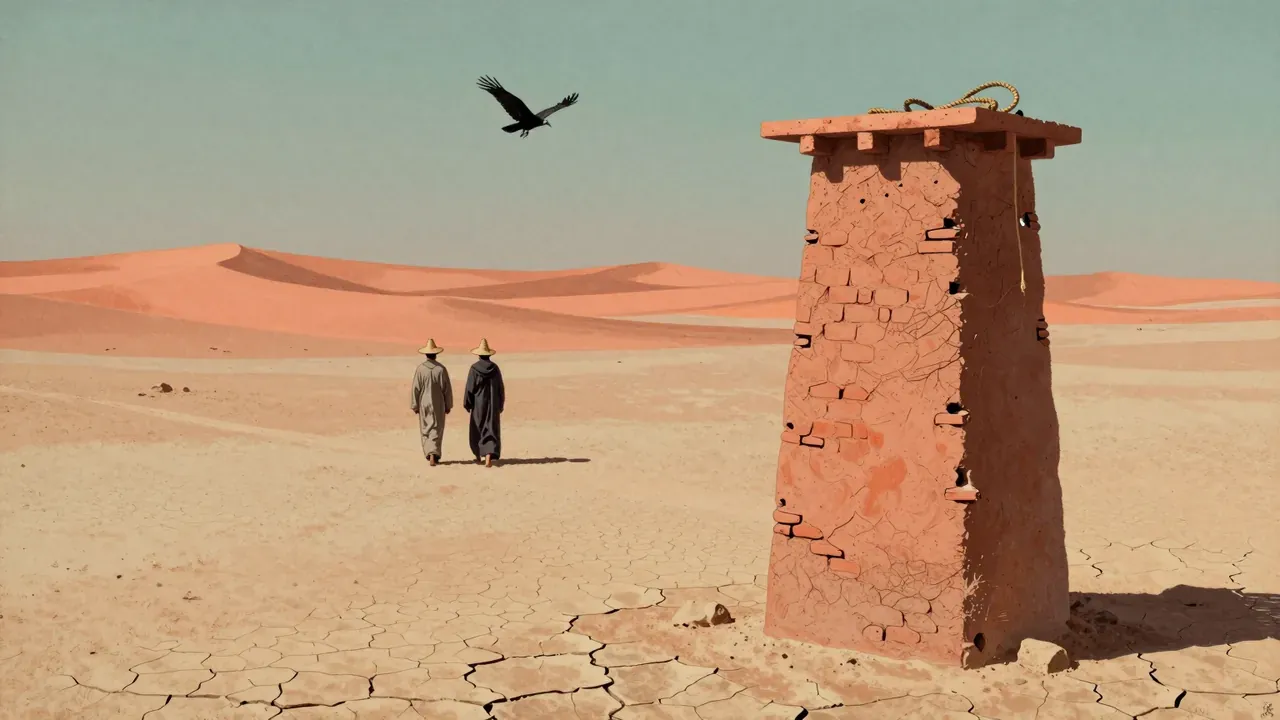
Black God, White Devil is a Brazilian Cinema Novo film that uses the sertão — the arid backlands of Bahia — as both setting and argument. It does not aim to tell a coherent story of cause and effect but to stage a series of ritual confrontations between mythic forces: God and Devil, landowner and labourer, saint and bandit, faith and violence. Glauber Rocha, aged twenty-five, wrote and directed it as a polemic against political passivity and theological complicity in Brazil’s entrenched inequality. The film rejects naturalism in favour of allegory, borrowing the structure of a Western not for genre thrills but to expose how power operates through spectacle, charisma, and sanctioned bloodshed. Its ambition is not psychological realism but ideological exposure: to show how religion, revolution, and revenge all become interchangeable currencies in a landscape where drought makes survival itself a political act. It treats history not as sequence but as recurrence — the same betrayals, the same killings, the same failed conversions, repeated across different uniforms and names.
The look of it
The narrative follows Manoel and Rosa as they drift from one violent authority to another — ranch boss, messianic cult, cangaceiro band — without ever gaining agency or clarity. Geraldo Del Rey’s performance as Manoel is physically committed but deliberately blank, a vessel for exhaustion rather than insight. Othon Bastos gives Corisco three distinct vocal registers in dubbing, underlining the film’s layered artifice. Sérgio Ricardo’s score alternates between folk guitar, dissonant brass, and silence, refusing emotional guidance. Rocha edits with abrupt cuts and long, static takes that resist momentum. The black-and-white photography, shot on location in Monte Santo and Canudos, favours high contrast and deep shadow; faces are often half-obscured, landscapes flattened into symbolic planes. There is no continuity editing, no establishing shots to orient the viewer — only confrontation, repetition, and rupture. The film’s craft is inseparable from its politics: every formal decision denies comfort, explanation, or catharsis.
What stays
What lands is the film’s unrelenting physicality and moral unease. The image of Manoel crawling up Monte Santo with a stone on his head remains indelible not because it is symbolic but because it is real — Del Rey bore actual weight, and the strain shows. The camera lingers on cracked earth, calloused hands, sweat-streaked faces, and the hollow eyes of children — textures that bypass interpretation and register as evidence. The recurring motif of fire — in ritual, in murder, in purification — gains force through repetition rather than exposition. Rocha’s refusal to distinguish between sacred and profane violence lands with cumulative weight: when Sebastião preaches while holding a rifle, or when Antônio das Mortes kills with liturgical calm, the film makes theology and terror feel structurally identical. The sound design, too, works precisely: sparse dialogue, sudden silences, and bursts of raw, unprocessed music make the sertão feel less like a place than a condition — one of perpetual tension, never release.
What slips
What does not land is the film’s insistence on opacity as virtue. Its references to Brazilian history — Canudos, Lampião, the cangaço — remain inaccessible without prior knowledge, and the film offers no foothold for orientation. Characters shift allegiance without motivation, ideology without grounding, and names recur without clarification (Sebastião, Corisco, Antônio das Mortes all echo real figures, but the film assumes familiarity). The plot dissolves into parable so thoroughly that even the central couple’s arc feels incidental rather than consequential. Some sequences — particularly the extended religious sermons — rely on rhetorical intensity rather than dramatic function, and their power depends entirely on accepting Rocha’s framing as self-evident. Viewers unfamiliar with Cinema Novo’s rejection of narrative convention may find the pacing inert rather than deliberate, the repetitions dogmatic rather than dialectical. The film does not invite interpretation so much as demand submission to its logic — a demand it does not earn for everyone.
The ground it stands on
The themes that matter are endurance as resistance, the weaponisation of belief, and the impossibility of clean rebellion in a system that absorbs and recycles dissent. The sertão is not backdrop but protagonist — a terrain that exhausts, reveals, and punishes. Religion here is neither solace nor delusion but infrastructure: it organises violence, legitimises killing, and displaces class conflict onto metaphysical terms. The film treats landownership as theological theft — the rancher’s claim to soil mirrors the church’s claim to salvation. Even the cangaceiros, who seem to offer secular revolt, replicate the hierarchies they oppose: Corisco wears medals, Dadá poses for portraits, their raids follow ritual form. Rocha refuses redemptive arcs or clarifying endings. There is no liberation, only relocation — Manoel and Rosa keep moving, not toward freedom but away from the last failure. The film’s deepest theme is exhaustion as political fact: not fatigue of body alone, but of imagination, of language, of alternatives.
Who walks with it
This film is for viewers who approach cinema as philosophical provocation rather than narrative immersion — those accustomed to Godard, early Pasolini, or the more austere strands of Eastern European modernism. It rewards patience with formal rigour and rewards rewatching with new patterns of recurrence and inversion. It is not for viewers who need character motivation, chronological coherence, or emotional resolution. Those who expect historical context to be embedded in exposition, or who rely on performance to convey interiority, will find it alienating. A viewer who values clarity over contradiction, empathy over estrangement, or storytelling over staging will leave frustrated. The verdict changes only if one accepts that some films exist not to be understood but to be endured — and that endurance, in this case, is the point.
Is it worth your evening
Yes, it is worth your evening — but only if you watch it on terms it sets, not yours. It demands attention without offering comfort, coherence without granting explanation, and beauty without softening its brutality. Its 125 minutes do not pass quickly, and its black-and-white austerity resists easy absorption. Yet its formal discipline, its physical commitment, and its unflinching interrogation of power remain urgent. It is not a film to enjoy, but one to reckon with — and reckoning takes time. Those who dismiss it as obscure miss how precisely its obscurity serves its argument: in a world where ideology masquerades as common sense, clarity can be complicity. To watch it is to sit with discomfort as method. That is not everyone’s idea of an evening well spent — but for those who accept that challenge, it is indispensable.